
When Police Shields Become a Roof, Who Feels Welcome?
When Police Shields Become a Roof, Who Feels Welcome?
A shield does not protect everyone. It protects someone from someone else. Turn it sideways, lift it above a crowd and call it a roof: does that relationship change, or merely become harder to see?
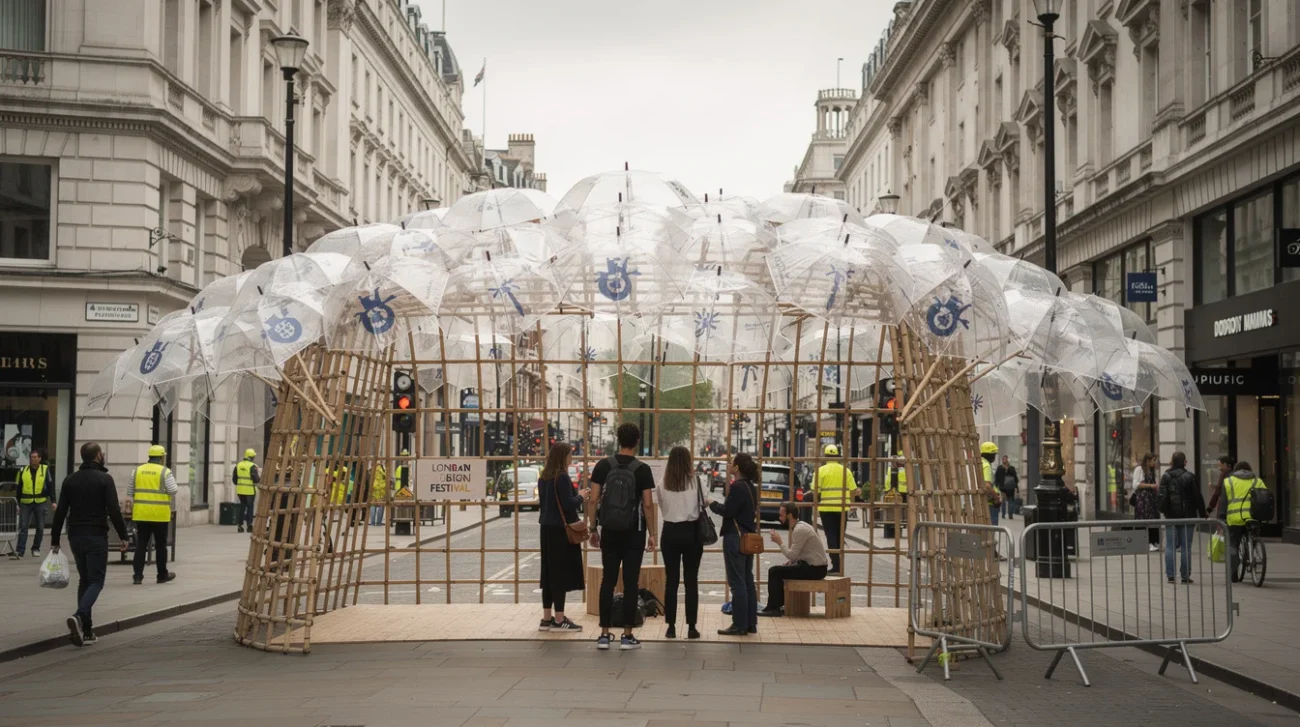
Studio Saar’s Pangolin Shield pavilion, a landmark project for London Design Festival, makes that question architectural. According to Dezeen’s report, the structure occupies the newly pedestrianised stretch of the Strand, combining a bamboo grid with police and rain shields. Its name and scaly appearance refer to the pangolin. Its stated historical territory is the relationship between Britain and India, shaped by colonialism.
The proposition deserves more than admiration for inventive reuse. A rain shield and a police shield may both offer protection, but their political meanings are not interchangeable. There are two serious readings here: architecture can make difficult history approachable through shared experience; it can also turn that history into an attractive surface that asks very little of its audience.
PRO: A Public Roof Can Open a Difficult Conversation
The strongest defence of the pavilion begins with access. Colonial history is often encountered through museum labels, academic language or monuments whose authority appears settled before anyone approaches them. A temporary shelter offers another threshold. You need not buy a ticket to an exhibition or already possess the vocabulary of decolonisation to understand the difference between standing behind a shield and facing one.
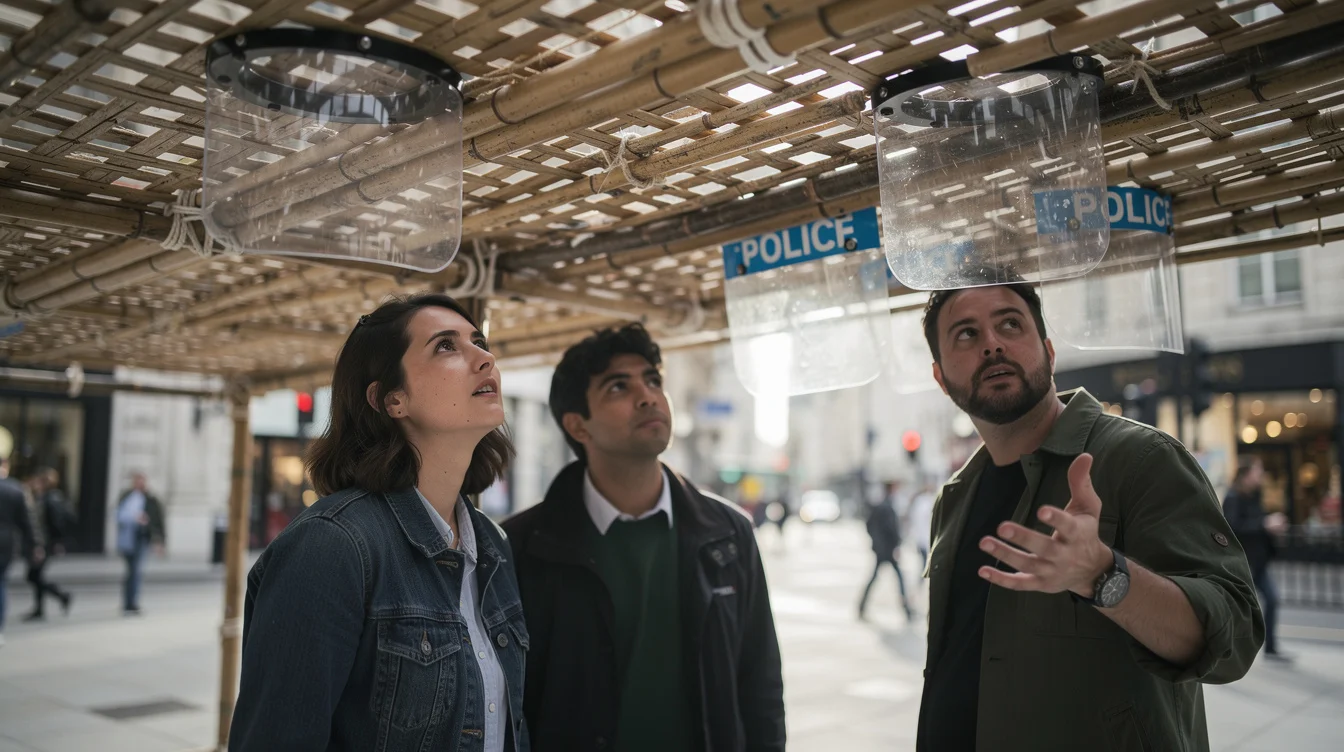
Moving shields overhead potentially changes the public’s relationship to them. Instead of encountering a defensive line at eye level, visitors can occupy a shared space underneath. The object remains recognisable, but its arrangement interrupts its usual function. That interruption can make interpretation possible: who was protected by imperial institutions, and who experienced those same institutions as coercion?
Michael Rakowitz’s The Invisible Enemy Should Not Exist, installed on Trafalgar Square’s Fourth Plinth in 2018, provides a useful comparison. His reconstruction of a destroyed Assyrian lamassu used date-syrup cans to connect cultural destruction with everyday trade and displacement. The material transformation did not replace the history; it provided an entry point into it.
The Pangolin Shield can work through a comparable friction between familiar material and unfamiliar placement. The Strand matters here. The discussion is brought into a working pedestrian environment rather than reserved for a specialist gallery audience. At its best, public design does not simplify difficult history. It makes the first encounter with that history less exclusive.
PRO: Shelter Can Make Interpretation Physical
The second argument is bodily rather than symbolic. Architecture can make people feel a proposition before they formulate an opinion about it. Under this roof, protection is not only an exhibition theme: it is the spatial promise of the structure. The productive discomfort comes from recognising that some of its protective components also belong to confrontational settings.
Francis Kéré’s 2017 Serpentine Pavilion demonstrated how a temporary roof could organise gathering around environmental experience. Its broad canopy and central opening made rain, shade and collective occupation part of the architectural event. The relevant lesson is not a visual resemblance to Studio Saar’s project. It is that a festival pavilion can offer an actual civic experience rather than merely an image of one.
Here, the bamboo grid also gives the shields a new structural context. Their repetition suggests scales, while the pangolin reference introduces a defensive body rather than a triumphant military figure. Read critically, that shift could destabilise the assumption that protection must always look monumental, permanent or sovereign.
None of this establishes that every visitor will understand the intended Britain–India connection. It establishes an opportunity. Clear interpretation, historically specific accounts and conversations involving people with differing experiences of policing could turn spatial curiosity into learning. These should be understood as criteria for success, not as documented features of the installation. The pro case is persuasive precisely because architecture offers an opening that a conventional historical display might not.
CONTRA: The Festival Can Turn Conflict into Pattern
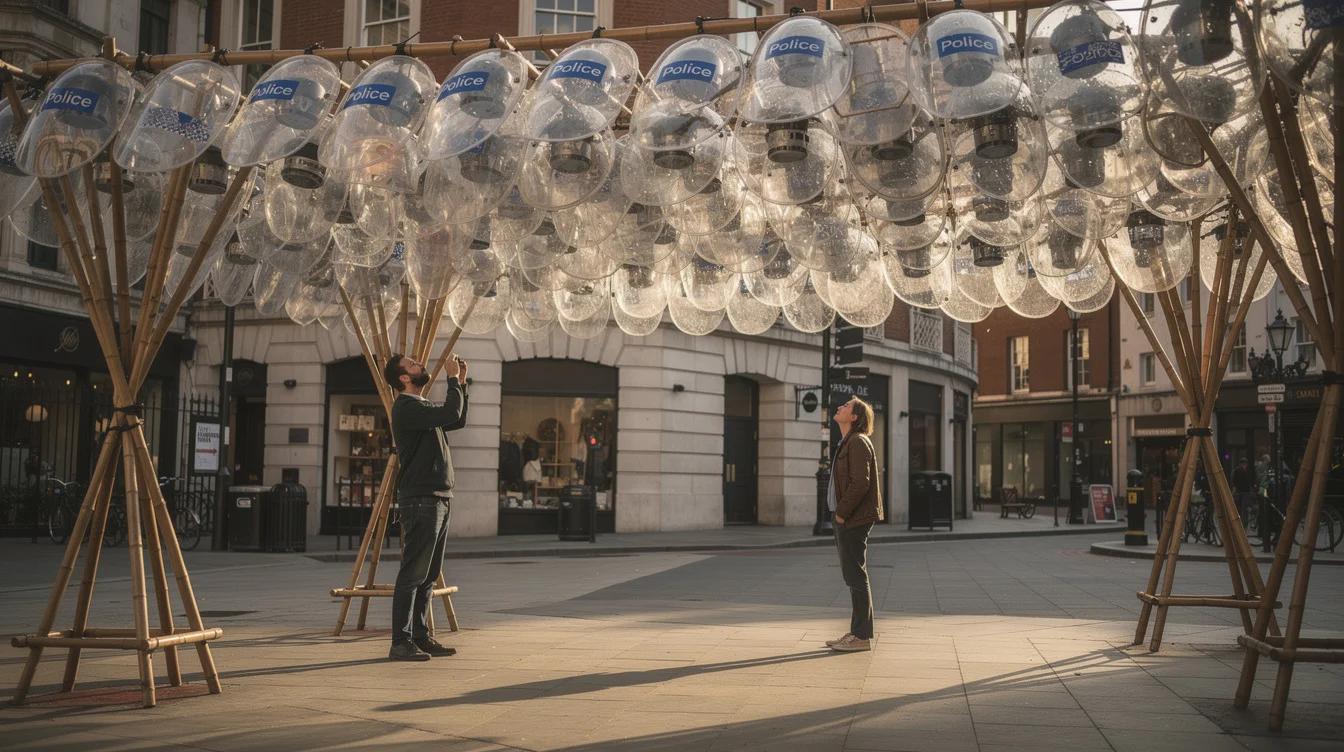
The strongest objection is equally physical: once shields become roofing, their most troubling associations can become decorative. Repetition produces rhythm. Overlap produces a scaly silhouette. A compelling photograph can register ingenuity while losing the unequal relationship between the person holding a police shield and the person confronting it. The architecture may neutralise the symbol more effectively than it interrogates it.
London Design Festival is an especially charged setting for that risk. Temporary installations compete for attention through strong forms and immediately legible stories. “Shields become shelter” is an excellent headline. The historical mechanisms connecting Britain and India—trade monopoly, conquest, extraction, resistance and state violence—are much less compressible.
Kara Walker’s Fons Americanus, commissioned for Tate Modern’s Turbine Hall in 2019, offers a demanding comparison. Its fountain form drew on imperial monumentality while confronting the histories of slavery and empire that celebratory public sculpture suppresses. Its disturbing narrative imagery made uncomplicated admiration difficult. Beauty was not allowed to close the argument.
For the Pangolin Shield, the question is whether anything comparably resistant survives the transformation into a welcoming canopy. The supplied account does not establish where individual shields came from or whether they have specific histories of use. Those histories should not be invented. But without material provenance or precise interpretation, the objects risk becoming generic signs of “power”: politically suggestive, historically underdetermined and exceptionally easy to photograph.
CONTRA: Welcome Cannot Be Declared by the Designer
A second objection concerns who gets to decide that the transformation is welcoming. A designer may see an ingenious conversion of defensive equipment into shared infrastructure. Someone with direct experience of aggressive policing may still see police equipment. Neither the change in orientation nor the language of shelter cancels that recognition.
Britain and India’s colonial history also cannot be adequately represented as a balanced encounter between two equivalent parties. The East India Company’s territorial power and the subsequent British Raj depended on institutions of unequal rule. A project addressing that inheritance needs more than a general meditation on the ambiguity of protection. Otherwise, ambiguity becomes a convenient substitute for naming responsibility.
Yinka Shonibare’s Nelson’s Ship in a Bottle, installed on the Fourth Plinth in 2010, shows how seductive form can retain historical specificity. Its model of HMS Victory and patterned textile sails unsettled ideas of British identity through the histories of empire and cultural exchange. The pleasure of looking did not require the national reference to disappear.
That is the standard worth applying here. Who explains the shields, whose accounts accompany them, and what happens to the materials after the festival? These are not administrative footnotes. They determine whether the pavilion redistributes interpretive authority or simply borrows contested imagery. The contra case is not an argument for banning difficult objects from public design. It is an insistence that reframing power is not the same as surrendering it.
FAQ
What is the Pangolin Shield pavilion?
It is a Studio Saar pavilion presented as a London Design Festival landmark project on the newly pedestrianised part of the Strand. Dezeen describes a bamboo-grid structure covered with police and rain shields, with a scaly appearance that recalls a pangolin.
How does the pavilion address Britain and India’s colonial history?
Its stated theme connects that history with the tension between protection and aggression. The shields provide an architectural starting point, but understanding specific colonial relationships requires historical explanation beyond the objects’ appearance.
Why might police shields make a public shelter feel unwelcoming?
Police shields can signify safety to some visitors and coercion to others. Moving them overhead changes their function within the pavilion, but does not guarantee that associations with confrontation or unequal state power disappear.
What would distinguish historical engagement from festival spectacle?
Specific historical interpretation, transparent material provenance where available, and meaningful opportunities for affected communities to shape the discussion would strengthen the project. Visual novelty alone cannot demonstrate that the pavilion has made colonial history more accessible.
When a police shield becomes a public roof, who should decide whether it now represents welcome: the designer, the festival, or the people who have stood on its other side?
Watch the Mainifesto Short
Get the Mainifesto weekly — curated design debates, speculative ideas and the week's best articles every Saturday.
Editorial Perspectives
Questions and counterpoints developed by the Mainifesto editorial desk to extend the discussion.
Perspective 1
I’m for turning the shield into shelter: adaptive reuse can keep a difficult history visible rather than pretend it never happened. But we’ve seen enough ‘reclaimed’ spaces become places their neighbours can’t enter; the people who faced those shields need a real say in what welcome means here.
Perspective 2
I don’t buy the redemption story: putting a police shield overhead changes its position, not necessarily its politics. Brecht might ask who gets to enjoy the transformation—and who supplies the suffering that makes it interesting.
Perspective 3
I’d want to test welcome as carefully as structural performance: who approaches, who stays, and who avoids walking underneath? The people who have faced these shields should help set those criteria before the geometry is final, while their answers can still change the design.