The New Moral Economy of Productivity
Productivity Is No Longer Just a Work Problem
Productivity has escaped the office. It now sits in the living room, hides in the kitchen, colonises the bedroom and dictates the terrace. We no longer simply ask how to work better; we ask how to live more efficiently, furnish more intelligently, plan more optimally, and recover faster so we can do it all again. The design world has helped build this mentality. From agile home offices to multipurpose sofas, from app-managed lighting to “smart” storage systems that promise frictionless order, architecture and interiors have become accomplices in a moral economy that treats speed as virtue and rest as a flaw.
This is not a neutral shift. It is an ideological one. The ancient Romans, as Monocle’s original provocation reminds us, did not necessarily treat time as a commodity to be endlessly maximised. Contemporary culture does. And when architecture adopts that logic, it begins to measure domestic life by throughput: how many functions a room can absorb, how seamlessly a circulation route can shave seconds, how well a home can behave like a logistics system. The danger is not that design becomes efficient; the danger is that efficiency becomes the only acceptable evidence of care.
The Home as a Performance Infrastructure

Look at the modern apartment and you will see the footprint of productivity everywhere. The open-plan plan is often defended as social, but it is also a visibility machine: fewer walls, fewer pauses, fewer excuses. The kitchen island becomes a workbench. The dining table becomes a desk. The hallway becomes dead space unless it is converted into storage. Even the bed is recruited, as if sleep itself must now be optimised through mattresses that track pressure, circadian lighting, and ritualised “wind-down” routines sold as performance enhancement.
Design history is full of good intentions that have hardened into discipline. The 20th century dream of rational planning, from the Frankfurt Kitchen to Le Corbusier’s domestic zoning, aimed to improve life through order. But in the 2020s, the logic has mutated. Contemporary furniture brands celebrate modularity not as flexibility but as responsiveness to constantly changing demands. The result is a house that behaves less like a refuge and more like a warehouse of potential states. Everything must be ready to pivot.
This is where the moral language enters. The productive home is presented as responsible, even ethically superior. A tidy desk signals seriousness. A multipurpose room signals maturity. A decluttered interior signals control. Yet these are aesthetic codes attached to a social hierarchy: those with enough space, money and support can curate “efficiency” as lifestyle, while everyone else is forced into improvisation. In that sense, productivity is not just design language; it is a class instrument.
That tension also connects to bigger questions about domestic norms and whether a single ideal layout can ever serve everyone. Articles like Do We Still Need a Universal Home? suggest that the very idea of one rationalised domestic model may be part of the problem.
Design’s Complicity: When Efficiency Becomes a Selling Point
The design sector often frames itself as progressive, but it has been quick to monetise acceleration. The rise of home tech, subscription-based furnishing, space-saving systems and “wellness” interiors has created a market in which every object promises to remove inconvenience. Consider the surge of ergonomic chairs, standing desks, acoustic pods and focus lamps: they are not inherently bad, but they reveal a culture that has decided comfort is valuable only if it increases output. Even the vocabulary gives the game away. We do not rest; we “recover.” We do not inhabit; we “optimise.”
Architecture has mirrored this shift in the workspace. Corporate campuses and new-generation co-working environments have borrowed hotel logic, domestic textures and biophilic cues to make labour feel seamless. The office becomes a lifestyle environment, and the home borrows the office’s instrumental discipline. We are told this is humane. Sometimes it is. But it also means design increasingly smooths over the distinction between living and producing. If every place is designed for productivity, where does unproductive life actually happen?
There are counterexamples, and they matter because they prove that design can resist the tyranny of performance. Lina Bo Bardi’s Sesc Pompéia in São Paulo remains a model of social architecture that values lingering, gathering and irregular use over streamlined circulation. Peter Zumthor’s Therme Vals slows the body down rather than disciplines it into efficiency. In Japan, SANAA’s work often produces ambiguity and drift rather than hard-function certainty. These projects do not reject order; they reject the idea that architecture’s highest calling is to remove all resistance.
That same resistance is visible in buildings that keep their environmental logic upfront rather than hiding it behind a polished image. If you want another angle on this debate, When Architecture Stops Hiding Its Ecology shows how design can foreground material and ecological reality instead of smoothing everything into a performance surface.
What Happens When Architecture Refuses Acceleration?
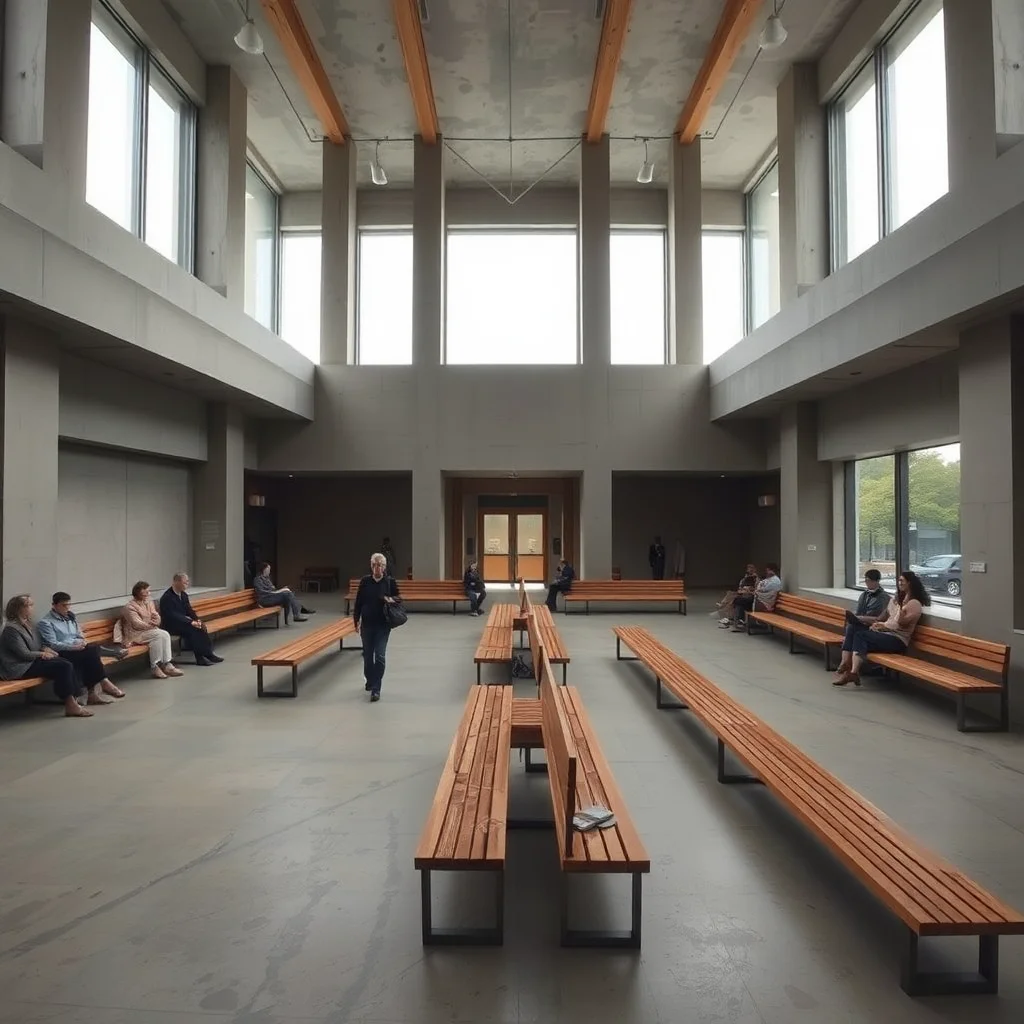
To resist acceleration is not to romanticise inconvenience. Nobody needs a leaking roof or a dysfunctional floor plan. The real challenge is more radical: can architecture make room for slowness without turning it into luxury branding? Can buildings support attention rather than demand constant productivity from their occupants? Can interiors be generous in ways that are not measurable by output?
One clue lies in space that tolerates ambiguity. A broad threshold, a deep sill, an unprogrammed alcove, a stair landing where one might sit for no reason at all: these are small acts of architectural insubordination. They interrupt efficiency, but they expand life. Think of Aldo van Eyck’s playgrounds, which turned leftover urban fragments into sites of play rather than transit. Or James Turrell’s light works, which ask the viewer to do almost nothing except be present. These are not productivity devices. They are anti-instruments.
Contemporary practice is not without allies in this argument. The “slow architecture” tendency visible in local material sourcing, low-energy construction, and repair-led projects also pushes against acceleration, though it is often presented as sustainability rather than culture critique. The best of it refuses slickness. It accepts weathering, maintenance and incompletion. In a market that rewards instant polish, this is a political stance. A building that gets better with age rather than newer with speed is already saying no.
The New Moral Economy of Everyday Life
The broader issue is that productivity has become a proxy for virtue. In homes, cities and offices, we now perform responsibility through optimisation. We buy storage systems to prove discipline. We arrange schedules to prove seriousness. We design interiors that look as if they can absorb pressure without complaint. Yet the more every surface is tasked with efficiency, the more depleted we become. The culture of maximum usefulness leaves little room for idleness, and without idleness there is no curiosity, no drift, no genuine recovery.
This is why architecture matters so much. Built space trains behaviour. A room with too many functions demands constant self-management. A city tuned to speed punishes pause. A home organised around throughput tells its inhabitants that stillness is waste. If design continues to reinforce this logic, it will help produce a citizen who is always preparing, always catching up, always accountable to invisible metrics. That is not wellbeing. That is internalised management.
There is another way. It starts by refusing the lie that every square metre must earn its keep in the same manner. A kitchen can be inefficient and welcoming. A living room can have dead corners. A corridor can be more than circulation. Architecture can preserve ambiguity, reserve and unmarketable time. The challenge for designers is not to make life smoother at all costs, but to create conditions where human value exceeds utility.
In that respect, the conversation overlaps with broader shifts in how cities support care, ageing and everyday dependency. The Future of Aging at Neighborhood Scale is a useful companion piece for thinking about how domestic and urban space can be organised around human rhythms rather than productivity alone.
Against the Tyranny of the Useful
The productivity obsession has turned design into a moral accomplice, teaching us to praise the streamlined, the flexible and the endlessly adaptable. But a life built only on adaptation is a life with no centre. Architecture should not merely keep pace with this acceleration; it should interrupt it. It should defend pause, waste, redundancy and play as essential civic goods, not decorative extras.
That means favouring spaces that do not immediately announce their purpose, materials that age visibly, layouts that allow hesitation and rooms that resist total capture by work logic. It means recognising that wellbeing is not the same as efficiency, and that a beautiful building is not one that gets you to the next task faster. The design world must decide whether it wants to serve a culture of perpetual self-optimisation or help build forms of living that are less obedient to the clock.
The more productivity becomes a moral language, the more urgent it is for architecture to become morally disobedient. Not chaotic, not careless—just unwilling to confuse speed with a good life.
FAQ
How is productivity culture affecting architecture? It is pushing homes and workplaces toward multifunctionality, constant adaptability and efficiency-first planning. That often reduces spaces for rest, ambiguity and unproductive use.
What does it mean for design to be complicit? It means the design industry sells products and spaces that frame efficiency as a moral good: ergonomic gear, smart homes, modular furniture and layouts that erase downtime.
Which architects or designers resist this logic? Lina Bo Bardi, Peter Zumthor, Aldo van Eyck and SANAA are often cited for work that values lingering, play, slowness or spatial ambiguity rather than pure functional speed.
What would an anti-productivity architecture look like? It would include generous thresholds, unprogrammed spaces, adaptable but not over-determined layouts, and materials and forms that invite pause, not just performance.
FAQ
- How is productivity culture affecting architecture? It is pushing homes and workplaces toward multifunctionality, constant adaptability and efficiency-first planning. That often reduces spaces for rest, ambiguity and unproductive use.
- What does it mean for design to be complicit? It means the design industry sells products and spaces that frame efficiency as a moral good: ergonomic gear, smart homes, modular furniture and layouts that erase downtime.
- Which architects or designers resist this logic? Lina Bo Bardi, Peter Zumthor, Aldo van Eyck and SANAA are often cited for work that values lingering, play, slowness or spatial ambiguity rather than pure functional speed.
- What would an anti-productivity architecture look like? It would include generous thresholds, unprogrammed spaces, adaptable but not over-determined layouts, and materials and forms that invite pause, not just performance.
What would happen if architects stopped designing for efficiency first and started designing for a life less obedient to productivity metrics?
Get the Mainifesto weekly — curated design debates, speculative ideas and the week's best articles every Saturday.
Editorial Perspectives
Questions and counterpoints developed by the Mainifesto editorial desk to extend the discussion.
Perspective 1
If architects stopped leading with efficiency, we'd probably get better buildings for actual humans, but the rent still has to get paid. The useful question is where efficiency stops being smart planning and starts becoming an excuse for bland, over-optimized space. A building can be economical without feeling like a spreadsheet.
Perspective 2
I’m all for less obedience to productivity metrics if it makes the guest experience feel more memorable and less machine-like. But if the space slows people down in the wrong way, it’s dead on arrival—hospitality still has to move, turn, and perform. The real win is designing friction that feels intentional, not inefficient.
Perspective 3
This is where the discipline gets interesting: efficiency is a metric, not a value system. If architects designed for a life less obedient to productivity, they’d have to measure comfort, ambiguity, social latency, even boredom—and that’s much harder to parametrize. The question isn’t whether to reject efficiency, but what other forms of performance we’re willing to optimize for.
Perspective 4
Architecture has never been only about speed, and the best old buildings prove that complexity can be productive in a different register. What worries me is when “less efficient” gets used to market a place to newcomers while pushing out the people who already made it work. Resistance to acceleration should mean staying with what a site already knows, not turning slowness into a luxury aesthetic.