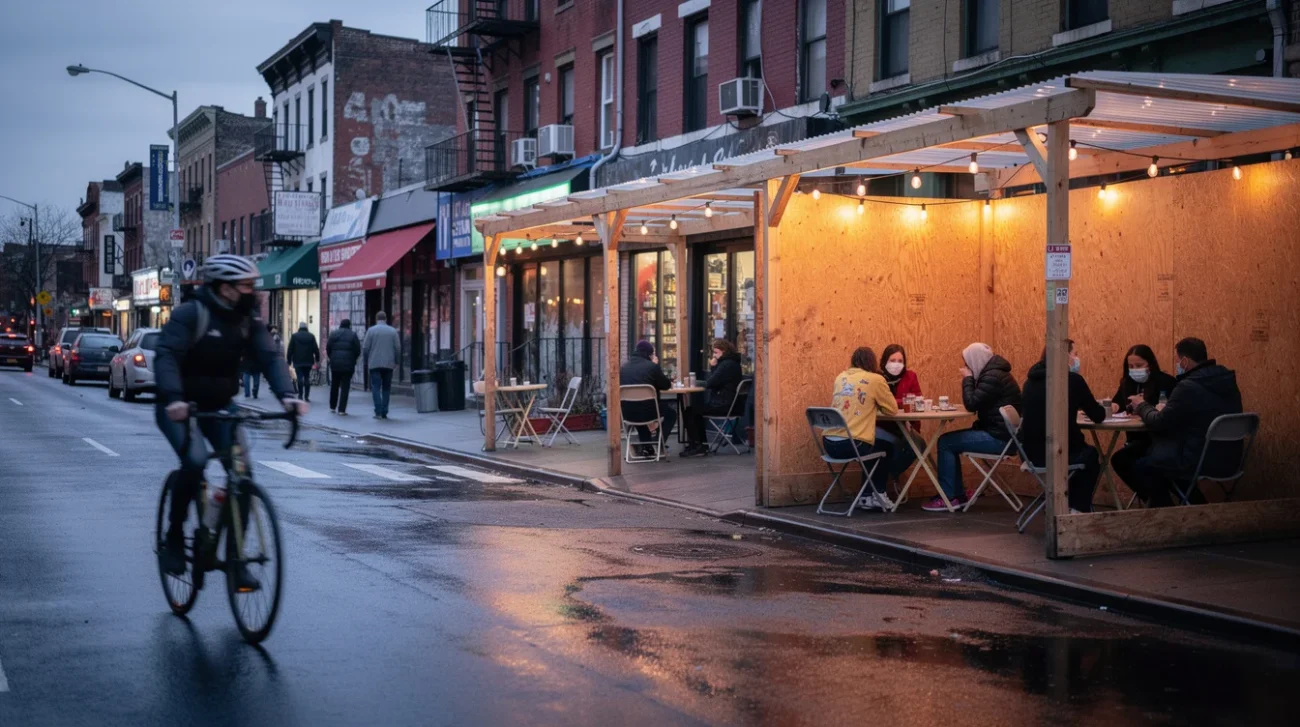

Reinventing Car Parks as Mobility Hubs
The car park has stopped pretending to be neutral
For decades, parking structures were the architectural equivalent of a shrug: necessary, ugly, and strategically ignored. They absorbed the social cost of automobility while giving cities a convenient excuse not to confront the amount of land, money, and urban life sacrificed to cars. That era is ending—not because the automobile has disappeared, but because the car park is being asked to do too much. It must now charge electric vehicles, host car-sharing fleets, provide neighborhood services, generate energy, and sometimes even behave like a civic building. The result is a strange new typology: part infrastructure, part concierge, part urban altar.
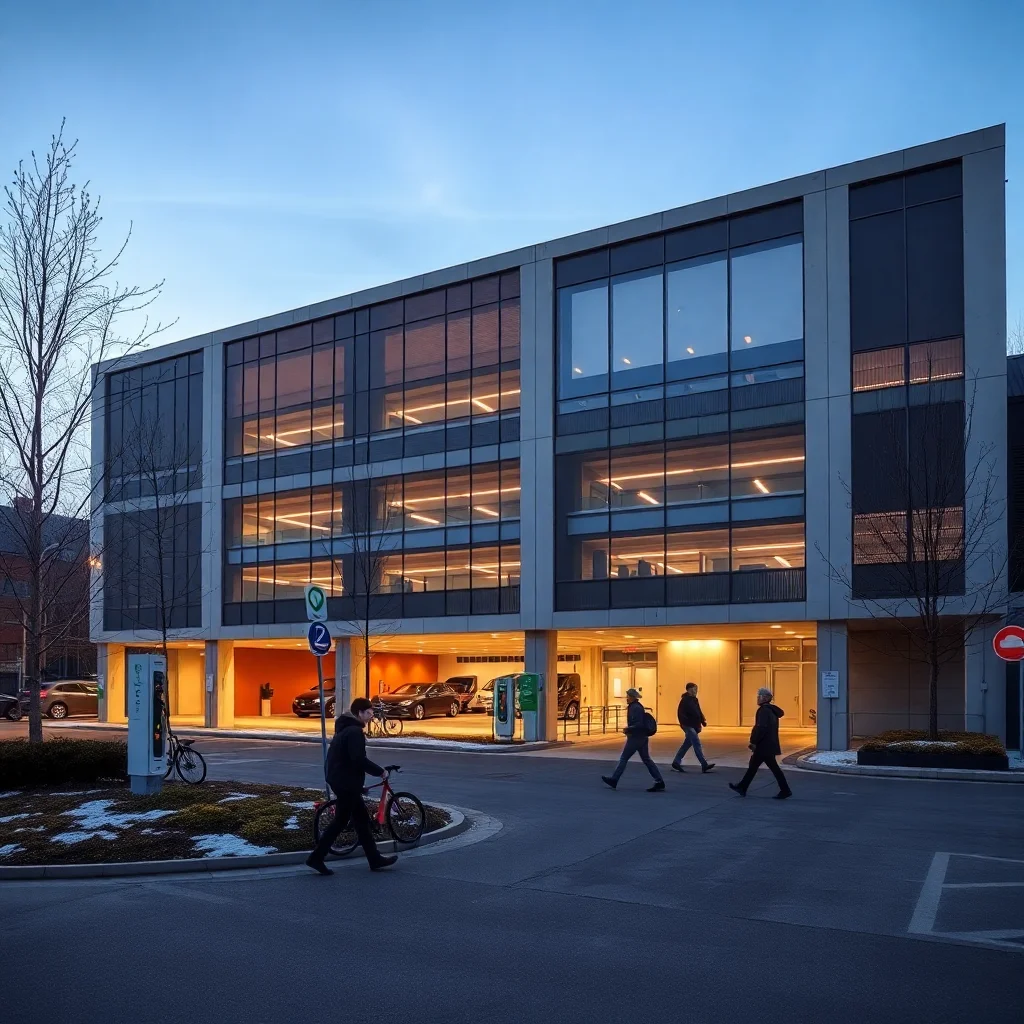
The Neckarbogen neighborhood parking garage in Heilbronn makes this shift explicit. Designed by Wittfoht Architekten, the building is not merely a place to store vehicles; it packages parking, EV charging, car-sharing, local energy generation, and community functions into one highly visible object. Most tellingly, its mobility station sits in a prominent corner position and can operate independently of car traffic. That detail matters. It suggests a parking building no longer hidden at the edge of the development plan, but folded into the daily life of the neighborhood as a service node. The car park, in other words, has become a public interface.
This is one reason the project feels connected to the new public utility aesthetic, where infrastructure is no longer meant to disappear but to perform its civic role visibly. Parking, charging, and neighborhood services begin to read less like back-of-house necessities and more like shared urban equipment. In that sense, the garage is not just accommodating cars; it is participating in a broader shift in how cities present essential systems to the public.
From dead space to urban hardware
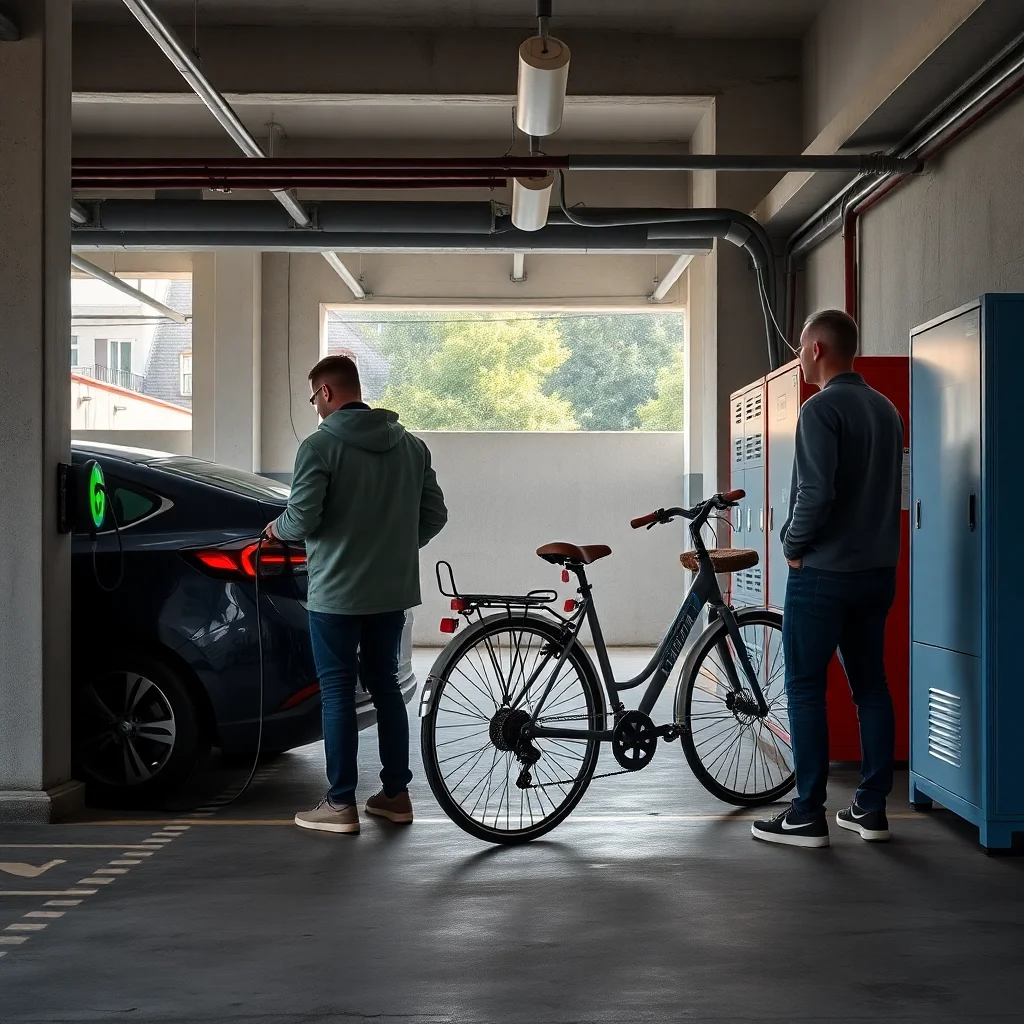
This reinvention is happening because parking has been exposed as a spatial lie. Even at its most efficient, the conventional garage is a machine for storing idle private property. It consumes expensive urban land for the lowest possible social return. As cities attempt to decarbonize transport and reduce car dependency, parking structures are being drafted into a new mission: to act less like dead storage and more like urban hardware. Their roofs become solar surfaces; their façades accommodate ventilation, daylight, and signage; their ground floors take on social and logistical roles. Suddenly, the garage is asked to be a mediator between mobility systems and civic life.
This is not without precedent. The mobility hub has a long lineage in transport planning, from Dutch interchange models to contemporary transit-oriented districts in Northern Europe. But architecture has recently given the idea a more seductive face. In Vienna, the mobilitätsstation model integrates bike parking, car-sharing, and public transport connections into compact stations. In Amsterdam, mobility-as-a-service projects have tried to replace private car ownership with shared vehicle pools and last-mile infrastructure. In Tokyo and Singapore, where land scarcity forces brutal efficiency, multi-level parking is often hybridized with retail, logistics, or community programs. The lesson is clear: once parking is forced to justify itself, it starts becoming something else.
That “something else” often resembles what critics describe as architecture becoming climate infrastructure. A garage that helps manage energy, reduce emissions, and coordinate shared mobility is no longer just a container for vehicles; it becomes part of the city’s operational climate apparatus. The shift is significant because it repositions architecture from static object to active system, with all the benefits and compromises that implies.
Heilbronn’s signal: the garage as neighborhood instrument
The Neckarbogen garage matters because it refuses the old binary between “parking structure” and “good architecture.” It is not trying to erase its function through a glamorous envelope. Instead, it acknowledges parking as a transitional necessity and then overloads it with civic ambition. The building’s shared mobility services and energy infrastructure make it a neighborhood instrument rather than a monofunctional container. That shift from object to system is crucial. A garage that supports electric charging, shared vehicles, and local energy production participates in the larger metabolism of a district. It begins to operate like an urban utility.
Architecturally, this is where the debate becomes interesting. If a parking structure is visible, accessible, and programmatically mixed, it can help normalize lower-car lifestyles by making alternatives convenient. Residents may borrow a shared vehicle rather than own one, charge an EV while collecting groceries or parcels, or treat the building as a regular stop in the course of daily life. But convenience is politically ambiguous. The same infrastructure can also stabilize the car’s future by making car use cleaner, smarter, and easier to live with. In other words, the question is not whether the parking garage is modern. The question is what kind of modernity it serves.
That ambiguity is part of the new civic monument debate: when a utility building becomes prominent, legible, and even beautiful, it starts to carry symbolic weight beyond its practical function. The garage can inspire confidence in a low-carbon district, but it can also normalize a continuing reliance on cars by making the infrastructure feel socially redeemed. Visibility is not neutral.
The seductive politics of hybridization
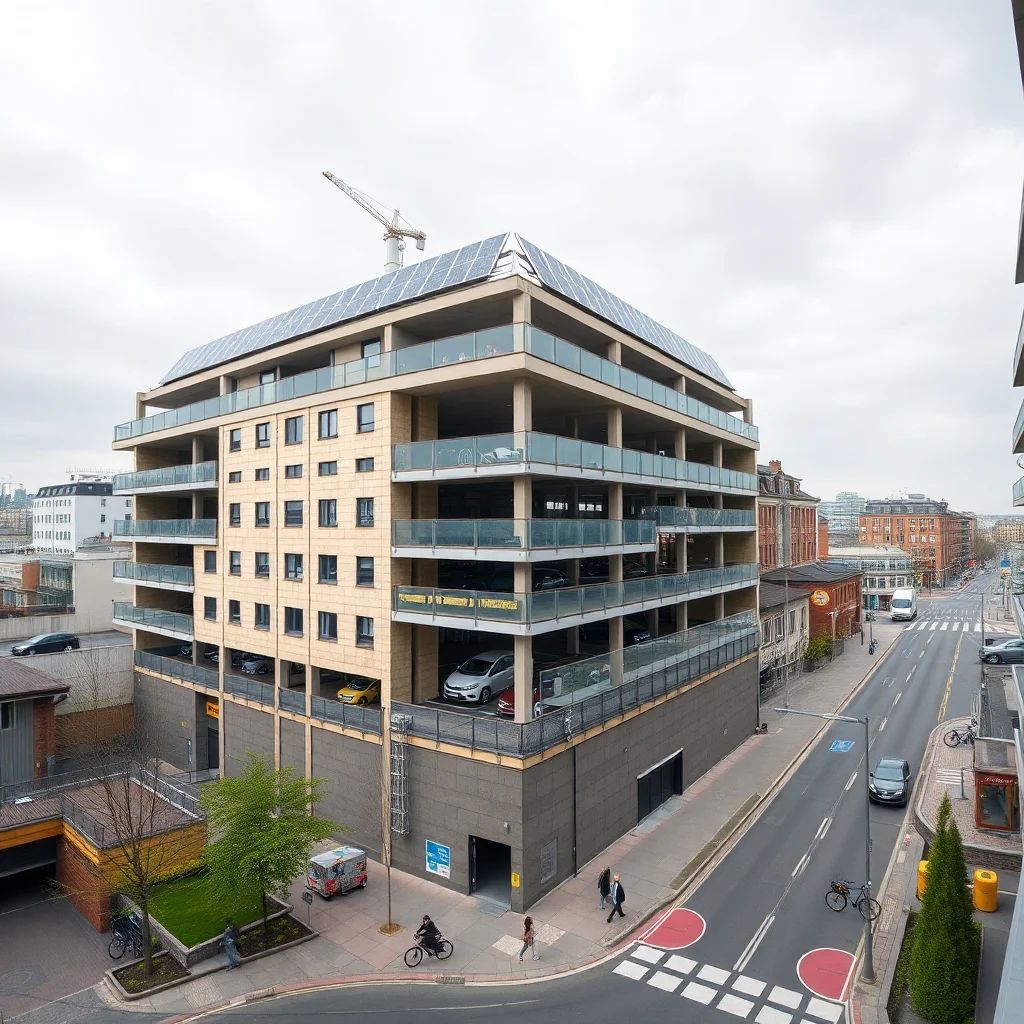
Hybridization is the current urban gospel. If an infrastructure can accommodate multiple uses, generate revenue, and appear socially useful, it is treated as progress. But the hybrid garage is not automatically emancipatory. It can function as a transitional device toward reduced car ownership, or as a sophisticated machine for preserving automobility under greener branding. This ambiguity should worry us. When parking structures add bike repair shops, parcel lockers, cafés, daycare rooms, or public terraces, they risk laundering the car’s dominance through a layer of civic friendliness. The garage becomes less offensive, not necessarily less car-centric.
There are designers and planners who understand this tension. Jan Gehl has long argued that cities must prioritize human-scale movement over car throughput; by his logic, any parking project should be judged by how much it reduces the need for parking overall. Gehl Architects and like-minded urbanists would ask whether a mobility hub is actually shrinking the footprint of automobility or merely improving its user experience. Meanwhile, speculative transportation thinkers such as Transit-Oriented Development advocates and shared-mobility planners insist that mobility hubs are essential because they make non-car choices legible and practical. Both positions are true. That is precisely the problem.
Monument, prototype, or trap?
The visual language of new parking structures reveals the cultural stakes. They are increasingly designed as landmarks—carefully articulated, openly ventilated, often wrapped in grids, screens, or expressive structural rhythms. This is not only an aesthetic upgrade; it is a political one. A monument implies permanence, and permanence is a dangerous claim for any car-related infrastructure in the age of climate targets. A “beautiful” garage can seduce a city into overinvesting in the wrong thing. It can become the respectable face of a transitional technology that should, in some places, be actively phased out.
And yet, the anti-garage position can be simplistic. Not every city can abolish parking overnight. In dense neighborhoods, in mixed-use districts with service access needs, in places where public transit is improving but incomplete, some form of managed vehicle storage will remain. The challenge is to design those remnants so they are reversible, adaptable, and politically honest. The best mobility hubs should be treated as provisional civic infrastructure, not as permanent apologies for car dependence. They should be sized with the expectation that demand may shrink. They should be built to convert. They should be able to become workshops, depots, housing, or public facilities if the car continues to lose ground.
That logic is closely related to adaptive reuse as a status symbol: the most credible long-term buildings are those that can absorb change without pretending the future is fixed. For parking structures, reversibility is not a nice-to-have. It is the difference between an infrastructure that can evolve with policy and one that locks a neighborhood into yesterday’s assumptions.
What the next garage should actually do
The next generation of parking structures should be judged by harder criteria than form or novelty. Does the building reduce total parking demand in its district? Does it consolidate private car storage so that street-level parking can disappear? Does it share energy with the neighborhood, or merely brand itself as green? Does it make public transport, cycling, and walking more convenient than driving? If the answer is no, then the project is not a mobility hub—it is a climate-conscious parking lot with better graphics.
There are already promising references. In some Nordic developments, garages are combined with bicycle parking and weather-protected pedestrian links, encouraging multi-modal trips rather than single-car dependency. In parts of Germany and the Netherlands, shared mobility stations have begun to replace scattered on-street parking with centralized access points. In masterplans by firms such as MVRDV and Foster + Partners, transport infrastructure is increasingly embedded into larger mixed-use systems, hinting at a future in which parking is just one module among many. But architecture alone cannot solve the contradiction. A well-designed garage inside a car-dependent policy regime remains a car dependency machine.
That is why the most provocative reading of Neckarbogen is also the most useful: it is not a final answer, but a test case. It shows how far the car park can be stretched before it becomes something else. If it supports a lower-car district by absorbing necessary storage and enabling shared, electrified mobility, it is part of the transition. If it reassures residents that they can keep driving with a cleaner conscience, it is a monument to delay. The architecture is the same. The politics are not.
FAQ
What is a mobility hub in architectural terms?
A mobility hub is a building or urban node that combines several transport-related functions—parking, charging, bike storage, car-sharing, parcel services, and sometimes community uses—into one accessible place. Its goal is to make non-private-car mobility easier and more integrated.
Why are parking garages being redesigned now?
Because cities are under pressure to cut emissions, reduce car dependence, and use land more efficiently. Parking structures are being asked to justify their footprint by taking on energy, mobility, and public-service roles.
Do hybrid parking structures support a post-car future?
They can, but only if they reduce the overall need for private cars rather than simply improving the experience of driving. A hybrid garage is progressive only when it helps cities remove street parking, expand shared mobility, and prioritize transit, cycling, and walking.
What is the main risk of the new parking typology?
The main risk is greenwashing automobility. If a garage becomes more attractive without reducing car ownership or car use, it may end up prolonging the car’s dominance instead of helping cities move beyond it.
Could parking buildings be converted into other uses later?
Yes, and they should be designed for that possibility. Reversible structures can eventually become depots, workshops, housing, public facilities, or mixed-use spaces as transport demand changes.
So is the car park dead space or civic infrastructure?
It is both, depending on who controls it and what urban agenda it serves. That is why the reinvention of the car park is so politically charged: it is not just an architectural upgrade, but a decision about whether cities are building pathways out of automobility or polishing the infrastructure that keeps it alive. The future garage may indeed be greener, shared, and more civic. But until parking is treated as a shrinking necessity rather than a permanent entitlement, its reinvention will remain suspiciously close to preservation.
Get the Mainifesto weekly — curated design debates, speculative ideas and the week's best articles every Saturday.
Editorial Perspectives
Questions and counterpoints developed by the Mainifesto editorial desk to extend the discussion.
Perspective 1
The article gets to the real issue: a garage can be an energy node, but that doesn’t automatically make it a mobility transition. If the dominant use case is still private cars, we’ve just polished the old model and added some solar panels. The test is whether the project actually reduces parking demand and reallocates street space, not whether it looks civic.
Perspective 2
I’m wary of celebrating these conversions as if they were neutral technical upgrades. In many cities, “mobility hubs” can become another way to sanitize automobility while displacing the messier, more affordable systems people actually use. Adaptive reuse is valuable, but only if it serves a broader public shift rather than dressing up car infrastructure for a new era.
Perspective 3
This is the contemporary charm of infrastructure: we ask the garage to become a civic stage, then pretend the script has changed. But the typology retains its grammar, and grammar matters; a cleaner car park is still a car park unless the urban bargain around it is rewritten. Otherwise, we are merely aestheticizing dependence.
Perspective 4
From a development standpoint, the question is whether these hubs are operationally useful, not just conceptually satisfying. Shared charging, parcel lockers, bike storage, maybe transit connections — fine, but if the scheme still depends on expensive car capacity, it’s not really shifting behavior. I’d rather see fewer parking spaces and more flexible floors than a shiny garage pretending to be a mobility manifesto.