
The CD Player Returns: Did We Lose Too Much to Streaming?
The CD Player Returns. Did We Give Up Too Much for Streaming?
Streaming won by making music feel weightless. No shelves, no scratched cases, no hunt for the album someone borrowed in 2006. Yet that disappearance was also a transfer of control: from a collection you could inspect to a catalogue somebody else administers. The convenience is real. So is the surrender.
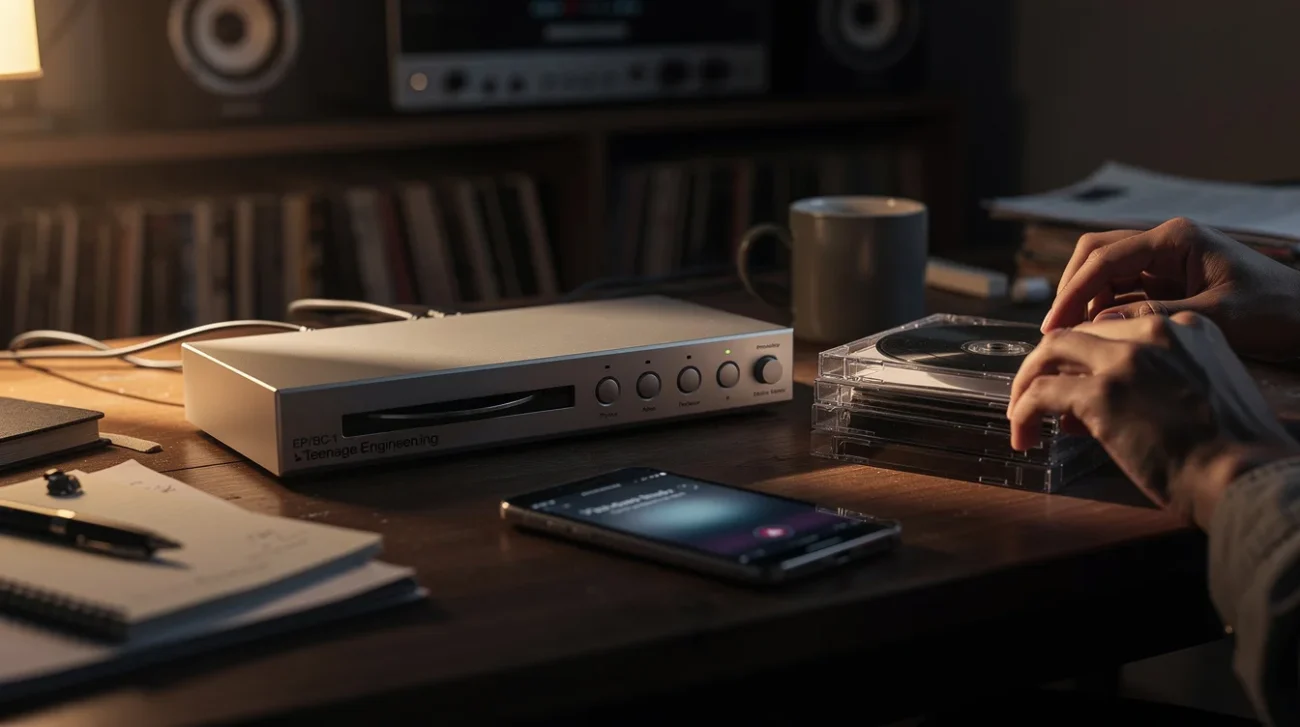
Teenage Engineering’s EP/BC-1, the Swedish company’s first CD player, brings that bargain back into view. Wallpaper describes a slender, retro-looking unit with pro-grade features. But the important design question is not whether an old format can look desirable again. It is whether contemporary hardware can make ownership useful enough to justify its physical demands. A beautiful player is not, by itself, an argument for keeping hundreds of plastic boxes. Here are the two cases worth taking seriously.
PRO: Ownership Is a Function, Not a Feeling
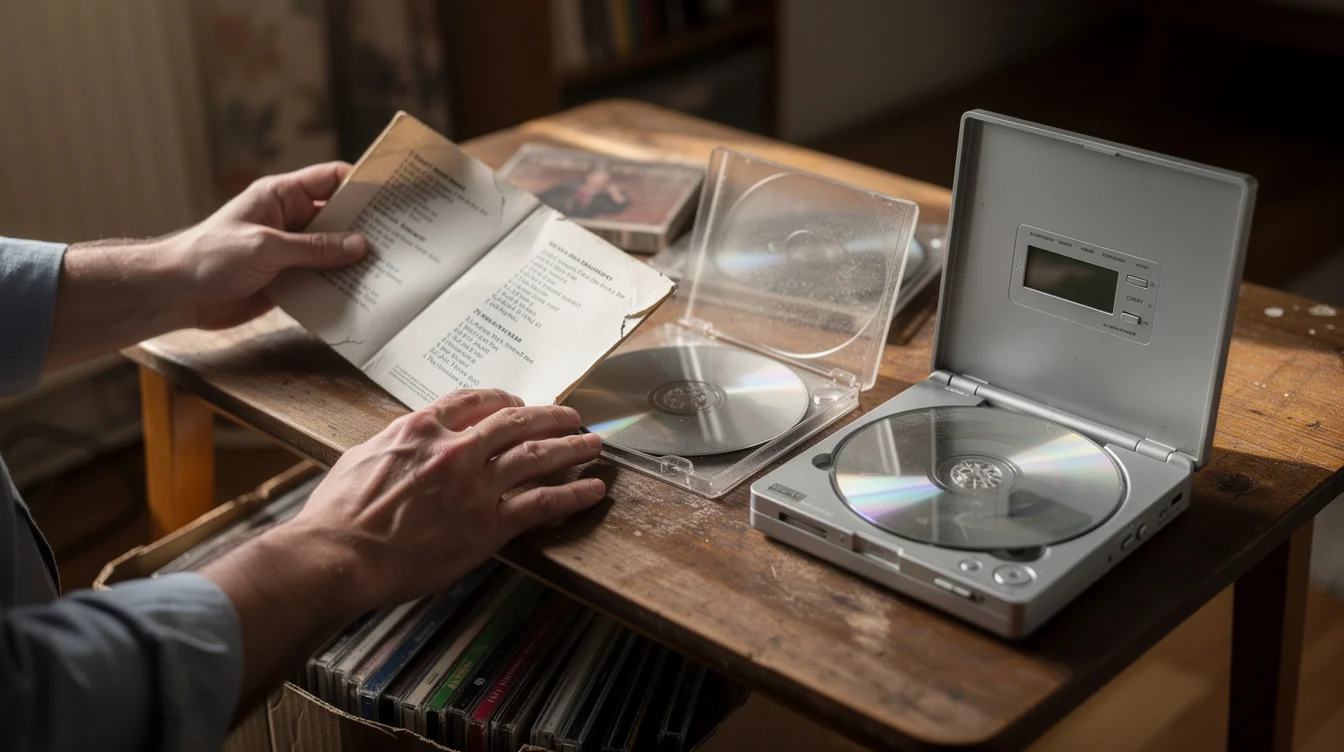
A purchased CD offers something a streaming subscription cannot guarantee: continued access to that particular copy without an ongoing service payment. You still need functioning playback equipment, and damaged discs can fail. But a licensing dispute cannot remotely remove the album from your shelf. Ownership does not eliminate dependency; it makes the dependencies more visible and more local.
This distinction matters when music is treated as cultural material rather than interchangeable background. A particular CD edition might contain a bonus track, a different mastering or booklet notes absent from the version available on a service. The packaging of Radiohead’s Kid A, developed through the band’s collaboration with Stanley Donwood, illustrates how an album’s visual world can extend beyond a thumbnail. Not every jewel case deserves museum status. Some genuinely carry information the interface discards.
A collection also preserves decisions. The sequence of records bought during a year, inherited from a parent or found in a second-hand shop becomes a personal archive. A playlist can do this too, but its contents remain dependent on the service’s catalogue.
The strongest pro-CD position is therefore not that physical media makes everyone a better listener. It is that access and possession are different product functions. Streaming made one extraordinarily efficient while encouraging us to stop asking for the other.
PRO: Good Hardware Can Make the Collection Work Again
The EP/BC-1 matters because playback hardware mediates the whole ownership experience. An awkward tray, illegible display or confusing control sequence turns a collection into a chore. A direct, legible interface can make choosing one album easier than negotiating a screen full of recommendations. That is a design achievement, not merely a nostalgic pleasure. The same question animates the debate over simpler trucks: which complications are worth keeping?
There are useful precedents. Sony’s D-50 helped establish the portable CD player as a credible personal object. Bang & Olufsen’s BeoSound 9000, designed by David Lewis, made six discs visibly available within one dramatic mechanism. They pursued different ambitions: portability in one case, the collection as part of the room in the other. Neither depended solely on imitating an older machine.
Contemporary players should be judged just as rigorously. Can essential controls be understood without a tutorial? Can listeners read track information from their usual seat? Does the player connect sensibly to equipment they already own? Can a failed mechanism be serviced? These are evaluation criteria, not claims about the EP/BC-1’s specifications.
Even the slender enclosure raises a practical question: does the machine occupy less space once loading clearance, cables and discs are included? The opportunity is to redesign the complete listening routine. If Teenage Engineering’s return to the disc helps establish that standard, the category gains more than another photogenic collectible.
CONTRA: Streaming Removed Work, Not Just Objects
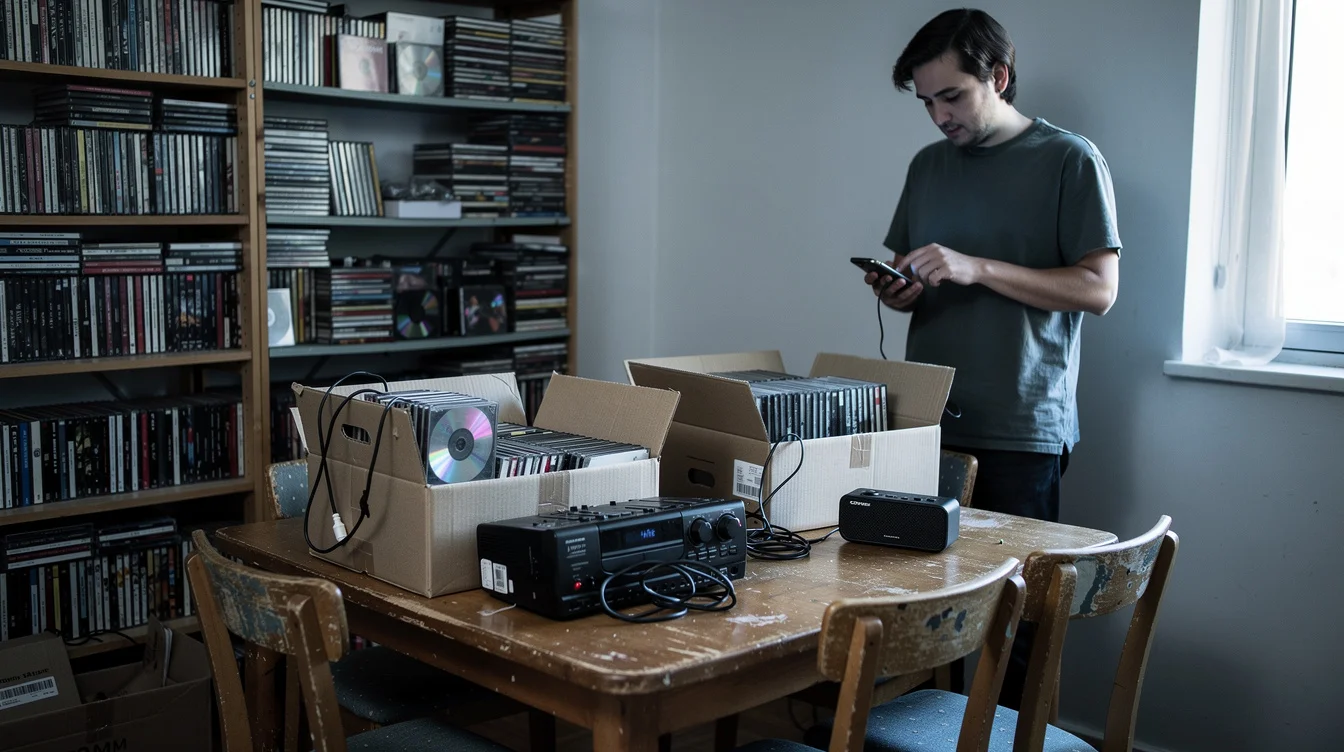
The physical-media revival often mistakes inconvenience for depth. Carrying a disc, opening its case and returning it to a shelf can create a satisfying ritual. They can also be irritating tasks performed by someone who simply wants music while cooking. Product design should not moralise the difference.
Streaming’s strongest argument is the range of situations it handles. A commuter can explore an unfamiliar musician immediately. A household can move between children’s songs, radio-like discovery and a long album without maintaining separate physical libraries. Search reduces the need to remember where something was filed. For users with limited reach or dexterity, avoiding cases and loading mechanisms can be materially useful, although app accessibility remains uneven.
Spotify Connect and networked systems such as Sonos illustrate how playback can be separated from the device used to select it. Their dependence on software and support deserves scrutiny, but the interaction solves a genuine problem: music can follow domestic routines rather than requiring those routines to orbit a dedicated player.
Streaming also lowers the immediate cost of experimentation. Buying an unfamiliar album creates a financial commitment and a storage obligation; sampling it through an existing subscription does not. Recommendations can narrow taste, but searchable catalogues can expand it. The convenience is not a cultural defect. It is the incumbent design achievement any returning CD player must confront.
CONTRA: A Slim Player Does Not Make Ownership Lightweight
The machine is the smallest part of the ownership proposition. A substantial CD collection needs shelving, an indexing habit and space that survives the next move. Cases crack. Discs get misplaced. Players contain mechanical components that wear. Reducing the enclosure’s thickness does not remove any of these responsibilities; it may simply move them outside the promotional photograph.
Dieter Rams’s insistence on long-lasting design offers a tougher benchmark than retro styling. A new player should earn its place through durability and intelligibility, not visual references alone. Repair documentation, replacement mechanisms and a credible service route matter more to long-term ownership than whether the controls evoke a studio instrument. Without them, the supposedly permanent collection depends on increasingly disposable gateways.
The environmental case also resists easy slogans. An existing collection played on maintained equipment is a different proposition from buying a new player and rebuilding a library through individually shipped purchases. Streaming relies on devices, networks and data centres; discs require materials, manufacture and transport. Listening frequency, equipment lifespan and purchasing habits change the comparison. As with the afterlife of a bioplastic dress, environmental claims need to account for what happens beyond the product’s debut.
The sensible verdict is conditional, not neutral: new CD hardware must prove its usefulness beyond the launch image. For a committed collector, the EP/BC-1 may reopen a meaningful category. For someone starting from zero, streaming remains formidable. Ownership becomes compelling when the entire system is worth maintaining—not when the player merely makes maintenance look romantic.
FAQ: Buying Back Control
What is the Teenage Engineering EP/BC-1?
It is Teenage Engineering’s first CD player. Wallpaper describes it as a slender unit combining retro looks with pro-grade features. Its significance here is the renewed attention it brings to dedicated playback hardware and physical music collections.
Does owning a CD guarantee permanent access to an album?
It removes dependence on a streaming service’s continuing licence for that copy, but it does not guarantee permanence. The disc must remain readable and compatible playback equipment must remain available. Ownership changes the maintenance problem rather than abolishing it.
Do CDs necessarily sound better than streaming?
No. CDs carry uncompressed digital audio, but some streaming services offer lossless audio at equivalent or higher technical resolutions. Mastering differences, playback equipment and listening conditions can matter more than the choice between a disc and a stream.
Can a physical collection coexist sensibly with streaming?
Yes. Streaming can support discovery and mobile listening, while a selective CD collection preserves favourite albums or particular editions. Buying selectively avoids turning every new musical interest into a permanent demand on storage space.
If a beautifully designed player can return control to the listener, how much space, effort and maintenance should we be willing to give that control?
Get the Mainifesto weekly — curated design debates, speculative ideas and the week's best articles every Saturday.
Editorial Perspectives
Questions and counterpoints developed by the Mainifesto editorial desk to extend the discussion.
Perspective 1
I’d give a shelf to music that can’t disappear when a licensing agreement changes. In a small flat, that’s a reasonable trade for ownership—but the player needs to earn its footprint with durable construction and straightforward repairs.
Perspective 2
I make objects for a living, and I’m not convinced we need this one back. A beautiful player doesn’t restore control if it adds another fragile mechanism to maintain; I’d rather keep streaming than mistake a fashionable purchase for a lasting relationship with music.
Perspective 3
The record cabinet was never just storage; like the bourgeois library, it displayed the person you wished to be. This CD revival updates that old performance with a designer object, so let’s not confuse choosing our furniture with escaping the culture industry.