

Should Old Cars Become Buildings—or Materials Again?
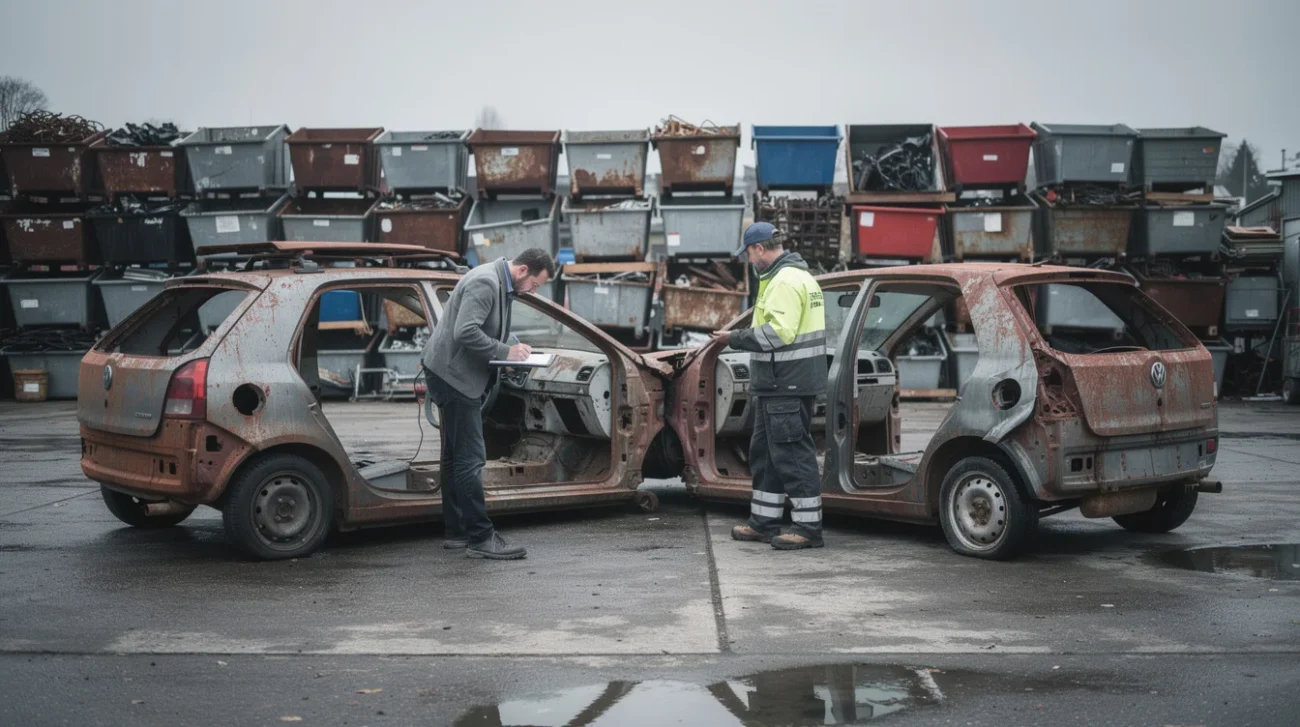
A dead car is not necessarily dead matter. Its body still encloses space; its steel still has strength; its components retain the industrial intelligence of stamping, casting and assembly. Yet none of that automatically makes it a good building. The provocative question is not whether architecture can absorb automotive waste. It is whether architecture deserves those resources more than the material systems that could reclaim them.
Giona Bierens de Haan’s It All Remains, described by designboom as an installation addressing automotive waste in Switzerland, reinterprets decommissioned vehicles as structural building blocks and local resources for a post-fossil-fuel architecture. Treat it as a proposition, not proof of a certified construction system. Its power lies in making two circular strategies collide: preserve the assembled object, or dismantle it so its materials can work again elsewhere.
PRO: Preserve the Work Already Done
Recycling is not a magic reset button. Collection, separation, shredding and remelting require infrastructure and energy. Direct reuse can bypass some of those operations while retaining useful geometry and fabrication. A vehicle body is not simply a quantity of steel: it is steel already shaped into a spatial assembly. Destroying that assembly before asking whether it remains useful can be industrial amnesia.
This is the strongest reading of cars as buildings. If a safely prepared body can replace a newly manufactured enclosure, partition or sheltered seating element with little modification, its second life may avoid both immediate recycling operations and production of the substitute. The crucial word is replace. An additional pavilion that nobody needed is not automatically a resource saving merely because its ingredients came from a scrapyard.
Architecture already has precedents for retaining industrial assemblies. LOT-EK’s shipping-container work explores the spatial possibilities of an existing manufactured object rather than treating it as scrap steel. The Freitag flagship store in Zürich similarly makes reused containers into an architectural presence. Neither proves that cars perform like containers: their geometry, connections and load paths differ substantially. They do, however, establish the cultural argument. A building need not begin with anonymous products arriving from a catalogue. It can begin with what a territory already has.
PRO: Make Reuse Local, Legible and Reversible

Direct reuse becomes more persuasive when the supply chain is short and the transformation modest. Consider a hypothetical covered gathering space near a Swiss vehicle dismantler. Professionally depolluted car bodies could form non-load-bearing alcoves beneath an independently engineered roof. Their retained shapes would provide seating niches and spatial identity without pretending that crashworthy automotive design equals building-code compliance.
This distinction matters. Using an object architecturally does not require making it carry the building. A separate support system may be justified if the bodies replace substantial new fit-out materials; it becomes harder to defend if that support system outweighs everything saved. Transport, lifting equipment, corrosion protection and maintenance also belong in the calculation. As with citizen-built shade for climate adaptation, who builds and maintains the shelter matters alongside what it is made from.
Rural Studio’s early work with salvaged materials, including its windshield-based chapel experiment in Alabama, offers a useful reference: a discarded automotive component can become an architectural element without importing an entire car. Rotor DC, the Brussels-based building-component reclamation operation, demonstrates another principle worth borrowing: inventory, assess and match reclaimed objects to actual demand.
For Bierens de Haan’s proposition to become more than a compelling image, reversibility is essential. Accessible bolts, identifiable components and an extraction plan would let the architecture function as temporary custody rather than a material tomb. The best version of direct reuse does not defeat recycling. It postpones it while delivering a genuinely useful service.
CONTRA: A Car Is Not a Ready-Made Building Product
The assembled object also carries liabilities. End-of-life vehicles contain combinations of metals, polymers, foams, glass, coatings and electrical components designed for automotive service, not decades of architectural exposure. Before reuse, fluids and hazardous components need appropriate handling. Fuel systems, refrigerants, airbags and batteries are not decorative complications. They are reasons to involve qualified dismantlers before involving a photographer.
Then come structural and environmental questions. A vehicle body’s performance in a collision does not establish its capacity under stacked, sustained building loads. Corrosion can be concealed. Large openings cut for circulation can remove stiffness. Acoustics, overheating, drainage, accessibility and fire performance all demand attention. The apparent shortcut can become a bespoke engineering project supported by so much new material that the original resource argument collapses.
Container architecture offers a warning as well as inspiration. Extensive cutting, reinforcement and insulation can erode the benefits of retaining the box. With cars, smaller interiors and irregular shapes make the mismatch potentially sharper.
Earthship construction provides another instructive comparison: discarded tyres can become earth-packed wall units, but the tyre alone does not constitute a compliant, comfortable building. Assemblies, detailing and local conditions decide performance. The same scrutiny should apply to car-based architecture. Radical appearance must not purchase an exemption from ordinary technical questions.
CONTRA: Keeping Everything Can Waste the Best Parts
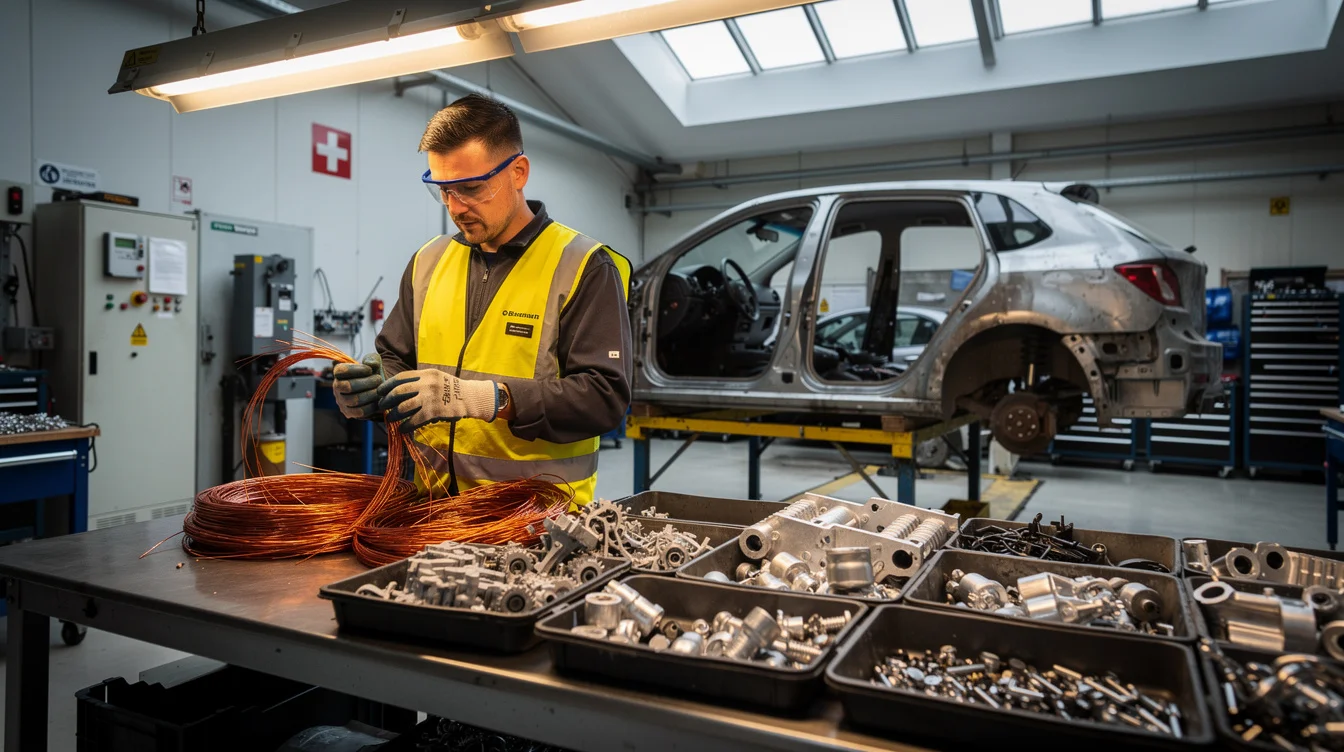
A vehicle is also a reservoir of materials and components with competing destinations. A serviceable spare part may deliver more value by maintaining another vehicle than by becoming part of a wall. Copper wiring and aluminium components may have strong recovery routes. For electric vehicles, battery assessment requires specialist handling; a pack should not be assumed suitable for architectural energy storage merely because the car has been retired.
The opportunity cost is central. If a shell becomes a low-use sculpture while recoverable materials remain inaccessible inside it, preservation may lock resources into a weaker application. Dismantling can release several useful streams instead of forcing the whole object to accept one compromised job. But recycling deserves scrutiny too: mixed alloys, contamination and losses can reduce the quality or quantity of recovered output. The word does not guarantee a closed loop. The end-of-life questions raised by combining mycelium with electronics offer a parallel: material choices must account for how an assembly will eventually come apart.
A credible comparison therefore asks what each route actually supplies. Compare a car-based partition with an equivalent conventional partition, then account for what happens to the recovered materials under the dismantling option. Do not credit both routes with the same avoided production. Do not assume every kilogram of recovered metal replaces a kilogram of primary metal in practice.
Scale also changes the verdict. An installation can expose a problem brilliantly while absorbing very few vehicles. A repeatable dismantling network may deliver less photogenic but much larger resource benefits. Architecture should not confuse visibility with impact.
The Verdict: Preserve Utility, Not the Silhouette
The right unit of circularity is useful service, not the intact object. Keeping a car recognisable is not inherently better than separating it. Equally, shredding a useful assembly simply because the recovery infrastructure already exists is not inherently efficient.
The strongest pathway may be selective: recover hazardous and high-value components, retain a body or subassembly where it performs a demonstrable architectural role, and design for eventual disassembly. That decision needs a credible service-life estimate, a bill of added materials, transport assumptions and a comparison with the product being replaced.
It All Remains matters because it interrupts the reflex that labels a retired vehicle worthless. The next step must interrupt the opposite reflex: that anything visibly reused is sustainable. Architecture should earn the right to keep these objects by making them useful—not merely by making waste look visionary.
FAQ
Can decommissioned cars safely become structural building blocks?
Potentially, but only through project-specific assessment, professional depollution, engineering and approval under applicable rules. An automotive body is not automatically a certified building component. Using prepared shells as non-load-bearing elements can reduce some structural complications, but fire, exposure and occupant-safety requirements still apply.
Is direct reuse always lower-carbon than recycling?
No. Reuse can avoid processing and new manufacturing, but transport, reinforcement, insulation and maintenance may offset those savings. The comparison must provide an equivalent function over a stated service life and account for the alternative destinations of recovered materials.
Which vehicle components should be assessed for removal first?
Qualified dismantlers should identify fluids, batteries, refrigerants, pyrotechnic devices and other hazardous components. Reusable spare parts and recoverable materials also warrant separate assessment. What remains suitable for architecture depends on condition, intended use and local requirements.
How can a car-based building avoid becoming a material trap?
Use accessible mechanical connections, document retained materials and provide a realistic removal route. Avoid unnecessarily bonding mixed materials together. A named recovery partner and a funded disassembly plan are more convincing than a vague promise of future recyclability.
If an old car can become either an extraordinary room or useful materials for many ordinary things, which future should architecture claim—and who gets to decide?
Get the Mainifesto weekly — curated design debates, speculative ideas and the week's best articles every Saturday.
Editorial Perspectives
Questions and counterpoints developed by the Mainifesto editorial desk to extend the discussion.
Perspective 1
I’m for turning the car into a room when it replaces new construction, not just decorates it. Calling scrap recovery the responsible option means little unless we know where the metal goes, who does the processing, and whether the value stays locally.
Perspective 2
Recover the materials; a car shell is usually a costly starting point for a useful room. Once you’ve paid for decontamination, insulation, access and weatherproofing, the extraordinary object may be doing very little ordinary work.
Perspective 3
Show me what each option actually replaces, how much processing it needs, and how long the result will last. I’d also want to know whether the car can still be dismantled later—reuse shouldn’t quietly become a dead end for recovery.
Perspective 4
Some cars carry a history worth keeping intact; others are simply available steel, and age alone doesn’t settle that. The people who owned, repaired and lived around them deserve a say, especially if an architect’s clever room becomes the selling point for a development they can’t afford.