
A Repairable Lamp Needs More Than Replaceable Parts
A Repairable Lamp Needs More Than Replaceable Parts
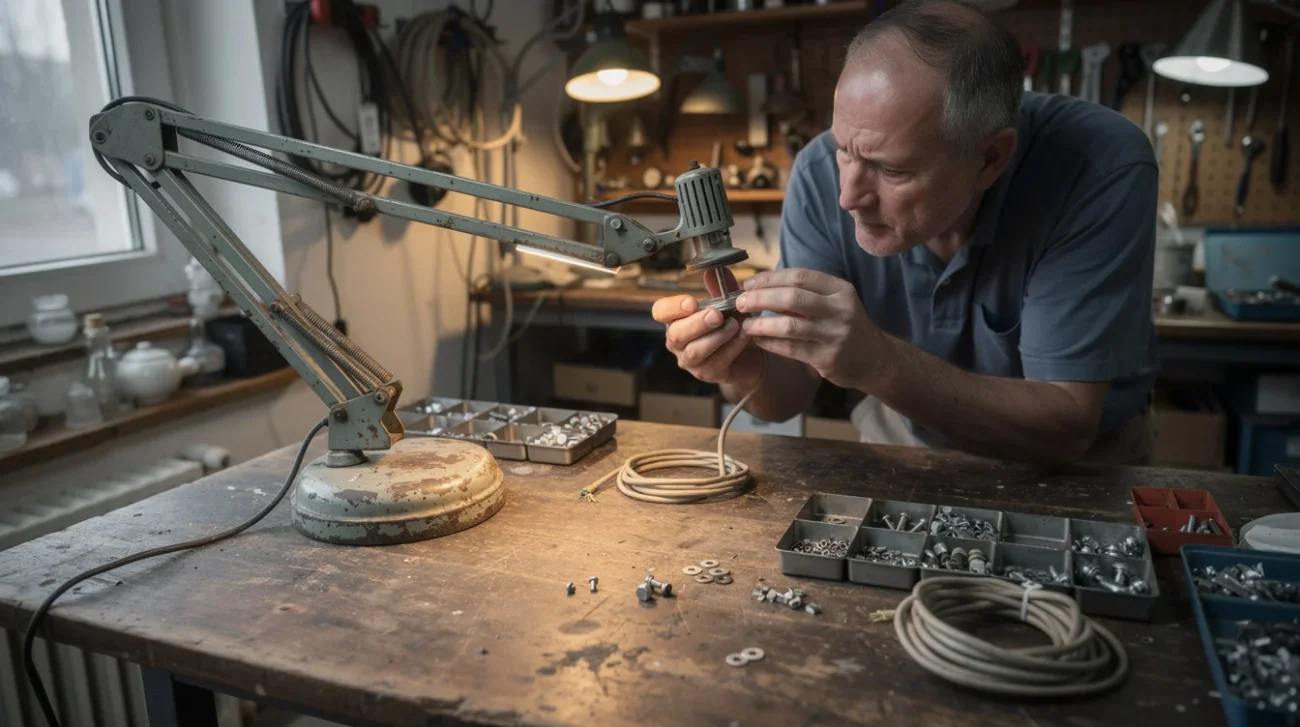
A lamp can outlive its designer and still be defeated by a missing screw. Not because the screw is technically extraordinary, but because nobody knows its specification, the manufacturer no longer stocks it, or finding someone to fit it costs more than buying another light. This is where design’s favourite sustainability promise encounters its least photogenic reality: the service counter.
Monocle’s reporting on German lighting manufacturer Midgard, framed around restoring century-old lamps and designing entirely repairable fixtures, offers a sharper provocation than another celebration of durable metalwork. If an articulated light can return to service after decades, replacement stops looking inevitable. Yet a successful restoration does not automatically establish a repair system that ordinary owners can afford.
Repairability is not simply a quality embedded in an object. It is a relationship that must remain operational after the sale. That relationship involves inventories, documentation, technicians, pricing and successors who inherit responsibilities alongside a brand name. Midgard makes the long life of lighting tangible. The uncomfortable question is whether the commercial infrastructure around such objects can become as enduring as their physical construction.
The Joint Is Only the Beginning
Midgard belongs to a history in which adjustable lighting was a working tool before it became a collectible. Founded by Curt Fischer in 1919, the company developed articulated lights that brought illumination closer to the task. Their continuing relevance exposes the absurdity of treating a serviceable mechanism as disposable simply because its wiring or one moving component has aged.
George Carwardine’s spring-balanced Anglepoise mechanism, embodied in the Original 1227 introduced in 1935, offers a parallel lesson: a recognisable lamp is also an assembly of interacting parts. Arms, springs, joints, shades and electrical components do not fail at the same rate. Designing them as separable elements allows maintenance to follow actual wear rather than a marketing calendar.
But an accessible fastener is only an invitation to repair. Someone still needs to identify the right component, establish whether it is compatible and check the finished light’s safety. An old metal desk lamp may need assessment of cable condition, insulation and earthing, not merely a fresh bulb.
This distinction matters when contemporary lighting integrates LEDs and drivers into compact housings. A replaceable light source is useful; an obtainable, compatible driver is equally consequential. A lamp that opens neatly but depends on an unavailable electronic module is a beautifully organised dead end.
A Spare-Parts Catalogue Is a Commercial Commitment
The showroom sells the complete object. Longevity depends on the much less glamorous business of selling an inexpensive component decades later. Keeping that transaction possible means maintaining part numbers, recording revisions, storing stock or retaining the means to manufacture replacements. None of this happens because a product photograph looks timeless.
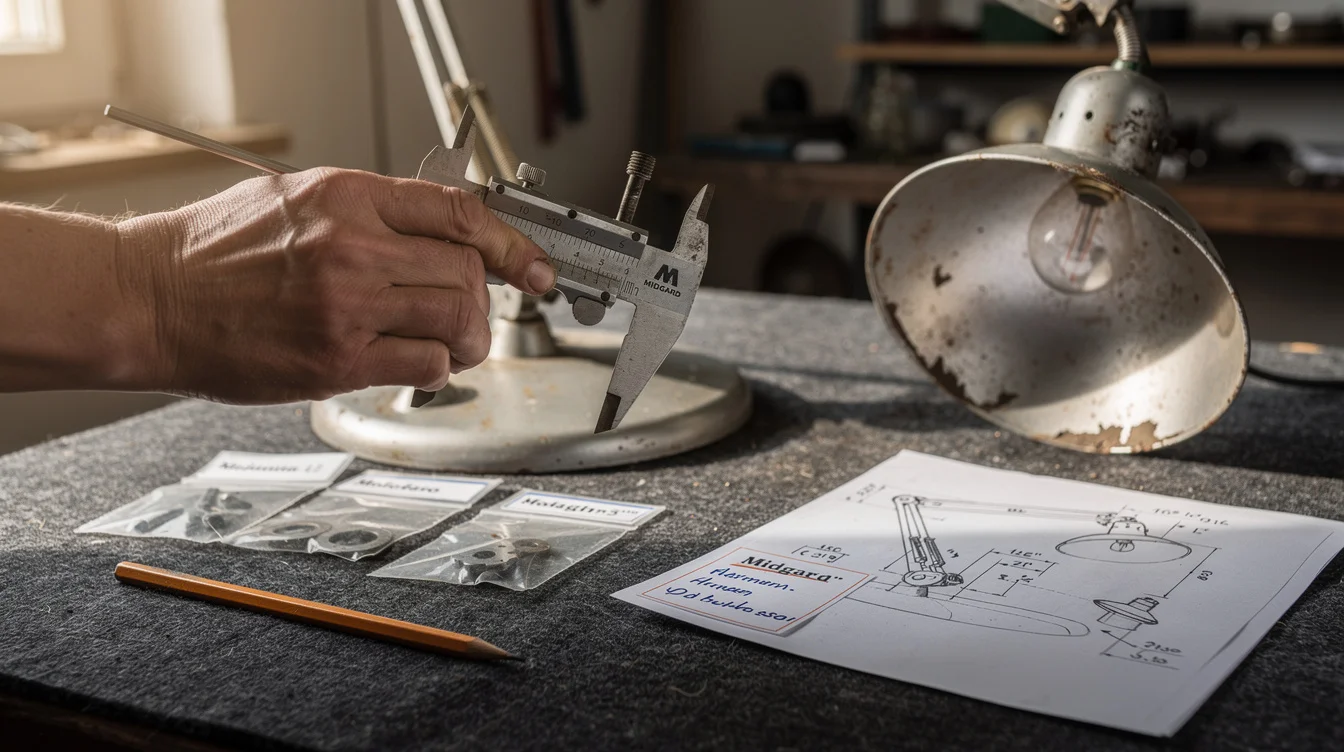
Imagine a second-hand Midgard lamp bought at an estate sale. Its new owner has no receipt and cannot identify its production year. One joint slips. The decisive service is not a campaign about circularity but a reliable route from photographs and measurements to a compatible replacement. This is a test scenario, not a claim about a particular Midgard service policy: any manufacturer invoking generational longevity should be able to explain how it would respond.
Framework’s replaceable laptop modules and Fairphone’s modular smartphones provide useful comparisons beyond furniture. They make parts and disassembly central to the product proposition, while demonstrating that modularity still depends on an ecosystem of compatible components and support. Similar questions arise with home robots assembled one body part at a time: the module is only as useful as the support behind it.
Lighting brands should therefore publish more than exploded diagrams. Buyers need stated support periods, compatibility information and a policy for discontinued components. Those statements should distinguish stocked parts from made-to-order replacements. “Repairable” without a declared support horizon asks the customer to mistake corporate goodwill for infrastructure.
Affordable Labour Is the Missing Component
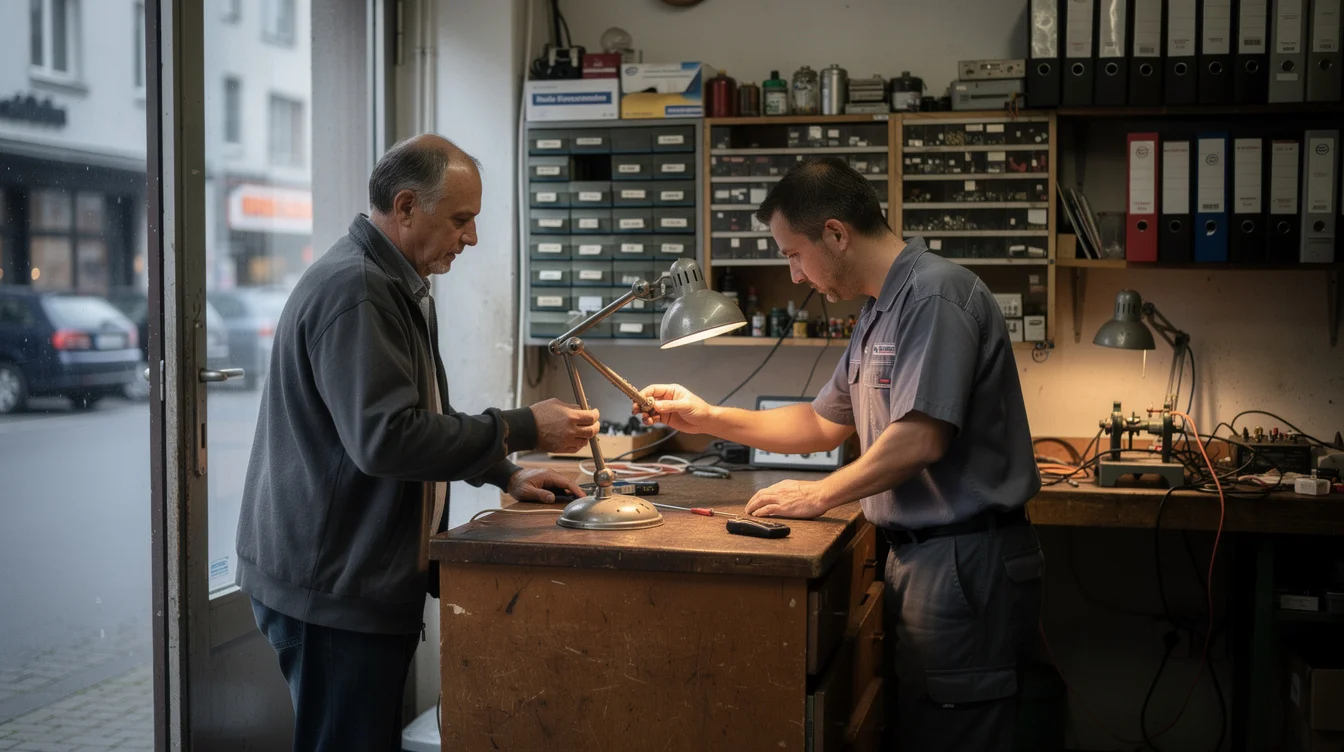
Even a perfectly supplied spare part cannot repair a lamp by itself. Diagnosis, correspondence, disassembly, electrical testing and return shipping all consume time. For an inexpensive fixture, professional attention can rapidly exceed its replacement price. For a collectible lamp, the same bill may look reasonable because the object carries financial and emotional value.
That gap should trouble a design industry eager to present heritage restoration as a universal sustainability model. Saving a desirable century-old light is worthwhile. It does not prove that repair works economically for a rented flat, a school or a café with twenty ordinary fittings. If longevity is reserved for objects whose resale value subsidises maintenance, circularity becomes another premium amenity.
The Repair Café movement, initiated by Martine Postma in Amsterdam in 2009, demonstrates how local knowledge and shared equipment can lower barriers. The idea of cafés becoming neighbourhood materials utilities poses a related question: could everyday gathering places make shared resources easier to access? But volunteer networks should complement paid repair work, not become the invisible subsidy that makes manufacturers’ promises sound credible. Electrical work also requires appropriate competence; enthusiasm cannot substitute for safe assessment.
A stronger lighting offer would include transparent diagnostic charges, common repair-price examples and access to qualified local technicians. Architects specifying a restaurant or library could compare maintenance costs alongside purchase prices. Procurement would then reward the fixture that stays economically serviceable, rather than the cheapest unit on opening day.
Knowledge Must Travel With the Lamp
Generational ownership is untidy. Packaging disappears. Businesses relocate. Lamps move from factories to studios, then through auctions and family homes. The person attempting a repair in forty years may have no relationship with the original retailer and no idea which version sits on the workbench.
Enzo Mari’s 1974 Autoprogettazione project treated construction knowledge as something to distribute, making drawings and assembly logic central to its proposition. Electrical lighting cannot simply adopt the same do-it-yourself assumptions, but the principle remains disruptive: understanding how an object is made should not be a privilege that expires with the sales relationship.
Permanent model identification, downloadable service manuals, dimensioned mechanical drawings and clearly labelled component revisions would help that understanding survive. A QR code can provide convenient access, but it cannot be the only archive: websites vanish and links break. Documentation needs durable identifiers and copies that owners and independent repairers can retain.
Manufacturers should also separate legitimate safety restrictions from commercial gatekeeping. Instructions can distinguish user-replaceable elements from work requiring a qualified technician. That is more useful than either sealing everything shut or pretending every repair is harmless. The aim is not universal amateur repair. It is repair that does not depend on one company remaining the sole interpreter of its own product.
Design for the Day the Manufacturer Disappears
The hardest longevity test is corporate mortality. A brand can change owners, abandon a product line or cease trading while thousands of functioning lamps remain in circulation. A design intended to cross generations needs an answer to that possibility, not just confidence that heritage will protect the business.
One credible approach would be a repair-continuity agreement: manufacturers could arrange for specified mechanical drawings, tooling information and parts specifications to become available under defined conditions if support ends. Some components could use established standards; proprietary ones could carry explicit plans for licensed reproduction. This is a proposed model, not an existing commitment attributed to Midgard.
There are real constraints. Documentation must be accurate, intellectual property has value, and replacement electrical components must meet applicable safety requirements. Openness alone does not certify a repaired lamp. Nevertheless, these are problems to organise around, not excuses to let usable products become stranded assets.
Midgard’s example should push the conversation beyond admiration for old things. The next design achievement is not merely a lamp that can be dismantled, but a business arrangement that makes keeping it working ordinary. Longevity becomes credible when the promise survives the original customer, the original technician and, eventually, the original company.
FAQ: What Makes Repairable Lighting Last?
What is the difference between durable and repairable lighting?
Durable lighting resists wear and failure. Repairable lighting allows failed elements to be identified and replaced without unnecessarily discarding the whole fixture. A long-lived lamp needs both, supported by obtainable parts, useful documentation and economically accessible maintenance.
Does a replaceable bulb make a lamp fully repairable?
No. Cables, switches, sockets, joints and, where fitted, LED drivers may also need attention. Their accessibility and compatibility matter, as does the ability to restore electrical safety. A replaceable bulb solves only one potential failure.
What should buyers ask before purchasing a repairable lamp?
Ask which components can be replaced, how long parts will be supported and whether service information is available to independent technicians. Request indicative repair costs and check whether support remains accessible to second-hand owners without the original receipt.
Can a vintage lamp be repaired safely?
Often, but age and appearance alone cannot establish safety. A qualified repairer should assess the fixture’s electrical condition and any necessary modifications under applicable local requirements. Mechanical restoration and electrical assessment are related tasks, not interchangeable ones.
If a brand sells a lamp on the promise that it will serve generations, what repair obligations should survive the company itself?
Get the Mainifesto weekly — curated design debates, speculative ideas and the week's best articles every Saturday.
Editorial Perspectives
Questions and counterpoints developed by the Mainifesto editorial desk to extend the discussion.
Perspective 1
A replaceable part only reduces waste if someone can actually source and fit it. If a lamp is sold on a generations-long promise, its drawings, material specifications and repair instructions should pass to an independent archive when the company closes, with permission for others to make the parts.
Perspective 2
“For generations” is a brand promise with a very long deadline. The identity may disappear, but the repair knowledge should remain public and usable; a logo should never be the gatekeeper to keeping a lamp alive.
Perspective 3
A replacement joint is little use if nobody knows how tightly to set it or how to dismantle it without damaging the finish. A brand promising generations of service should document those workshop details and train repairers beyond its own network while it still can.