
Winchester Girls’ Boarding Houses: Equality by Design?
New Rooms, Old Traditions: Designing Girls into Winchester College
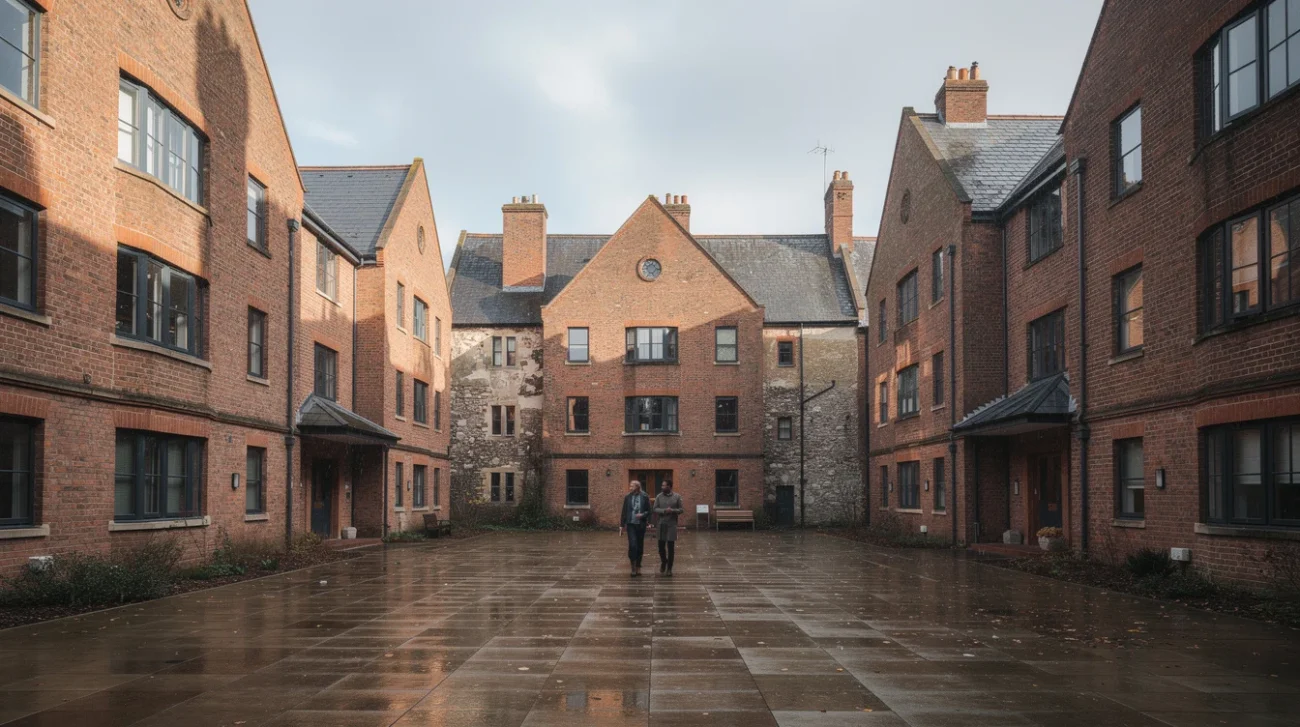
An institution can open its doors without changing its organising logic. That is the provocative possibility raised by Stanton Williams’ two new girls’ boarding houses at Winchester College. As reported by Dezeen, the buildings wrap courtyards in gabled brick architecture, referencing the historic layout and character of a school founded in 1382. This is Winchester’s first new boarding complex since 1912: an exceptional opportunity to decide what boarding should now mean.
The architectural proposition is continuity, not rupture. Girls enter an established visual language rather than a conspicuously separate contemporary annex. That deserves serious defence—and equally serious interrogation. Does spatial equality mean receiving an equal share of inherited traditions, or gaining the power to rewrite the routines those traditions contain?
PRO: Belonging should be built into the institution
At a school whose identity is inseparable from its buildings, architectural continuity is not merely conservative taste. It can function as a declaration of membership. Gables, brickwork and courtyards place the new houses within Winchester’s recognisable institutional vocabulary. The message is potentially powerful: girls are not temporary guests whose accommodation can be treated as an experiment at the edge of the estate.
Distinctiveness is not automatically liberation. A radically contrasting building might offer excellent rooms while still marking its occupants as the exception. Architecture communicates status through placement, permanence and material investment as much as through floor area. Giving newcomers a credible claim to the school’s established architectural identity can therefore be a substantive form of equality.
Louis Kahn’s Phillips Exeter Academy Library, completed in 1972, offers a useful comparison—not as a boarding model, but as an argument about institutional architecture. Its brick exterior converses with the academy’s setting while its monumental interior reorganises the experience of study. The lesson is that continuity outside need not prohibit invention within.
Winchester’s approach should be judged with that distinction intact. A historic-looking building is not proof of a historic social programme. Rejecting the project simply because it speaks the institution’s existing language would confuse aesthetic novelty with social progress. Belonging can require access to symbols previously monopolised by others. As in debates over selective building reuse, the useful question is not whether to favour old or new in the abstract, but what deserves to endure and what needs to change.
PRO: Shared traditions can become shared resources
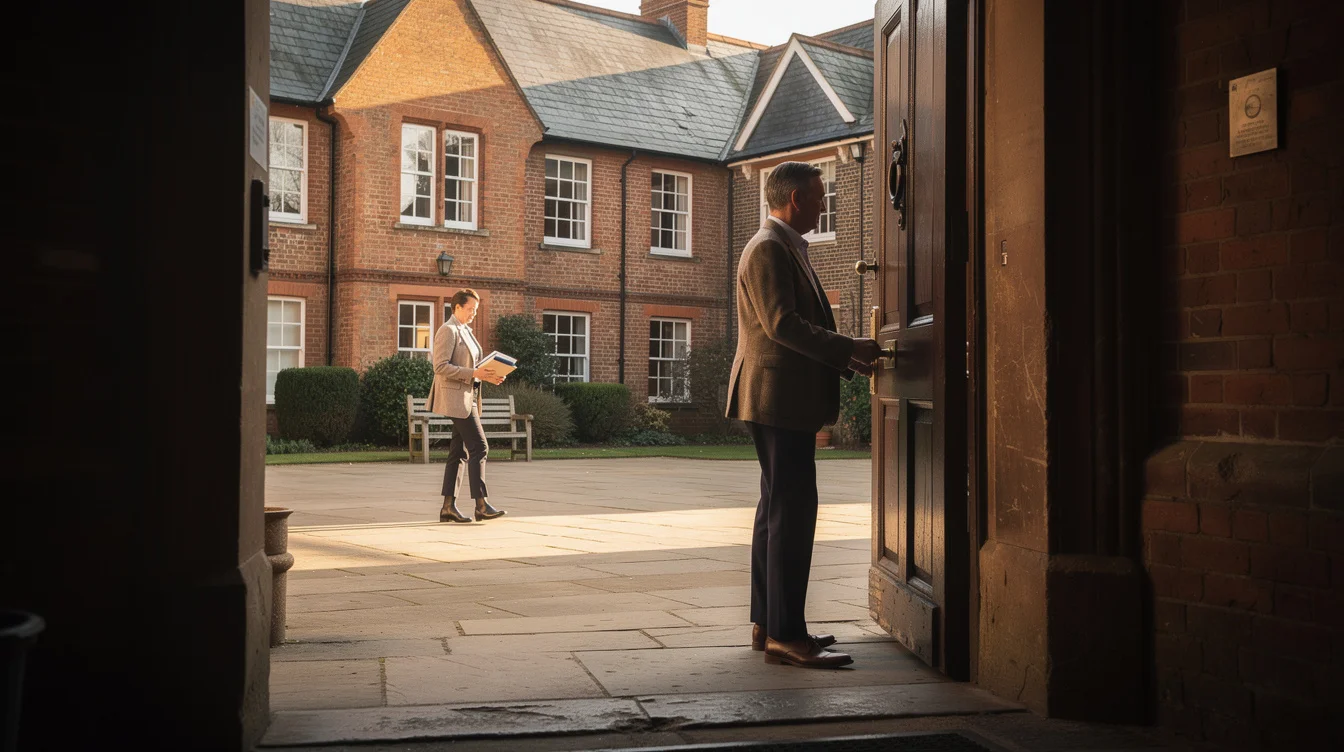
The courtyard also deserves a defence beyond picturesque imagery. As a spatial type, it can turn accommodation into a recognisable community rather than a collection of beds. Repeated encounters on the way to study, eat or return to a room can help newcomers establish friendships. A shared exterior space can offer a legible centre without requiring every social interaction to become a scheduled activity.
This is an argument about architectural potential, not a claim about the precise circulation or operation of Winchester’s new houses. The supplied project account establishes their courtyard organisation, but does not establish how individual rooms, bathrooms or staff spaces work. Those distinctions matter.
Alvar Aalto’s Baker House at the Massachusetts Institute of Technology, completed in 1949, demonstrates how a residential building can reconcile collective identity with individual experience. Its serpentine plan gives many student rooms oblique views towards the Charles River, while shared facilities help organise communal life. Although university accommodation is not school boarding, the precedent challenges the assumption that strong collective form must erase the individual.
Winchester’s inherited boarding culture could likewise be treated as a resource rather than an immutable script. House identity, mutual support and intergenerational memory are not inherently male possessions. Extending them to girls may be more consequential than inventing a separate, supposedly feminine architectural language. The strongest defence of Stanton Williams’ approach is therefore not that nothing changes, but that new occupants gain ownership of something worth changing from within.
CONTRA: An equal address can conceal unequal routines
The counterargument begins where architectural symbolism stops. Matching institutional dignity does not guarantee an equal everyday experience. A bedroom may look generous in a photograph yet offer inadequate acoustic separation. A bathroom may satisfy technical requirements while making users feel exposed on the route to it. A common room can be beautifully furnished and still be difficult to avoid when someone needs solitude.
None of these conditions is established here as a defect in Winchester’s completed project. They are the tests that its language of continuity cannot answer. The available account does not establish bedroom occupancy, sanitary arrangements, acoustic performance or residents’ control over shared spaces. Without such evidence, declaring the scheme socially progressive would be as careless as condemning it.
Virginia Woolf’s insistence on a room of one’s own remains relevant because it links space to agency rather than decoration. For a boarding pupil, agency includes somewhere to withdraw without being treated as antisocial, somewhere to manage illness or menstruation discreetly, and somewhere to communicate privately with family. These are not demands for a gender-coded interior; many apply across genders.
The problem is assuming that an inherited standard becomes equitable once everyone receives it. If that standard normalises excessive exposure or compulsory sociability, equal provision merely distributes the same limitation more widely. Admission into tradition is not the same as freedom within it. The parallel with public access to the preserved Thompson Center is a question of governance: gaining entry to a valued building does not settle who controls the terms of its use.
CONTRA: The brief must change, not just the occupants

Designing around girls’ needs should not mean assuming that girls want softer colours, more mirrors or a particular kind of sociability. It should mean asking residents what makes daily life workable, and recognising differences between them. A confident extrovert, a pupil with sensory sensitivities and someone navigating a difficult relationship with peers may need different ways to occupy the same house.
Matrix Feminist Design Co-operative’s work, including its 1984 book Making Space: Women and the Man-Made Environment, supplies the sharper methodological precedent. Its challenge was to question who defines the brief and whose ordinary experience is excluded from supposedly universal design assumptions. Applied here, that means scrutinising access, supervision, domestic labour and privacy—not assigning a feminine appearance to inherited plans.
A serious evaluation would ask pupils to map uncomfortable routes and identify spaces they avoid. It would examine whether changing and washing arrangements offer meaningful privacy, whether communal rooms support both quiet company and larger gatherings, and whether staff oversight protects residents without making every movement feel monitored. Maintenance and housekeeping routines belong in that assessment too: domestic life is never produced by architecture alone.
Post-occupancy evaluation should then give residents a route to securing changes, not merely an opportunity to provide feedback. Continuity becomes defensible only when it can be corrected. Winchester’s brickwork may establish that girls belong to the institution; the harder measure is whether the institution allows their experience to reshape what belonging requires.
FAQ: Equality beyond the architectural image
What has Stanton Williams completed at Winchester College?
The studio has completed two girls’ boarding houses, arranged around courtyards with gabled brick buildings that reference the school’s historic architecture and layout. According to the source report, they form Winchester’s first new boarding complex since 1912.
Why does the historic architectural language matter?
At a school founded in 1382, architecture carries institutional identity. Using an established vocabulary can signal that girls are permanent, full members of the community. However, that symbolic inclusion does not establish whether their accommodation provides sufficient privacy, flexibility or everyday autonomy.
Does designing for girls require a different architectural style?
No. It requires an evidence-based brief rather than gender stereotypes. Relevant questions concern private retreat, washing and changing facilities, acoustic comfort, accessibility and different forms of sociability. Many resulting improvements could benefit pupils of all genders.
How should the houses’ success be assessed?
Architectural quality should be assessed alongside residents’ experience after occupation. Confidential feedback, observation of how shared spaces are used and reviews of privacy and supervision can reveal whether the design works. Crucially, the school should be willing to change spaces and routines in response.
When girls enter an institution built around centuries of male experience, should architecture secure their place in its traditions—or give them the power to remake those traditions?
Watch the Mainifesto Short
Get the Mainifesto weekly — curated design debates, speculative ideas and the week's best articles every Saturday.
Editorial Perspectives
Questions and counterpoints developed by the Mainifesto editorial desk to extend the discussion.
Perspective 1
I’d defend giving girls a place within Winchester’s historic fabric rather than treating their arrival as an architectural exception. In adaptive reuse, belonging can be a claim on what happens next: the old buildings needn’t be erased, but the boys can no longer be their only legitimate heirs.
Perspective 2
A handsome boarding house isn’t equality if girls still have to navigate rules written for boys. Before calling this a success, I’d want to know what they can actually change—from access to shared facilities to house routines—and whether the investment gives them authority, not just accommodation.