
What If the Home Robot Arrived One Body Part at a Time?
What If the Home Robot Arrived One Body Part at a Time?
The humanoid servant is an expensive answer to a question product design has barely interrogated. Why should the machine that retrieves a dropped sock also need shoulders, a face and the physical capacity to open every cupboard? The fantasy mistakes a familiar silhouette for a sensible distribution of power. A more interesting domestic future might arrive piecemeal: a hand, a brush, a carrier, each competent within deliberately narrow limits.
As reported by designboom, ETH Zurich’s 818-gram robotic hand prototype can move on its fingertips without legs, wheels or an attached robotic arm. That is the concrete provocation, not evidence that a disembodied hand is ready to roam a family kitchen. Its locomotion does not establish household reliability, safe human contact or useful performance across domestic chores. But it does loosen an assumption: a manipulator need not remain tethered to a larger body.
What follows is a design proposition, not a description of ETH Zurich’s system. Keeping design inspiration distinct from evidence is essential. Imagine modular home robots as an ecosystem of small, task-specific appliances. The test is not whether they look less intimidating than a humanoid. It is whether their distributed capabilities can be made more legible, repairable and governable.
A Household of Specialists, Not a Servant in Pieces
There is already a partial precedent under the sofa. The Roomba established a recognisable category of mobile domestic appliance organised around one job rather than human resemblance. Its lesson is not that every tool should wander. It is that useful automation can begin with a constrained task, an operating area and somewhere to return.
Our speculative household extends that logic selectively. A low carrier transports a laundry basket between two rooms. A small cleaning device works only inside a shower enclosure. A hand-like manipulator sorts robust objects on a dedicated utility-room surface, never crossing into food preparation. These devices need not share a chassis or even a manufacturer. They need compatible rules for access, interruption and storage.
Crucially, mobility must earn its place. A motorised drawer may retrieve medication more safely than a travelling gripper. A fixed dishwasher remains preferable to several miniature machines improvising around knives and glass. Joe Colombo’s Total Furnishing Unit offers a useful historical counterpoint: domestic functions can be concentrated and organised rather than endlessly dispersed. The appropriate future is neither one universal robot nor a robot in every object. It is a carefully edited division of labour.
The Furniture Becomes Part of the Machine
A fingertip-walking device turns an ordinary tabletop into operational terrain. Edges become fall risks; loose cloth becomes unstable ground; narrow joints may trap moving components. Rather than pretending that intelligence will overcome every obstacle, furniture designers would need to specify where movement is permitted and make those boundaries physically credible.
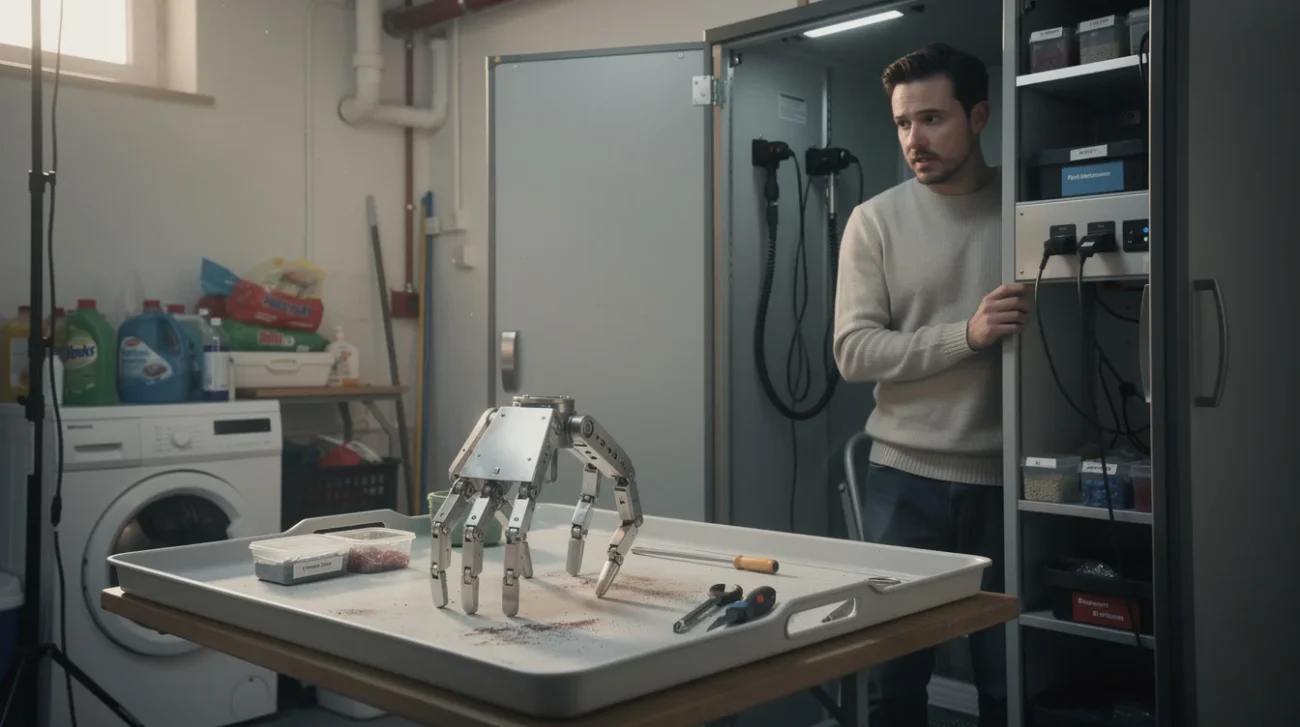
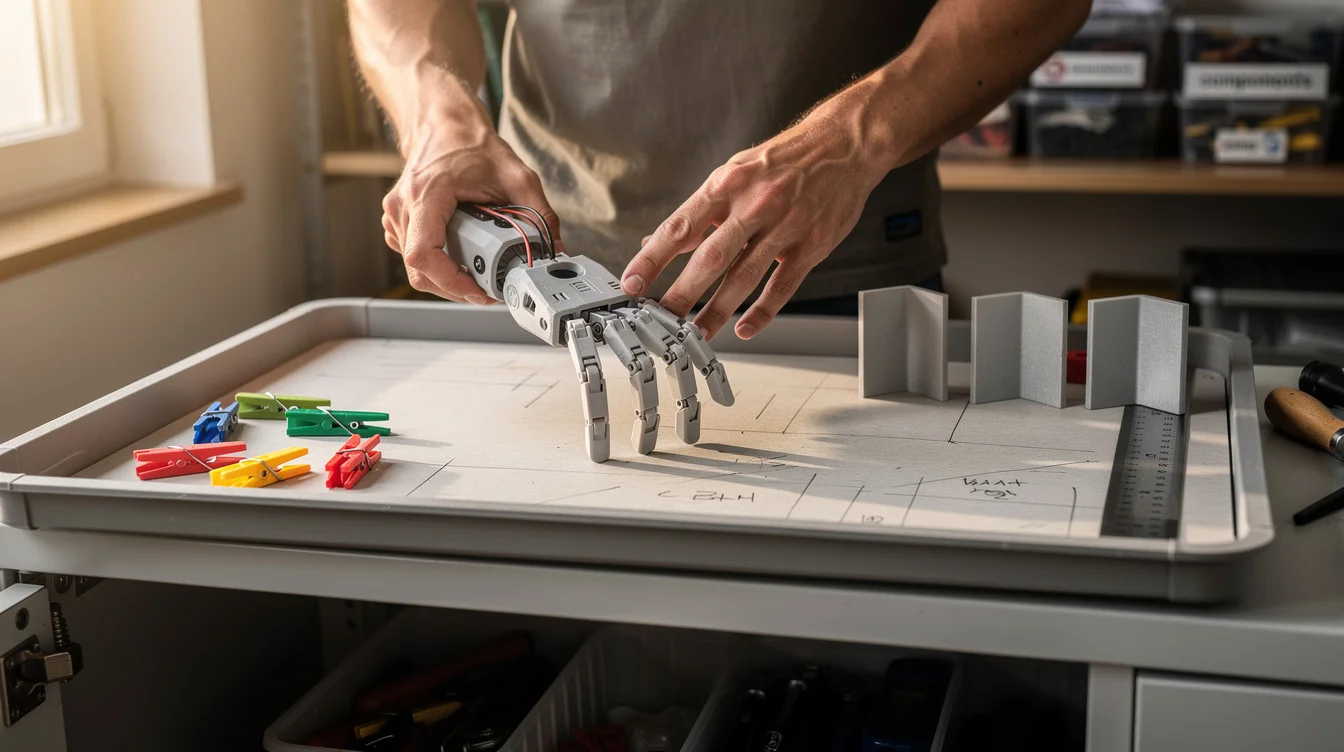
Consider a utility cabinet with a recessed work surface, a raised perimeter and a washable landing area. Inside it, a manipulator could sort clothes pegs or move small containers. Charging contacts would sit in a protected docking recess, separated from wet cleaning supplies. The speculative cabinet is less photogenic than a hand scrambling across a dining table. It is also a more responsible product proposal.
Dieter Rams’s 606 Universal Shelving System and USM Haller suggest a relevant design discipline: durable structures that accommodate changing arrangements. Neither is robot infrastructure, but their modular logic points towards replaceable docking inserts rather than whole kitchens made obsolete by one connector.
The political question is who pays for adaptation. If automation demands proprietary countertops, special thresholds and permanent navigation markings, the supposedly modest robot becomes a renovation programme. Renters should not have to rebuild a home to accommodate a cleaning tool. Retrofit docks and removable work trays must come before robot-ready property premiums.
Storage Must Become a Visible Off Switch
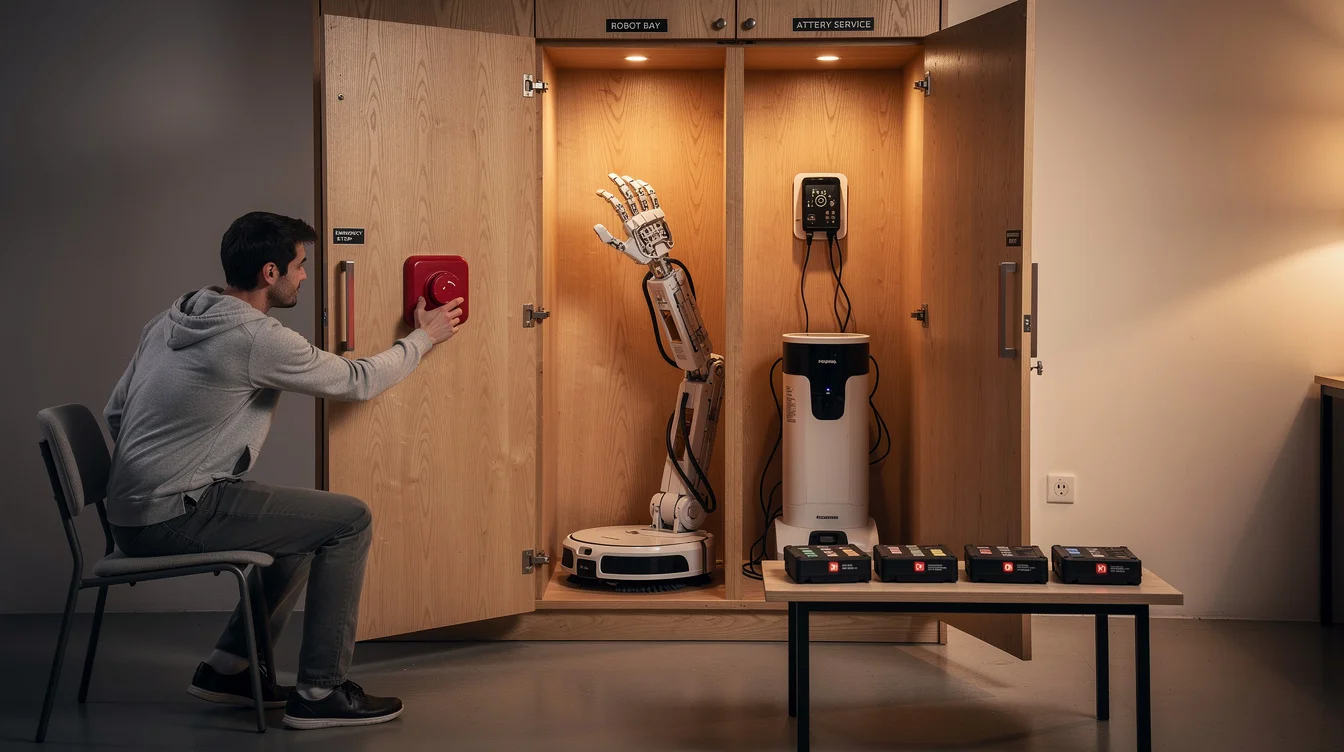
Domestic storage traditionally makes tools disappear. Mobile tools require something stronger: storage that makes their operating state unmistakable. A knife in a drawer cannot decide to emerge. A powered manipulator introduces a different relationship between containment, energy and permission.
Imagine a docking cabinet with separate, clearly marked bays. One device is charging; another is mechanically restrained for maintenance; a third is available for a scheduled task. A physical control disables movement independently of the household app. Servicing requires a separate battery-isolation procedure. Status lights may help, but the essential distinction should also be readable through position, labels and tactile controls.
The Shaker peg rail is a useful reference because it makes the organisation of household tools visible. The robot dock should borrow that clarity without putting powered moving parts within a child’s reach. It should be an understandable piece of furniture, not a mysterious charging altar.
Permissions should be equally tangible. A bathroom device does not gain access to the nursery because somebody accepted a software update. A guest should be able to stop nearby movement without an account. An internet outage must not remove local stopping controls. Ownership means authority over when an appliance acts, not merely responsibility for keeping it charged.
Small Machines Can Still Create Large Hazards
The ETH Zurich prototype’s 818-gram mass is a useful corrective to the language of cute robotics. A device need not be human-sized to hurt someone when it falls from a shelf. Fingers can create pinch points. A low-moving carrier can become a trip hazard. A cleaning attachment may transfer contamination between rooms. Smallness changes the risk profile; it does not abolish it.
ISO 13482, which addresses safety requirements for personal care robots, is a relevant reference point for some domestic robotic applications, not a blanket certification route for every proposed gadget. Each product would need its applicable standards and operating conditions assessed. Testing should include foreseeable misuse, obstruction, wet surfaces and interactions with children and pets, rather than only obedient adults in cleared demonstration rooms.
The architecture of restraint matters as much as sensing. Keep a worktop manipulator behind a physical edge barrier. Prevent a carrier from entering stairs through environmental separation, not a promise that its camera will always recognise a drop. Specify safe behaviour when communication fails or another machine blocks a route.
Fragmentation also creates system-level hazards: several individually acceptable devices may obstruct an escape path or converge around someone using a walking frame. Household safety must therefore be evaluated as a shared environment, not a collection of successful product demonstrations.
Repairability Is a Contract, Not a Silhouette
Splitting the robot into specialists could make failure less disruptive. A broken cleaning unit need not disable laundry transport. But five sealed products with five subscriptions would not constitute progress. They would distribute dependency while multiplying batteries, chargers and eventual waste.
Fairphone and Framework provide useful precedents for treating replaceable components as part of a product offer. Their lesson must be extended, not merely borrowed as an aesthetic. A domestic robot needs obtainable wear parts, documented servicing, supported software and a credible route to battery replacement. Replaceable fingertips are meaningless if the controller becomes unusable when a cloud service closes. The ambition echoes the challenge of making reuse a mark of quality in design, rather than merely a responsibility.
Modularity also needs limits. A compatible connector should not imply permission to fit any tool. A gentle gripper and a heated cleaning attachment demand different safeguards. Repairs affecting force, sensing or restraint may require calibration and verification before the device returns to service.
The strongest case for fragmented automation is bounded authority, not miniature spectacle. Judge the ecosystem against simpler appliances: total maintenance cost, years of support, energy consumption, accessible controls and actual time saved. Some tasks will justify a mobile tool. Others should remain with a drawer, a brush or a person. A good robotic home would contain fewer unnecessary decisions, not more machines competing for attention.
FAQ
Is ETH Zurich’s fingertip-walking robotic hand a household product?
The source describes an 818-gram research prototype capable of moving on its fingertips without an attached arm, legs or wheels. It does not establish a consumer-ready household product. The domestic ecosystem explored here is speculative.
Could several small robots be safer than one humanoid?
Potentially, if each device has tightly bounded capabilities and a restricted operating area. However, multiple devices introduce coordination, charging, contamination and obstruction risks. Safety depends on the complete household arrangement, not size alone.
Would homes need entirely new furniture?
Not necessarily. Removable docks, protected work trays and accessible stopping controls could support limited tasks. A system requiring extensive renovation would undermine the affordability and flexibility that make small, specialised devices attractive.
What would make modular home robots genuinely repairable?
Available spare parts, replaceable batteries, documented repairs, long-term software support and local operation would all matter. Repairs to safety-critical components would also need appropriate checks. Detachable parts alone do not guarantee repairability.
If useful automation requires us to redesign the home, which should have the final say: the machine’s capabilities or the inhabitant’s right to refuse them?
Watch the Mainifesto Short
Get the Mainifesto weekly — curated design debates, speculative ideas and the week's best articles every Saturday.
Editorial Perspectives
Questions and counterpoints developed by the Mainifesto editorial desk to extend the discussion.
Perspective 1
A hand walking on its fingertips is stranger—and more interesting—than another robot pretending to be a person. But once the furniture has to accommodate it, the choreography becomes political: who gets to tell it to stop?
Perspective 2
If the hand needs a new kitchen to clear the table, I’d want to see the full bill before calling it useful. Design in cheap, reversible adaptations where they help, but the home still has to work for someone who never switches the robot on.
Perspective 3
A modular robot is only repairable if parts, tools and documentation are actually available where you live. The inhabitant should have the final say, but that means little if a landlord installs the system or an import restriction leaves the hand stranded on a shelf.
Perspective 4
Smaller robotic parts could mean less material, but I’d want evidence on service life, batteries and how often those parts need replacing. Adapting an existing table might be worthwhile; replacing sound furniture to suit a short-lived device is much harder to justify.