

Camera-Free AI Glasses: The Next Privacy Test

Camera-Free, Not Concern-Free: The Next Test for AI Glasses
The camera was always the easiest part to object to. A lens pointed across a dinner table makes the possibility of capture tangible. Remove it, return the frame to something resembling ordinary eyewear, and the encounter becomes less awkward. But less awkward for whom?
According to Dezeen’s September 24 report on Meta’s Connect 2026 announcements, the company has introduced camera-free Ray-Ban Meta Audio glasses alongside lightweight VR glasses intended for immersive entertainment on the go. The audio model sharpens a question that industrial design can no longer defer to a privacy policy: does a wearable become more respectful when it becomes less conspicuous, or simply harder to challenge?
Removing a camera is a meaningful limitation, not a cosmetic trick. It removes that device’s ability to capture photographs or video through an onboard lens. Yet audio has its own capacity to expose people, places and relationships. The supplied announcement context establishes the absence of a camera; it does not establish how microphones operate, where speech is processed or what is retained. Those unknowns belong at the centre of the design conversation.
The Camera Was a Boundary, Not the Whole Problem

Consider an architect meeting a client in a café. Without a camera, the glasses cannot photograph the plans spread across the table. That matters. But if an audio system captures the conversation, it could still encounter the client’s budget, home address and reasons for leaving a relationship. Privacy is not organised according to the distinction between pictures and sound. It follows what information reveals.
Google Glass made this conflict spectacular because its face-mounted apparatus visibly disrupted social expectations. Camera-free products such as Amazon Echo Frames and Bose Frames have explored another route: speakers and microphones packaged within recognisable eyewear. Their existence demonstrates that the category predates Meta’s latest announcement. It does not demonstrate that every audio frame has the same capabilities, processing architecture or risks.
The correct comparison is therefore not simply camera versus no camera. It is one sensing system versus another, with different boundaries. Does the device capture sound only after a deliberate action? Does a wake-word detector analyse a temporary local buffer? Can a service receive speech, retain transcripts or derive other information? These are separate operations, and treating all of them as “listening” makes meaningful scrutiny almost impossible.
Ordinary Styling Can Become Social Camouflage
Ray-Ban’s cultural value is not only its silhouette. It is the permission that familiar eyewear already possesses. Sunglasses can enter a restaurant, a hotel lobby or a pavement conversation without requiring an explanation. Electronics embedded in that familiar form inherit an unusually powerful social advantage.
There is nothing inherently wrong with that. People should not have to wear an awkward apparatus to access navigation, calls or an assistant. Discreet technology can also support accessibility without forcing someone to publicly explain their needs. The bystander problem with smart glasses begins when discretion for the wearer becomes uncertainty for everyone else.
Mark Weiser’s influential vision of ubiquitous computing imagined technology receding into everyday life. Audio eyewear exposes the unfinished social contract inside that ambition: a device can disappear from attention while continuing to mediate an encounter. The interface has not vanished; its burden has moved to other people.
Compare Sony’s original LinkBuds, whose visible ring-shaped earpieces make their status as audio equipment relatively easy to recognise. Ordinary-looking glasses offer fewer such clues. Yet recognition alone would not settle consent either. Knowing that someone wears a microphone is different from knowing that it is active. The design target should be discreet equipment with legible behaviour, not equipment whose behaviour disappears with its hardware.
Listening Needs a Public Interface
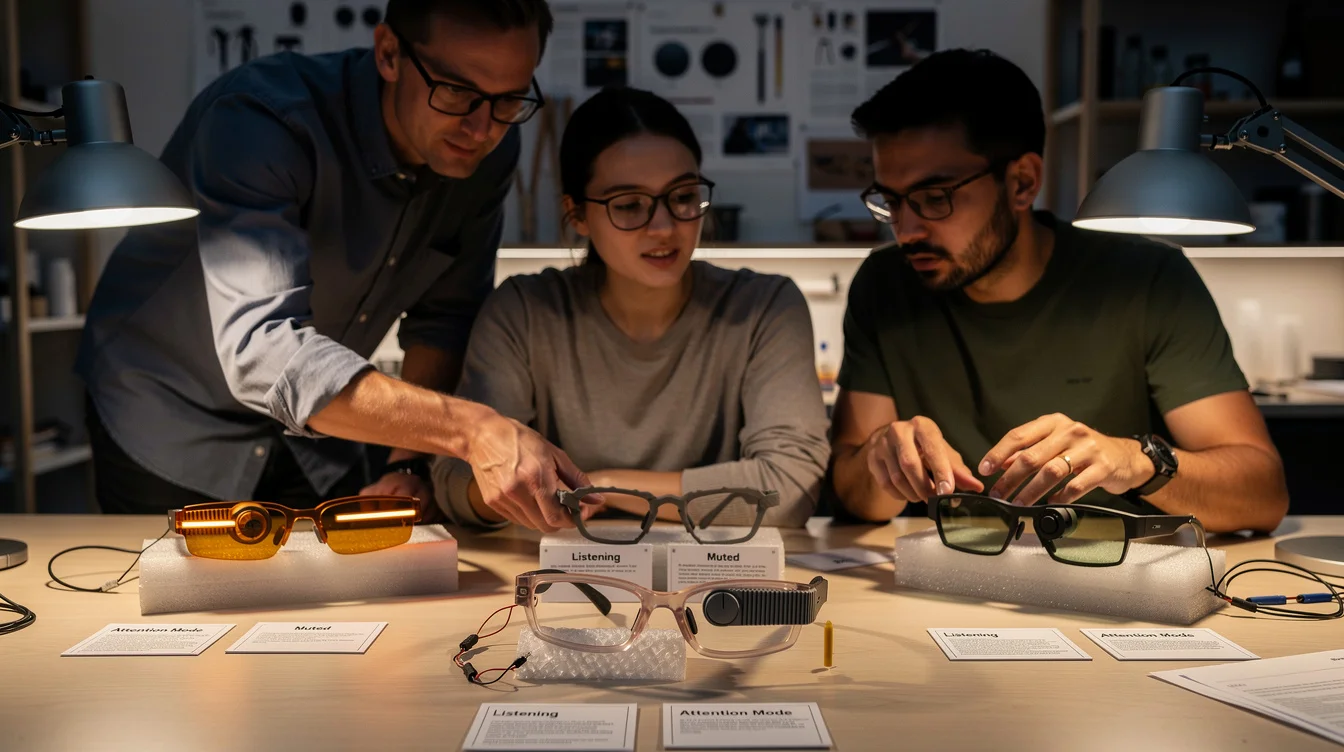
A battery icon can remain private because its consequences mostly concern the owner. A microphone state cannot always make the same claim. Audio wearables need an interface addressed to the room, not just the person wearing them.
That does not mean attaching a permanently flashing warning light to every temple. It means identifying which transitions deserve an outward signal. A proposed system might distinguish deliberate speech capture, transmission to a remote service and an extended recording session. These are design proposals, not confirmed features of Meta’s new glasses. The exact signalling scheme would require testing, including whether people can perceive and understand it in bright sunlight, crowded interiors and low-light restaurants.
Don Norman’s work on signifiers is useful here: a cue only helps if people understand what it signifies. An unexplained blue dot is branding, not informed awareness. Colour alone also excludes some users; tiny lights are inaccessible to others. A combination of visible state changes, an appropriate audible cue and a wearer-controlled explanation may work better than any single signal.
Most importantly, an indicator is not consent. A light cannot authorise recording a colleague’s disclosure or a stranger’s conversation. It can make a behaviour contestable. That is a necessary first step, not the finish line.
Privacy Must Be Built Behind the Signal
The most elegant indicator is worthless if it provides a misleading account of the underlying system. Product teams should explain what happens between microphone input and assistant response: what processing occurs on the frame, what depends on a paired phone, what reaches a server and what survives the interaction. For these newly announced glasses, the supplied source context does not answer those questions.
Existing products offer partial design references rather than complete solutions. Apple’s microphone-use indicator makes sensor access visible to the device owner, but not necessarily to bystanders. Physical microphone switches on some smart speakers provide a more tangible control, although the strength of that assurance depends on implementation. Neither approach can simply be miniaturised and declared sufficient for eyewear.
A serious brief would ask for a hardware-backed microphone disconnect, clear disclosure of any exceptions, short retention by default and an accessible account of stored recordings or transcripts. It would separate the data needed to answer a request from data kept for other purposes. As with AI systems that listen for danger, local processing can reduce transmission, but it does not automatically resolve retention, security or bystander concerns.
Imagine asking for directions while passing a school gate. The useful input is the wearer’s request. Nearby children’s speech should not become incidental material for an unrelated data pipeline. That boundary must be engineered, not merely promised.
The Next Design Test Happens Across the Table
Architecture already teaches that the same action changes meaning across thresholds. A conversation in a public square, a consultation room and a shared kitchen carries different expectations. Wearable interfaces should acknowledge those differences rather than pretending that a single setting called “privacy” can govern every encounter.
A design studio reviewing an unannounced competition entry might agree that assistants stay muted. A museum workshop could establish a clearly explained recording session. A dinner guest should be able to ask whether glasses are processing speech without being treated as technologically paranoid. These are proposed social practices, not evidence that the product already supports them.
Venue rules should focus on behaviour rather than automatically excluding an entire category of eyewear, especially where accessibility needs are involved. The stronger solution is a device that can enter an intelligible, verifiable non-capture state without becoming useless as glasses.
Meta deserves credit for removing a sensor if that removal narrows what the product can collect. But the design industry should resist awarding a privacy victory for a cleaner silhouette. The next benchmark is not whether AI glasses can pass as ordinary. It is whether the people around them can understand what is happening and meaningfully object. Social acceptance earned through clarity is progress. Acceptance produced by ambiguity is merely friction displaced onto everyone else.
FAQ: Camera-Free Glasses and Consent
Do camera-free AI glasses meaningfully improve privacy?
Yes, in a specific way: removing the onboard camera prevents the glasses from capturing photographs or video through that sensor. It does not settle questions about microphone input, speech processing, storage or information inferred from conversations.
Are Ray-Ban Meta Audio glasses always recording?
The supplied announcement context does not establish their microphone activation, recording or retention behaviour. Wake-word detection, temporary audio buffering, remote processing and stored recordings are different operations; claims about this model require product-specific documentation.
What should audio glasses communicate to bystanders?
They should make consequential capture states understandable, particularly deliberate speech capture or extended recording. Public signals should be backed by accessible explanations of processing and retention. A signal creates awareness, but it does not itself obtain consent.
Does processing audio locally solve the consent problem?
No. Local processing can reduce the need to transmit audio to external services, but people may still object to their speech being captured or analysed. Retention, access, security and the ability to stop capture remain important.
If AI glasses look ordinary but their listening remains difficult to read, whose comfort is the design really protecting?
Watch the Mainifesto Short
Get the Mainifesto weekly — curated design debates, speculative ideas and the week's best articles every Saturday.
Editorial Perspectives
Questions and counterpoints developed by the Mainifesto editorial desk to extend the discussion.
Perspective 1
Ordinary-looking frames protect the wearer’s social comfort; everyone nearby gets the uncertainty. In a shared taxi or a crowded café, consent cannot depend on having the confidence—or power—to challenge a stranger. Removing the camera does nothing to explain where captured speech goes or whose laws govern it.
Perspective 2
We should treat listening status as part of the form, not bury it in an app. A visible signal needs to distinguish a live microphone from speech being sent to a server, though neither signal amounts to consent. Can we call these glasses well-designed if only the wearer can understand what they’re doing?