
What If Cafés Became Neighbourhood Materials Utilities?
What If Your Local Café Became a Neighbourhood Materials Utility?
The espresso machine is already a processing plant. It takes agricultural matter, water, electricity and human attention, then delivers a desirable product alongside a less glamorous stream of wet grounds, leftover milk and wastewater. Architecture usually treats those outputs as somebody else’s problem. What if the café began treating them as a neighbourhood’s material inventory?
Found Associations offers a starting point, not a finished answer. As reported by designboom, four Latvian designers and artists partnered with Kalve Coffee to explore the café as a small-scale material ecosystem, experimenting with coffee grounds, milk and dirty water for a project presented at Paris Design Week. Its provocation is useful precisely because it shifts attention from the finished coffee cup to everything surrounding it.
Now extend that experiment beyond the exhibition. Imagine independent cafés pooling selected waste streams, jointly commissioning processing capacity and buying back suitable materials for their interiors. This is a speculative proposal, not a description of an existing Found Associations network. Its promise is not that every café becomes a laboratory. It is that cafés stop pretending they are isolated businesses with isolated bins.
From Café Laboratory to Shared Infrastructure
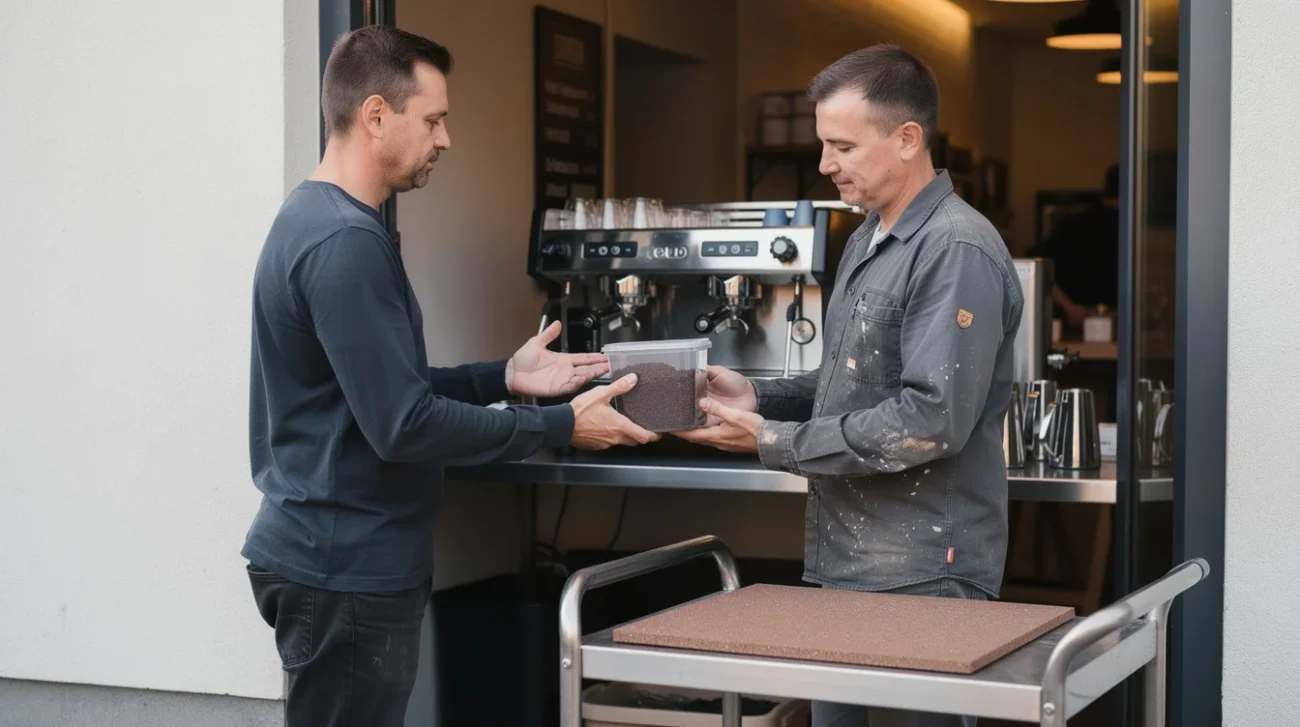
Our proposed neighbourhood materials utility begins with a modest cluster: perhaps twelve cafés within a compact collection route. They do not install presses beside pastry cabinets. They agree on separation rules, provide measured quantities of suitable residues and contract a shared workshop with appropriate environmental and manufacturing controls. An existing processor could be commissioned before anyone builds a new facility.
Kalundborg Symbiosis in Denmark offers a useful organisational reference. Its industrial exchanges demonstrate the value of treating one operation’s outputs as another’s inputs. A café network would be smaller, more fragmented and much less predictable. The lesson is coordination, not a claim that cappuccino waste can reproduce industrial economics.
Each participating café would need a simple material account: kilograms collected, rejected batches, contamination incidents and collection costs. The workshop would publish its own figures for energy, additional ingredients and usable output. A collection crate is not evidence of circularity; an accountable mass balance is.
The utility could be a cooperative, a service contract or a partnership with a local manufacturer. Whatever its legal form, someone must own the quality standard and carry product liability. Without that unglamorous centre, distributed design becomes a distributed excuse: everyone contributes waste, but nobody takes responsibility for the material.
Three Waste Streams, Three Different Problems
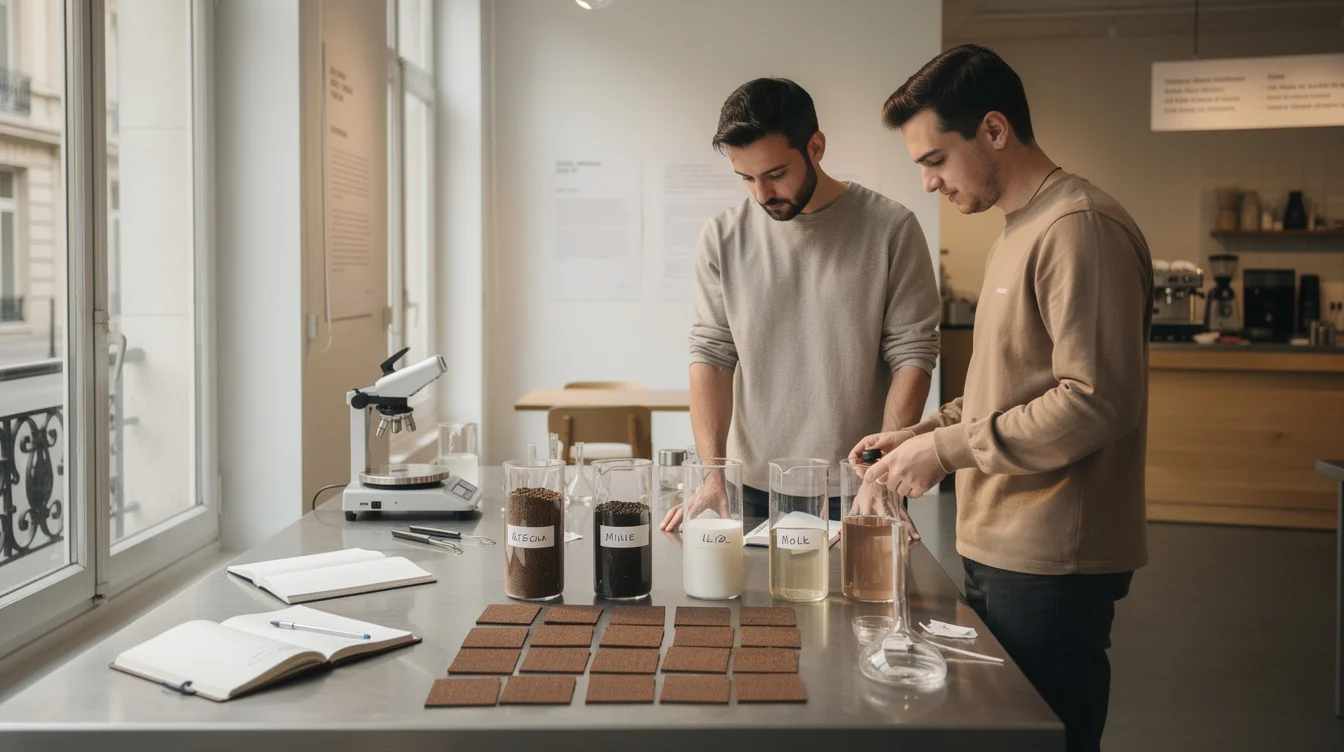
Coffee grounds are the obvious first candidate because they are recognisable and relatively easy to separate at the machine. They are also wet, variable and vulnerable to microbial growth. Any credible route needs defined collection intervals, stabilisation procedures and acceptance criteria. A sealed bucket may make handling tidier; it does not make its contents indefinitely safe.
Berlin-based Kaffeeform provides a relevant commercial reference for products incorporating used coffee grounds. The important lesson is that grounds become part of a designed material system, not that they magically behave like plastic. Binders, additives and manufacturing methods determine performance and what happens after use. The utility should disclose those ingredients rather than sell a reassuring brown surface as proof of environmental virtue.
Milk demands a different conversation. Casein has a long history in plastics such as Galalith, but that precedent does not establish a sensible route for mixed café milk waste. Spoilage, cleaning requirements and the energy needed for separation may overwhelm the value recovered. Avoiding milk waste remains preferable to manufacturing a reason to generate it.
Dirty water is less a universal feedstock than a changing mixture requiring characterisation. Detergents and other contaminants matter. The network should investigate treatment and permitted reuse separately from solid-material production. A circular system earns credibility by refusing unsuitable inputs.
Commission an Interior, Not Another Sample Tray
Exhibition prototypes enjoy conditions that interiors do not: short lives, careful handling and audiences predisposed to admire them. A neighbourhood utility needs an order book that starts with a real maintenance problem. For example, several cafés might jointly commission replaceable decorative panels for the fronts of freestanding storage units, installed away from sinks, food preparation and heavy impact.
That narrow brief is more useful than announcing a universal coffee-based building material. Panel dimensions could be standardised across the network, with mechanical fixings allowing individual units to be removed. Spare parts would be budgeted from the outset. A scuffed panel could return to the workshop for assessment rather than sending an entire cabinet to the skip.
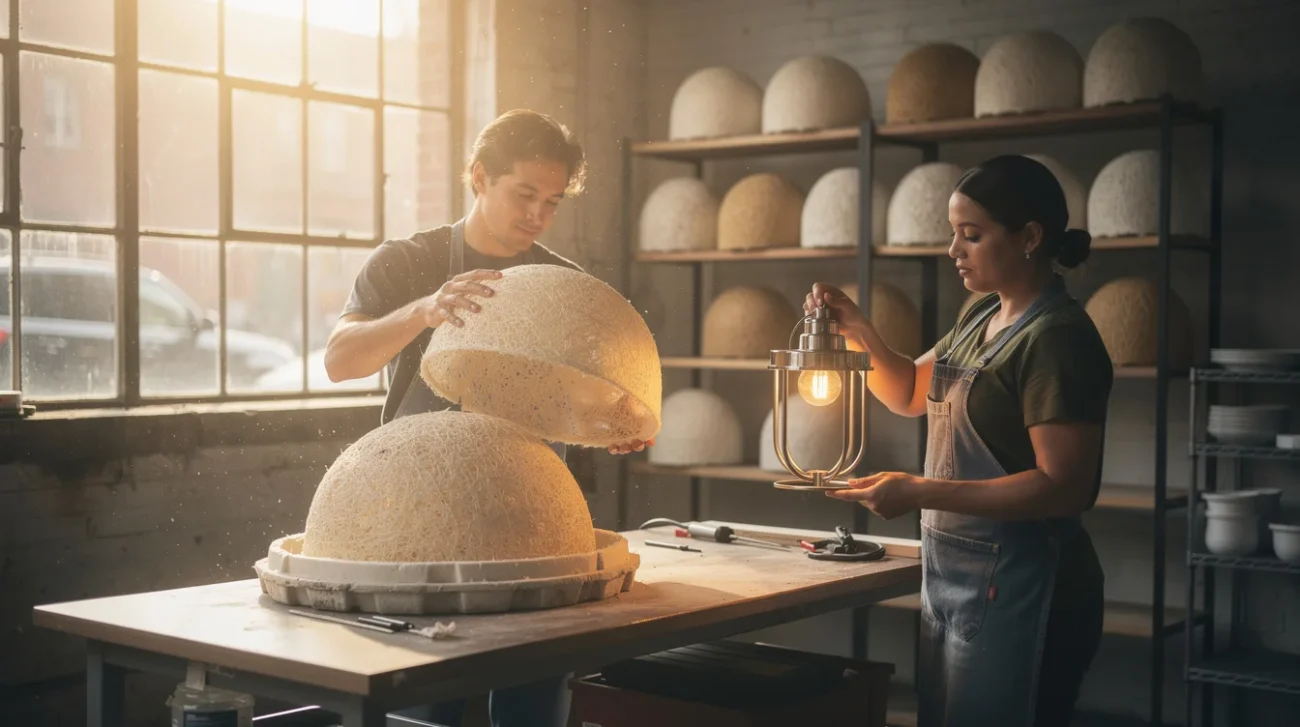
Designer references help establish the ambition without proving this particular proposal. Mogu’s mycelium-based interior products show how biological material development can target defined applications, a question also explored through neighbourhood-grown mycelium lampshades. Ottan’s work with plant-derived residues similarly offers a reference for turning overlooked inputs into designed surfaces. Neither precedent removes the need to validate a café-derived formulation.
The first commission should avoid structural claims, direct food contact and vaguely promised acoustic performance. Even decorative components may face requirements concerning fire behaviour, emissions and cleanability. The radical move is not to bypass standards. It is to make a small, genuinely serviceable product survive them.
The Real Design Brief Is Energy and Labour
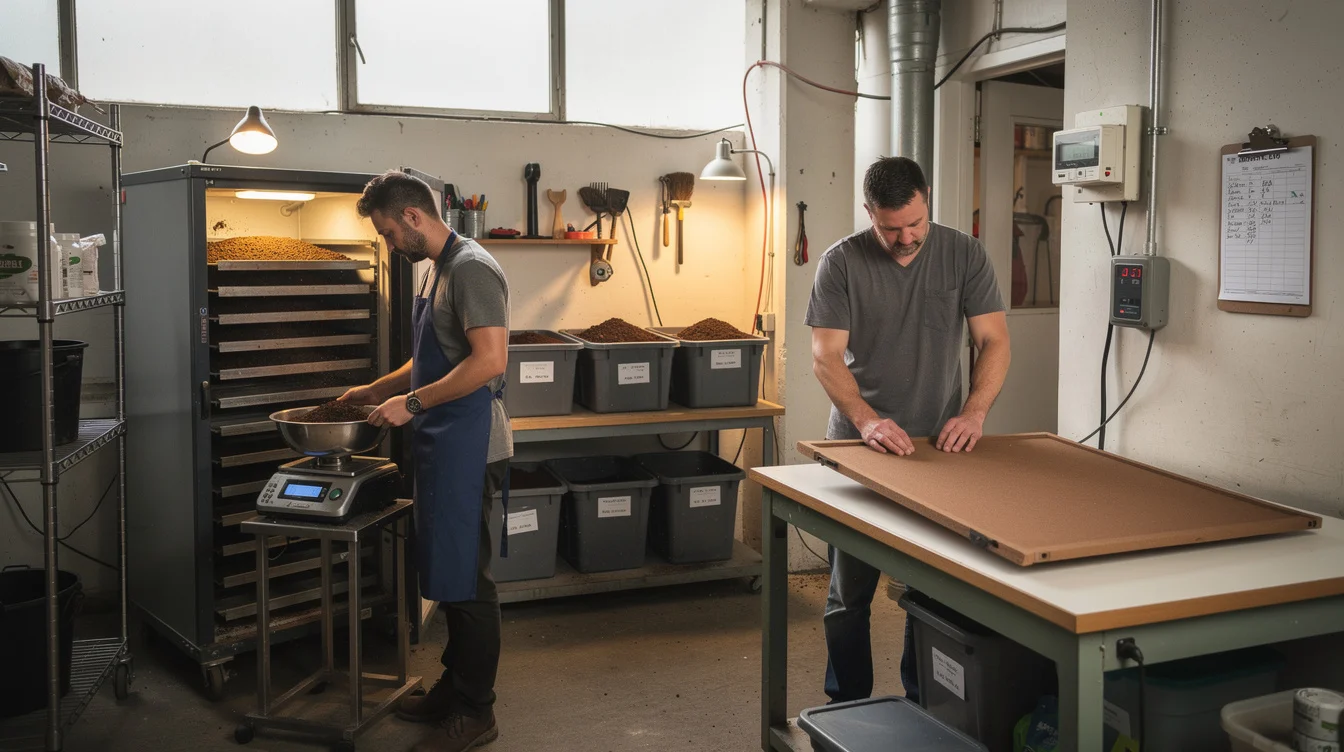
Drying could become the network’s decisive expense. Transporting wet grounds means moving water; removing that water requires energy. Decentralised stabilisation might reduce spoilage and collection frequency, but putting a small dryer in every café could multiply equipment, maintenance and electricity demand. Central processing has its own burdens. Neither arrangement deserves an automatic green halo.
A pilot should meter energy per kilogram of usable finished material, not merely per kilogram of waste accepted. It should count rejected batches, binder production, cleaning, transport and workshop ventilation. Comparisons should use the same function and expected service life: a panel that must be replaced twice as often is not equivalent to a durable alternative simply because its ingredients sound better.
Heat recovery is worth investigating where a suitable, dependable source exists. It is not a free-energy incantation. Temperature, timing, equipment and backup provision determine whether recovered heat can actually support the process.
Labour belongs in the same calculation. Who empties the collection vessel during the breakfast rush? Who washes it? Who checks for stray packaging and records a failed batch? Baristas should not become unpaid waste technicians to support a designer’s portfolio. If the business model depends on invisible work, it is not circular innovation; it is cost displacement.
A Utility Needs Rules for Saying No
The most plausible service would have explicit admission rules. Start with a single well-separated stream, one contracted manufacturer and a limited product range. Add other inputs only when processing evidence justifies the complexity. The café-as-biolaboratory can remain a research model without making every experimental ingredient part of routine operations.
Governance would determine whether this becomes shared infrastructure or a branding scheme. Cafés need transparent charges and clear compensation for handling. The processor needs minimum-volume agreements without incentives to produce more waste. Designers need access to performance data rather than a proprietary origin story. Customers need honest descriptions: a composite containing coffee grounds is not necessarily biodegradable, recyclable or safe for every application.
Rotor Deconstruction in Brussels offers another useful reference through its work recovering and circulating building components. Its relevance is a reminder that material value often depends on logistics, documentation and an identifiable buyer. Making a new substance is only one possible circular strategy. Sometimes the café’s best interior purchase will be a reclaimed shelf, not a newly manufactured bio-composite.
The network therefore needs an exit route for unsuccessful trials. If a formulation cannot meet performance requirements or offers no defensible environmental advantage, stop producing it. Composting or anaerobic digestion may be better options where local facilities accept the stream. Failure should produce useful evidence, not another limited-edition collection.
Scale the Service Before Scaling the Substance
Success would not necessarily mean a materials workshop on every high street. It could mean a replicable service specification: how to separate grounds, how to contract collections, how to test batches and how to commission components that can be maintained. Neighbourhoods could then purchase capacity from qualified regional manufacturers rather than duplicate underused machinery.
The pilot’s milestones should be blunt. Can the product meet its intended requirements? Can it be produced consistently across changes in supply? Does the full process outperform a credible alternative? Can every person handling it be paid? Is there an actual customer beyond the exhibition circuit? Increasing the number of participating cafés before answering those questions would scale uncertainty, not circularity.
Found Associations’ café experiment matters because it makes an everyday consumption space available for material inquiry. The next step should preserve that curiosity while abandoning the romance of effortless regeneration. A network would succeed through contracts, paid shifts, clean handling and repeat orders, not through the visual charm of coffee-coloured objects.
The café deserves to become a neighbourhood materials utility only where the utility is real. Otherwise, the more radical design decision is to waste less, keep the existing furniture and admit that not every residue needs a product launch.
FAQ
What is a neighbourhood materials utility?
In this proposal, it is a shared service through which cafés separate suitable residues, pool collection and commission processing into specified products for local interiors. It is speculative, rather than an existing network attributed to Found Associations.
Can café waste safely become interior products?
Some formulations may suit specific applications after appropriate processing and testing. Safety depends on the complete material, including binders and additives, as well as microbial control, emissions, fire behaviour and intended use. A successful prototype alone establishes none of these.
Would local production necessarily use less energy?
No. Shorter journeys can help, but drying wet grounds, cleaning equipment and operating underused machinery may offset transport savings. Metered production data and a comparison with functionally equivalent products are essential.
Which café waste stream should a pilot start with?
Separately collected coffee grounds are a practical candidate to investigate, not a guaranteed environmental winner. Milk and wastewater introduce different treatment challenges. A pilot should select its first stream only after reviewing local volumes, processing options and existing waste routes.
Would you pay more for a café interior made through an accountable neighbourhood materials utility—or should that money first go towards wasting less and keeping what is already there?
Get the Mainifesto weekly — curated design debates, speculative ideas and the week's best articles every Saturday.
Editorial Perspectives
Questions and counterpoints developed by the Mainifesto editorial desk to extend the discussion.
Perspective 1
A café does not need a new interior to tell a better story. I’d pay more to sit at a well-kept table whose repairs are visible; neighbourhood-made materials make sense when something genuinely needs replacing.
Perspective 2
I’d put waste prevention and keeping existing fittings first, then ask what the local materials process actually costs in drying energy, hygiene controls and paid labour. Coffee grounds aren’t automatically a low-impact material just because they’re nearby; I’d want evidence that the finished piece lasts and has somewhere to go afterwards.