
Police Shield Pavilion: Shelter or Political Spectacle?
When Police Shields Become a Pavilion, Does Their Politics Disappear?
A police shield promises protection. The political question is always: protection for whom, from whom, and on whose terms? Move that object from a police line to a pavilion roof and its function changes. Its history does not automatically follow.
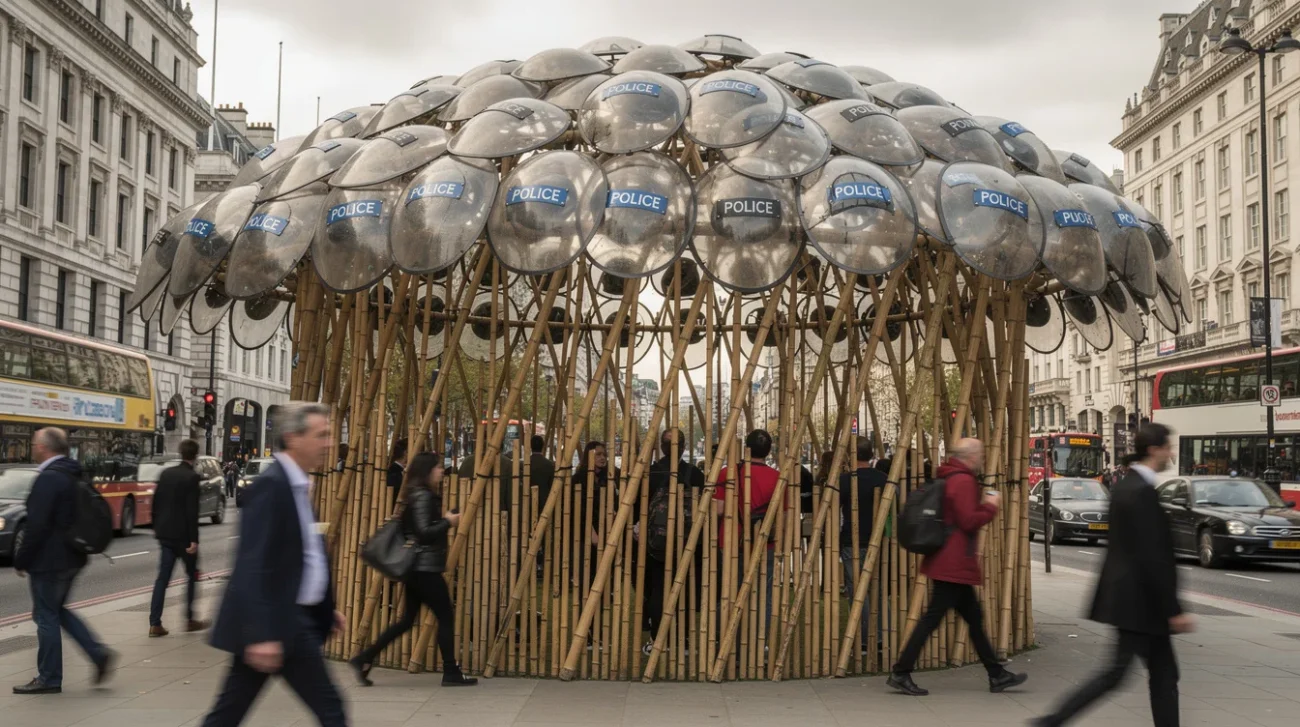
At London Design Festival, the Pangolin Shield pavilion brings this contradiction onto the Strand in central London. Dezeen’s September 19, 2026 roundup describes a bamboo structure topped with two types of shield, including traditional Indian police shields constructed from lathis. The supplied report does not establish whether the shields were previously deployed, how they were obtained, or what interpretation accompanies them. Those gaps matter: an object associated with policing is not necessarily a recovered instrument of a documented confrontation.
Still, the proposition is potent. Equipment designed to establish a defended boundary becomes architectural shelter. The strongest case for this transformation is that it makes power discussable. The strongest case against it is that the festival makes power photogenic instead.
PRO: Changing the Function Can Expose the Politics
Material transformation can do more than decorate an argument. It can enact one. A shield normally places its holder on one side and someone else on the other. Overhead, that relationship is rearranged: visitors occupy a shared space beneath objects associated with separation. The change does not abolish coercion, but it can make the original arrangement suddenly visible.
Pedro Reyes’s Palas por Pistolas, initiated in Culiacán, Mexico, in 2008, offers a useful precedent. Collected firearms were melted down and made into shovels for planting trees. His later Disarm project turned decommissioned weapons into musical instruments. Neither project depended on pretending that metal had become innocent. Their force came from keeping the previous function legible while demonstrating another possible use.
The police shield pavilion can operate through a similar reversal, although without the supplied source establishing equivalent disarmament or collection procedures. Bamboo and shields bring two visual vocabularies into contact: lightweight construction and the equipment of controlled confrontation. That friction is more interesting than a pavilion whose only message is technical ingenuity.
A visitor need not know the designer’s intentions to register the contradiction. Recognising police equipment above a place of rest can interrupt the easy assumption that protection is a universally benevolent act. Architecture rarely makes that assumption available for inspection so directly.
PRO: A Public Encounter Can Outperform a Gallery Statement
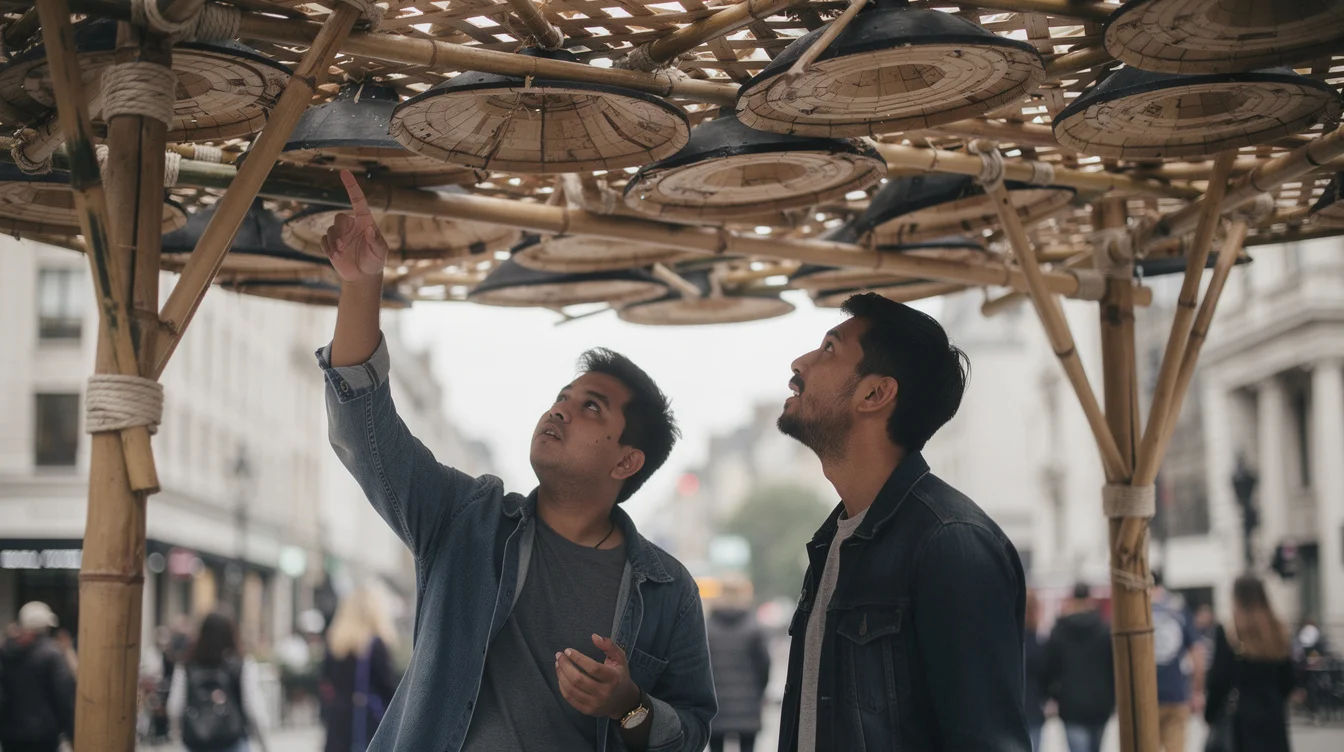
The Strand matters. This is not simply an object encountered by appointment in a specialist gallery. A festival installation in central London has the potential to meet commuters, tourists, workers and people who would never choose an exhibition about policing. Its political value lies partly in that imperfect, uncurated audience.
Consider Teeter-Totter Wall, the 2019 intervention by Ronald Rael and Virginia San Fratello that briefly installed seesaws through the US–Mexico border barrier. Play did not remove the border’s violence or bureaucracy. It made mutual dependence physically demonstrable: movement on one side affected someone on the other. The intervention was temporary, but its spatial argument was immediately intelligible.
A shield canopy could likewise turn an abstract dispute into an embodied question. Who gets to relax beneath protection? Who associates the same silhouette with fear? Those readings do not have to converge. Indeed, a pavilion that accommodates disagreement may be more publicly useful than one offering an impeccably agreeable sustainability message.
But this defence requires more than hoping visitors infer the right things. Clear information about the shields’ manufacture and acquisition, conversations with people affected by policing, and facilitated public discussion would strengthen the project. These are criteria for meaningful engagement, not verified features of this installation. Design opens a debate when it supplies the conditions for disagreement—not merely an arresting object around which disagreement might happen.
CONTRA: Spectacle Can Make Coercion Look Like Innovation
The opposing case begins with the festival’s own machinery. Pavilions compete for attention through instant visual comprehension. A startling material substitution produces a headline, a photograph and a shareable story. Police equipment becomes shelter; bamboo provides an appealing structural counterpoint. The result can be consumed before anyone asks what histories have been compressed into that image.
This is not an argument against beauty. It is an argument against beauty doing the work of absolution. A shield placed overhead no longer confronts the visitor at chest height. Its threatening orientation has been removed. Repetition can turn identifiable equipment into an attractive surface, allowing the pleasure of the pattern to displace questions about the institution associated with it.
Ai Weiwei’s Straight, made from reinforcing steel recovered after the 2008 Sichuan earthquake, demonstrates what a demanding alternative looks like. The material transformation remained tied to collapsed school buildings and the deaths investigated through his wider work. The steel was not simply presented as an ingenious salvage resource; its provenance sustained the accusation.
That distinction is decisive here. Without accessible accounts of what the shields are, where they came from and why these particular objects were selected, political ambiguity risks becoming a premium aesthetic. The installation can borrow the intensity of policing while leaving actual police power comfortably outside the frame.
CONTRA: Reuse Is Not Accountability
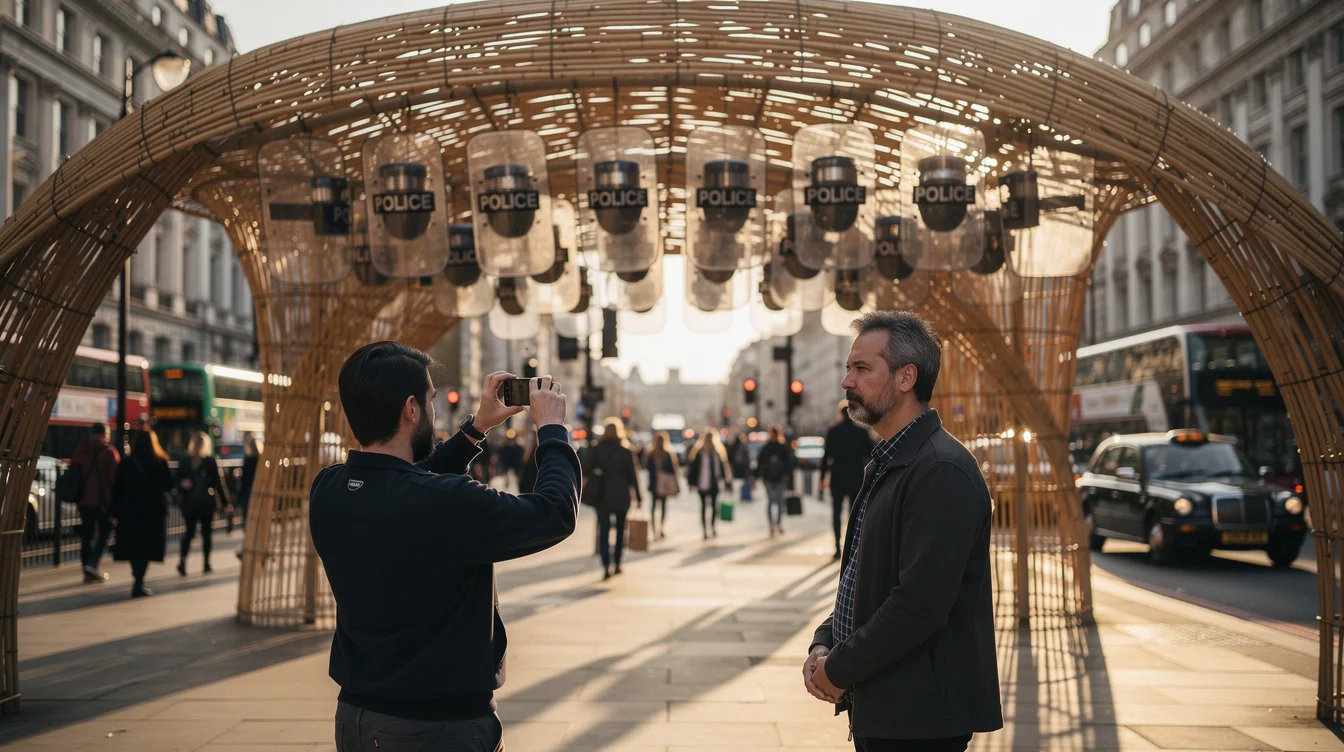
The language of reuse invites a particularly convenient mistake: assuming that a new material function amounts to an ethical repair. Even if an object has been diverted from disposal, that achievement says little about its previous institutional role. Conversely, if equipment was newly produced for display, the project would be a symbolic recontextualisation rather than the retirement of existing tools. The available source excerpt does not settle that distinction.
Forensic Architecture’s Triple-Chaser, presented at the 2019 Whitney Biennial, offers another model for design’s encounter with policing. Its investigation used computer-generated imagery and machine-learning methods to help identify tear-gas canisters in images. The object became an entry point into questions about use, manufacture and institutional relationships—not just a carrier of troubling associations.
A temporary pavilion need not become a forensic investigation. But once it recruits police equipment as its central gesture, asking for a chain of explanation is hardly unreasonable. Who supplied it? Did its acquisition financially benefit an equipment producer? Whose accounts of protection and intimidation inform the presentation? These questions distinguish political engagement from political styling.
The test is therefore symmetrical. The PRO case succeeds if the transformation makes the shield’s politics harder to ignore. The CONTRA case succeeds if visitors leave remembering an inventive roof while its institutional associations dissolve. Public visibility is an opportunity, not proof of public debate. A crowd beneath the canopy cannot, by itself, certify either consent or critique.
FAQ: Police Shields, Public Space and Political Meaning
What is the Pangolin Shield pavilion?
It is a pavilion on the Strand in central London featured in Dezeen’s September 19, 2026 London Design Festival roundup. The supplied summary describes a bamboo structure topped with two types of shield, including traditional Indian police shields constructed from lathis.
Were the shields previously used by police?
The supplied source excerpt does not establish previous deployment or acquisition details. It would therefore be misleading to describe them as recovered from protests, decommissioned equipment or proven waste diverted from landfill.
Can transforming police equipment into architecture be politically meaningful?
Yes, when the new use keeps the old function legible and creates informed opportunities to question it. Provenance, interpretation and participation by people with different experiences of policing can turn a visual contradiction into substantive public discussion.
How should visitors judge whether the pavilion challenges or sanitises power?
Look beyond the material surprise. Ask whether the presentation explains the objects’ origins, acknowledges conflicting experiences of protection, and permits criticism of policing rather than treating controversy as an attractive backdrop.
If a police shield becomes a roof above everyone, has design redistributed protection—or simply taught us to admire the shield?
Watch the Mainifesto Short
Get the Mainifesto weekly — curated design debates, speculative ideas and the week's best articles every Saturday.
Editorial Perspectives
Questions and counterpoints developed by the Mainifesto editorial desk to extend the discussion.
Perspective 1
I’m for it: putting redundant equipment to work as shelter beats commissioning another pile of festival material. The practical test is whether it keeps people dry, costs sensibly and has somewhere to go afterwards—not whether it resolves the politics of policing.
Perspective 2
I’m not convinced this transformation deserves applause. Put a shield overhead, let daylight soften its edges, and exhibition design can make an instrument of force feel reassuring without making anyone safer.
Perspective 3
Reuse changes a material’s job; it doesn’t erase its history. I’d want to know whose accounts of those shields are included, because ‘above everyone’ is a generous claim when the same object has meant protection to some and intimidation to others.
Perspective 4
A shield becoming a roof is exactly the sort of rethink industrial design should attempt—but the second life needs more than a festival photograph. Can it be repaired, dismantled and used again, and do people who’ve faced those shields get a say in what happens next?