
What If Your Next Lampshade Was Grown Around the Corner?
What If Your Next Lampshade Was Grown Around the Corner?
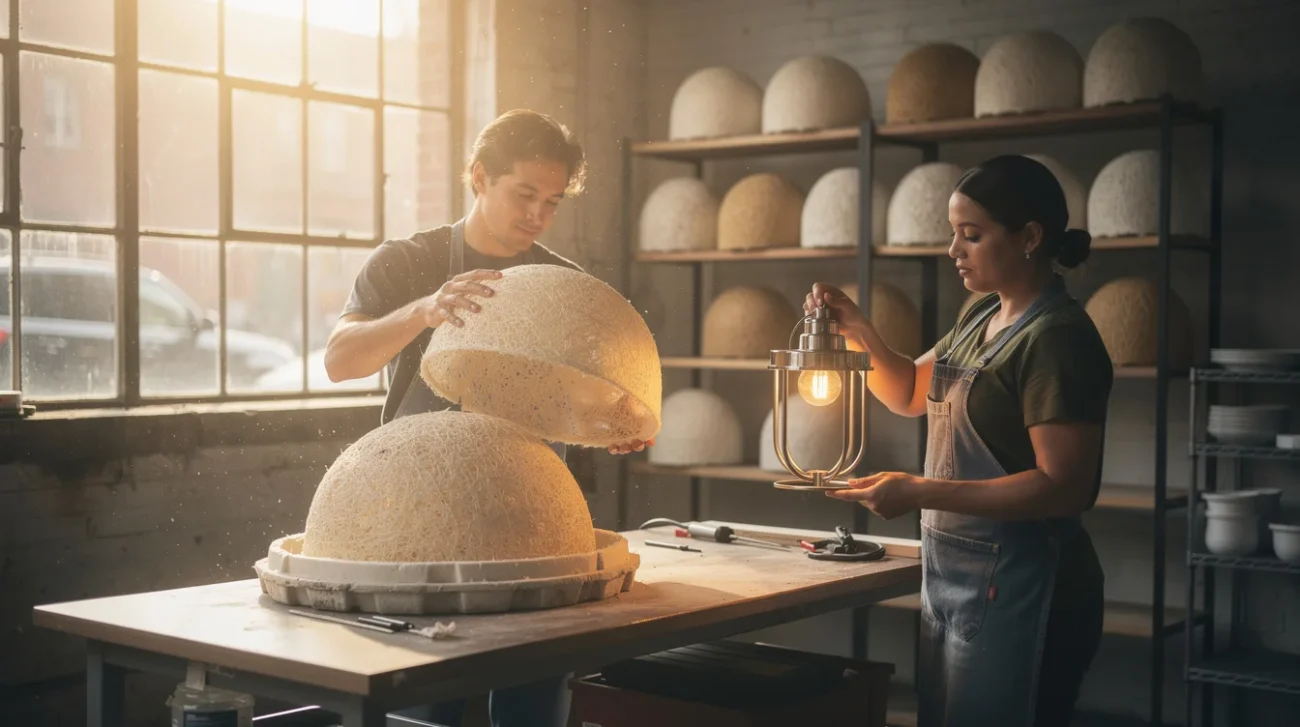
Your next lampshade could arrive without crossing an ocean. Not because a retailer has relocated its warehouse, but because a workshop near your home has grown it around hemp particles in a reusable mould. The electrical fitting stays on your ceiling. The shade becomes a replaceable, locally manufactured component rather than the excuse for buying another complete object.
This is a speculative production model, not an existing MushLume service. Its starting point, however, is concrete. Designboom’s coverage of MushLume at MADE: Bush Terminal describes lighting made from hemp byproducts and mushroom mycelium, with sound-absorbing properties and Class A fire-rated performance. Mycelium—the branching network associated with fungi—binds loose plant material into a composite that can take the shape of a mould.
The interesting proposition is not that fungi can make another attractive pendant. We already know they can. It is whether neighbourhood manufacturing could turn this biological process into dependable infrastructure: repeatable parts, credible safety evidence and replacements that ordinary households can afford. The radical object is not the shade. It is the system that lets you replace one without replacing everything.
Keep the Fitting. Grow the Replaceable Part.
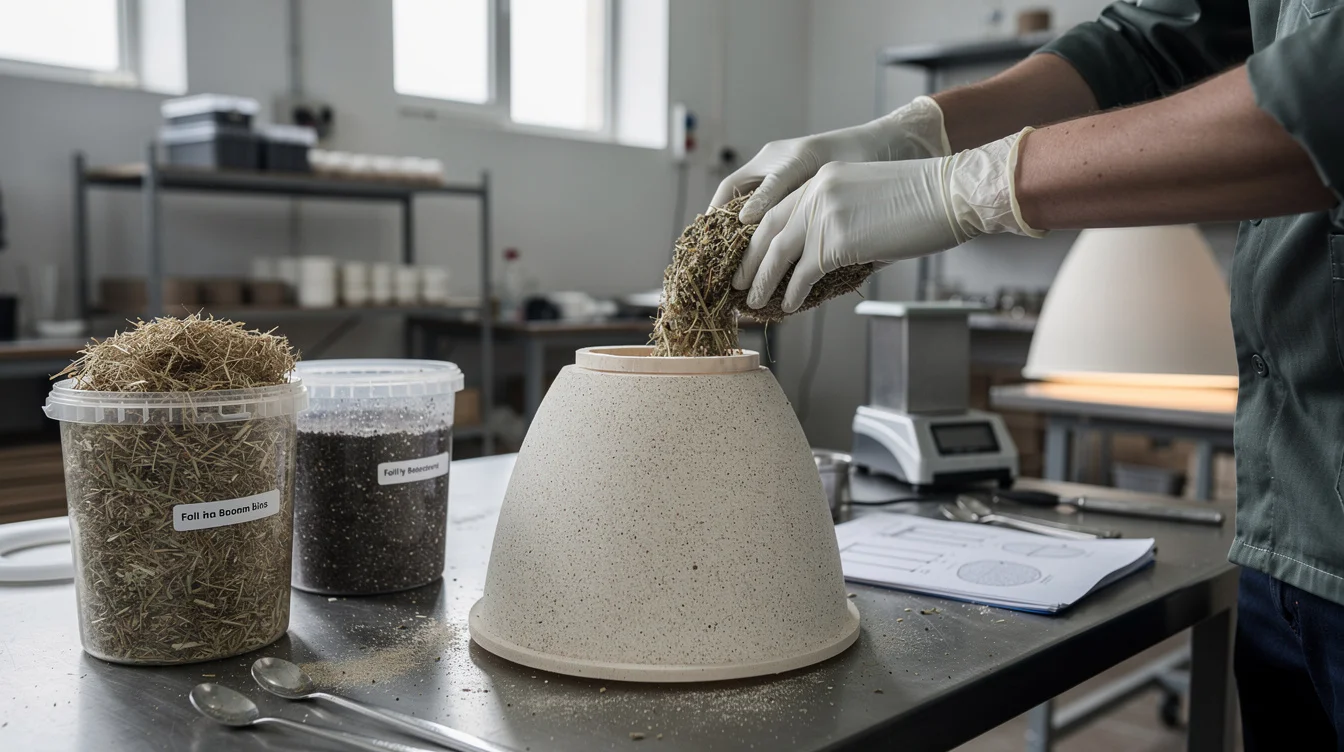
Imagine a network of workshops serving a city and its surrounding agricultural region. Each produces a limited catalogue of shades compatible with a shared mechanical interface. A customer orders a shallow dome or a deeper bell, brings back a damaged shade and keeps the existing LED module, wiring and suspension hardware.
This demands separation by design. The shade should attach to a durable carrier through a defined connection, with specified clearances and weight limits. A biological composite should not casually inherit the job of supporting electrical components. Dieter Rams’s 606 shelving system offers a useful precedent in another category: long-lived infrastructure becomes more valuable when its parts can change independently.
For fungi-based production, Ecovative provides a material precedent through its work on grown mycelium composites. But a distributed lighting network would need something beyond material know-how: shared mould specifications, controlled recipes, inspection rules and clear responsibility for failures.
A municipal library could purchase one fitting family for its reading rooms while commissioning locally grown shades in two approved geometries. Ten years later, it could replace damaged shades without discarding working electronics. That is a more consequential design achievement than launching another supposedly sustainable collection with a proprietary socket and no spare parts.
Local Feedstock Is Not an Interchangeable Ingredient
The tempting story is wonderfully simple: every region feeds its agricultural leftovers into the same mould. Hemp in one place, cereal straw in another, whatever is available after harvest. The engineering story is less forgiving. Particle size, moisture, contamination, nutrient composition and fungal strain can affect growth and the resulting composite.
In this model, agricultural byproducts would be candidates for qualification, not automatic substitutes. A workshop switching from hemp hurd to straw could not assume that its established fire evidence, strength or dimensional tolerances still applied. Regional variation would need to sit inside a controlled material specification, with substantial changes triggering further assessment.
David Benjamin’s practice The Living explored the architectural potential of mycelium-based bricks in Hy-Fi, the temporary installation at MoMA PS1 in 2014. That project helped make biological fabrication culturally legible. Neighbourhood production would face a different task: reproducing acceptable outcomes after the exhibition has closed and the original designer has left.
Each workshop would need documented substrate preparation, controlled growth conditions and a validated drying or heat-treatment process to stop growth. The finished shade should not depend on remaining biologically active in someone’s home. Surface mottling might be welcome; uncontrolled growth, persistent dampness and unreliable attachment points would not.
Fire Performance Cannot Be a Brand Adjective
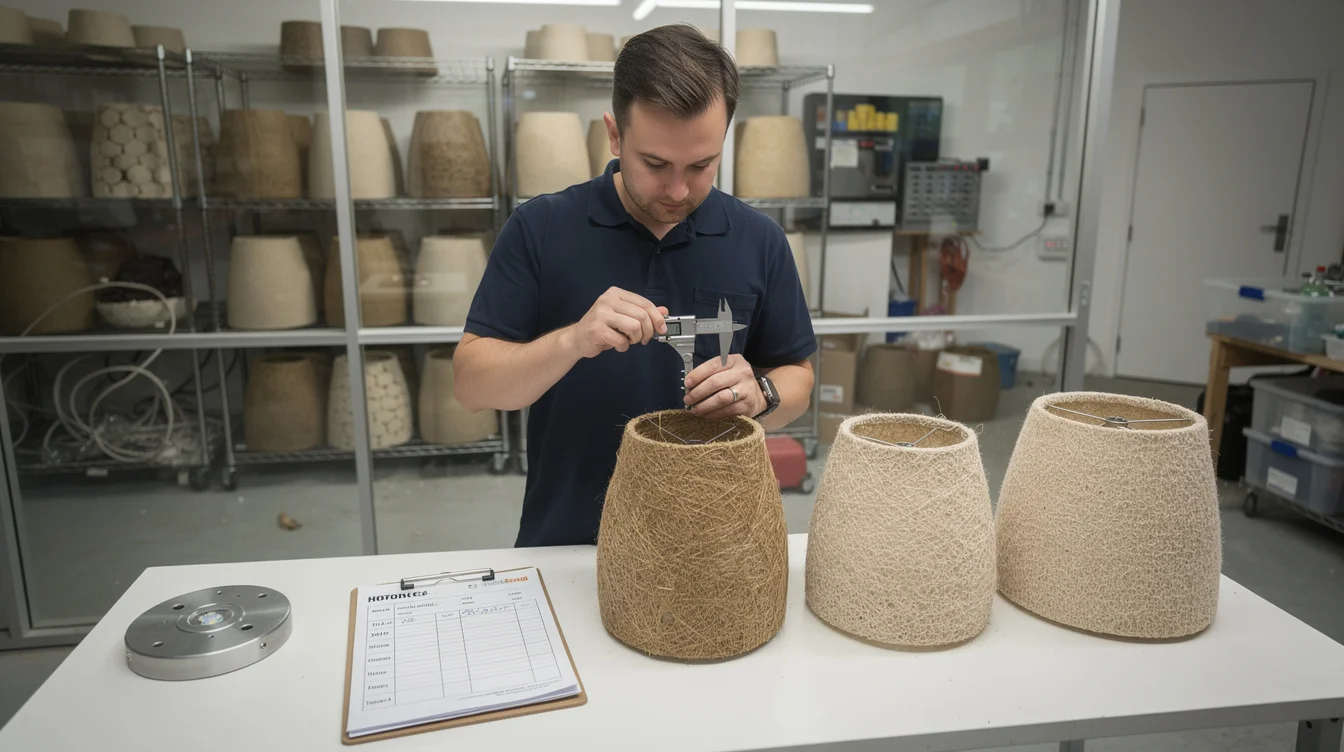
The source describes MushLume’s lighting as Class A fire-rated. That is significant, but the summary does not establish the underlying test standard, specimen configuration or scope of that classification. It should not be stretched into a claim that every mycelium composite—or every lamp assembled from one—is safe.
A material classification is not a universal permission slip for a complete luminaire. Depending on the relevant standard, a Class A designation may concern surface-burning behaviour rather than the safety of an electrical lighting assembly. Geometry, material thickness, coatings, ventilation and proximity to heat sources can all matter. An LED source reduces some thermal challenges; it does not abolish them.
The proposed network therefore needs a shared technical authority, not just a shared logo. Approved designs would undergo the assessments required in their markets. Workshops would follow controlled production specifications, retain batch records and submit to an appropriate quality-assurance regime. A new feedstock or decorative coating would pass through formal change control rather than an Instagram launch.
Sound absorption deserves similar discipline. Companies such as Mogu have developed mycelium-based acoustic products, but that does not make every grown lampshade an effective acoustic treatment. Performance depends on the product and its installation. A café specifying pendant shades to reduce reverberation should receive relevant test data, not a poetic account of fungal porosity.
Grow to Stock, Not to a Customer’s Patience
Biology complicates the familiar promise of next-day delivery. Preparation, growth, drying, inspection and possible rejection all sit between an order and a finished shade. None should disappear from the schedule simply because the brand prefers the word “grown” to “manufactured”.
The practical answer is a hybrid inventory model. Workshops could grow common sizes ahead of demand, keep a modest stock of inspected replacements and reserve made-to-order production for less common variants. A restaurant replacing a broken shade needs a credible dispatch date, not privileged access to the drama of fungal development.
Neighbourhood production also needs redundancy. If one workshop loses a batch to contamination, another qualified workshop should be able to supply the same approved component. Shared interfaces make that possible; highly individual recipes and incompatible moulds undermine it. Localism should shorten supply chains, not trap customers inside a single producer’s capacity.
Affordability remains unproven. Low-value feedstock does not mean low-cost manufacturing once labour, premises, energy, testing, rejected batches and administration are included. The meaningful comparison is the total cost of maintaining the lighting system over time. Keeping an expensive fitting while replacing only its shade may create savings, but the network would need to demonstrate them through published replacement prices and realistic service commitments.
Standardise the Risk, Not the Entire Appearance
What should a customer be allowed to notice? Slight differences in colour, visible hemp fragments and subtle variations in surface texture could become signatures of production rather than defects. An uneven mounting rim, an obstructed ventilation gap or a shade outside its approved weight range is another matter entirely.
The network should define an aesthetic tolerance alongside its technical tolerances. Two shades might look like relatives rather than twins while still fitting the same carrier and meeting the same acceptance criteria. Architects specifying a row of pendants could choose between tighter visual matching and a deliberately varied batch.
Formafantasma’s Cambio offers a useful intellectual reference: material choices are inseparable from extraction, governance and supply chains. Here, too, the seductive surface should lead back to institutional questions. Who owns the mould files? Can an independent workshop qualify? Who pays when a batch fails? Does the customer have access to compatible replacements if the original supplier closes?
End-of-life claims need equal scrutiny. A bio-based shade is not automatically suitable for home composting, particularly once additives, finishes or attached hardware enter the picture. Take-back should identify a verified treatment route. A genuinely local product must have a local plan for failure, replacement and disposal—not merely a local origin story.
FAQ
Are mycelium lampshades alive when installed?
In the proposed network, no. Mycelium would grow through the substrate during manufacture, followed by a validated process that stops growth and stabilises the composite. Customers would receive a finished shade, not an organism requiring watering or feeding.
Would every neighbourhood-grown shade have the same fire performance?
Not automatically. Comparable performance would require qualified materials, controlled production, approved geometries and appropriate testing and oversight. MushLume’s reported Class A rating cannot simply be transferred to another workshop’s recipe or lighting assembly.
Could locally grown lampshades be cheaper to replace?
Potentially, especially if the electrical fitting remains in use. However, regional feedstock and shorter transport do not guarantee savings. Labour, quality control, drying, testing and rejected batches must be included in a transparent replacement price.
Can a damaged mycelium shade go into household compost?
Only if the finished product is demonstrably suitable for that route, including any coatings or additives, and local conditions allow it. The proposed network should provide product-specific disposal instructions and take-back where a suitable treatment route exists.
If safety and fit were guaranteed, how much visual variation—and how much waiting—would you accept to have your next lampshade grown around the corner?
Get the Mainifesto weekly — curated design debates, speculative ideas and the week's best articles every Saturday.
Editorial Perspectives
Questions and counterpoints developed by the Mainifesto editorial desk to extend the discussion.
Perspective 1
Around the corner is only resilient if the workshop can survive power cuts and doesn’t depend on one imported input. I’d accept visible variation and a three-week wait, but local production needs shared equipment and backup capacity—not just a charming address.
Perspective 2
I’d welcome uneven colour and texture, provided the shade still gives the quiet, comfortable light I chose it for. A month is fine for my own room; for an exhibition, I need a delivery date I can build the installation around.
Perspective 3
I’d happily take a mottled shade and wait a few weeks, but being grown nearby doesn’t automatically make it low-impact. Show me the energy used for drying, the batches that fail, and whether any fire treatment leaves a realistic composting route.