
Shade as Urban Infrastructure in Bangkok
When shade stops being decoration and starts acting like policy
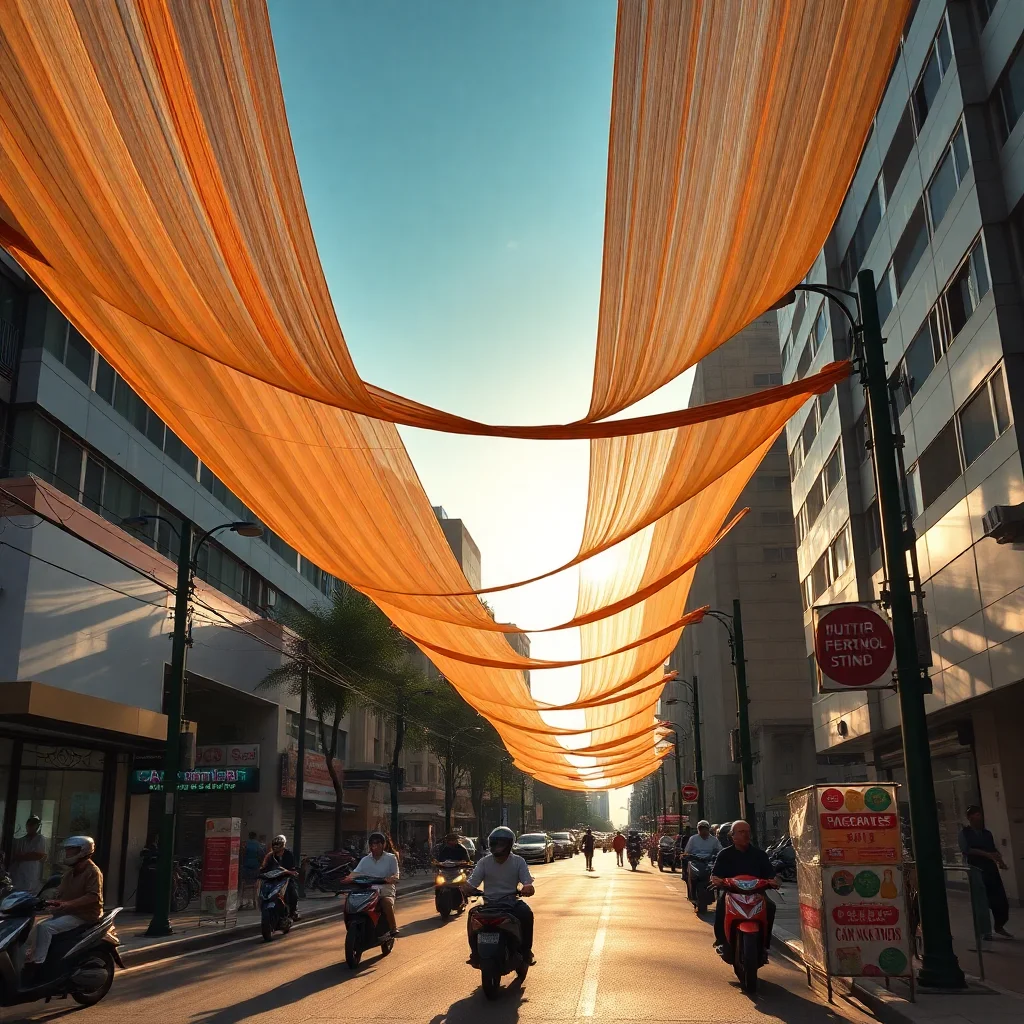
Bangkok’s recyclable fabric ribbon canopy is more than a photogenic intervention strung between streetlights. It proposes a blunt thesis: in a city where heat is relentless and public space is often too exposed to be usable, shade is not an accessory. It is infrastructure. Curved textile bands filtering sunlight into shifting patterns do what good civic design should do: they change behavior, soften intensity, and give people a reason to linger. In that sense, the canopy is not an object in the street. It is a temporary climate machine that edits how the street works.
This matters because urban design has spent decades fetishizing permanence. Concrete plazas, hard paving, monumental gestures: these have dominated the imagination of “serious” public space. But in hot, congested, rapidly changing cities, permanence can become a liability. A lightweight, reconfigurable canopy can arrive faster, cost less, and adapt more quickly than a fixed civic retrofit. The provocation is obvious: what if the most effective urban interventions were not buildings, but atmospheric devices?
Bangkok provides the perfect test case. The city’s streets are alive, crowded, and exposed. Shade arrives irregularly from overhangs, trees, awnings, and commercial spillover, but rarely as a coherent civic system. The recyclable ribbon canopy turns that absence into a design opportunity, demonstrating that temporary textile gestures can perform three roles at once: microclimate management, streetscape identity, and public invitation.
That is a serious claim, and it should be treated seriously. Cities facing higher temperatures cannot rely on trees alone, and they certainly cannot wait decades for mature canopy cover to fix pedestrian discomfort. A civic shade strategy can be deployed at the speed of need. It can be seasonal, event-based, iterative, and site-specific. In a hot metropolis, the right temporary intervention can be more democratic than a permanent one because it can move where vulnerability is greatest.
Bangkok’s ribbon canopy and the politics of lightness
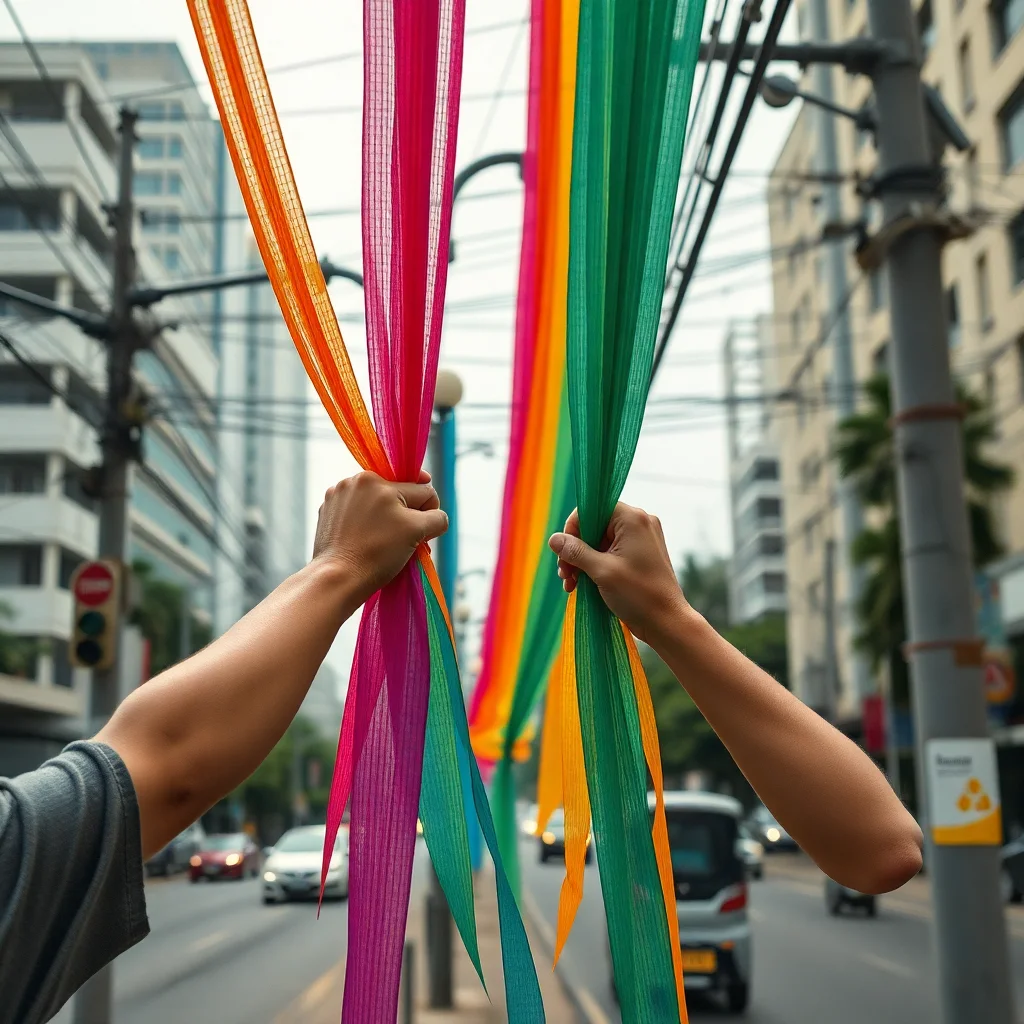
The Bangkok intervention draws its force from restraint. Fabric ribbons, recycled and curved, weave between existing streetlights rather than replacing the street with a new structure. This is a crucial distinction. The project does not announce a tabula rasa urban future. It parasitizes the infrastructure already there, using the ordinary armature of the city to create an unexpected public room overhead. The result is a canopy that is both festive and infrastructural, both lightweight and consequential.
In urban design terms, this is a shift away from the heroic object and toward the tactical layer. Think of Umbrella Sky installations in Portugal, where suspended parasols generate instant pedestrian identity, or the shadow-making pavilions that appear each year in festival contexts. But Bangkok’s canopy is less about spectacle than about operational value. It filters sunlight, calibrates experience, and defines territory in a city where the boundary between street and social life is always unstable.
There is also an environmental intelligence in the choice of recyclability. Temporary does not have to mean wasteful. If a canopy is designed for recovery, reuse, and reconfiguration, then it can become a circular urban asset rather than a one-off event prop. This is where many shade projects fail: they are visually memorable but ecologically shallow. Bangkok’s ribbon canopy points in the opposite direction, toward a kind of civic textile that can be repeatedly deployed, stored, reassembled, and redirected.
Lightness is not weakness. In fact, lightness may be the defining ethical condition of future public space. Cities need interventions that do not demand permanent ground disturbance, that can be installed with minimal carbon cost, and that can leave room for the city to remain unfinished. The canopy’s power lies in its refusal to harden into another monument. It performs its public duty precisely by staying mutable.
That logic is increasingly familiar across architecture debates, from adaptive reuse as civic infrastructure to the idea that existing systems can be reworked rather than replaced. In Bangkok, the streetlights become the frame, and the fabric becomes the adjustment layer.
Shade as street design: from survival to civic ritual
To understand why this matters, look at how shade already structures urban life in warm climates. In markets across Southeast Asia, under arcades in Latin America, along souks in North Africa, and beneath the dense trellises of Mediterranean streets, shade is the invisible infrastructure that determines where commerce happens, where people pause, and which routes feel walkable. It is not aesthetic garnish. It is the condition of use.
Modern planning has often ignored this fact, privileging visibility, order, and hard-edged circulation over thermal comfort. But the best contemporary projects are correcting that bias. Jeanne Gang’s landscape urbanism has repeatedly argued for public realms that are ecologically performative rather than merely representational. On a different scale, festival canopies, market awnings, and temporary shading systems reveal how quickly a place can become socially legible once sun exposure is reduced.
Bangkok’s canopy suggests that shade can also become civic ritual. A textile ceiling shifts the emotional temperature of a street as much as the physical one. It tells pedestrians they have entered a designed zone where attention has been paid to their comfort. That message is architectural even before it is climatic. It says: this is for you.
This is where many cities fail their public realm. They spend on icons and neglect on comfort. They build spectacular squares that are empty at noon because nobody can stand on them. They celebrate openness without acknowledging that, in a warming climate, openness without shade is exclusion. If public space is to remain public, it must be habitable, and habitability begins with protection from heat.
This broader shift is part of a wider rethinking of civic experience, one that also underpins the new public utility aesthetic, where usefulness and visual identity are no longer treated as opposites.
Canopies, precedents, and the future of adaptable civic form
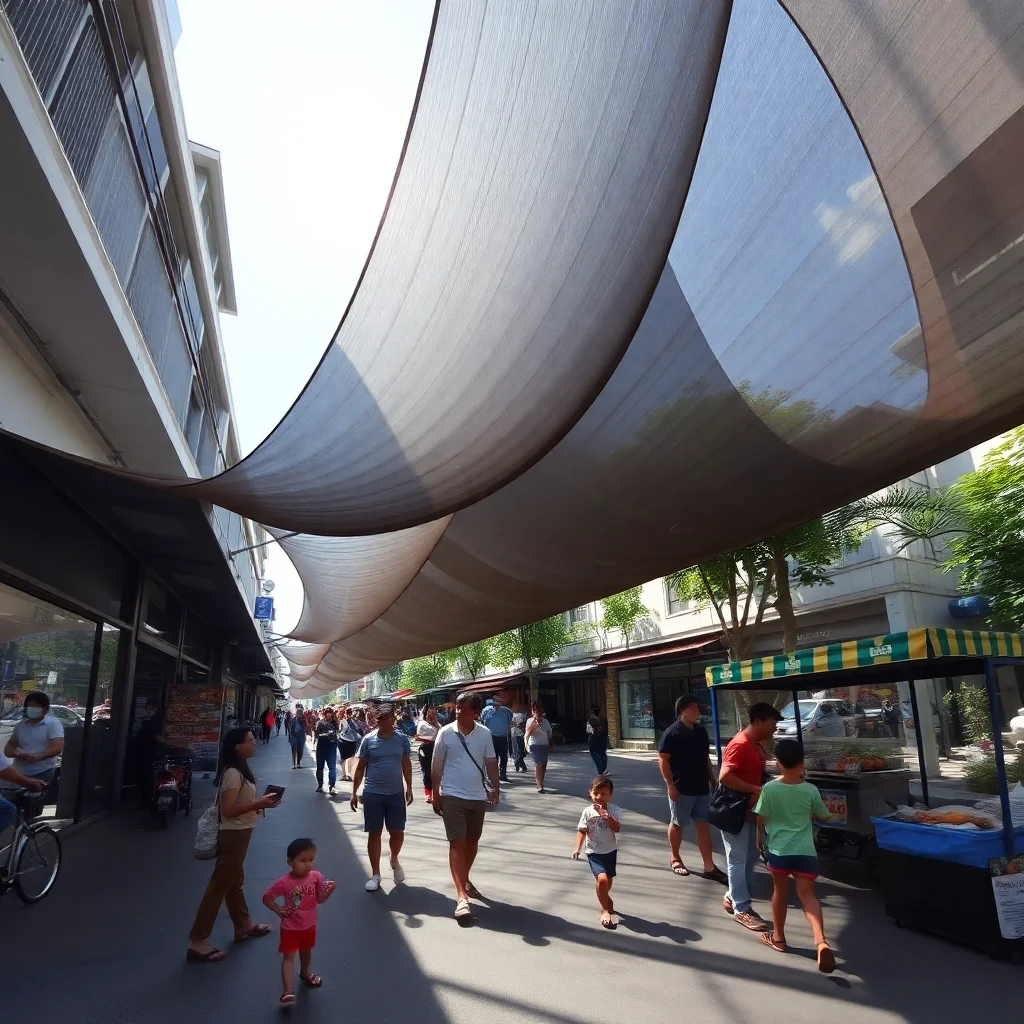
The most persuasive argument for textile shade is not that it looks beautiful, but that it offers a new grammar for public infrastructure. Its precedents are already everywhere if one knows where to look. Temporary tensile structures have long been used in disaster relief, event architecture, and seasonal markets. The architectural lineage runs through Frei Otto’s lightweight experiments, through contemporary membrane pavilions, and through the pragmatic canopy systems that support everyday street life. The difference now is urgency: climate change makes these experiments less optional and more necessary.
Consider how different cities have tested adaptive public cover. In Barcelona, certain plazas and schoolyards have been retrofitted with shade sails and pergola systems as heat mitigation strategies. In Paris, summer urbanism increasingly depends on pop-up shade and cooling interventions. In Singapore, high-density planning has long treated microclimate as a design problem rather than an afterthought, from covered walkways to lush canopy networks. Each example points to the same conclusion: shade can be planned as infrastructure, not merely tolerated as landscape.
Bangkok’s ribbon canopy adds something important to this lineage: a deliberately soft and reconfigurable civic identity. Because the material is textile rather than heavy construction, it can absorb color, motion, and variation. It can mark a neighborhood event, a pedestrian priority corridor, a temporary market route, or a cultural festival. In other words, it can be both city service and urban signage.
That dual role is the future. Infrastructure that is invisible often escapes public imagination; infrastructure that is beautiful often escapes budget justification. A canopy that is simultaneously useful and expressive breaks that stalemate. It helps a city signal care while delivering measurable comfort. It is not just what urban space looks like. It is how the city behaves under pressure.
The same tension between form and function appears in debates over whether existing assets should be overhauled or remade, a question explored in Repair or Replace? Europe’s Architecture Culture War. Bangkok’s answer is neither grand replacement nor nostalgic preservation, but a nimble third option: recalibrate what is already there.
The case against romanticizing temporary shade
But if shade is infrastructure, then it must also be held to infrastructural standards. Temporary systems can become aesthetic alibis for cities that refuse to invest in deeper transformations. A ribbon canopy may cool a street for a season, but it does not solve inequitable transit, deficient tree canopies, or the structural heat island effects caused by asphalt and overdevelopment. The danger is that lightweight interventions become a substitute for harder political work.
There is another issue: maintenance. Textile installations deteriorate. They collect pollution, demand cleaning, and require structural vigilance. In humid, polluted urban conditions, materials that begin as elegant gestures can quickly become visual clutter or functional failure. A canopy only deserves to be called infrastructure if there is a plan for repair, storage, and reuse. Otherwise it is just event design with a civic accent.
Then there is the question of access. Who gets the shaded street? Who authorizes it? Which neighborhoods receive comfort, and which remain exposed? If temporary shade is deployed only where tourism, branding, or property value make it attractive, then the project becomes another uneven urban amenity. Cities should not use canopy design to polish the already-visible while leaving vulnerable communities to fry.
So yes, the critique is real. Lightness can be co-opted. Flexibility can become precarity. The challenge is to embed textile shade inside a broader public strategy: tree planting, transit upgrades, permeable surfaces, and local stewardship. Without that, the canopy is an image. With it, the canopy becomes a working part of the city’s climate response.
A new civic imagination built from fabric, not finality
What Bangkok’s recyclable ribbon canopy ultimately offers is a different idea of urban dignity. It assumes that public space does not need to be fixed to be meaningful. It assumes that cities can be edited in real time, responding to heat, crowd flow, and cultural change with interventions that are responsive rather than monumental. That is a powerful architectural proposition because it moves design away from the fantasy of final form and toward the ethics of adaptability.
In a century of climate instability, cities will need more than durable objects. They will need systems that can be deployed rapidly, scaled modestly, and transformed often. Shade will be one of the most contested of those systems because it sits at the intersection of climate justice, urban design, and public life. Whoever controls shade controls comfort, and whoever controls comfort shapes who belongs.
That is why textile canopies should not be dismissed as decorative interventions. They are prototypes for a more responsive civic order. They can turn dead streets into lived ones, heat-stressed corridors into social rooms, and leftover infrastructure into public atmosphere. Bangkok’s example is not a finished solution. It is a provocation: if a city can be made more inhabitable by a ribbon of recyclable fabric, what other forms of public infrastructure have we been overbuilding all this time?
And if temporary shade can do the work of streetscape, microclimate, and identity at once, why are we still designing public space as if permanence were the highest form of seriousness?
That question connects to the domestic scale too, especially in a climate where comfort increasingly depends on how existing spaces are adapted. The same logic appears in Can Homes Absorb Climate Chaos?, which asks whether resilience should begin at the level of shelter before expanding outward to the street.
FAQ
What makes a canopy “infrastructure” rather than decoration?
It becomes infrastructure when it measurably changes how a city functions: lowering perceived heat, improving walkability, supporting public gathering, and shaping movement patterns. If the canopy affects behavior and access, it is doing civic work, not merely visual work.
Can temporary shade really help in hot cities?
Yes, especially where shade is missing and tree cover cannot be delivered quickly enough. Temporary systems can provide immediate relief, define pedestrian routes, and activate underused streets while longer-term cooling strategies are developed.
Is recyclable fabric enough to make a project sustainable?
No. Recyclability is only one part of sustainability. The real test is whether the canopy is designed for repeated use, easy maintenance, low-impact installation, and integration with broader urban climate policies.
What is the risk of relying on shade canopies too much?
The main risk is substitution: cities may use visible shade projects to avoid deeper fixes like transit reform, tree planting, or cooling infrastructure. Canopies should complement, not replace, systemic urban change.
Open question: if shade is essential to public life in warming cities, should it be designed as a basic civic right rather than an optional architectural gesture?
Get the Mainifesto weekly — curated design debates, speculative ideas and the week's best articles every Saturday.
Editorial Perspectives
Questions and counterpoints developed by the Mainifesto editorial desk to extend the discussion.
Perspective 1
Bangkok is doing what too many cities still refuse to do: treating heat as infrastructure, not weather. If shade is what makes streets usable for the poorest and the most exposed, then yes, it belongs in the civic baseline—like drainage, lighting, and transit, not as a decorative afterthought.
Perspective 2
I’m sympathetic to the argument, but calling shade a right only works if cities can actually maintain it. The smarter move is to fold lightweight canopy systems into public works budgets and performance standards, so you get durable comfort without pretending every square meter needs a bespoke architectural statement.
Perspective 3
From a user-experience standpoint, shade is not a nice-to-have; it changes whether people linger, spend, or just escape. If a public realm is too hot to use for half the day, that’s a failed asset, and I’d rather see cities invest in repeatable shade infrastructure than in more polished renderings.
Perspective 4
The best thing about this project is that it treats shade as part of everyday urban culture, not as a luxury layer dropped onto a masterplan. But if cities make it a “right,” they need to be careful it doesn’t become a tool for sanitizing streets and pushing out the informal life that already knows how to survive the heat.