
Off-Grid Is Not the Same as Low-Impact
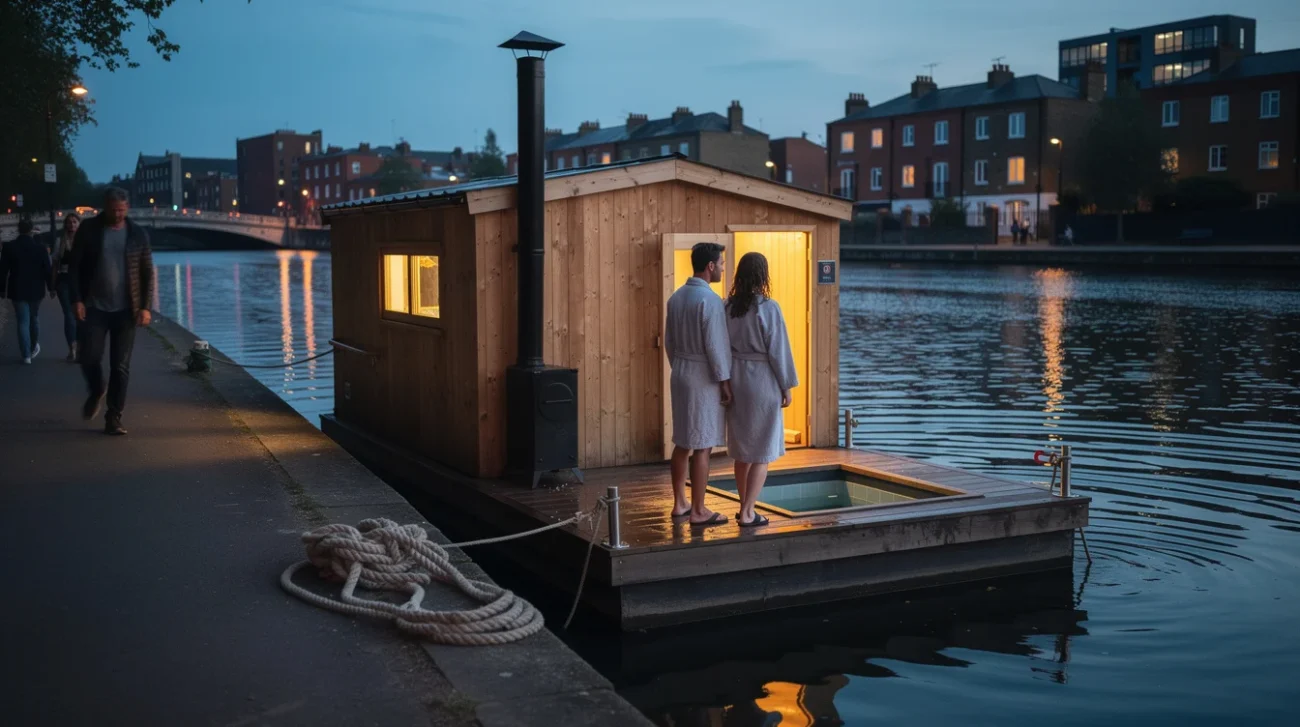
Disconnecting from utilities is an engineering decision. Calling that disconnection sustainable is an environmental claim—and it needs evidence. London’s floating, wood-fired Soak sauna sits precisely in that gap. As described by Dwell, Soak bills itself as an off-grid wellness space, combining a steam room, cold plunges, showers, and a café and bar area. The proposition is seductive: leave the city’s machinery behind without actually leaving the city.
But the machinery does not disappear. It moves. Energy arrives as fuel; water must come from somewhere; wastewater must go somewhere else. A chimney connects the retreat to the surrounding atmosphere as surely as a cable connects a building to the electricity network. Independence from one infrastructure often means dependence on another, less visible one.
This is not a verdict that Soak is environmentally worse than a conventional spa. The available project description does not establish its full operating footprint. It is a challenge to the language surrounding it. Architecture magazines should stop allowing “off-grid” to perform the work of a life-cycle assessment. The interesting design question is not whether a retreat can disconnect, but whether its particular arrangement of heat, water and hospitality reduces harm.
The grid is not the enemy
Off-grid architecture inherits a powerful cultural script: autonomy means virtue. The self-sufficient cabin, the remote solar house and the floating refuge promise freedom from extractive systems. Michael Reynolds’s Earthships made that promise architectural, bringing energy generation, water collection and waste handling into the design itself. Yet their lesson is that infrastructure must be designed—not that eliminating a utility connection automatically eliminates impact.
In London, this distinction matters. Grid electricity has a changing carbon intensity, shaped by generation and demand. Electrification can benefit from the wider system’s decarbonisation. A wood-fired installation does not become cleaner simply because the electricity network does. Equally, an electric sauna is not automatically efficient: insulation, occupancy, operating hours and equipment performance remain decisive.
Amsterdam’s Schoonschip floating neighbourhood offers a useful counterpoint. Its shared energy arrangements and water-source heat pumps treat living on water as an opportunity for coordinated infrastructure, rather than a fantasy of isolation. It is not a direct technical template for a sauna, which has different temperature requirements. It does, however, puncture the idea that floating architecture must prove its ecological seriousness through disconnection. Sometimes the progressive move is a better connection.
Wood needs a biography, not a halo
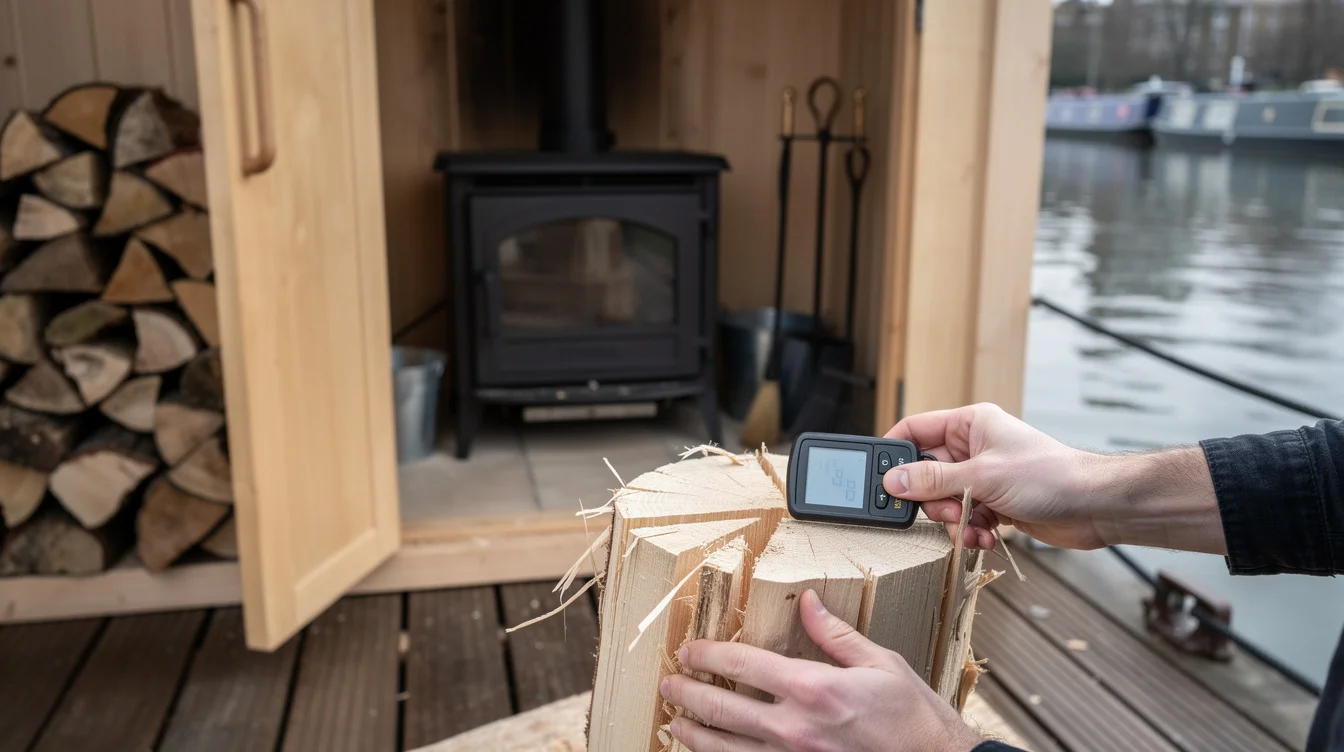
The first serious question for any wood-fired retreat is brutally ordinary: what, exactly, is being burned? “Natural,” “local” and “renewable” describe different attributes. None supplies a complete answer. Fuel assessment should identify species, origin, moisture content, processing, transport and whether the material is a genuine residue or wood with a plausible longer-lived use.
Forest Stewardship Council certification can support responsible forest-sourcing claims, but it is not proof that combustion is carbon-neutral. Burning wood releases carbon immediately; subsequent uptake depends on forest growth and the counterfactual—what would have happened to the wood and forest without that demand. Residues that would decompose relatively quickly present a different accounting problem from harvesting additional trees. Neither case should be reduced to a green flame icon.
Seasoning also matters. Wet fuel wastes energy evaporating water and can worsen combustion. Kiln drying improves consistency but introduces another energy input that belongs in the calculation. Delivering small loads across London adds a logistical footprint, even if the woodland itself is nearby.
For Soak, the useful disclosure would be fuel consumption per year and per visitor-hour, accompanied by sourcing records. That would turn rustic atmosphere into an assessable supply chain.
A chimney is a connection to everyone else
Wood heat is intensely legible to the visitor: stacked logs, radiant warmth, the ritual of tending a fire. Its emissions are less photogenic. Combustion can release fine particulate matter, nitrogen oxides, carbon monoxide and other pollutants. The quantities depend on the appliance, fuel, maintenance and operating practice. A modern stove is not interchangeable with an open fire, but “modern” does not mean emission-free.
London makes this more than a technical footnote. A waterside retreat may share its air with towpath users, nearby homes, boats and staff working repeated shifts. A flue that disperses smoke above the roofline has not made those emissions vanish. Compliance with applicable smoke-control rules is a baseline obligation, not a comprehensive sustainability rating.
The World Health Organization’s air-quality guidance places particular emphasis on fine particles because exposure carries serious health risks. That creates an uncomfortable contradiction for wellness architecture: the comfort of one paying customer should not depend on exporting pollution to someone outside the changing room.
Assessment should therefore include appliance-specific emissions information, operating schedules and the local dispersion context. Electricity-based alternatives deserve comparison, with upstream impacts included. At the point of use, however, avoiding combustion offers an unmistakable advantage: no wood smoke.
The plunge pool is an infrastructure question
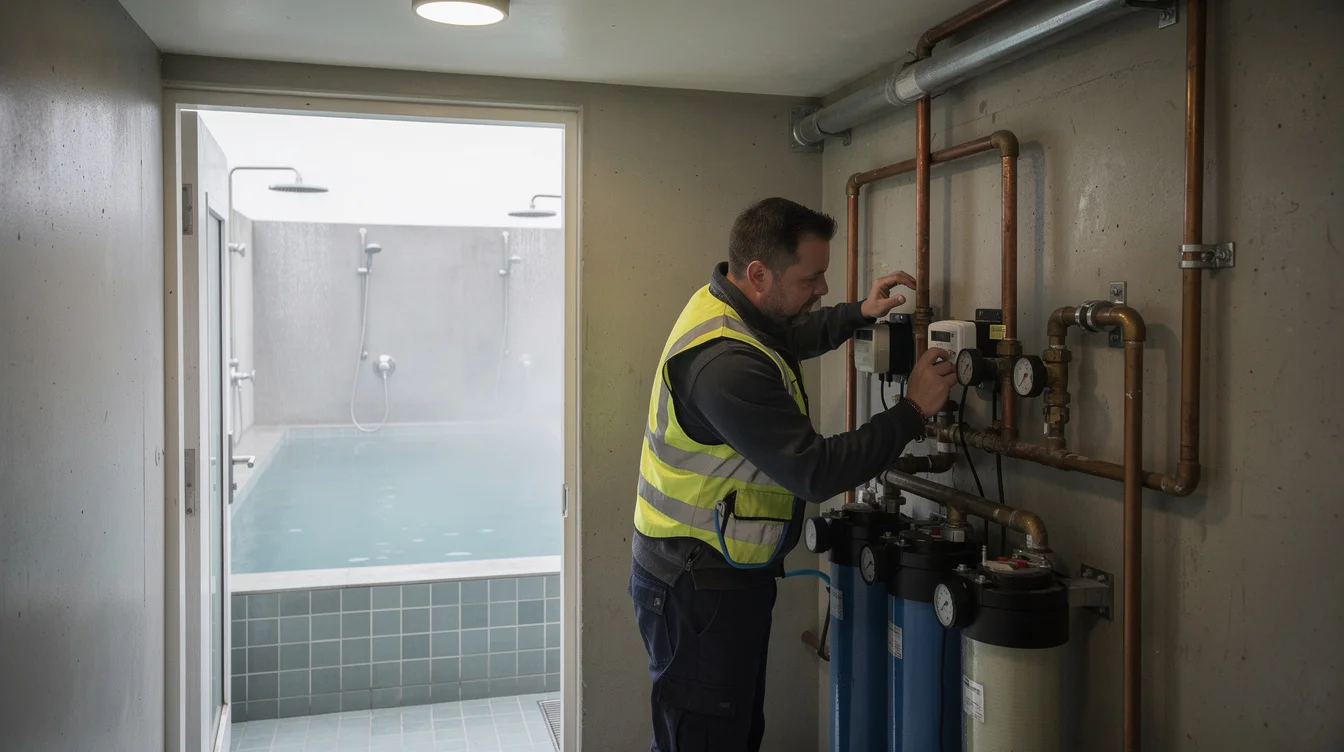
A cold plunge looks elemental. Its environmental performance is anything but. The assessment must distinguish the first fill from replacement water, shower demand, cleaning, filter backwashing and any mechanical chilling. A small vessel repeatedly emptied can consume more water than its modest dimensions suggest. A recirculating system may reduce demand while adding filtration, treatment and electricity requirements.
Hygiene cannot be traded away for a lower water figure. The task is to meet appropriate public-health requirements with the least unnecessary consumption. Timed showers, leak detection, metering and well-managed treatment may be less visually exciting than a waterfront deck, but they are architecture’s environmental work.
Soak’s source description does not establish where its water comes from or how effluent is handled. Those are unanswered questions, not evidence of wrongdoing. A floating venue should explain whether supplies arrive through a connection or deliveries, and whether wastewater enters an authorised sewer connection or is stored for collection and treatment. Being surrounded by water is not permission to discharge into it.
Even the café and bar belong inside this boundary. Dishwashing, cleaning and hospitality waste are part of the retreat’s operation. Drawing the sustainability diagram around the sauna alone would be convenient—and misleading.
Measure the retreat, not the mood
The next step is comparison. An annual emissions total matters, but it needs context: opening hours, visitor numbers, heated volume and the services provided. Reporting impacts per visitor-hour alongside absolute totals helps distinguish efficient operation from a venue that merely runs infrequently. Neither metric should replace the other.
A credible assessment would compare the wood-fired arrangement with feasible alternatives delivering similar experiences and hygiene standards. These might include a grid-electric sauna, heat pumps for suitable lower-temperature loads, heat recovery or a hybrid system. High-temperature sauna heating cannot simply be assigned the efficiency of a domestic heat pump. Technical realism is more useful than swapping one green slogan for another.
Construction also belongs in the account: the floating platform, buoyancy system, insulation, equipment, maintenance and eventual replacement. Adaptation of an existing structure could avoid some new material demand, but that benefit must be documented rather than presumed. That account should also establish who remains responsible for materials when they become waste.
Avanto Architects’ Löyly in Helsinki demonstrates how sauna architecture can frame bathing as a civic waterfront experience. Its relevance here is cultural, not proof of environmental performance. The pleasure and public value of a waterside sauna deserve recognition; they still need a separate carbon, air-quality and water ledger.
Wellness should publish its externalities
The provocative conclusion is not that urban saunas should close. It is that they should become more demanding pieces of architecture. A floating retreat can offer social connection, bodily pleasure and a renewed relationship with the waterfront. Those are substantial benefits. They do not grant immunity from scrutiny.
Soak could make the off-grid claim more meaningful by publishing an operational account: fuel provenance and quantities, metered water use, electricity sources, wastewater arrangements and the basis for any emissions calculations. Where data are modelled rather than measured, that distinction should be explicit. Seasonal reporting would reveal how weather and occupancy change the picture.
Designers and editors have responsibilities too. Stop illustrating sustainability exclusively with timber, water and softly lit bodies. Show the fuel store, the flue, the treatment equipment and the maintenance access. Ask who supplies, operates and cleans the systems that make escape possible.
The most credible urban retreat is not the one that appears furthest from infrastructure. It is the one that accounts most honestly for its participation in it. Off-grid may remain a compelling experience. Low-impact must remain a proposition to be tested.
FAQ
Does off-grid automatically mean sustainable?
No. Off-grid describes independence from particular utility networks. Environmental performance depends on replacement energy sources, materials, transport, water consumption, waste treatment and operating efficiency.
Can a wood-fired sauna be considered low-impact?
Potentially, but only within a clearly defined comparison. Fuel provenance, carbon accounting, appliance performance and local air pollution all matter. Renewable fuel does not make combustion emissions disappear.
What water information should a floating spa disclose?
It should identify its supply source, consumption, pool treatment and replacement practices, shower demand, and wastewater destination. Any reuse system must meet relevant hygiene and environmental requirements.
What would make Soak’s environmental claims assessable?
Published operating data, documented fuel sourcing, emissions information, water and wastewater records, and comparison with feasible alternatives. The available project description alone does not establish whether it outperforms a grid-connected retreat.
If an urban retreat disconnects from utilities but still shares everyone else’s air and water, what should it have to prove before we call it sustainable?
Get the Mainifesto weekly — curated design debates, speculative ideas and the week's best articles every Saturday.
Editorial Perspectives
Questions and counterpoints developed by the Mainifesto editorial desk to extend the discussion.
Perspective 1
Before calling it sustainable, show the fuel use, particulate emissions and water treatment per visitor, then compare those with a grid-connected sauna. In a dense city, disconnecting from utilities is not much of an achievement if the neighbours inherit the pollution.
Perspective 2
There is something very picturesque about burning wood on a London waterway and calling it progress. As with the pastoral retreats of the eighteenth century, the apparent escape depends on the city it disavows. Sustainability needs a less flattering account of what happens beyond the frame.
Perspective 3
In Beirut, disconnection from utilities is hardly a sustainability credential; it can mean diesel generators and privately delivered water. A London retreat should have to trace its wood supply, account for wastewater and measure the pollution it leaves with its neighbours. Off-grid tells us where the pipes and cables stop, not where the impacts stop.