
Is AI Becoming Architecture’s Junior Partner?

AI is no longer just making pretty pictures
For the last few years, architecture has treated AI like a mood board with a pulse: useful for atmosphere, dangerous in excess, and mostly quarantined to the front end of the design process. That phase is already over. The more consequential shift is not image generation, but decision support — the moment software starts shaping what gets built, why it gets built, and which trade-offs are deemed acceptable before a human has properly argued for them.
Chaos’s survey with Architizer, which found AI increasingly used to support decision-making as well as image generation, points to a deeper restructuring of practice. In studios, AI is no longer merely generating speculative façades or seductive renderings; it is entering the workflow around feasibility, coordination, material comparisons, performance checks, and client communication. That sounds efficient. It is efficient. But efficiency is not innocence. Once software begins to advise on decisions, it begins to influence judgment itself.
This is the editorial fault line the profession has been reluctant to name. Architecture has always involved delegation — to consultants, software, standards, and precedents. Yet AI is different because it does not simply extend the architect’s hand; it begins to compress the architect’s hesitation. And hesitation is where design ethics often live.
The real disruption is in the middle of the workflow

Image generation is noisy and visible, which makes it easy to critique. Decision support is quieter, which makes it more dangerous. The middle of the workflow is where a building’s fate is often decided: massing options are filtered, daylight strategies are ranked, material assemblies are compared, energy performance is optimized, and cost pressures are translated into “recommended” outcomes. Here AI does not need to invent a building. It only needs to steer the ranking of possibilities.
That steering has consequences. If a generative model nudges a designer toward a certain structural grid because it is “better” for cost or speed, the model is already participating in authorship. If an AI assistant flags one façade as more climate-responsive while quietly favoring a less ambitious spatial arrangement, it is not merely assisting — it is editorializing. In architecture, every “optimization” suppresses an alternative value. What gets optimized can be extracted from a spreadsheet; what gets lost often cannot.
We have seen versions of this before. BIM transformed coordination into a form of managerial intelligence. Energy software reshaped the way sustainability is discussed, often narrowing imagination to what can be simulated. Parametric design made form feel like a consequence of rules rather than a result of argument. AI is the next step, but it is also the most rhetorically slippery step because it can talk back in fluent language. It can explain itself. It can sound reasonable. That is precisely the problem. For a broader look at how technology can shape the visual side of practice, see The New Visualizer Is an Algorithm.
When software starts advising, who owns the judgment?
Architecture has always depended on judgment under uncertainty. A designer balances code, budget, climate, social use, symbolism, client ambition, and construction reality. The profession’s value lies not in pretending there is one correct answer, but in defending a particular answer with conviction. Decision-support AI threatens that stance by making the most contested part of design appear procedural. It recasts judgment as the output of a system instead of a discipline of responsibility.
That shift matters because accountability cannot be automated by rhetoric. If an AI tool recommends a spatial layout that improves circulation but weakens communal life, who is answerable? The software vendor? The office that deployed it? The project lead who accepted its output? Or the client who demanded speed and certainty? The answer, uncomfortably, is still the architect — which is exactly why the profession should be alarmed when its tools begin to speak as though they share that burden.
There is a seductive fantasy that AI makes design more objective. It does not. It makes certain biases feel less personal. In an industry already governed by risk aversion, AI can become a moral laundering machine: a way to say “the system preferred this” when the real author of the preference is the culture of the office, the economics of the commission, or the politics of the brief. That is not neutrality. It is outsourced conviction.
Speed is not the same as intelligence
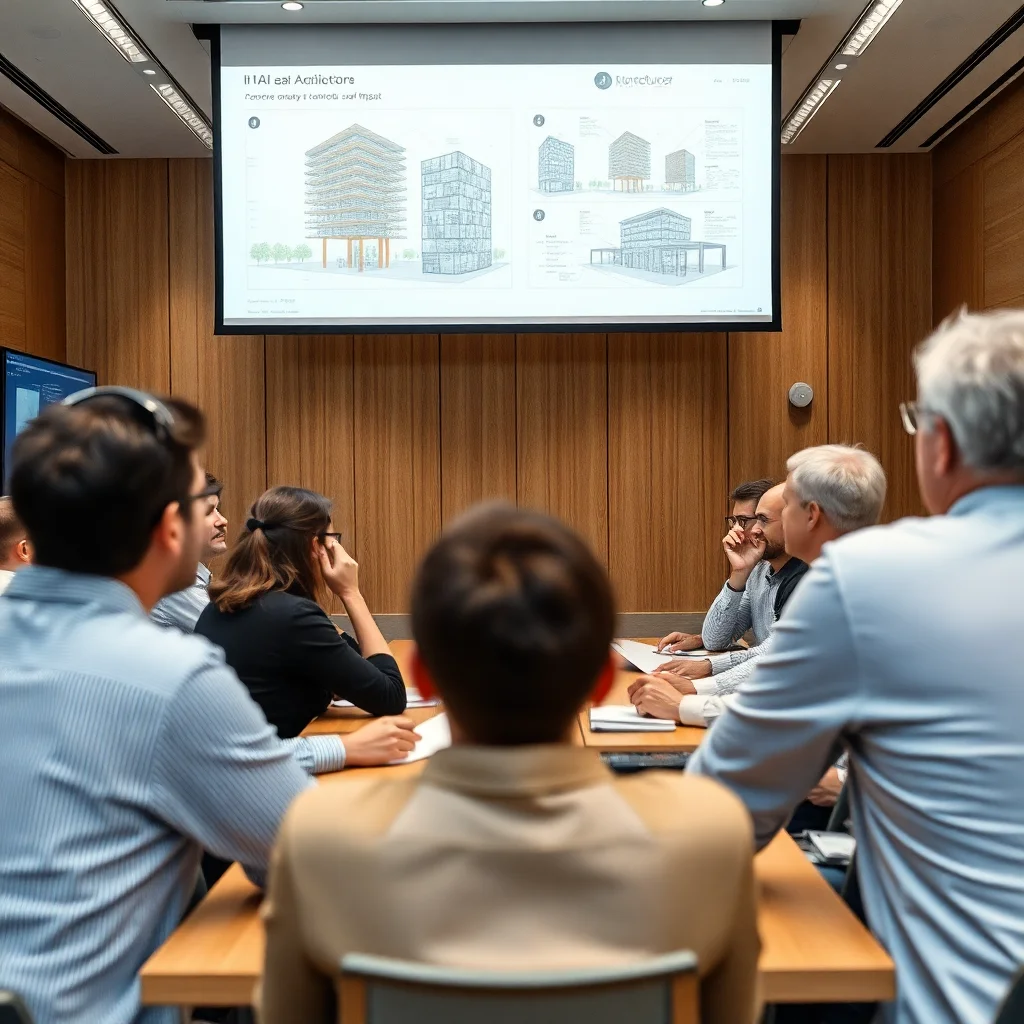
The strongest case for AI in architecture is not that it produces genius, but that it accelerates labor. For large practices, especially those wrestling with relentless deadlines and complex consultant ecosystems, this is a powerful promise. Feasibility studies can be drafted faster. Repetitive documentation can be summarized. Early options can be sorted before a human team spends days on dead ends. In a profession where time is often the most exhausted material, that promise is hard to resist.
But speed has a politics. A faster workflow can become a thinner one. When the machine helps you arrive at answers sooner, you risk skipping the argumentative phase where architecture becomes more than problem-solving. This is where the profession should remember figures like Cedric Price, who treated design as a question rather than a solution, or Denise Scott Brown, whose work repeatedly exposed the social and symbolic complexity that simplistic optimization tends to erase. The best architecture is rarely the fastest path to consensus.
There is also a creative danger in over-trusting consensus itself. AI systems trained on past data are excellent at reproducing what is already legible to the profession: familiar massing tropes, conventional circulation logic, standard material hierarchies, and broadly acceptable aesthetics. That means they may accelerate not innovation but the average. A tool that helps every studio move faster toward the center can make the built environment more competent and less interesting at the same time. Similar questions come up in material innovation too, as explored in Self-Healing Materials in Architecture: Science Fiction or Near Future?.
Why this feels like a junior partner — and why that matters
The phrase “junior partner” is useful because it captures both dependence and hierarchy. AI is not yet the decision-maker, but it is increasingly present in the room, speaking early and often, shaping the menu of choices. Like a junior associate in a law firm or a young designer in a studio, it can be productive, tireless, and occasionally brilliant. Unlike a human junior, however, it cannot be mentored into ethical maturity. It can only be tuned, constrained, or replaced.
That difference should stop the profession from romanticizing collaboration. A junior partner is supposed to learn the culture of the office, absorb standards of accountability, and grow into judgment. AI learns patterns, not ethics. It can imitate the language of confidence without acquiring the burden of consequence. If architecture begins treating its tools as collaborators rather than instruments, the studio risks confusing fluency with wisdom.
And yet the profession is clearly moving in that direction because the incentives are obvious. Clients want speed, consultants want clarity, and offices want leverage. The result is a new kind of editorial hierarchy inside practice: the machine drafts, the team curates, the lead signs off, and the client approves what was already pre-selected by software. This is not simply automation. It is a shifting of authorship downstream, away from the public-facing moment of design and into opaque computational processes.
The profession needs rules, not just enthusiasm
If architecture is to adopt AI without surrendering its authority, it needs a stricter culture of disclosure. Firms should be able to say where AI was used, for what purpose, and with what degree of influence. A design generated by software is not automatically invalid, but hidden dependence is corrosive. The profession is already comfortable citing structural engineers, sustainability consultants, and specialist manufacturers. It should learn to name its algorithms with the same seriousness.
There should also be a stronger distinction between ideation and recommendation. Let AI speculate wildly in early concept phases if that expands the design field. But once the tool starts ranking options for a client, affecting planning strategy, or informing material choices, the threshold of accountability changes. At that point, the software is not just a sketch partner. It is part of the argument.
Architects often speak about stewardship — of resources, of place, of public life. That language now has to extend to the tools themselves. A profession that hands judgment to opaque systems in the name of productivity will eventually discover that it has optimized away its own legitimacy. The hard truth is that architecture does not need more certainty. It needs better reasons. The same caution applies when architects start relying on adaptive building envelopes, as discussed in Smart Facade Systems: Adaptive Exteriors That Respond to Climate and Light.
FAQ
Is AI in architecture mainly about rendering images?
No. Image generation is only the most visible use. The more important shift is decision support, where AI helps compare options, summarize trade-offs, and influence what gets prioritized in early design and coordination.
Why is decision-support AI more controversial than image tools?
Because it affects real outcomes. When software influences massing, cost, materials, or performance decisions, it is no longer just illustrating an idea — it is helping determine what gets built and why.
Does using AI reduce the architect’s responsibility?
No. If anything, it increases the need for accountability. Even when software suggests a direction, the architect remains responsible for judging whether that direction serves the project, the client, and the public.
What should firms do before adopting AI more deeply?
They should define where AI is allowed to assist, where human review is mandatory, and how its role will be disclosed. Without those guardrails, AI can quietly shift authorship and judgment without anyone admitting it.
Get the Mainifesto weekly — curated design debates, speculative ideas and the week's best articles every Saturday.
Editorial Perspectives
Questions and counterpoints developed by the Mainifesto editorial desk to extend the discussion.
Perspective 1
AI isn’t a junior partner, it’s a force multiplier for whoever already controls the brief, the data, and the liability. If studios pretend it’s just a neutral tool, they’ll end up outsourcing judgment without admitting it — and in cities already shaped by uneven power, that’s a political decision, not a technical one.
Perspective 2
I’m interested in AI when it expands the field of possibility, but the minute it starts masquerading as judgment, the hype gets dangerous. A collaborator needs ethics, accountability, and limits; otherwise it’s just a very polished way to launder bias through software.
Perspective 3
What worries me is not whether AI can generate options, but whether teams understand the assumptions hidden in the model before they let it shape design decisions. If we treat it like a collaborator, then we need a clear protocol for review, authorship, and responsibility — otherwise we’re confusing computational confidence with architectural judgment.