
Cluj-Napoca Waterfront Urbanism and Civic Life
The waterfront is no longer a property line
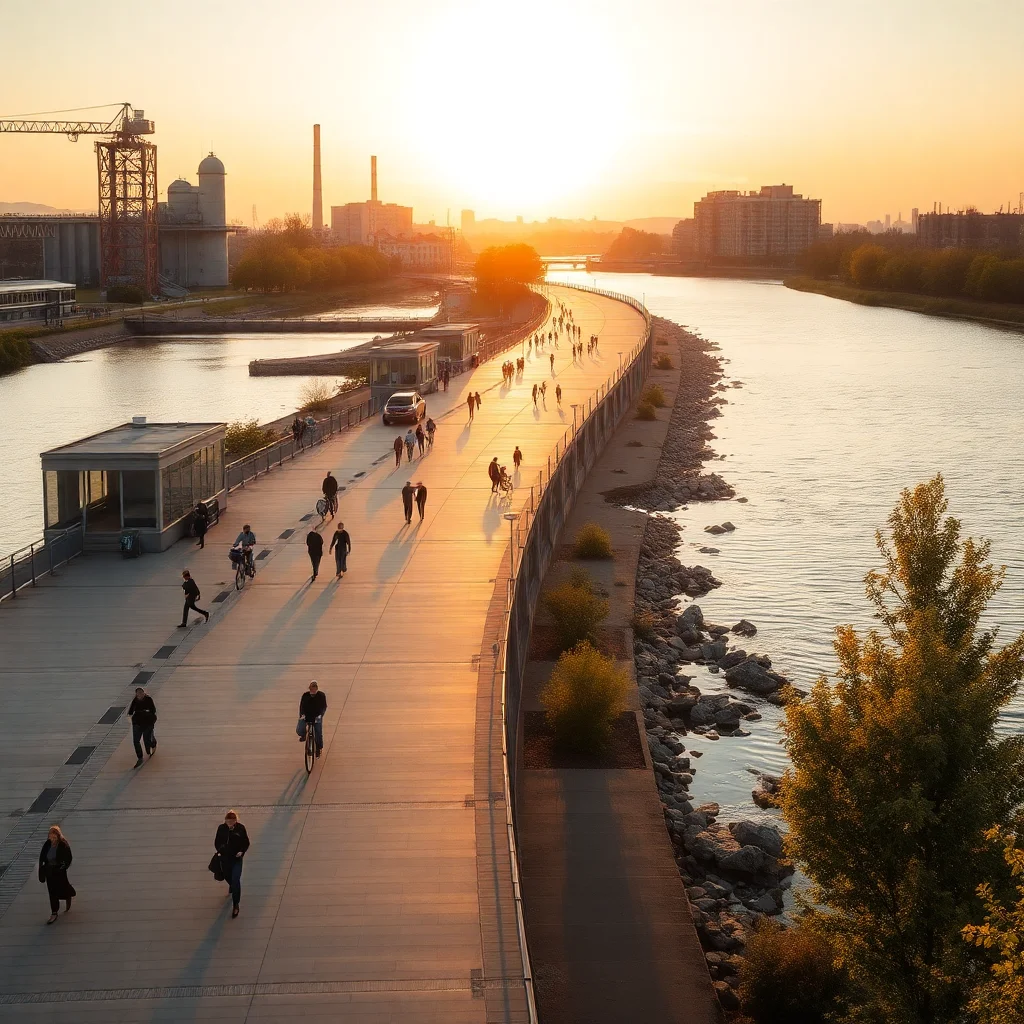
For decades, the river edge was treated as the city’s backstage: industrial, fenced, polluted, and useful only in the most extractive sense. In Cluj-Napoca, the former Carbochim platform along the Someș River is being recast as something more ambitious than a redevelopment parcel. The RIVUS master plan by UNStudio, with Felixx Landscape Architects and Planners, proposes a river-oriented district that combines adaptive reuse, public space, mobility, and mixed-use development. But the real question is not whether the site can be made profitable. The question is whether it can be made civic.
That distinction matters because “waterfront urbanism” has become a familiar script. Cities from Hamburg to Copenhagen, from Bilbao to London, have learned how to turn obsolete industrial land into attractive districts. Too often, however, the river becomes scenery for consumption: promenades polished into lifestyle assets, public access filtered through retail, and ecology used as branding rather than repair. Cluj’s former industrial river edge exposes that contradiction clearly. A waterfront can reconnect a city to water, or it can become a beautifully designed enclosure that merely sells the feeling of openness.
UNStudio’s proposal is interesting precisely because it frames regeneration as a system, not a single object. Landscape is not a decorative wrapper. Mobility is not an afterthought. Public space is not residual space. Yet the pressure from development logic remains: whenever a prime riverfront is “activated,” the temptation is to convert civic potential into real-estate value. The article’s real tension lies there, and it is not a minor one.
Cluj’s industrial edge as a test case
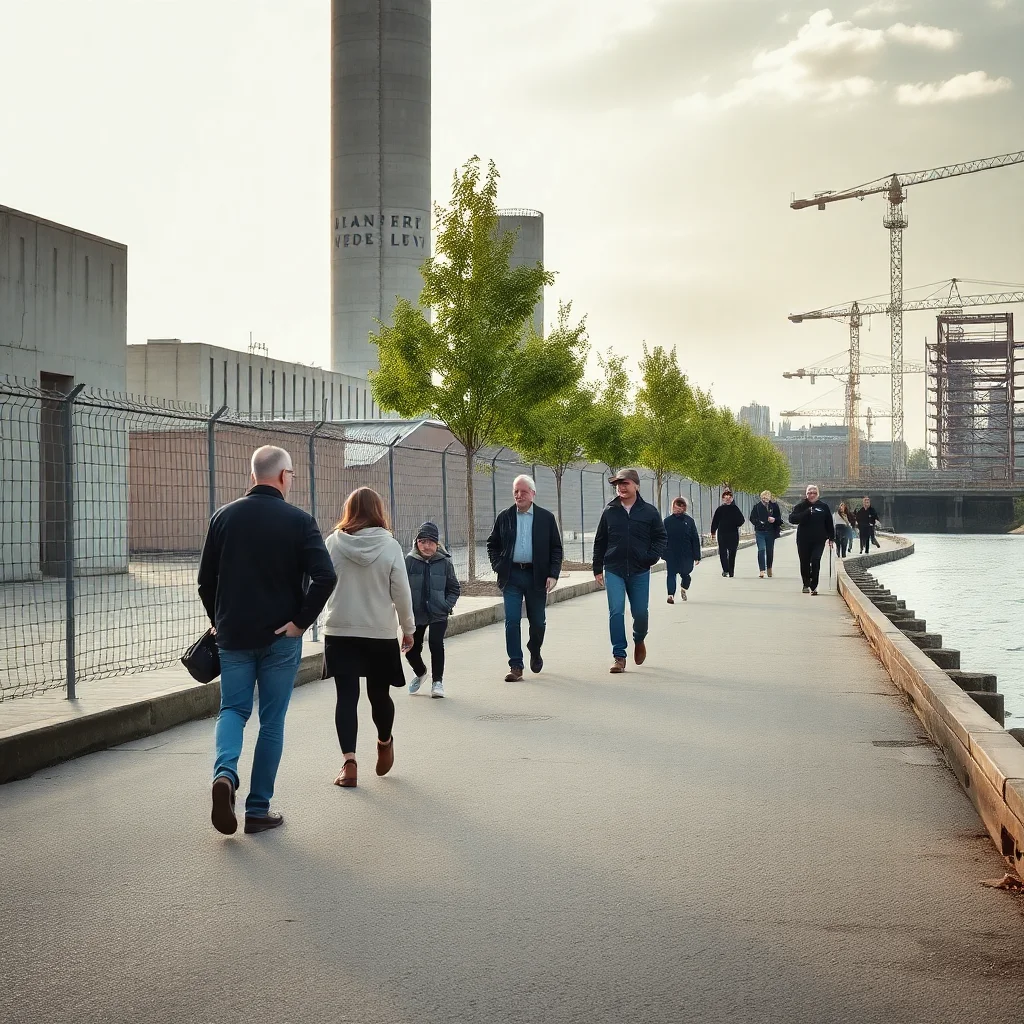
Cluj-Napoca has already become one of Romania’s most dynamic urban economies, with a fast-growing tech sector, expanding institutions, and intense pressure on land use. That growth makes the riverfront more than a local planning issue. It is a test of what kind of city Cluj wants to become when there is no more room for easy expansion and every leftover parcel is monetized. Former industrial land along the Someș is not simply vacant; it is politically charged terrain where public expectation, private capital, and urban memory collide.
The former Carbochim site carries the legacy of a manufacturing landscape now being rewritten as a mixed-use district. That transformation is not inherently suspect. In many European cities, from Malmö’s docklands to Vienna’s Aspern-adjacent renewal zones, former industrial districts have provided the ground for more walkable, more mixed, and sometimes more democratic urban conditions. But the quality of that transition depends on whether the old industrial logic of exclusion is replaced with genuine urban porosity, or merely repackaged as a premium neighborhood with a river view.
What makes Cluj compelling is that the project was developed through public participation, with local residents involved in shaping the vision. That alone does not guarantee an open city, but it does change the terms of debate. A waterfront that emerges from consultation is not automatically just, yet it is harder to reduce to pure speculation. The issue is whether participation influences the eventual spatial and economic structure, or whether it becomes a legitimizing ritual for a pre-decided investment model.
In that sense, the project also echoes wider debates about the limits of image-led sustainability. Cities increasingly use green language to frame change, but the difference between real repair and spectacle is easy to miss. The same skepticism that applies to ocean plastic façades and green theatre is relevant here: a well-intentioned material or landscape gesture can still be mostly symbolic if the underlying urban logic remains unchanged.
Public access only matters if it is unconditional
Every waterfront master plan now claims to “connect the city to the river.” The phrase has become so common that it risks meaning nothing. In practice, connection can mean a promenade that is technically public but functionally controlled by retail, events, surveillance, and design cues that tell some users they belong more than others. A river edge can be open in legal terms while remaining socially narrow. This is the most important trap in contemporary waterfront urbanism: access that looks civic but behaves like a curated amenity.
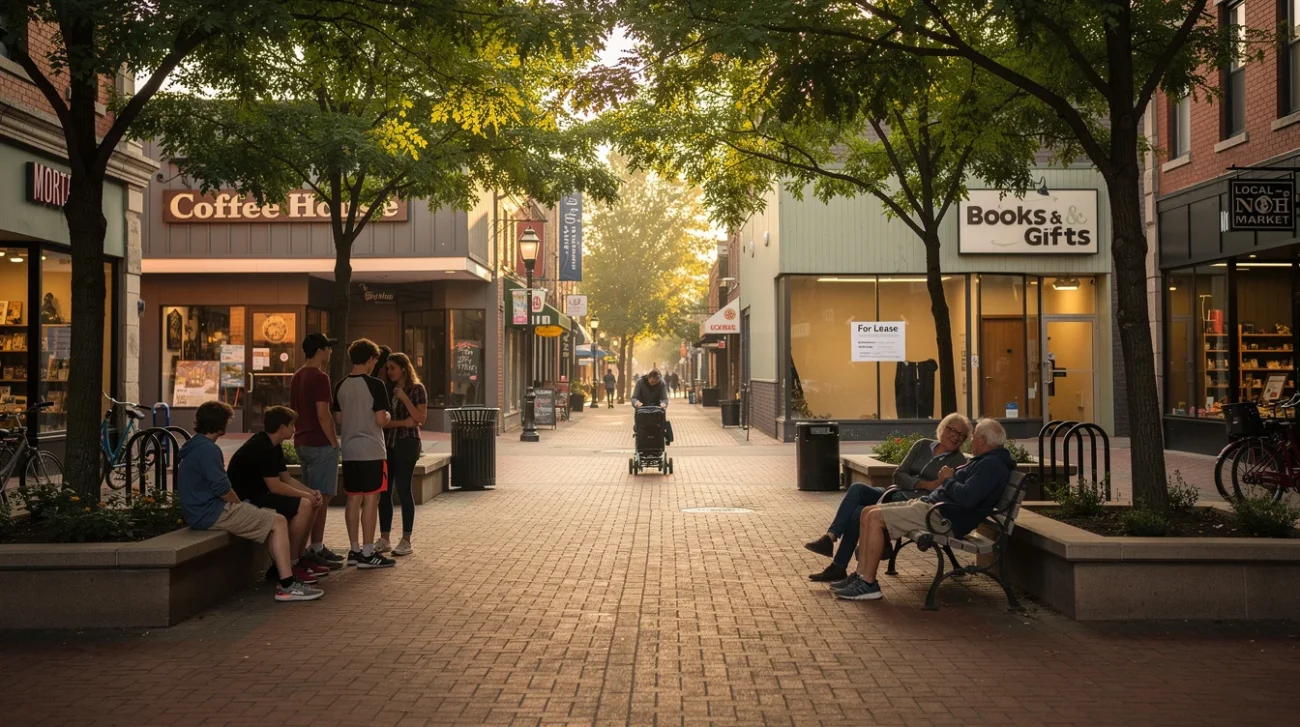
Cluj’s challenge is to avoid that trap by making public space legible, continuous, and everyday. The best waterfronts are not exceptional destinations; they are ordinary parts of urban life. Think of the Thames Path when it is truly continuous, or of Copenhagen’s harbor baths when they work as shared infrastructure rather than spectacle. The point is not that every riverfront should imitate the Nordic model. It is that river access must serve use, not just image. Seating, shade, crossings, edges, and routes matter as much as iconic gestures.
This is where design becomes political. If the district’s ground floor is dominated by consumption, the river becomes a backdrop. If the public realm is fragmented into branded micro-spaces, civic life is replaced by managerial choreography. A river-oriented district should do the opposite: absorb daily routines, allow informal lingering, and support non-transactional use. It must be possible to be there without buying anything, without attending an event, without performing the role of a consumer.
That everyday quality is part of a broader architectural conversation about pace and atmosphere. Some projects succeed because they create room for lingering rather than maximizing throughput. The logic behind slowness in architecture matters here: when a place is designed to reward staying, not just passing through, it can begin to function as a civic setting instead of a commercial corridor.
Ecological repair cannot be decorative
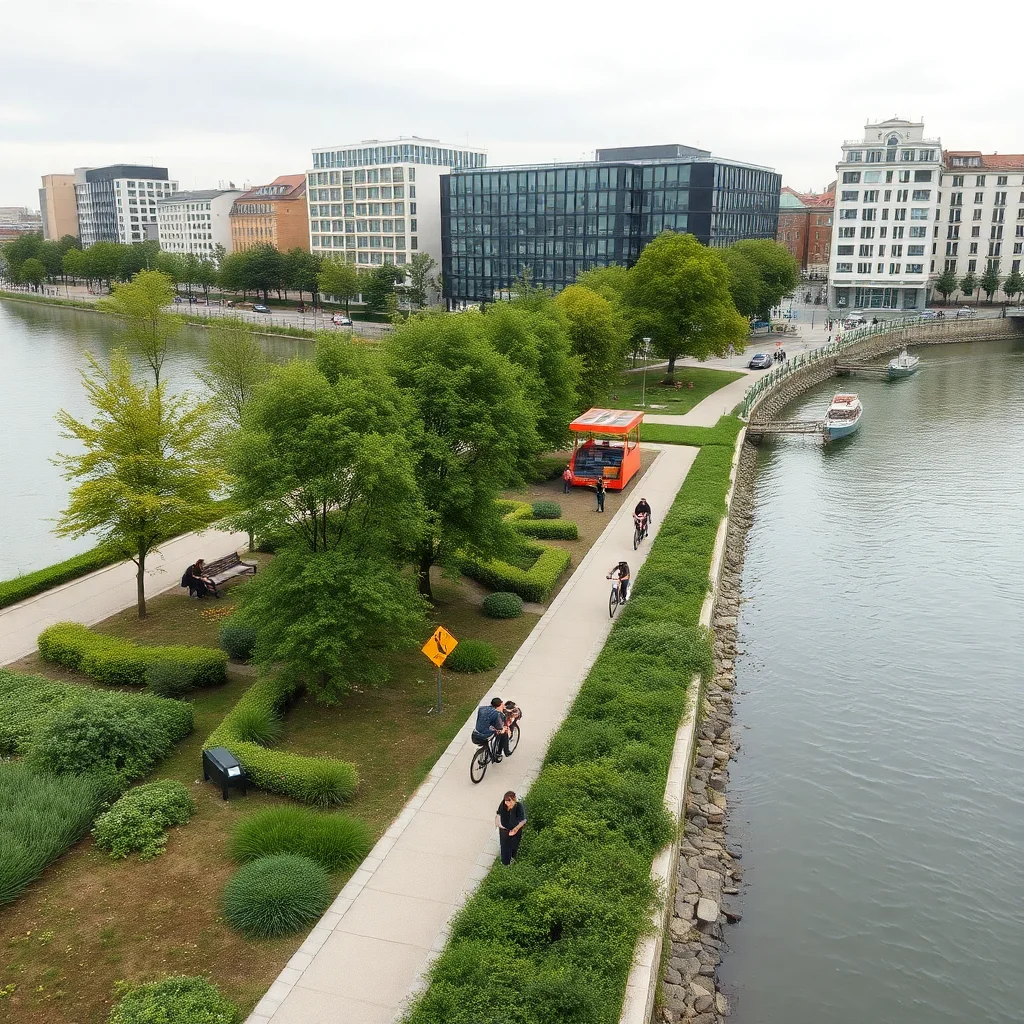
River regeneration is now often sold through the language of landscape: restored banks, biodiversity corridors, permeable surfaces, cooling shade, native planting. These are necessary tools, but they are not sufficient. Ecological repair should not be used as a soft aesthetic that makes development more palatable. It must change how the site behaves hydrologically, how stormwater is handled, how the river edge absorbs seasonal variation, and how people encounter non-human systems.
Felixx Landscape Architects and Planners bring a discipline that matters here, because landscape is not just a visual layer but an urban engine. The strongest European precedents understand this. Madrid Río transformed infrastructure into public landscape by making mobility, ecology, and leisure inseparable. In Basel, river edges and green corridors work as part of a larger urban environmental logic. In each case, landscape did more than decorate the city; it redistributed access to climate comfort, movement, and leisure.
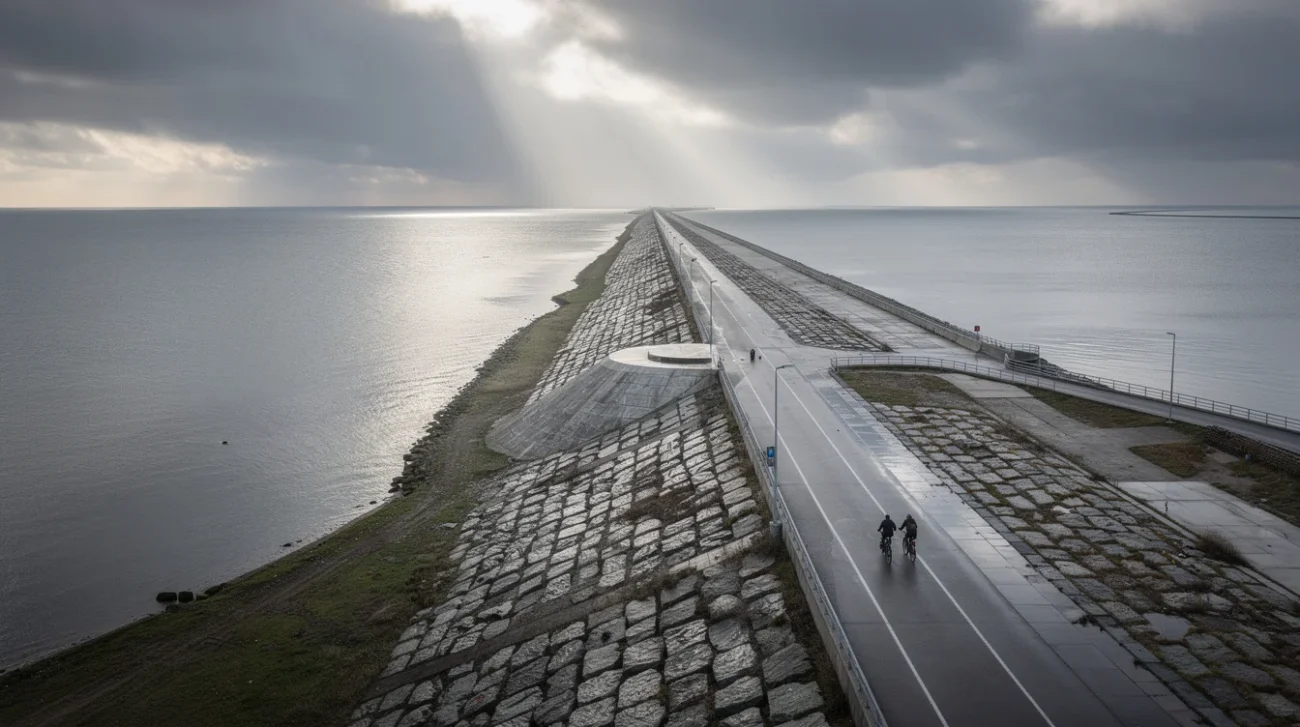
Cluj’s former industrial river edge needs the same seriousness. If the riverbank becomes a styled ecological strip attached to premium development, it will be vulnerable to the old mistake: nature as value-added imagery. Real ecological repair should slow runoff, create habitat, and offer flood-sensitive public terrain. It should also be visible enough for residents to understand that the city is not simply prettifying the river, but renegotiating its relationship with it.
The clearest version of that idea is when weather itself is allowed to shape the project. Rather than treating climate as a problem to conceal, some architects are exploring forms that respond directly to wind, rain, heat, and shade. That approach is close to the argument in architecture that lets weather author the plan, where environmental conditions are not afterthoughts but design partners.
Mixed use is not the same as mixed life
Developers love mixed-use because it sounds plural and inclusive while remaining highly legible to finance. Offices, residences, retail, leisure, and culture can be stacked into one district, producing an urban product that appears complete from day one. But mixed use is not the same thing as mixed life. A district can have many functions and still be socially thin if those functions are aimed at the same demographic, the same income bracket, and the same consumption habits.
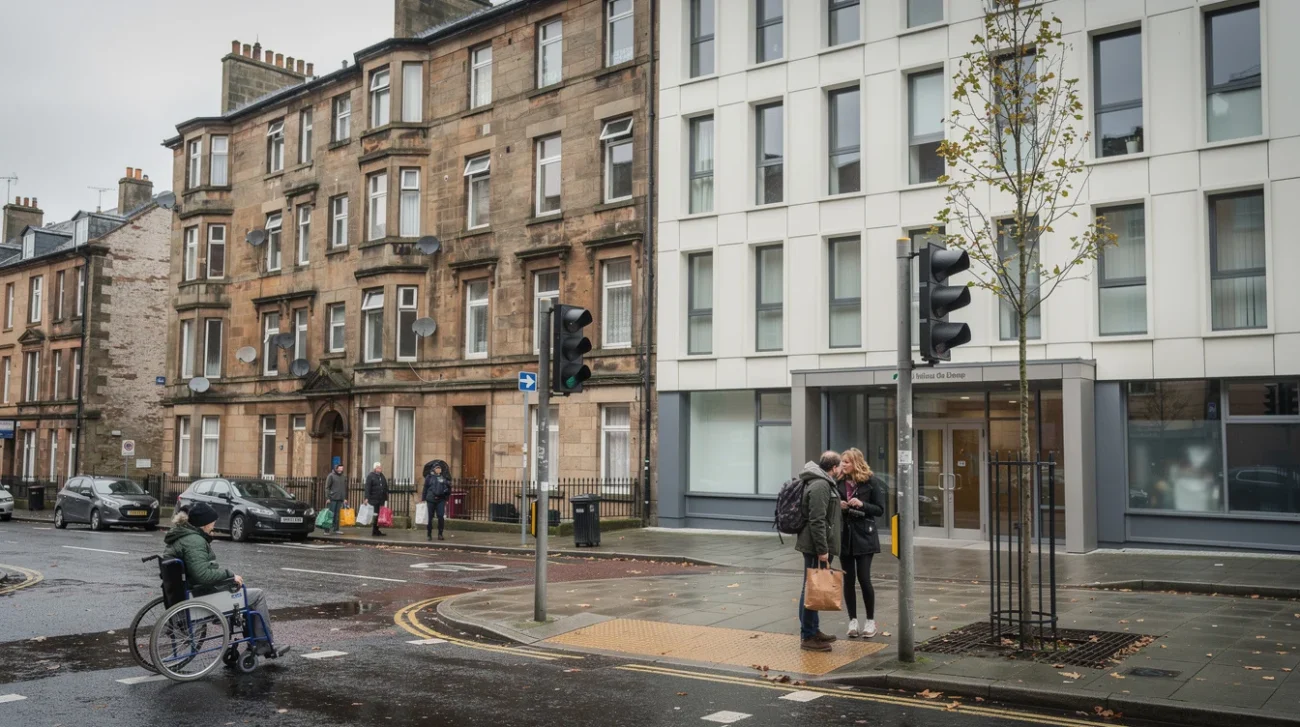
This is where many waterfront redevelopments falter. They deliver a polished density of uses but not a durable civic culture. Real urbanism depends on friction: workers, residents, visitors, children, older people, and non-paying users overlapping in the same space. It depends on thresholds that are generous rather than policed, on informal activity that is not immediately treated as disorder, and on enough spatial redundancy that the district can absorb unpredictability.
UNStudio has long been associated with systemic thinking, from mobility-driven urban schemes to mixed-use environments that seek to blur boundaries. That approach is useful, but it also carries a risk: systems can become overly elegant. The more comprehensively a district is planned, the easier it is to over-determine behavior. Waterfront urbanism should resist becoming too smooth. Civic life is not optimized; it is negotiated. A good river district leaves room for disagreement, improvisation, and uses that cannot be easily monetized.
One reason this matters is that the “in-between” scales of urban life are often what make a district memorable and socially useful. Small structures, kiosks, and casual meeting points can help produce that everyday texture. The thinking behind kiosks and the new third place shows how modest interventions can support a richer public realm without needing to become icons.
The real benchmark is not design quality, but civic resilience
Cluj-Napoca’s riverfront is not merely a local regeneration project. It joins a larger European debate about what to do with underused industrial land in cities that are growing fast enough to attract capital but vulnerable enough to be reshaped by it. The old model of redevelopment was simple: clean up the site, add housing, add retail, add a public square, and call it urban revival. The new model has to do more. It has to produce civic resilience.
That means a waterfront must remain accessible across income groups and across time. It should be usable in winter and summer, day and night, for planned and unplanned activities. It should feel like a civic corridor rather than a gated lifestyle district. It should also be honest about value capture: if public investment, river restoration, and new infrastructure are being used to raise land values, then the project must publicly justify who gains and who is protected from displacement.
In this sense, Cluj’s former industrial river edge is a useful provocation. It shows that waterfront urbanism has matured beyond the old binary of dereliction versus development. The sharper issue is whether public space can remain genuinely public once it becomes economically productive. If the answer is yes, then waterfront regeneration can rebuild civic life. If the answer is no, then the riverfront will simply become another elegant machine for private gain, dressed up as urban generosity.
FAQ
What makes waterfront urbanism different from ordinary redevelopment? Waterfront urbanism deals with a public edge that carries environmental, social, and symbolic weight. It is not just about adding buildings to unused land; it is about redefining how a city meets its river, coast, or harbor.
Why is Cluj-Napoca’s riverfront important beyond Romania? Because it reflects a broader European pattern: former industrial land near water is becoming scarce and highly valuable, so the real issue is whether regeneration can stay public while also attracting investment.
Is mixed-use development enough to create a vibrant district? No. Mixed use can generate activity, but without open access, inclusive public space, and non-commercial everyday use, the result is often a polished but socially narrow enclave.
How can ecological repair be kept from becoming just visual branding? By making it functional: managing stormwater, improving habitat, shaping climate comfort, and designing river edges that visibly respond to seasonal and environmental conditions.
Will public participation prevent gentrification? Not by itself. Participation can improve legitimacy and shape design outcomes, but it must be paired with governance, affordability, and long-term public safeguards to influence who the district serves.
Get the Mainifesto weekly — curated design debates, speculative ideas and the week's best articles every Saturday.
Editorial Perspectives
Questions and counterpoints developed by the Mainifesto editorial desk to extend the discussion.
Perspective 1
Riverfront projects always arrive wrapped in the language of civic repair, but the land value usually has other plans. If Cluj-Napoca is serious about rebuilding civic life, it has to protect uses that are messy, low-margin, and locally owned — otherwise the waterfront becomes a polished backdrop for displacement.
Perspective 2
The interesting question is whether the spatial framework can actually hold everyday civic behavior over time, not just attract footfall. I’d want to know how the design handles thresholds, flood resilience, and program mix so the public realm stays genuinely public after the market pressure settles in.
Perspective 3
This is the old story of the promenade dressed up as urban regeneration: a noble civic script, then the property market quietly takes over the stage. Waterfronts can host civic life, yes, but only when the city accepts that ambiguity and friction are not design failures.
Perspective 4
No, the economics do not magically disappear because the architecture is civic-minded. If the governance, land assembly, and long-term operating model aren’t built to resist capture, the riverfront will be converted into a premium product with a public-facing logo.