
Can Bio-Based Building Be Ordinary Enough to Be Affordable?
The real breakthrough for bio-based architecture will not be another beautiful museum. It will be a contractor pricing a hempcrete wall without adding a premium for uncertainty.
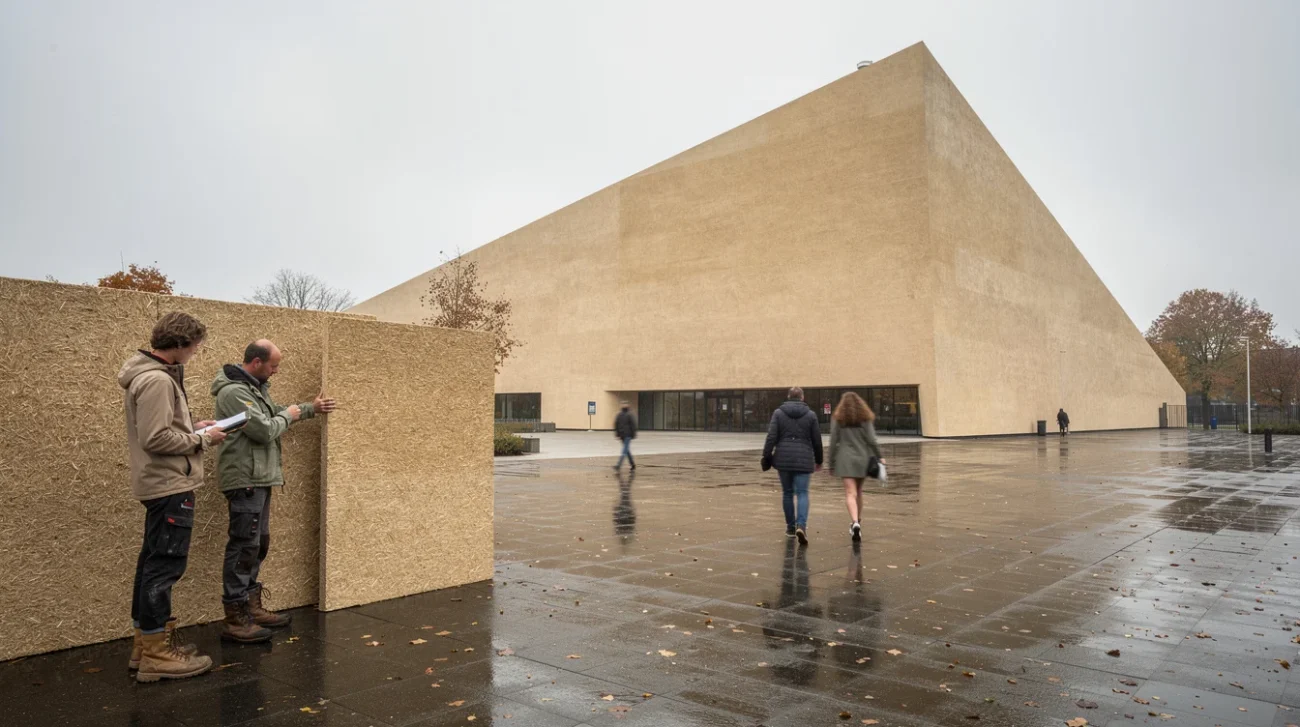
Museum Vonk, the wedge-shaped history museum in Eindhoven by Studio Marco Vermeulen, makes that distinction newly urgent. As reported by Dezeen, its hempcrete facades are coloured with pigmented lime plaster, and its material palette draws on biomaterials. Built on a former driving-school track, it explores 10,000 years of regional history through hands-on, interactive experiences. Yet its most consequential proposition concerns the future: the museum is presented as a testing ground for affordable bio-based construction.
Testing ground is the right phrase. Proof would be premature. The source account supplied here provides no itemised construction budget, labour breakdown or like-for-like comparison with a conventional specification. What Vonk offers is therefore a question worth taking seriously, not an economic verdict. Can materials associated with experimental commissions become ordinary enough for a school extension, a housing development or a warehouse whose client cannot afford an architectural research programme?
A showcase is a hypothesis, not a price benchmark
Museums can legitimise unfamiliar materials. They give architects room to explain an approach, attract attention to suppliers and demonstrate that ecological construction need not look apologetic. Vonk’s coloured lime plaster matters in this respect: it takes hempcrete beyond the familiar visual language of earnest, beige sustainability. Desirability helps build a market.
But desirability and affordability answer different questions. A cultural commission can accommodate ambitions, fundraising structures and design effort that ordinary developments cannot. That does not establish that Vonk received unusual financial support; it identifies the variables any serious evaluation should disclose. Who paid for testing? How much design coordination was required? Did suppliers contribute development work outside the construction contract?
Practice Architecture’s Flat House at Margent Farm in Cambridgeshire offers a useful parallel. Its prefabricated hemp-based construction demonstrates an architectural and manufacturing possibility. It does not, by itself, establish a universally competitive housing price. The same discipline should apply in Eindhoven: celebrate what has been built, then separate the demonstrator’s achievements from its transferable economics.
A prototype earns its importance by revealing what the next project can avoid paying for. Without that distinction, every exceptional building becomes an advertisement for a market that does not yet exist.
The wall is cheap only if the work is counted
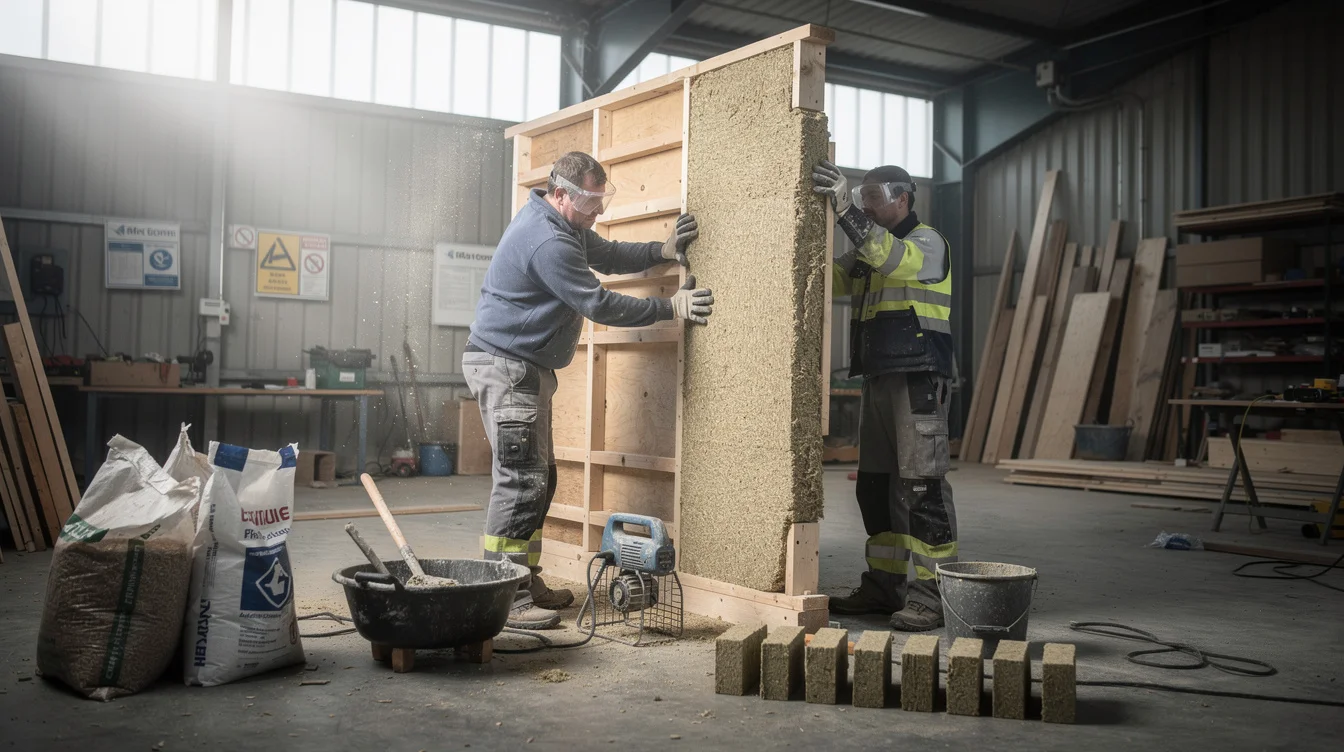
Hempcrete is generally a non-loadbearing composite of hemp shiv and a lime-based binder. It typically needs a supporting structure, weather-conscious detailing and compatible finishes. Comparing a quantity of hemp shiv with a quantity of concrete therefore produces a seductive but largely useless number. The relevant comparison is between complete assemblies delivering equivalent structural, thermal, moisture, fire and acoustic performance.
For cast-in-place hempcrete, the bill can include mixing, formwork, placement, coordination and drying time. Drying may affect when subsequent work can proceed, depending on the system and conditions. Blocks or prefabricated panels can move some work into a factory, but introduce their own manufacturing, transport, lifting and connection costs. Neither route is automatically the economical one.
Consider an ordinary school extension. If its wall system requires additional site visits from a specialist, unfamiliar fixings and a revised programme before classrooms can open, those consequences belong in the material decision. Conversely, if a well-developed assembly combines functions and eliminates separate layers or operations, that saving belongs there too.
The available source summary does not identify Vonk’s installation method. It would be misleading to assign it a particular labour profile. The useful demand is simpler: publish hours per square metre, crew composition, programme effects and remedial work alongside the finished facade photographs.
Procurement can erase a material saving
A building product does not become affordable merely because its feedstock grows quickly. Hemp must be processed into suitable shiv, combined with an appropriate binder and delivered in a consistent form. Designers need credible product information. Contractors need dependable lead times. Clients and insurers need confidence that the proposed assembly can meet their requirements.
Each missing piece creates transaction costs. A cheaper wall material can lose its advantage if the design team spends weeks obtaining evidence or the contractor prices an unfamiliar junction as a risk. A single distant supplier can make replacement orders disproportionately expensive. Local cultivation is not the same thing as a local construction supply chain.
LILAC, the cohousing development in Leeds designed by White Design using ModCell straw-based panels, points towards a more useful unit of analysis: the repeatable system rather than the heroic raw material. Straw’s agricultural abundance is only part of the proposition. Panel production, interfaces and installation determine whether that abundance translates into buildable value.
For Vonk’s experiment to travel, other teams need accessible specifications and a realistic procurement map. Who supplies the assembly, who installs it, and who can step in if either fails? Competitive tendering becomes fragile when only one bidder understands the wall.
Specialist knowledge must stop being a luxury service
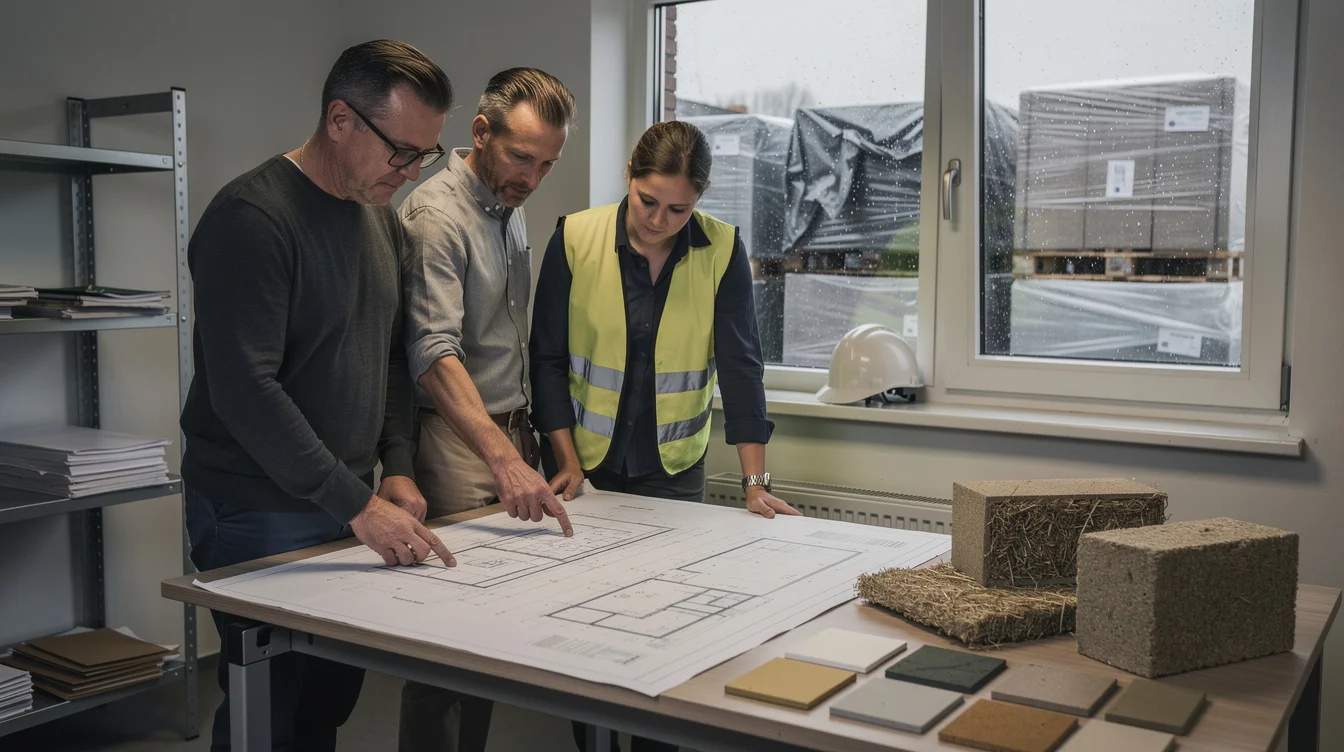
Bio-based construction often depends on people who understand moisture movement, binder behaviour and material tolerances unusually well. Their expertise is valuable. The affordability problem emerges when every project must purchase that knowledge anew, through bespoke consultancy and repeated design development.
The answer is not to pretend that a conventional crew can improvise its way through an unfamiliar specification. Poor sequencing or inappropriate finishes can turn an apparent saving into a defect. Training, sample panels and inspections are legitimate costs, not embarrassing qualifications to an ecological success story.
Instead, specialist knowledge must become reusable infrastructure: tested details, clear installation guidance, recognised training and assemblies with documented performance. Adnams’ distribution centre near Southwold, completed in 2006 with hemp-lime construction, is a reminder that the material’s use beyond boutique housing is not new. The uncomfortable question is why such precedents have not made procurement routine everywhere.
Some obstacles are regional, some regulatory, some commercial. None disappears because architects discover a fresh aesthetic. A public client could make progress by commissioning a series of modest buildings with a consistent system, allowing teams to carry learning forward. Repetition is less glamorous than a landmark, but it is how expensive judgement can become ordinary competence.
Affordable for whom, and over what period?
Upfront affordability and lifetime value must remain distinct. A client with a fixed capital budget cannot necessarily spend more today against a promise of future savings. Developers, tenants and long-term owners also capture different benefits. An assembly that makes sense for a municipality retaining a building for decades may not fit a speculative development’s financing.
Bio-based materials can offer carbon-storage and environmental benefits, but these depend on cultivation, processing, binder composition, transport, service life and end-of-life assumptions. Hemp content alone does not justify calling a finished building carbon-negative. Nor does a favourable carbon assessment pay the contractor’s invoice unless procurement rules, incentives or financing assign it financial value.
Operational savings also require evidence at building level. Airtightness, glazing, services, shading and occupant behaviour affect energy demand; hempcrete cannot claim the performance of the entire design. The practical demands of building maintenance should be assessed with similar care. Repairable lime finishes may offer advantages, but exposure, detailing and access determine actual upkeep.
A credible account of Vonk’s affordability would therefore distinguish capital cost, operating cost, maintenance and embodied environmental impacts. Bundling them into one reassuring sustainability narrative makes the numbers impossible to challenge—and leaves cash-constrained clients with very little they can use.
The next commission should be deliberately unexceptional
Vonk’s strongest potential contribution is not to prove that biomaterials belong in a museum. It is to produce information that makes them less risky somewhere else. That requires an economic record as carefully designed as the building itself: quantities, complete assembly costs, labour hours, testing expenditure, procurement delays and the cost of resolving mistakes.
The comparison should use a credible conventional alternative for the same brief, location and procurement period—not a generic national average or an inferior wall. One-off research costs should be visible rather than quietly deleted. Then a repeat-build estimate should explain which costs could fall, by how much, and on what assumptions. Economies of scale are a proposition to test, not a discount to apply in advance.
The decisive follow-up could be a municipal workshop or a small housing scheme: repetitive geometry, normal deadlines, a firm cost ceiling and a contractor without a reputation for ecological experimentation. If the system survives those conditions, the museum’s claim gains substance.
Bio-based construction does not need to become aesthetically ordinary. It needs to become administratively, commercially and technically ordinary. That is a more demanding ambition than material novelty—and a much more consequential one for architecture.
FAQ
Is hempcrete cheaper than conventional construction?
There is no universal answer. Compare complete wall assemblies with equivalent performance, including supporting structure, finishes, labour, drying or installation time, transport and compliance work. A low raw-material price does not establish a low installed cost.
Does Museum Vonk prove that bio-based building is affordable?
Not from the source information available here. Its testing-ground claim is significant, but establishing affordability requires a documented budget, a credible conventional comparison and evidence that the approach can be repeated without exceptional resources.
Can prefabrication make biomaterials more competitive?
It can reduce some site work and improve consistency. However, factory overheads, transport, lifting, connections and production volume matter. Prefabrication becomes economical through a viable production and delivery system, not simply by moving construction indoors.
What would help bio-based construction reach everyday budgets?
Reliable suppliers, standardised assemblies, reusable technical evidence, trained installers and repeat commissions could reduce uncertainty and duplicated work. Publishing actual project costs would let clients distinguish demonstrated savings from optimistic forecasts.
If the next bio-based building must meet an ordinary budget without special treatment, what should change first: the material system, the procurement rules or architecture’s appetite for the exceptional?
Watch the Mainifesto Short
Get the Mainifesto weekly — curated design debates, speculative ideas and the week's best articles every Saturday.
Editorial Perspectives
Questions and counterpoints developed by the Mainifesto editorial desk to extend the discussion.
Perspective 1
Change the procurement first: get the contractor and supplier pricing a repeatable wall build-up before the design is fixed. Hempcrete has to compete as an installed system, including programme and labour—not as a cheap ingredient with an expensive support act.
Perspective 2
Architecture’s appetite for the exceptional should change first: a new bio-based landmark shouldn’t get a free pass while an adaptable building next door is demolished. But ordinary budgets needn’t mean identical buildings—retain what works, pay for local skills, and ask whether the people already there can afford to stay.