Global Antiquity: Did Objects’ Meanings Cross Borders?
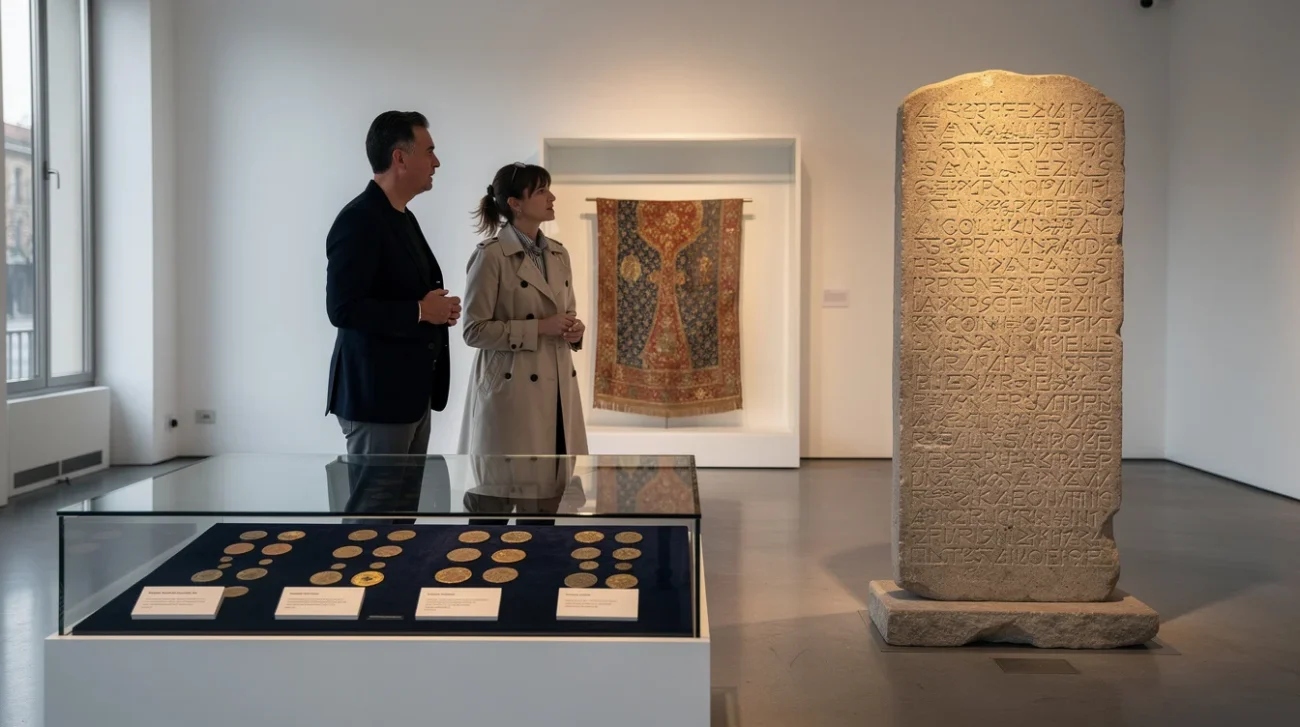
Ancient Objects Crossed Borders—but Did Their Meanings Travel Too?
An ancient coin can cross a frontier without carrying its issuing ruler’s authority. Silk can leave a workshop as merchandise and enter a sanctuary as sacred wrapping. A stele can borrow a visual language while making an emphatically local claim. Movement is not the same as continuity. That distinction should sit at the centre of any exhibition that turns antiquity into a network.
As framed in designboom’s account, Fondazione Prada’s Global Antiquity uses objects, routes, rituals and visual languages to challenge bounded accounts of civilisation. This is a necessary intervention: cultures were never the sealed containers that national museums often make them appear. But connection is not automatically an explanation, much less an ethical achievement. The following historical comparisons and design precedents are tools for assessing that proposition, not claims about the exhibition’s checklist or installed displays.
PRO: The Network Breaks Open the Civilisation Box
The strongest argument for a connected antiquity is that objects routinely contradict the categories museums impose on them. Separate galleries labelled Greek, Roman, Indian or Chinese can make those categories look like original conditions rather than retrospective sorting systems. Trade, migration, diplomacy and conquest become footnotes to supposedly self-contained traditions. A networked exhibition reverses that hierarchy: contact becomes constitutive, not incidental.
Kushan coinage offers a precise comparison. Under Kanishka I, coins included representations of deities associated with several religious traditions; some depicted the Buddha. Their scripts and imagery register a political environment that cannot be understood through a single modern national category. Yet the interesting question is not simply how many cultures appear on one surface. It is what this plurality enabled an imperial issuer to say, and which audiences could recognise the claim.
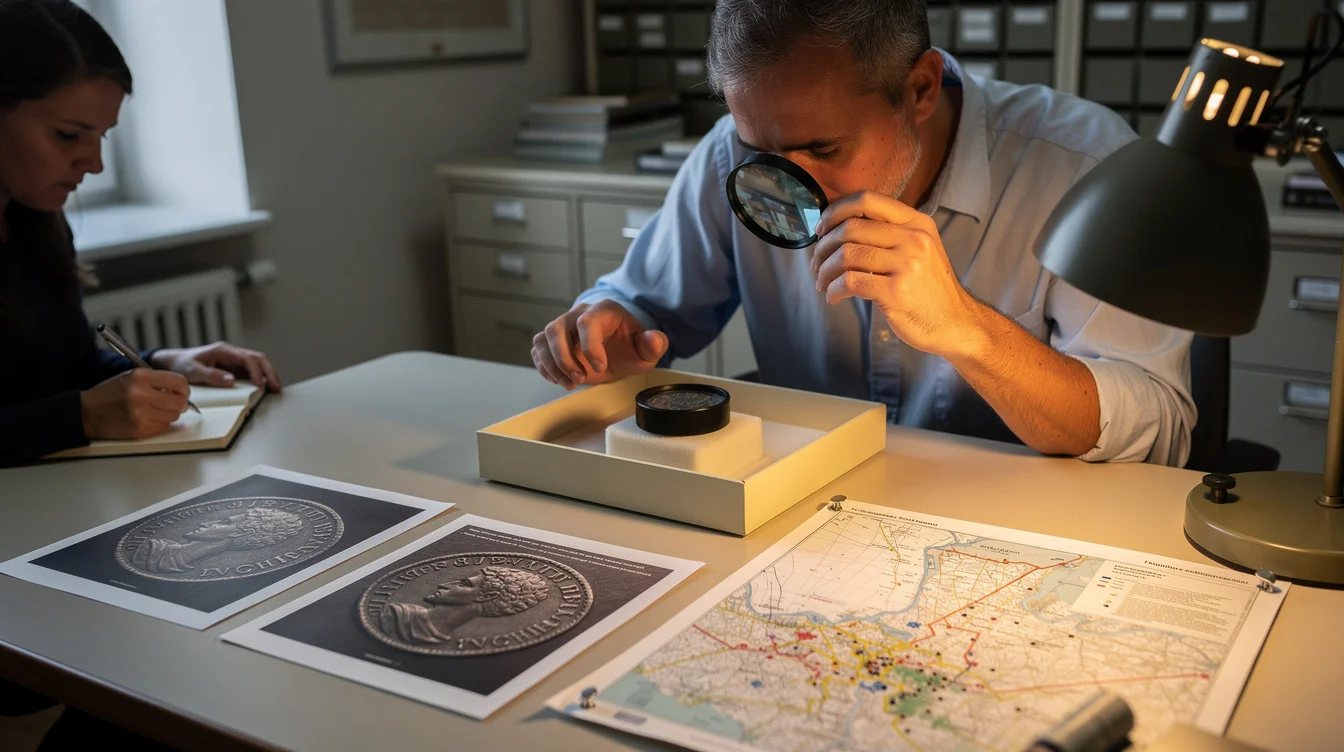
Exhibition design can make those questions visible by bringing different scales into one encounter: an enlarged photograph of a coin, the actual object, a dated account of its production and a map of documented circulation. The map should follow the evidence, not manufacture a seamless world. Distinguishing a mint from a findspot prevents an attractive line from becoming a false itinerary. Displaying uncertainty is not a failure of storytelling; it is the point at which storytelling becomes intellectually credible.
PRO: Good Design Can Show Meaning Being Remade
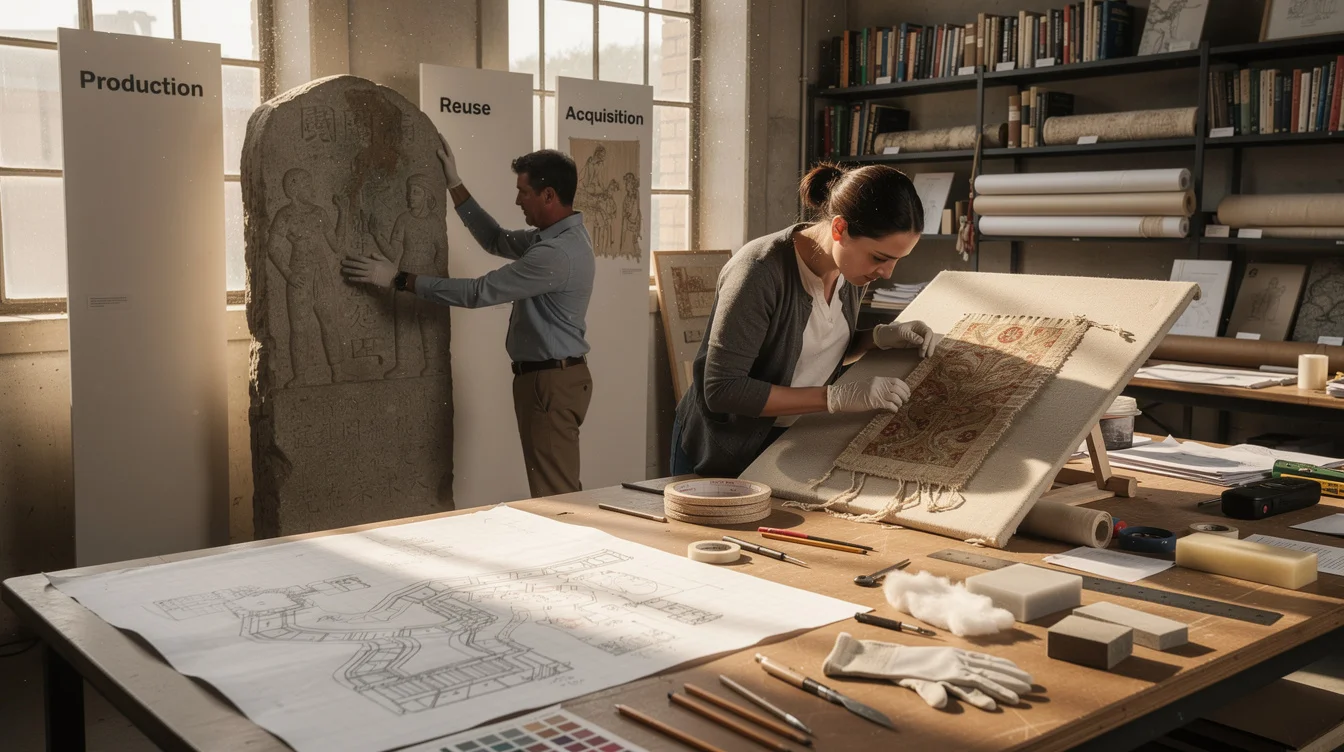
Connection becomes more persuasive when a display shows transformation rather than resemblance. Silk is especially useful because its material durability and portability allowed it to pass between radically different systems of value. Patterned silks associated with Central Asian production and exchange entered courts, churches and treasuries far from their places of manufacture. Some imported textiles were subsequently cut, reused or preserved as wrappings for Christian relics in medieval Europe. The fabric travelled; its function did not remain fixed.
A comparative display could organise such histories around successive actions: weaving, buying, gifting, cutting, consecrating and conserving. Magnified seams and surviving folds would then matter as much as decorative motifs. A merchant’s commodity and a sanctuary’s treasured wrapping would become different episodes in an object biography, rather than interchangeable evidence of an ancient global marketplace. Where the sequence is uncertain, the label should say so.
Lina Bo Bardi’s glass easels for the Museu de Arte de São Paulo, introduced in 1968, offer a useful spatial precedent—not an antiquities template. Their freestanding arrangement challenged the authority of the wall and allowed visitors to form relationships across works. An antiquities exhibition could borrow that openness while supplying more explicit chronological and contextual anchors. Multiple sightlines can break the civilisation box; carefully positioned interpretation must stop the resulting room from becoming a warehouse of beautiful affinities.
CONTRA: The Network Can Launder Unequal Power
The case against the connective narrative is equally strong: a route diagram can make coercion look like circulation. A line between two places does not reveal whether an object moved as merchandise, tribute, diplomatic gift, military booty or the possession of someone forced to migrate. These are not different flavours of exchange. They are different political relationships, with different distributions of agency.
Even a coin’s apparent mobility needs scrutiny. Away from its issuing authority, it might have been valued as bullion, pierced for suspension or adapted to a local monetary system. Those possibilities require object-specific evidence; none should be inferred simply because a coin was found far from its mint. A display that treats every distant find as successful cultural communication risks mistaking movement for consent and recognisability for shared belief.
Fred Wilson’s Mining the Museum, staged at the Maryland Historical Society in 1992, remains a decisive counterexample to comfortable museum storytelling. By juxtaposing objects including silver vessels and slave shackles, Wilson exposed the violence excluded from conventional accounts of refinement. For antiquities, the equivalent is not theatrical accusation without evidence. It is an insistence on showing the conditions of movement alongside its aesthetic results. A beautiful route map needs a political key: who transported, who commissioned, who profited, and whose choices the archive does not preserve.
CONTRA: Similar Forms Do Not Guarantee Shared Meanings
Visual comparison is powerful precisely because it can outrun interpretation. Put related motifs under matching lights and visitors may conclude that the objects express the same idea. The Xi’an stele of 781, which records the history of Christianity in Tang China through a largely Chinese inscription with Syriac elements, offers a useful warning. Its significance cannot be reduced to proof that Christianity travelled east. It also concerns how a religious community presented itself within a particular political and intellectual setting.
A responsible comparative display would provide selected translated passages, identify their intended claims and distinguish textual evidence from visual inference. It would ask how local vocabularies reshaped religious expression, rather than treating a familiar-looking form as a universal symbol. Meaning is negotiated in place; it is not freight sealed inside an object.
Carlo Scarpa’s work at Verona’s Castelvecchio Museum offers a relevant design lesson: mounts, intervals and carefully constructed viewpoints can make an object demand concentrated attention. That is the necessary counterweight to the panoramic network. Objects need relationships, but also room to resist equivalence. Ancient movement must also be distinguished from modern collecting: excavation, sale, export and accession belong on a separate evidentiary timeline. The strongest exhibition would make connectedness harder to consume, not easier—preserving the discontinuities that turn a universal story into accountable histories.
FAQ: Reading Cultural Movement Without Flattening It
What is the central issue raised by Global Antiquity?
Its connective framing challenges the idea that ancient civilisations developed in isolation. The critical issue is whether those connections are explained as historically specific encounters or presented as a reassuring, undifferentiated story of shared culture.
Did ancient objects retain their original meanings abroad?
Not necessarily. A coin could acquire a different monetary or ornamental role; imported silk could become a sacred wrapping. Changes must be established through evidence such as inscriptions, alterations, find contexts and documentary records.
How can exhibition design distinguish exchange from appropriation?
Labels and maps should identify the mechanism of transfer where known, the actors involved and the limits of the evidence. Appropriation requires an account of power and use; visual borrowing alone does not settle the question.
Why separate ancient circulation from modern provenance?
They answer different questions. Ancient circulation concerns historical movement and use; modern provenance concerns later custody and acquisition. Showing both prevents an object’s ancient mobility from becoming an excuse to avoid examining how it entered a collection.
If an exhibition makes every culture look connected, what must it show to keep connection from becoming another name for possession?
Get the Mainifesto weekly — curated design debates, speculative ideas and the week's best articles every Saturday.
Editorial Perspectives
Questions and counterpoints developed by the Mainifesto editorial desk to extend the discussion.
Perspective 1
I’m for showing antiquity as connected rather than sealed into separate cultures. Follow the materials: where they were extracted, whose labour shaped them, and whether objects travelled through trade, tribute or force. That gives connection an ecological and political history, instead of treating movement as inherently good.
Perspective 2
I’m skeptical of an exhibition that makes everything look connected: visual similarity is not evidence of equal exchange. In manufacturing, a shared technique tells you little about who controls production or captures the value; museums need that same distinction. Put provenance gaps, coercion and contested ownership beside the objects, even when they interrupt the elegant display.