

Banning Destruction Does Not Design Out Surplus

A coat can survive the shredder and still represent a failure of design. Its fabric has already consumed resources; its manufacture has already required energy and labour. If nobody wants it, keeping it intact does not reverse those costs. It merely leaves the industry with a more uncomfortable question: what, exactly, was this product made for?
The EU’s ban on destroying unsold fashion is a necessary intervention against an indefensible practice. But it also exposes a convenient confusion between protecting objects and preventing waste. A brand can comply with restrictions on destruction while continuing to commission more garments than it can sell. Its warehouse becomes cleaner evidence of the same commercial dysfunction.
The designboom report framing the new rules asks whether the ban goes far enough. The sharper question is whether fashion will use product longevity to avoid discussing production volume. Repairable excess is still excess. Alteration, maintenance and resale matter enormously, but only if they change what gets made next—not simply what happens to the leftovers.
The ban closes a disposal route, not the production tap
Under the EU’s Ecodesign for Sustainable Products Regulation, the prohibition on destroying unsold apparel, clothing accessories and footwear applies to large enterprises from 19 July 2026. Medium-sized enterprises follow in 2030; micro and small enterprises are exempt. The framework also allows defined derogations, including for certain health, hygiene and safety circumstances. This is not a universal prohibition covering every company, every product and every condition.
Nor should recycling be presented as an automatic escape hatch. The regulation’s definition of destruction includes discarding products as waste, with an exception for discarding solely to prepare them for reuse, including refurbishment or remanufacturing. Sending unsold stock to a shredder does not become acceptable merely because someone calls the resulting fibre circular.
The intervention nevertheless targets the fate of products after manufacture. It does not establish a general ceiling on how many garments a brand can commission. Burberry’s 2018 commitment to stop destroying unsaleable products, following public backlash, illustrated the distinction years before this legislation: ending destruction changes an inventory practice, but does not by itself demonstrate reduced production.
The ban creates friction where there was once an exit. Storage costs, discounting and redistribution can make surplus less attractive. Whether that friction changes buying decisions is the real test—not the number of garments diverted from a furnace.
Luxury’s scarcity problem is designed in the buying office
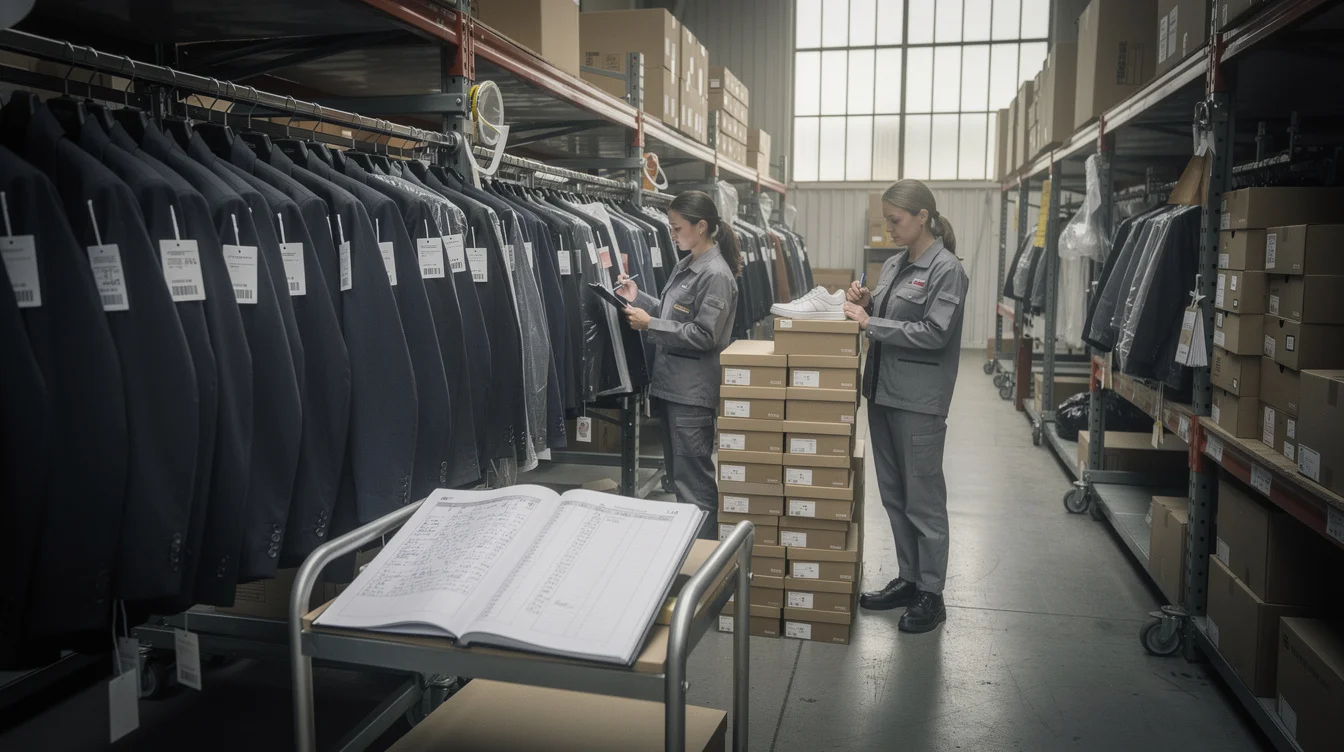
Fashion does not produce excess solely because forecasting is imperfect. Excess can also support a commercial proposition: full size runs, immediate availability, frequent novelty and enough stock to capture optimistic demand. The costs of producing too much are weighed against the feared costs of missing a sale. When disposal is cheap, that calculation can favour abundance.
Luxury adds another contradiction. A product must appear scarce while remaining available to the right customer in the right location. Deep discounts threaten the pricing story; visible leftovers expose the distance between manufactured exclusivity and actual demand. Destroying stock has offered a brutal way of protecting that story.
A ban disrupts this arrangement, but brands can still redirect inventory into outlets, storage, donation or secondary markets. Those routes are not equivalent. A well-matched donation can meet a genuine need; an indiscriminate shipment can transfer sorting costs and eventual waste to someone else. Export is a destination change, not proof of a useful second life.
Made-to-order businesses such as MaisonCléo offer a different starting point: obtain demand before committing to finished garments. The model has constraints, including waiting times and production capacity. But it tackles the sequence of decisions. Rather than designing an elegant afterlife for unwanted stock, it questions why that stock needed to exist.
Repair only works when someone wants to keep the garment
Product designers have substantial agency here. A replaceable zip, accessible seam, durable lining and available spare button can turn a minor failure into a repair instead of a disposal decision. Mixed materials, bonded assemblies and inaccessible components can make the opposite outcome almost inevitable. Repairability is not a mood board of visible stitching; it is a technical specification.
Nudie Jeans makes the argument tangible through repair services for its jeans. Patagonia’s Worn Wear combines repair activity with used-product resale in participating markets. These programmes demonstrate that the relationship between brand and wearer need not end at checkout. They also reveal what repair requires beyond the object: trained workers, logistics, customer communication and a budget.
Yet an unworn garment has no broken zip to fix. Its problem may be price, fit, style or the absence of a customer. Repair infrastructure cannot manufacture affection for a product that should not have been ordered in that quantity.
Durability also has to be measured in use, not merely in laboratory survival. A jacket capable of lasting twenty years delivers little environmental benefit if it spends nineteen of them untouched. The relevant achievement is extended service that reduces replacement demand. A repair count is useful evidence of activity, but not, on its own, evidence that fewer new garments were manufactured.
Alteration can rescue fit—but cannot tailor away volume
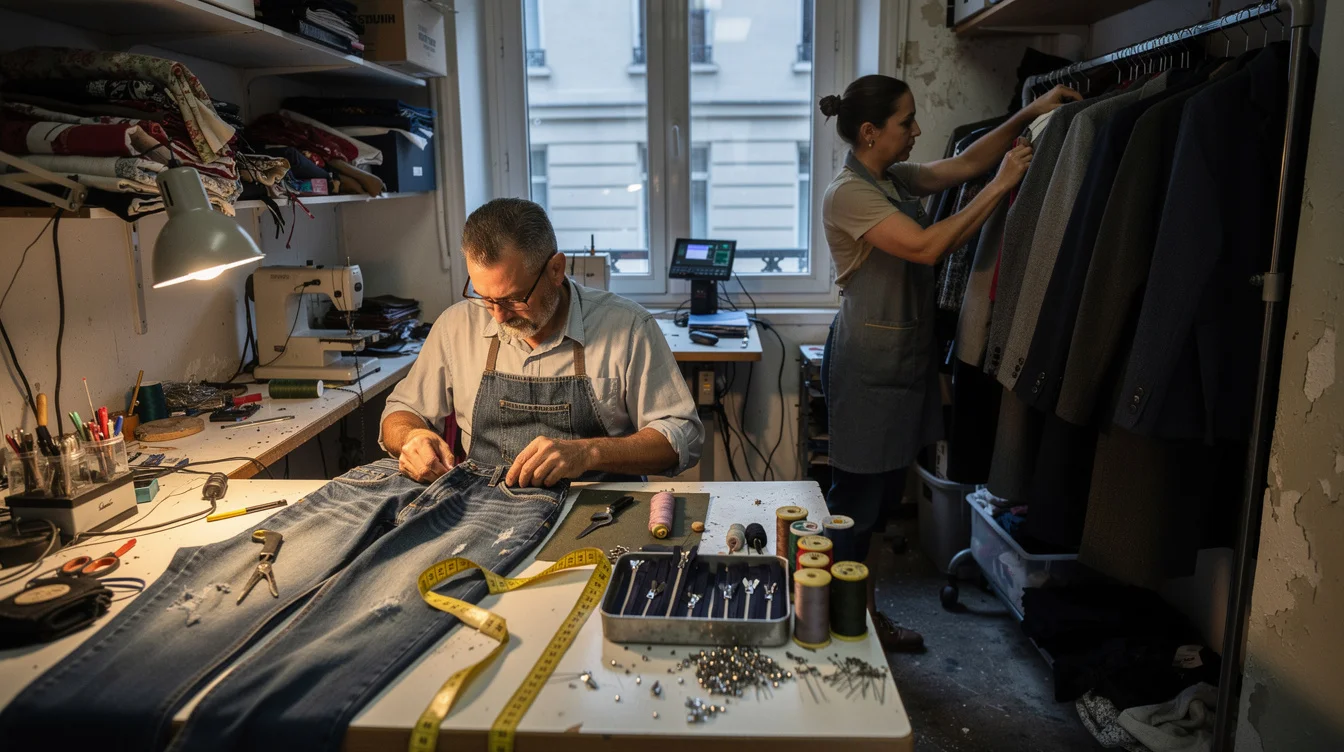
Alteration deserves more attention than it receives in circular-fashion rhetoric. Bodies change; standardised sizing excludes; a desirable garment can become unwearable through a small mismatch. Generous seam allowances, adjustable waistbands, hems with usable reserves and components that can be removed without destroying surrounding fabric can keep clothing in circulation.
Designers such as Holly McQuillan and Timo Rissanen have challenged conventional cutting through zero-waste fashion design. Their work matters because it treats material efficiency as a design problem rather than a bin-management problem. But it also helps expose a distinction: eliminating cutting scraps is not the same as eliminating finished-product surplus. A highly efficient pattern can still be multiplied into thousands of unwanted garments.
There are trade-offs rather than a single virtuous specification. Extra cloth for future alteration may conflict with minimising fabric in the initial garment. A design brief should evaluate the likely use and repair pathway instead of mechanically rewarding the lightest product.
The missing infrastructure is often local and decidedly unglamorous: alteration counters, accessible fitting rooms and fairly paid sewing expertise. Brands that celebrate adaptable clothing while making alterations inconvenient or unaffordable have designed a theoretical capability, not a functioning service. The seam allowance matters; so does the person who can use it.
Resale needs a customer, not just a platform
Eileen Fisher’s Renew programme offers a concrete model of taking back clothing and sorting it for pathways including resale. Alongside initiatives such as Patagonia’s Worn Wear, it makes a valuable proposition visible: the brand can remain involved after the first transaction. Product knowledge, recognisable quality and established customers can help support a second market.
But resale is not an infinite reservoir. Garments still need buyers, and collecting, inspecting, cleaning, photographing and distributing them requires labour and resources. An inexpensive item may cost more to process than it can recover. A luxury item may retain value, yet its resale does not automatically prevent a new purchase.
Take-back vouchers make the tension especially clear. They can encourage returns, but when redeemable against new stock they also stimulate another primary-market transaction. The business can report circular participation while continuing to expand first-hand sales. Whether that produces a net environmental improvement depends on actual behaviour, including how much new purchasing is displaced.
A resale listing is not a waste-reduction outcome. Neither is a collection box. Designers should ask what proportion of returned garments finds sustained use, what happens to rejected items and whether insights from returns reduce future orders. Without that feedback loop, circularity risks becoming an additional sales department attached to an unchanged production machine.
Make longevity answer to the production ledger
The most consequential design document may therefore be neither the pattern nor the repair manual. It may be the buying plan. If repair, alteration and resale are to reduce surplus, they must influence initial order quantities, replenishment decisions and the frequency of new releases. Otherwise, the industry improves the management of excess while preserving its creation.
A credible brand should disclose more than garments collected or repairs completed. It should report units placed on the market, unsold inventory, the destinations of surplus and the relationship between second-life sales and new production. Absolute volumes matter alongside percentages: a falling surplus rate can conceal rising numbers of unwanted products when overall output expands.
Policy can reinforce that discipline. Producer-responsibility fees could be designed to reflect relevant product characteristics and waste-management costs. Public procurement can require repair services and spare components. Stronger verification of surplus destinations can discourage the export of disposal problems. These are complementary measures, not claims that the current destruction ban already delivers them.
The EU has drawn a necessary line: commercial disappointment should not automatically authorise destruction. Product design must now draw another. A garment is not responsibly designed simply because it can survive multiple owners. Its production must also answer to plausible demand. The ambition should be fewer unwanted products—not increasingly sophisticated systems for keeping unwanted products moving.
FAQ
What does the EU’s unsold fashion ban cover?
It prohibits the destruction of unsold apparel, clothing accessories and footwear by covered enterprises, subject to defined derogations. It applies to large enterprises from July 2026 and medium-sized enterprises from 2030; micro and small enterprises are exempt.
Does the ban stop brands from overproducing?
No. It restricts a disposal route rather than imposing a general production cap. Higher costs of managing surplus may discourage excess orders, but reduced production is not an automatic consequence.
Can repair and alteration meaningfully reduce fashion waste?
Yes, when they extend actual use and reduce replacement purchases. They require suitable construction, affordable services and skilled labour. They cannot independently solve the problem of manufacturing garments that have no willing customer.
Is resale proof that a brand is becoming more sustainable?
No. Resale can extend product use, but its benefits depend on processing impacts, successful reuse and displacement of new purchases. Brands should show whether resale changes their new-production decisions, not merely report growing resale transactions.
If fashion remains free to manufacture unlimited excess, are we designing a less wasteful industry—or simply a more respectable warehouse?
Watch the Mainifesto Short
Get the Mainifesto weekly — curated design debates, speculative ideas and the week's best articles every Saturday.
Editorial Perspectives
Questions and counterpoints developed by the Mainifesto editorial desk to extend the discussion.
Perspective 1
Keeping unsold clothes intact is better than destroying them, but somebody still pays for the space they occupy. Repair and resale need to recover more than their handling and storage costs, or we’re just giving excess stock a longer lease.
Perspective 2
Try booking an alteration or returning a resale purchase: if either is a headache, customers will buy new. Make those services convenient and profitable, then show me that they’re replacing new production—not becoming another sales channel alongside it.
Perspective 3
In exhibitions, what disappears behind a partition can make the room feel resolved while leaving the storeroom full. The ban risks doing something similar for fashion: a cleaner public face, with the excess still there. Repair deserves a visible place in the shop, but the stockroom needs to get smaller too.