Circular Homes Need Take-Back Agreements That Last

A Circular Home Is Only as Reliable as Its Exit Agreements
A screw can remain removable long after the company that supplied it disappears. That is the uncomfortable gap at the heart of circular interiors: physical reversibility can be designed into a room, but commercial continuity cannot be detailed like a joint.
Urselmann Interior’s renovation of a 1939 apartment in Düsseldorf brings that gap into unusually sharp focus. As reported by designboom, the project combines reversible dry joinery, flexible multi-tiered timber platforms and operable textiles with nine manufacturer take-back agreements. The proposition goes beyond making an interior adaptable. It connects materials to organisations expected to receive them later.
That deserves attention. Too many projects call themselves circular because their components could theoretically be dismantled. Here, the return journey has at least entered the commercial conversation. But nine agreements are not nine guaranteed futures. The supplied project account does not establish their duration, transferability, collection costs or provisions for supplier insolvency. Those are not administrative footnotes. They determine whether a future resident inherits a resource or a removal bill.
The provocation is simple: a circular home needs an exit infrastructure, not just an exit intention. Architecture must start treating the durability of its agreements as seriously as the durability of its materials.
The Joint Is Only Half the Design
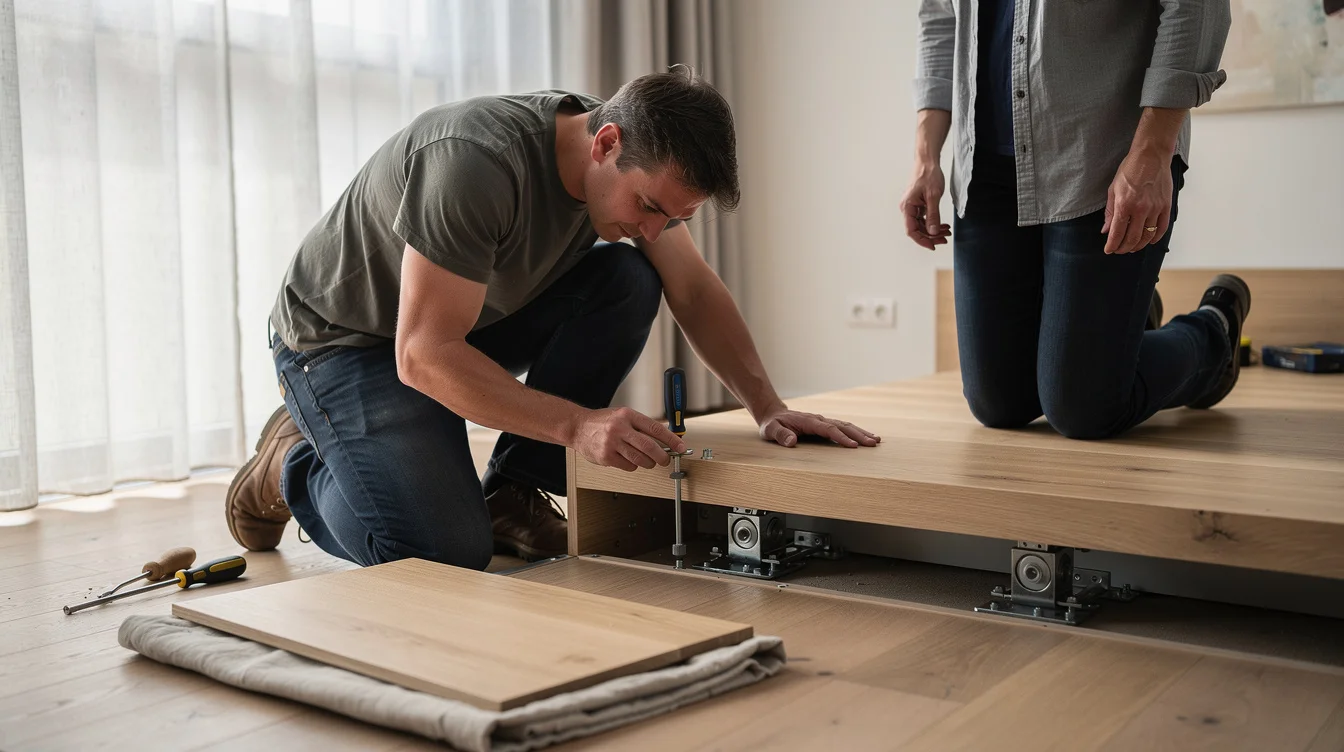
The Düsseldorf interior makes a persuasive physical argument. Dry connections avoid the destructive entanglements created by many bonded assemblies. Stepped timber platforms allow changes in level to organise occupation, while movable textiles offer a lighter means of dividing space than permanently fixing another partition. These choices can keep an interior useful through changing routines.
There is a lineage here. N. John Habraken’s support-and-infill thinking separated long-lived building structures from the shorter-lived elements shaped by occupants. Stewart Brand’s account of buildings as layers changing at different speeds likewise challenged the fantasy that a completed design should remain frozen. Urselmann Interior’s approach belongs within that broader argument: a home should accommodate revision rather than demand demolition.
Yet adaptability, disassembly and circularity are different achievements. An adjustable platform may extend the useful life of a room. A reversible connection may preserve a board during removal. Neither establishes that someone will collect that board, accept its condition or use it again.
Imagine a future renovation revealing timber components that still separate cleanly but no longer match a manufacturer’s production system. The technical design has succeeded. The proposed return route may nevertheless have failed. Circularity requires both outcomes to work together—or an alternative route ready when they do not.
Nine Agreements Need Nine Sets of Difficult Questions
The number of agreements is less revealing than their terms. Does take-back mean an unconditional obligation to receive a component, or an invitation to request assessment? Does acceptance require original packaging, proof of purchase or professional dismantling? Who pays for a collection from an occupied apartment when labour and transport cost more than the recovered material?
These are questions for the Düsseldorf model, not claims about undisclosed clauses. Without the agreements, it would be irresponsible to pronounce them robust or hollow. It is equally irresponsible for design culture to celebrate their existence as if performance were already proven.
Consider a floor panel after decades of use. It might have scratches, replacement fixings or a coating applied by a later occupant. An agreement should distinguish ordinary wear from disqualifying contamination. Otherwise, a return promise can quietly become a demand that a home remain a showroom.
Architect Thomas Rau and the material-passport platform Madaster have helped push the sector towards identifying materials as assets rather than anonymous building matter. Identification matters: a component record can preserve composition, location and recovery information. But a passport is not a buyer, a collection service or a solvent counterparty. Documentation must support a recovery obligation; it cannot substitute for one.
A Home Changes Hands; Does the Promise Follow?
A circular interior may outlast several ownership arrangements. The original client sells. A buyer lets the apartment. A tenant requests alterations. A later owner inherits both the fittings and a folder nobody opens. At each transition, the link between component and agreement can weaken.
A credible arrangement should make clear whether return rights pass to subsequent owners and who may exercise them. It should also distinguish the person entitled to request collection from the person responsible for preparation, storage and costs. A tenant occupying the home is not necessarily authorised to surrender an installed component. A landlord may own it without knowing its provenance.
The handover should therefore be designed as carefully as the joinery. A component register, dismantling instructions and copies of relevant agreements could accompany a sale or tenancy handover, with access rules appropriate to each party. Digital records help, but an account tied to the original designer’s email address is not durable infrastructure.
The EU-funded Buildings as Material Banks project explored material passports and reversible building design as complementary tools. Its framing remains useful here: buildings can hold resources for later use. Yet a bank requires governance. If ownership changes erase access to the return route, the material asset becomes stranded inside somebody else’s home.
The Manufacturer Must Not Be the Only Exit
The hardest test is not a careless resident. It is a manufacturer that closes, merges or abandons the relevant product range. An agreement with one company is exposed to that company’s future. A return obligation may offer little practical protection if there is no functioning business left to carry it out.
This is where circular design needs redundancy. Manufacturer take-back should be one route within a hierarchy that prioritises continued use, repair and direct reuse before material recycling. Components should remain intelligible and useful beyond their original supplier’s catalogue. Familiar fixings, accessible connections and clear material information can widen the field of possible recipients.
Superuse Studios’ Villa Welpeloo in Enschede offers a useful counterpoint. Its use of reclaimed materials demonstrates the value of finding new applications outside an original product’s intended lifecycle. It does not prove that every apartment component will find a second home. It shows why circularity should not be reduced to a closed loop back to a single manufacturer.
Shared recovery schemes, independently held financial reserves or agreements with alternative reuse operators could provide additional resilience. None is cost-free or automatically effective. But their cost makes the real issue visible: somebody must finance the interval between a material becoming unwanted here and becoming useful elsewhere.
Stop Making the Resident the Recovery Department
The unfair version of circular housing gives residents beautifully removable components and leaves them to organise a small logistics company when they move. They must identify products, contact suppliers, negotiate acceptance, arrange dismantling and store bulky pieces while collection dates slip. That is not a completed service. It is outsourced work.
For the Düsseldorf approach to become a convincing model rather than an exceptional demonstration, the commercial design must reduce that burden. A named coordination service, explicit cost allocation, realistic condition standards and a fallback destination would do more for credibility than another diagram of arrows returning to their starting point.
Performance should also be tested before the apartment reaches its next major renovation. A trial return of an eligible spare component, for example, could reveal whether contact details work, acceptance criteria are understandable and collection can actually be arranged. That would test the process now, without pretending to guarantee its operation in thirty years.
Urselmann Interior’s project is valuable precisely because it makes this argument unavoidable. Reversible construction brings materials to the threshold of another life. Agreements are supposed to get them across it. The next standard for circular interiors should not be merely designed for disassembly, but designed for a failed first exit. A home is more resilient when the disappearance of one supplier does not turn its material strategy into a resident’s liability.
FAQ: Circular Homes and Take-Back Agreements
What is a manufacturer take-back agreement?
It is an arrangement under which a manufacturer agrees to receive specified products or materials after use, subject to its terms. A credible agreement should define eligibility, condition requirements, costs, responsibilities and what happens after return. Take-back does not automatically mean direct reuse.
Does reversible construction guarantee a circular interior?
No. Reversible construction can enable components to be removed without unnecessary damage. Circular outcomes also depend on continued demand, suitable condition, affordable handling and a functioning destination. Keeping components in use may be preferable to removing them at all.
Do take-back rights automatically transfer when a home is sold?
That should not be assumed. Transfer depends on the agreement and applicable law. Buyers should receive the relevant documents and verify who can request a return, whether notification or consent is required, and who bears the associated costs.
What happens if the manufacturer closes?
The practical return route may disappear, even if contractual claims remain. Resilience requires alternatives such as independent reuse operators, shared recovery arrangements or components that other businesses can readily repair and repurpose. Their availability should be checked, not presumed.
If a home is sold as circular, who should pay when its promised exit route disappears: the manufacturer, the project’s original commissioner, or the resident left holding the materials?
Get the Mainifesto weekly — curated design debates, speculative ideas and the week's best articles every Saturday.
Editorial Perspectives
Questions and counterpoints developed by the Mainifesto editorial desk to extend the discussion.
Perspective 1
If I’m selling a home as circular, the cost of a failed take-back promise belongs in the project budget, not on a future resident’s bill. Have the manufacturer contribute to an independently held fund and make the commissioner cover any gap before calling it circular.
Perspective 2
A take-back agreement is only part of the evidence: what can actually happen to the material if that manufacturer disappears? I’d want documented composition, safe disassembly and a credible local reuse route before treating the promise as an environmental benefit.
Perspective 3
Show me how the panel comes off the wall: accessible screws, sound edges and a finish someone can repair matter as much as the return clause. The resident shouldn’t inherit the disposal bill, but we also shouldn’t make beautifully made components dependent on one company wanting them back.