

Listening Bar Design: Perfect Sound or Good Company?
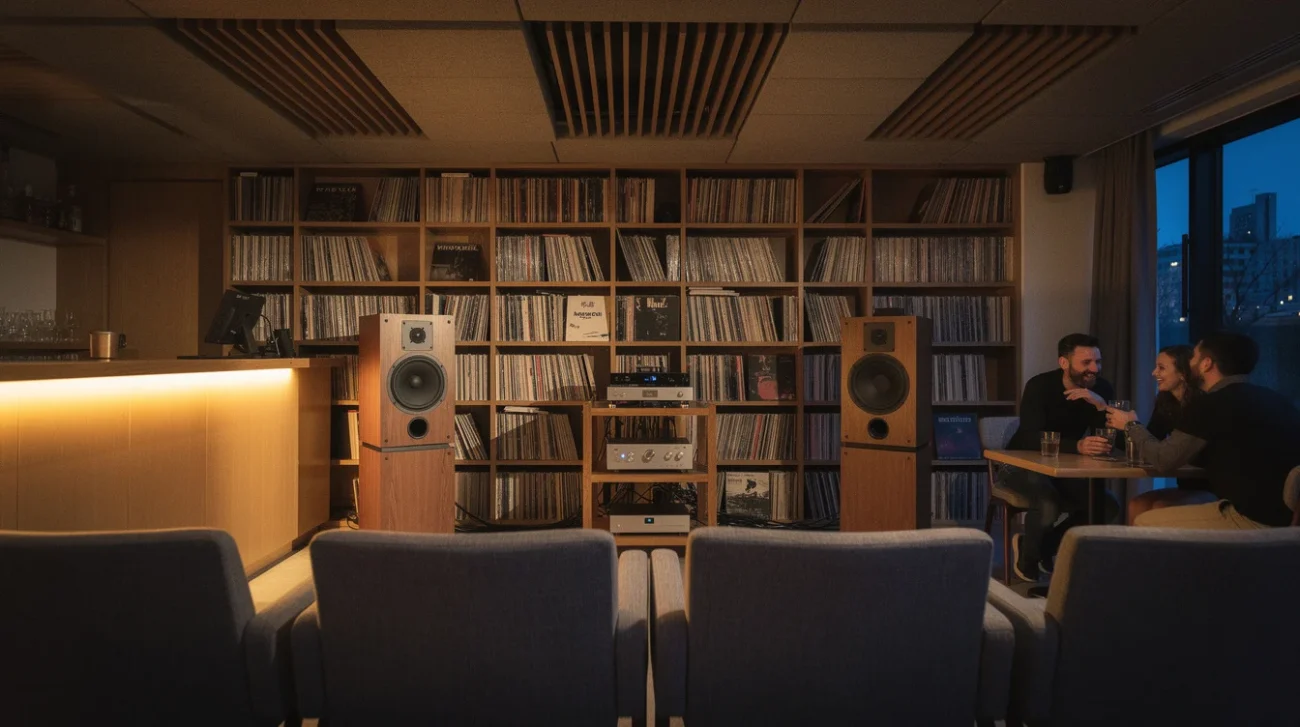
The Listening Bar’s Design Dilemma: Perfect Sound or Good Company?
A listening bar makes a seductive promise: music will no longer be the wallpaper behind your evening. Records receive attention, loudspeakers become architectural protagonists, and somebody has considered what happens between a stylus and your ears. But the promise conceals a territorial dispute. The ideal position for hearing a stereo recording is not necessarily the ideal position for meeting a friend.
The Financial Times frames the phenomenon’s reach as extending from Tokyo to the Barbican. That geographical shorthand captures a larger export: not simply Japanese equipment culture, but a different contract between patrons and a room. As listening bars proliferate, design must decide whether sociability should submit to the system. There are powerful arguments on both sides. Neither can be settled by buying more expensive speakers.
PRO: Let the music organise the room
The strongest defence of the listening bar is that concentrated attention now needs physical protection. Restaurants compete with playlists, bars confuse volume with atmosphere, and domestic listening competes with notifications. A room that puts music first offers something genuinely scarce. Its restrictions are not necessarily pretension; they can be the infrastructure of pleasure.
Japan’s listening traditions are not interchangeable. Tokyo’s Meikyoku Kissa Lion belongs to a classical-music café culture, while Yokohama’s Chigusa is a landmark of jazz listening. Neither should be reduced to the fashionable formula of cocktails, walnut and vinyl. Their relevance is behavioural: a venue can make the recording, rather than conversation, the principal shared event.
Seating orientation makes that proposition legible before anyone issues a rule. Chairs directed towards the loudspeakers create a common focus. Face-to-face tables announce a competing activity. Even a slight turn matters: a pair of seats angled towards the soundstage permits companionship without requiring continuous eye contact and speech. As in debates over the nuclear family’s influence on floor plans, spatial arrangements quietly decide which kinds of togetherness a space supports.
For stereo reproduction, the relationship between the two speakers and the listener is fundamental. A broadly symmetrical arrangement can support a stable central image; substantial asymmetry can pull that image sideways. The famous sweet spot is therefore not audiophile mythology. But it is also not a sufficient floor plan. A serious listening interior must extend rewarding listening beyond one privileged chair, testing actual seats rather than merely admiring equipment specifications.
PRO: Acoustic discipline can be a form of hospitality
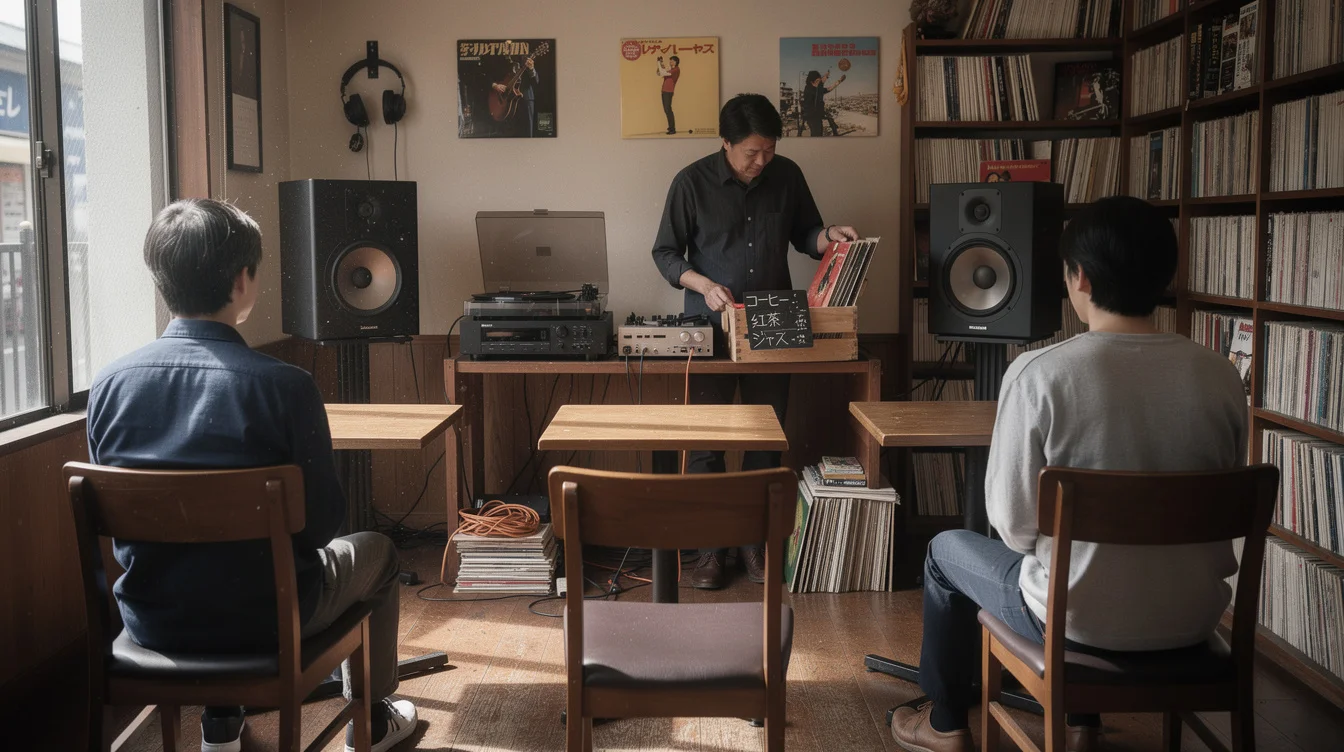
London’s Spiritland in King’s Cross, with its prominent Living Voice loudspeaker system, demonstrates how equipment can become a venue’s visual and cultural centre of gravity. The useful lesson is not that every bar needs monumental speakers. It is that the sound system should enter the design brief before furniture, lighting and service routes have consumed the room.
Placement is equipment-specific. Some loudspeakers need distance from boundaries; corner-loaded horn designs depend on a different relationship with the enclosure. Moving either to accommodate a photogenic plant can change the result. Designers should establish speaker positions through measurement and listening, then check how tables, bodies and circulation alter the experience.
Acoustic treatment deserves the same seriousness. Absorptive ceilings and upholstered surfaces can reduce reverberant build-up and make detail easier to hear without continually increasing playback level. Treatment at relevant reflection points can improve clarity, but thin felt is not a universal cure: controlling low-frequency resonances often requires substantial depth, tuned solutions or changes to placement.
There is a social dividend here. Lower background noise means music need not fight refrigeration, glass handling and ventilation. Separating an ice station from the principal listening area may achieve more than another amplifier upgrade. The pro position is uncompromising but defensible: organising the room around sound can make it more generous, not less, provided fidelity means intelligibility and comfort across occupied seats, rather than a trophy system performing for an empty interior.
CONTRA: A bar is not an auditorium with a till
The opposing argument begins with the word bar. People arrive in pairs, encounter strangers, disagree about records and change their minds about staying. Conversation is not automatically contamination. It is one of the reasons the venue exists. When every body must face forward, the interior risks replacing hospitality with supervision. The distinction between feeling at home and having control over a space matters here, too: comfort is not the same as permission to choose how to spend an evening.
Brilliant Corners in Dalston offers a useful counterpoint through its combination of Japanese food, an audiophile system and a programme that accommodates dancing. Its identity is not exhausted by seated, silent scrutiny. The broader lesson is that musical seriousness does not require a single bodily posture. A record can organise collective movement as convincingly as it organises concentrated stillness.
The difficulty becomes obvious at the table. A couple sharing a small surface may welcome a common listening direction; four friends usually need to see one another. Turning them into a row protects the soundstage but weakens the gathering. Conversely, a circular table makes conversation easier while placing listeners at different angles and distances from the speakers. That is a real compromise, not evidence of design failure.
The sweet spot also has a politics. If the room’s best experience belongs to two central seats while everyone else pays the same prices, technical perfection becomes an allocation problem. A supposedly democratic encounter with music can conceal a hierarchy of access. A bar should not need a bad seat so that somebody else can possess the perfect one.
CONTRA: Design for overlapping pleasures, not obedience
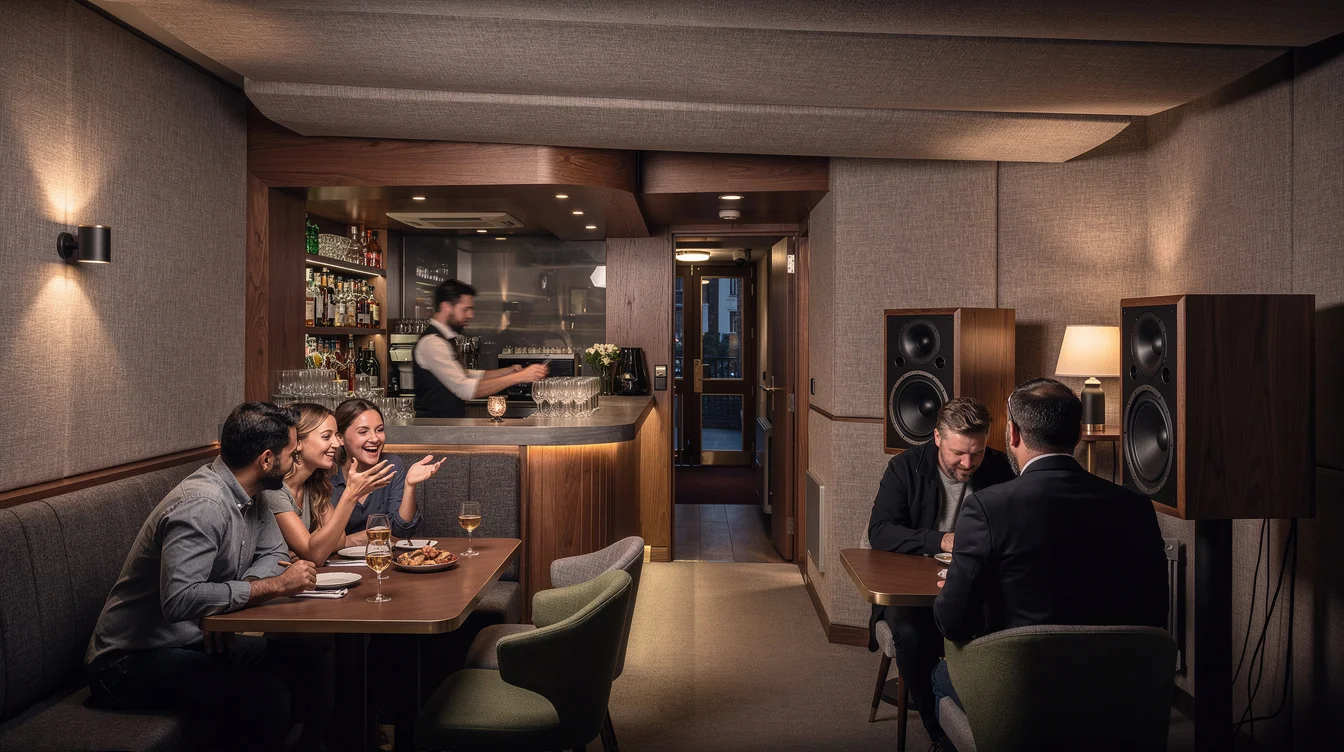
The alternative is not acoustic surrender. It is a room with more than one legitimate mode of occupation. A focused listening zone can sit alongside conversational booths and a more animated counter, provided the layout recognises that sound does not respect the lines on a furniture plan.
Distance, orientation and intervening spaces can help separate activities. A service core or enclosed vestibule may provide a more useful buffer than a decorative screen. Upholstered booths and absorptive ceilings can limit conversational build-up, but they do not soundproof adjoining areas. Bass is particularly difficult to contain. Where genuine separation is necessary, partitions, doors and ventilation paths need acoustic design rather than optimistic styling.
In a compact London bar, full separation may be impossible. Time then becomes a design material. Early-evening album sessions can favour front-facing seating and restrained service; later hours can permit conversation and movement. Lightweight chairs support that change more convincingly than a permanently installed listening congregation. Expectations should be explicit when booking, not enforced through public embarrassment after arrival.
Additional, carefully controlled loudspeakers may help distribute sound more evenly, although overlapping coverage and timing require expert attention and can compromise stereo imaging. That trade-off should be admitted, not disguised. The contra position is that fidelity belongs within hospitality, not above it. The most sophisticated interior may be the one that accepts several good listening experiences instead of engineering one immaculate experience around which everyone else must behave.
FAQ: What makes a listening bar work?
What distinguishes a listening bar from a conventional bar?
Music is a primary reason to visit, supported by deliberate selection, a considered sound system and an interior that encourages attention. Silence is not a universal requirement: some venues prioritise seated listening, while others welcome conversation or dancing.
Where should speakers be placed in a listening bar?
Placement depends on the loudspeaker design, room geometry and intended listening area. Establish it before fixing the furniture layout, then assess coverage, stereo balance and bass behaviour at multiple occupied seats through measurement and listening.
Can acoustic treatment support both music and conversation?
Yes. Appropriate absorption can reduce reverberation and improve clarity for both. However, treatment within a room is different from sound isolation between spaces, and thin decorative panels rarely solve substantial bass problems.
Must every seat face the loudspeakers?
No. Forward-facing seats support a shared musical focus, while angled pairs, booths and communal tables support different social needs. The important decision is whether the venue promises concentrated listening everywhere or offers clearly differentiated experiences.
If a listening bar achieves perfect sound only by disciplining everyone inside it, has the design succeeded—or forgotten what a bar is for?
Get the Mainifesto weekly — curated design debates, speculative ideas and the week's best articles every Saturday.
Editorial Perspectives
Questions and counterpoints developed by the Mainifesto editorial desk to extend the discussion.
Perspective 1
I don’t think a bar fails because it asks us to lower our voices and listen together. Low light, a comfortable chair and sound given room to breathe can make that restraint feel like hospitality rather than discipline.
Perspective 2
The Japanese listening bar has a particular history; that doesn’t make enforced silence a universal design virtue. If an imported concept treats the neighbourhood’s voices as interference, I’d say the design has failed, however carefully the room is tuned.