

Scaffolding Interiors: Circular Design or Daily Compromise?

Scaffolding Can Last for Decades—but Can You Live With It?
A scaffold disappears from a building site, but its components need not disappear from use. Standards, ledgers, braces and couplers move into storage, onto another truck and around another building. As ArchDaily’s discussion of scaffolding as interior architecture argues, the temporary quality belongs to the assembly, not necessarily to the material. A system designed for repeated handling exposes a weakness in architectural language: temporary does not have to mean disposable.
But longevity is not habitability. Bring that hardware into a workplace, café or home and another brief arrives: quiet conversation, unobstructed movement, cleanable surfaces and dependable maintenance. The circular-design argument deserves serious attention—and a harder test than whether exposed steel looks resourceful.
PRO: Reuse Is Already Built Into the System

Most supposedly adaptable interiors begin life as bespoke construction. Their partitions can theoretically move, but relocation may involve damaged boards, discarded finishes and new framing. Scaffolding starts from the opposite premise. Connections are intended to come apart; components have recognizable dimensions and functions; assembly is an episode rather than an irreversible commitment.
This is a practical version of an ambition associated with Cedric Price’s unbuilt Fun Palace, developed with theatre director Joan Littlewood: architecture as a framework for changing activities rather than a finished composition. Price’s project was not a specification for scaffold-based housing. Its relevance is the separation of a supporting system from the uses that occupy it. Scaffolding gives that principle an existing industrial vocabulary.
Consider a leased creative studio expecting to relocate in three years. A scaffold framework could support demountable display panels, shelving or a freestanding meeting-room enclosure, subject to appropriate structural design. At departure, its members could be inventoried and removed rather than smashed into a skip. The opportunity is especially strong where the alternative is a short-lived custom fit-out.
The environmental advantage is not that steel is inherently virtuous; it is that an existing steel component can perform another useful job. Purchasing new scaffold for one photogenic installation does not establish that advantage. The credible case needs an actual supply chain: serviceable components, compatible parts, storage, inspection and someone prepared to accept them afterward.
PRO: Comfort Can Be a Removable Layer
Occupant comfort need not require destroying the scaffold’s reversibility. N. John Habraken’s distinction between long-lived supports and changeable infill offers a useful design reference. For scaffold interiors, the lesson is not to make one system do everything. Let the frame carry; let separate, replaceable elements provide enclosure, sound absorption and touch-friendly surfaces.
In a shared office, for example, absorptive ceiling rafts and fabric-faced wall panels could be mounted using designed, removable connections. A meeting room would still need an enclosure detailed for speech privacy; curtains alone would not deliver it. Nevertheless, that enclosure could remain materially independent of the steel. In a shop, clip-on shelf supports could avoid cutting or drilling standard members. Accessible circulation could be established before the grid is fixed, rather than negotiated around inconvenient braces afterward.
Stewart Brand’s account of buildings as layers changing at different speeds sharpens the argument. Upholstery, wiring and room layouts may need replacement long before a steel frame does. Making them separable allows maintenance to follow those different lifetimes.
The decisive detail is the interface. A removable clamp with a protective liner may preserve a member’s condition; a welded bracket changes it permanently. Neither reversibility nor safety should be assumed from appearance. Connection design, load checks and supplier acceptance still matter. But an adaptation can improve occupation without consuming the underlying component—provided its removal was designed as carefully as its installation.
CONTRA: A Reusable Frame Is Not a Comfortable Room
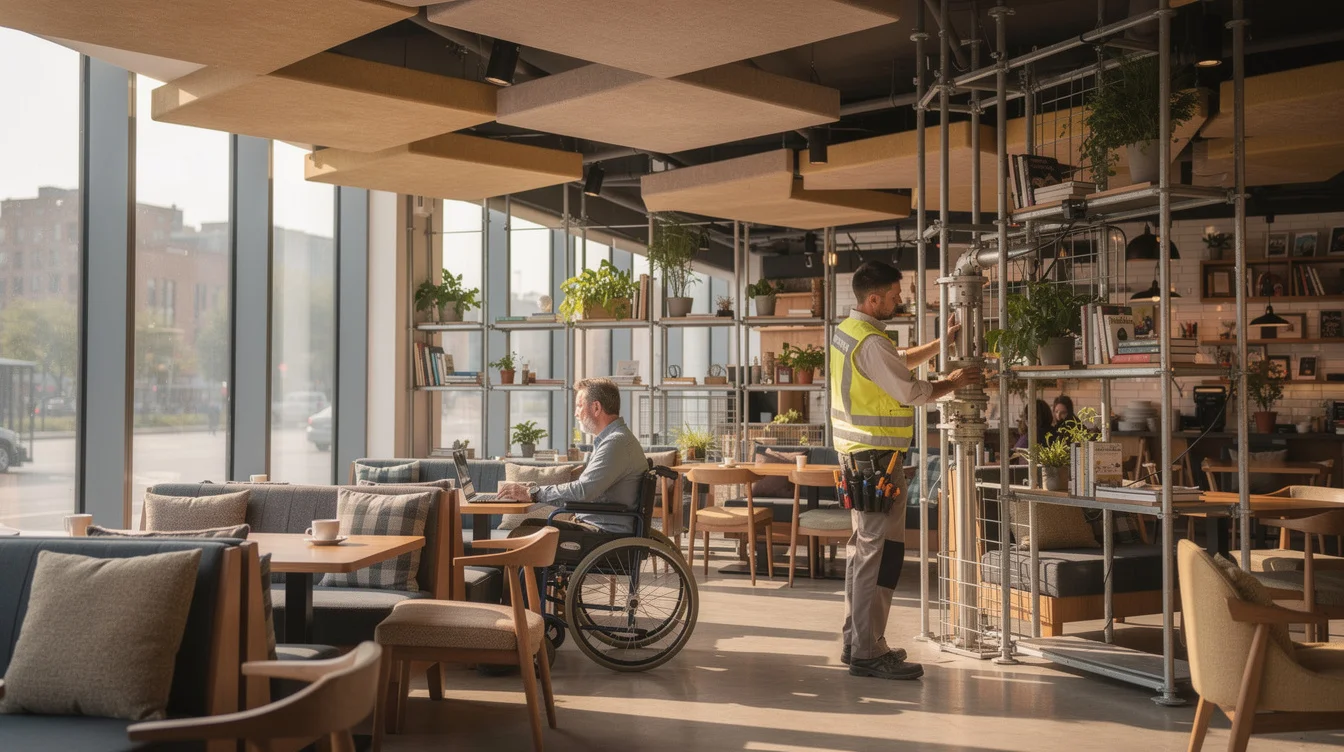
Construction workers tolerate conditions that would be unacceptable for a resident working from home or a customer trying to hear a conversation. Bare steel contributes little sound absorption. Where metal decks and rigid connections are used, footsteps, vibration and rattling can become intrusive unless the assembly is properly detailed. Reverberation, impact noise and speech privacy are different problems; an attractive felt panel does not solve all three.
The Centre Pompidou, designed by Renzo Piano and Richard Rogers, is a useful warning against confusing an exposed technical language with simplicity. It is not a scaffold interior. Its expressive frame and visible services belong to a highly engineered building, not evidence that industrial-looking architecture can dispense with environmental control. The same distinction applies at the scale of a room.
Accessibility is equally resistant to styling. Diagonal braces can obstruct circulation; projecting couplers can become collision or snagging hazards. A raised deck introduces questions about level access, edges and transitions. Clear routes must work for wheelchair users, people using walking aids and people with limited vision—not merely for the able-bodied occupant photographed beside the installation.
Removing an awkward brace is not an aesthetic adjustment: it may change structural stability. Adding ramps, guards, protective covers and acoustic assemblies can be entirely justified, but their space, material and maintenance demands belong in the assessment. If a scaffold saves components while making everyday occupation harder, it has optimized the wrong thing.
CONTRA: The Next Life Must Survive This One
A decade inside a café can leave a component less reusable than several carefully managed construction deployments. Grease, cleaning chemicals, spills and concealed moisture create different maintenance conditions. Couplers and ledgers create dust-catching junctions; boxed-in connections may become difficult to inspect. A domestic or hospitality setting also needs an identified party responsible for checks, repairs and records, rather than an assumption that industrial hardware looks after itself.
The greatest circularity risk may arrive through well-intentioned finishing. Welded shelf tabs, drilled service holes, bonded acoustic foam and coatings that obscure identification can make return to the original supply chain harder. A part may remain physically robust yet become commercially unacceptable to a rental supplier. Reuse depends on verified condition and system compatibility, not simply on whether a tube still looks straight.
Lacaton & Vassal’s work with Frédéric Druot on the transformation of Tour Bois-le-Prêtre provides a contrasting benchmark. It is not a scaffold conversion, but its retention of an existing residential structure accompanied improvements to living space and environmental performance. Conservation was a means to better occupation, not an excuse to suspend it.
Scaffold interiors deserve the same discipline. Compare the complete fit-out with credible alternatives, including retained partitions or demountable systems designed for occupation. Count the acoustic layers, access provisions, transport, cleaning and eventual separation—not just the steel skeleton. A return agreement and a disassembly trial are stronger evidence of circularity than a mood board. Without a realistic next destination, the supposedly reusable interior risks becoming bespoke construction in borrowed industrial clothing.
FAQ: Living With Scaffolding Interiors
Can scaffolding really remain in use for decades?
Some components can have long service lives across repeated deployments, but there is no universal lifespan. Material, exposure, handling, maintenance and damage all matter. Age alone neither proves fitness nor requires disposal; continued use needs appropriate inspection and compliance with the relevant system requirements.
Is construction scaffolding automatically suitable for an occupied interior?
No. Suitability depends on the proposed use and assembly. Structural stability, fire safety, escape routes, accessibility and any applicable occupancy rules require assessment. A system intended for temporary construction access does not automatically satisfy the requirements of a home, office or public venue.
Can acoustic treatment preserve the frame’s reuse potential?
Yes, where treatment is independently supported or attached through suitable removable connections. Absorptive panels can reduce reverberation, but privacy and impact noise usually require additional measures. Avoid treating permanently bonded finishes as circular merely because the underlying steel is durable.
What should a designer ask a scaffold supplier before specifying an interior?
Ask which components are suitable, what alterations are prohibited, how condition will be recorded and whether a return or buy-back route exists. Agree inspection responsibilities and acceptance criteria in advance. A theoretical second life is not a substitute for a workable recovery arrangement.
If making scaffolding genuinely comfortable requires substantial additional construction, when does its promise of reuse stop justifying its place in our interiors?
Get the Mainifesto weekly — curated design debates, speculative ideas and the week's best articles every Saturday.
Editorial Perspectives
Questions and counterpoints developed by the Mainifesto editorial desk to extend the discussion.
Perspective 1
I’m for scaffolding indoors, provided we give the surfaces people actually touch the same care as the frame. A beautifully finished timber tread or a removable upholstered back isn’t a betrayal of circularity; the craft is in making those layers comfortable, durable and separable.
Perspective 2
I’m against making scaffolding an interior system by default: once you add acoustic linings, finished floors and enclosures, the reusable frame may be solving very little. Show me a whole-life comparison with a conventional demountable fit-out, including the added materials and a credible next use—not just the possibility of dismantling it.
Perspective 3
Guests won’t forgive a noisy room or an awkward handrail because the frame has a promising second life. If scaffolding cuts refurbishment time and lets us replace worn parts without gutting the space, I’m interested; if comfort requires a bespoke interior built around it, show me where the savings survive.