
Can a Museum Entrance Be a Political Act?
When the doorway becomes the argument
The Louvre’s planned subterranean entrances, designed by Selldorf Architects and Studios Architecture, are more than a circulation upgrade. They are a direct challenge to the old museum script, in which the entrance is a singular, ceremonial face: climb the steps, pass the threshold, enter culture. In Paris, that script has long been strained by queues, tourism pressure, security theatre, and the sheer scale of the institution. The new proposal acknowledges what every major museum already knows but rarely says aloud: the entrance is not just an architectural gesture, it is a governance problem.
That matters because entrances are never neutral. They decide who waits, who is visible, who is screened, who is welcomed, and who gets to occupy public space before entering at all. When the threshold is rethought as a subterranean system rather than a façade, the museum stops behaving like a monument and starts behaving like infrastructure. That is a political shift. It replaces the image of culture as a static object with culture as an urban service, entangled with logistics, climate control, crowd management, and the everyday life of the city.
In that sense, the Louvre renovation belongs to a larger architectural trend: the museum as a porous civic machine. Think of SANAA’s Louvre-Lens, where the museum disperses across a landscape rather than asserting a single grand front; or David Chipperfield’s Neues Museum restoration, where architecture quietly reconciles history, access, and contemporary use without pretending that preservation is innocence. The new Louvre entrances are not yet a manifesto, but they point toward one. The grand entry is no longer guaranteed to be a façade. It may become a network.
That shift also echoes arguments made in When Museums Become Climate Machines, where the museum is framed less as a container for objects than as a responsive environmental system. Once arrival, ventilation, and crowd flow are treated as interconnected, the threshold starts to operate as part of the building’s climate logic rather than as a decorative front.
The end of the monumental queue
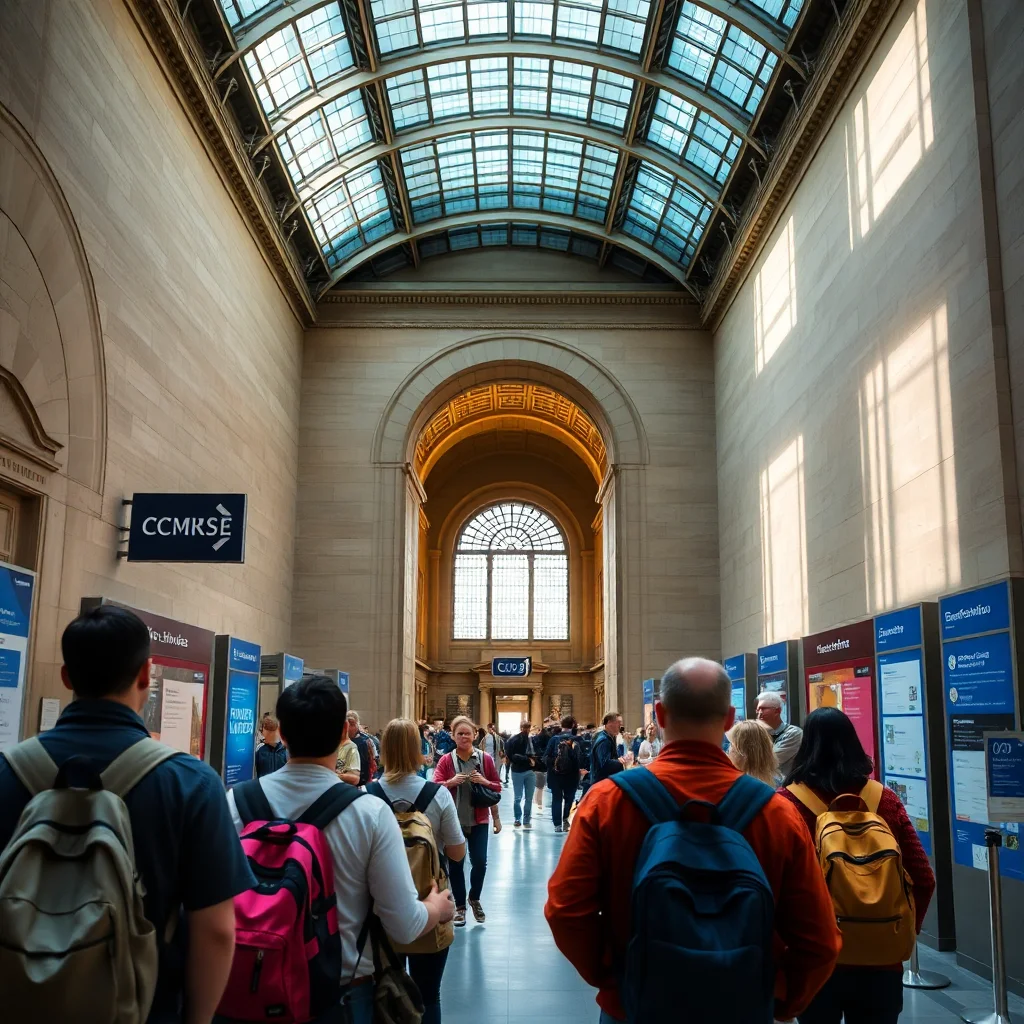
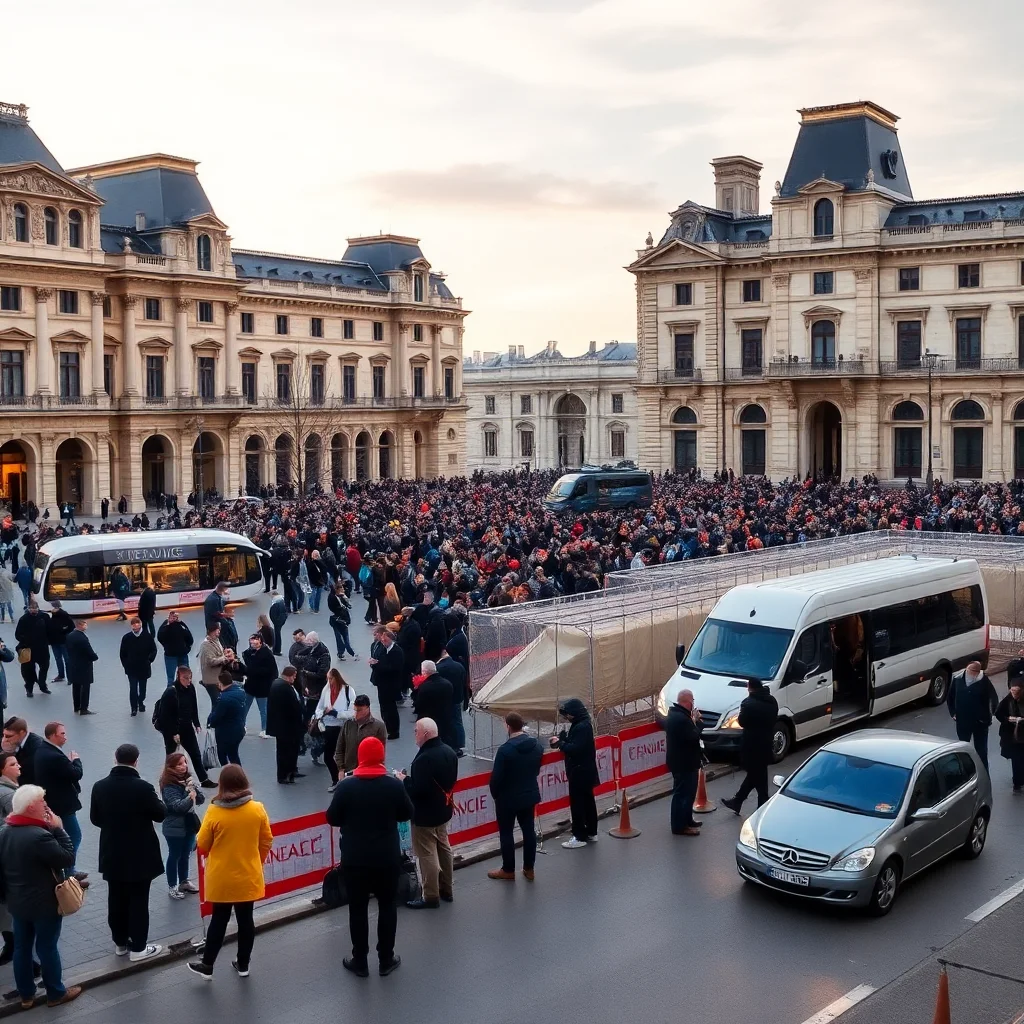
The modern museum entrance has often been designed as a theatrical compression of bodies. The sequence is familiar: arrival, queue, security, lobby, ticketing, and then release into the galleries. But that sequence is increasingly untenable for mega-museums that function as global destinations. The queue itself becomes part of the public realm, only usually in the worst possible way: exposed, inefficient, and politically fraught. In peak season, the museum’s front yard turns into a crowd-control device masquerading as civic space.
Subterranean entrances are a pragmatic response to that condition, but pragmatism here is radical. By moving arrival below grade, the museum can reclaim the surface for the city while creating a larger, more legible zone for screening, orientation, and climate buffering. The gesture echoes the logic of OMA’s Seattle Central Library, which treats circulation as a spatial manifesto, or the Sunken Garden approach seen in several contemporary civic projects where the earth absorbs the burden of threshold management. The difference is that a museum entrance is not just an internal convenience; it is a public interface with symbolic weight.
This is why the debate around the Louvre matters beyond Paris. Once a museum admits that its entrance must be distributed, its architecture begins to resemble transit, retail, and civic security systems more than classical composition. At that point, the question is not whether the façade is beautiful enough. It is whether the institution can handle the social fact of mass access without reducing public life to a bottleneck.
Subterranean thresholds and the politics of disappearance
There is a seductive rhetoric around going underground. It suggests discretion, technical sophistication, and an almost moral humility before the historic building above. But subterranean architecture is never innocent. It can free the surface for pedestrians and landscape, yes, but it can also hide the machinery of exclusion. Security checkpoints, bag searches, climate vaults, and staff logistics all disappear from view. The museum gains an elegant public face precisely because the messy apparatus is pushed into the earth.
That duality is familiar in contemporary architecture. Herzog & de Meuron’s Tate Modern expansion used buried infrastructure and a robust new public realm to extend the institution, while MVRDV’s work on urban ground planes has repeatedly argued that below-grade space can produce more generous civic surfaces above. Yet subterranean design also risks producing a new kind of controlled interiority, where the public realm is technically accessible but psychologically administered. The entrance becomes less an open door than a managed descent.
For the Louvre, this tension is unavoidable. The museum is a palace turned public institution, and its grandeur has always depended on selective access. A hidden threshold may democratize the approach, but it also intensifies the museum’s power to choreograph movement. The political question is whether this choreography is being used to expand the city or to protect the institution from it. The answer will be written not just in stone and glass, but in how long people wait, where they gather, and whether the surface remains a real civic space or just a photogenic lid.
That tension between visibility and control also appears in Armored Facades and Open Living, where the idea of openness is never simple or purely formal. In both cases, architecture is asked to perform welcome while still managing risk, and the design problem becomes one of negotiating how much of the apparatus should be seen.
From façade to civic system
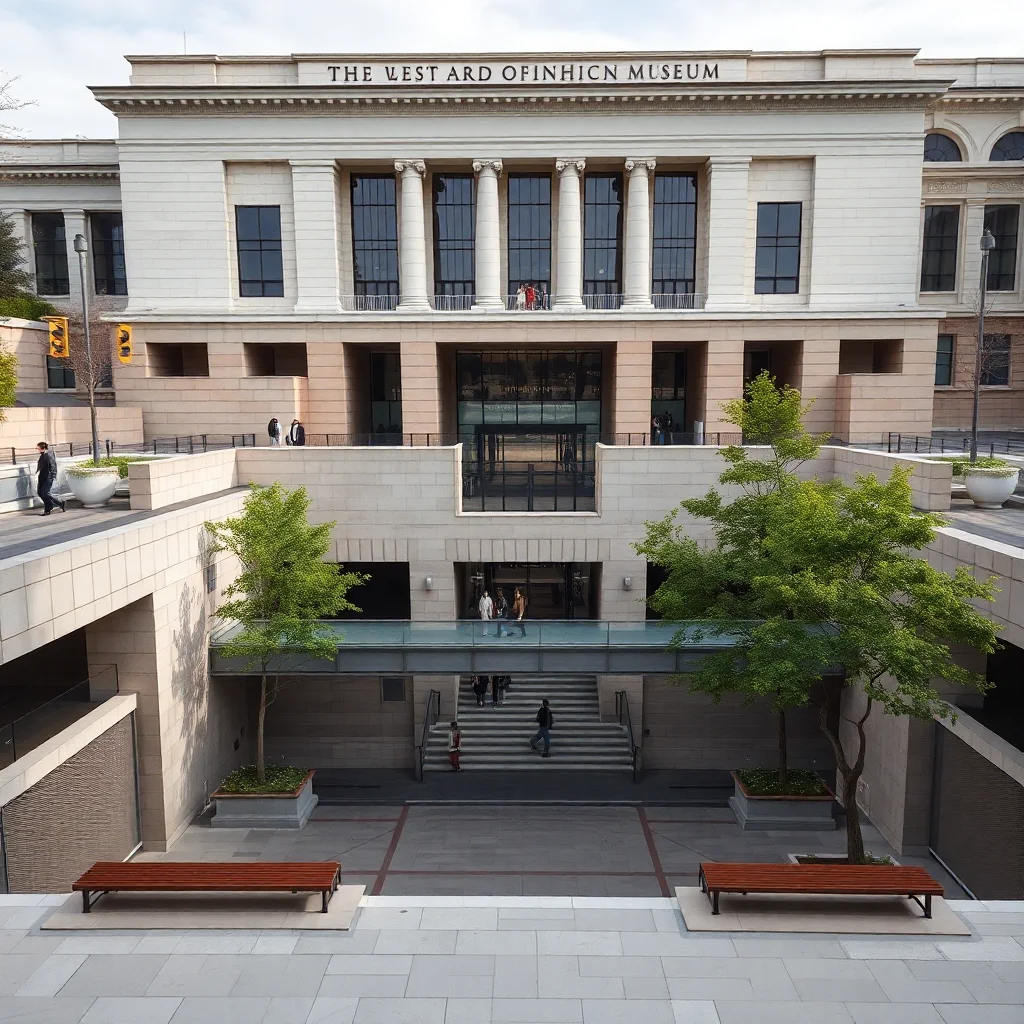
The most provocative implication of the Louvre renovation is that the museum entrance may soon operate like urban infrastructure. That means it is judged not only by aesthetic presence but by throughput, resilience, accessibility, and environmental performance. In a warming climate, museums are already under pressure to reduce energy loads and manage indoor conditions more intelligently. Entrances become thermal buffers. Queues become shaded or conditioned volumes. Security becomes part of a larger spatial protocol, not an afterthought tacked onto a historic portal.
Seen this way, the museum entrance is starting to resemble a transportation interchange or a civic data system. It must absorb peaks, reroute flows, communicate clearly, and prevent breakdown. The architecture of arrival becomes the architecture of systems management. This is not a retreat from architecture into engineering; it is architecture admitting that its public role is no longer confined to symbolism. The entrance is where the institution meets logistics, and logistics is where power hides.
Other institutions have already moved in this direction. The V&A East Storehouse in London rethinks museum access as a behind-the-scenes network of storage, viewing, and circulation. The British Museum’s long-running debates over its forecourt show how the ground in front of a museum can be as contested as any gallery. And the Centre Pompidou, for all its historic bravado, remains one of the clearest examples of a building that turned circulation into public drama. The Louvre’s next threshold may be less spectacular than Pompidou, but it could be more consequential: not a single heroic gesture, but a distributed civic system that treats access as a public utility.
Is the iconic entrance becoming obsolete?
There is a reason architects keep returning to the museum threshold: it is one of the last places where architecture can still declare itself in public. A grand entrance can signal confidence, legitimacy, and permanence. It can also mask inequality behind a civic smile. The danger of the current transition is that we may lose the entrance as an architectural event altogether, replacing it with invisible logistics and operational efficiency. If every museum entrance becomes an underground service machine, the city may gain convenience but lose symbolism.
That is the real provocation in the Louvre proposal. It is not simply about adding doors. It suggests a future in which the museum façade matters less than the system beneath it; less stone front, more urban metabolism. Some will call that a loss, a surrender of civic grandeur to administration. Others will see it as overdue honesty: if the museum is a public institution, then it should be designed like one, with the complexity of a transit hub, the openness of a square, and the discipline of an emergency system.
The strongest architecture will not choose between these positions. It will make them visible at once. The best museum entrance of the future may be one that refuses to perform innocence, one that admits it is both symbolic and operational, both welcoming and controlling. The Louvre’s next threshold is testing that proposition in real time.
- Architecture now has to negotiate mass access as carefully as it once composed façades.
- Public space is being redistributed below and around museums, not just in front of them.
- Security is no longer a hidden layer; it is part of the entrance design itself.
- Climate resilience is turning thresholds into thermal and environmental buffers.
- Civic identity is shifting from monumentality to operational performance.
FAQ
Why are subterranean museum entrances becoming more common?
Because major museums need to manage huge visitor volumes, security screening, climate control, and public congestion without overwhelming their historic façades or surrounding streets.
Does moving an entrance underground make a museum more democratic?
Not automatically. It can improve access and public space, but it can also hide exclusion behind efficient design. Democracy depends on how the system is operated, not just where it sits.
What makes the Louvre project politically significant?
The Louvre is a symbol of state culture and global tourism. Changing its entrance changes how the institution relates to the city, to queues, and to public life at scale.
Will iconic façades disappear if entrances become infrastructural?
Not necessarily, but their role may diminish. The façade may become symbolic backdrop while the real politics of access happen through subterranean, distributed systems.
So what is a museum entrance really for?
It is for greeting, yes. But it is also for sorting, filtering, delaying, cooling, protecting, and directing. The question is whether we want architecture to admit that truth publicly, or keep pretending the entrance is only a ceremonial front door.
Get the Mainifesto weekly — curated design debates, speculative ideas and the week's best articles every Saturday.
Editorial Perspectives
Questions and counterpoints developed by the Mainifesto editorial desk to extend the discussion.
Perspective 1
A museum entrance that melts into infrastructure says a lot about who the city is built for, and who gets left outside. In places where public space is already contested, “disappearing” architecture can read less like humility and more like control—access managed by systems, not by civic presence.
Perspective 2
If people can’t find the entrance, the museum has already failed the user. I’m all for elegant integration, but culture still needs a legible front door, because visibility matters for footfall, brand, and the basic psychology of feeling welcome.
Perspective 3
I’m wary of the idea that the best entrance vanishes into the city, because historic buildings are not just service diagrams. When architecture makes culture visibly public, it gives the institution a civic address; if everything is absorbed into infrastructure, you risk turning a museum into another premium flow zone.
Perspective 4
The interesting question is whether “infrastructure” can be made readable, not invisible. Could an entrance perform as both circulation device and civic marker—using light, section, and thresholds to signal publicness without reverting to a monumental gate?
Perspective 5
There is a long French habit of confusing discretion with democracy. The museum entrance is a symbolic device, and if it disappears entirely into the metro of the city, one loses the moment where culture declares itself as a public act rather than a logistical service.