
Should a Mobility Aid Have to Disguise Itself?
Should a Mobility Aid Have to Disguise Itself?
A suitcase announces a journey. A walking aid can provoke an entirely different response: unsolicited help, lowered expectations, the assumption that its user needs managing. That difference is not inherent in the objects. It is a social judgement, rehearsed through design.
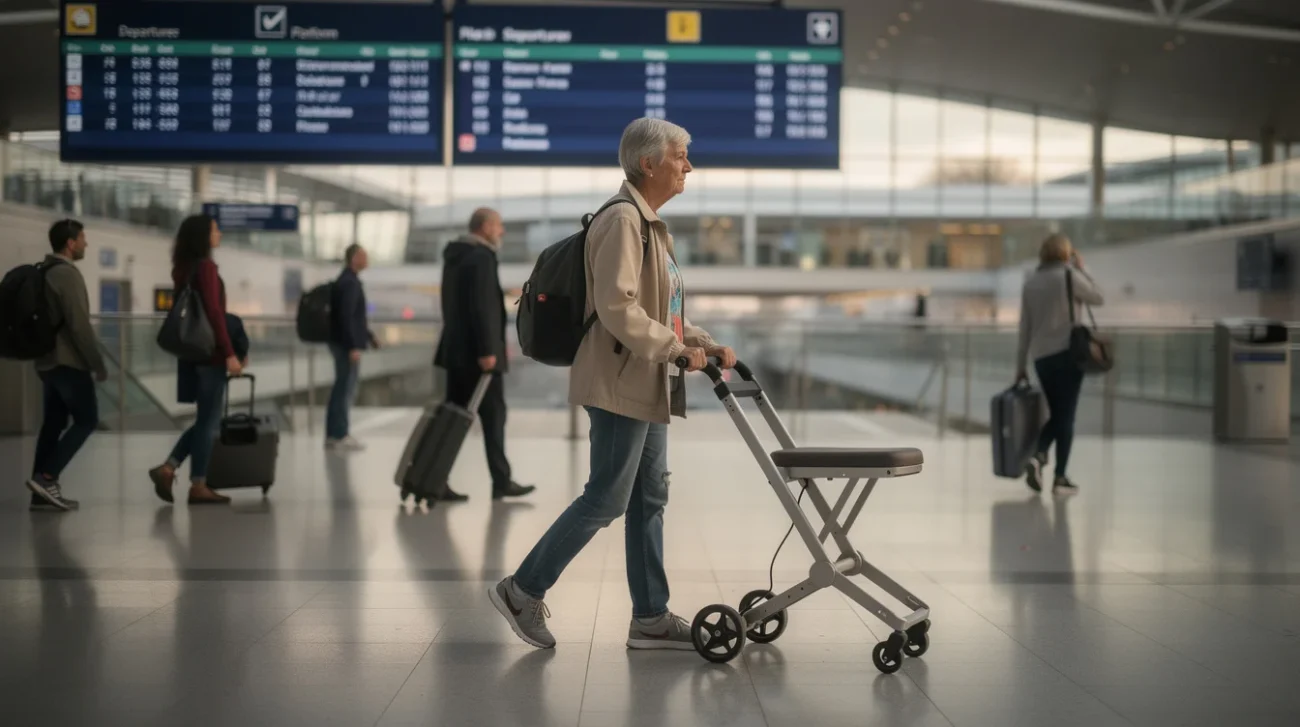
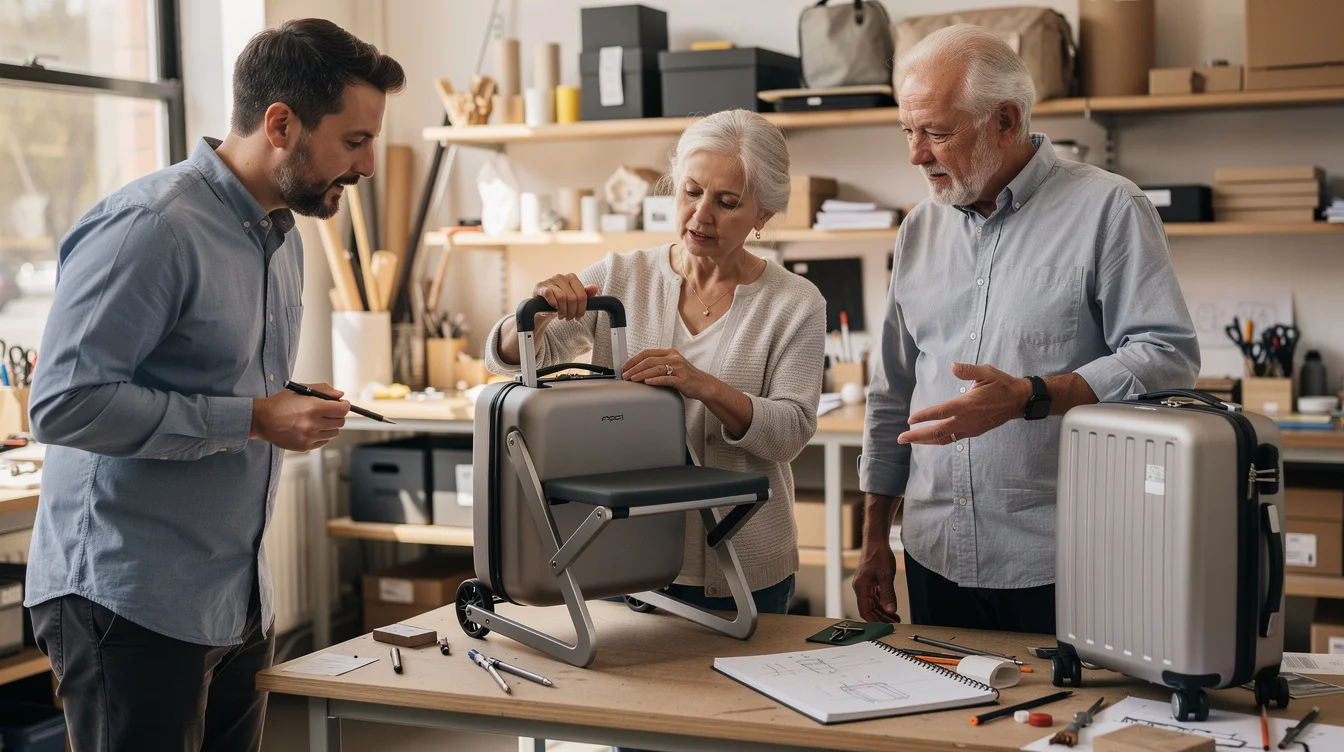
Developed with travellers aged 75 and over, Lorenzo Rimini’s Moove On combines luggage storage, walking support and an integrated resting perch. As reported by designboom, it challenges the conventional aesthetics of assistive products through discretion. The available source context establishes those functions and that participatory starting point; it does not establish tested performance, commercial availability or suitability for particular users.
The proposition nevertheless cuts straight to a product-design fault line. Should assistance become less conspicuous so people can move more freely? Or should design confront the prejudice that makes concealment attractive?
PRO: Discretion Can Be a Form of Self-Determination
The strongest argument for Moove On is not that it makes older people look younger. It is that nobody owes strangers an immediate explanation of their body. A traveller may want support during a long terminal walk without being treated as incapable of navigating the trip. Choosing how much to disclose is a legitimate freedom, not automatically an admission of shame.
Consider a hypothetical journey involving a taxi, a station concourse and a slow boarding queue. Storage, walking assistance and somewhere to rest are usually treated as separate requirements, potentially involving several objects and repeated negotiations. Bringing them together could reduce that practical burden. The attraction is not merely visual camouflage: it is having useful functions available without continually reorganising the journey around them.
A mobility aid that someone willingly brings can be more useful than an exemplary object they leave at home. This is not an excuse for stigma. It recognises that products enter imperfect social conditions, not an enlightened future.
OXO Good Grips offers a useful precedent. Developed by OXO with Smart Design, its early kitchen tools addressed difficulties associated with gripping conventional utensils, including those experienced by founder Sam Farber’s wife, Betsey, who had arthritis. Their generous handles became a mainstream design proposition rather than a segregated medical category. The lesson is not to erase disability, but to stop making useful accommodation look like admission to a separate world.
PRO: Hybrid Objects Can Expand the Vocabulary of Support
Moove On also questions why assistance must arrive in a recognisable, dedicated package. Eyeglasses correct vision while operating as fashion, identity and everyday equipment. Their cultural acceptance demonstrates that function and self-presentation need not be enemies. Mobility products deserve an equally broad aesthetic vocabulary, including quiet objects as well as expressive ones.
The resting perch is particularly important to the argument. Travel is not a continuous act of walking; it alternates between movement and enforced waiting. A station may offer step-free access yet leave passengers standing through a platform change or a delayed departure. An integrated place to pause acknowledges endurance as a fluctuating condition rather than dividing travellers into those who walk and those who do not.
Developing the project with people aged 75 and over is therefore consequential. It places actual travellers inside the design process rather than relying solely on a designer’s imagined elderly user. It does not, by itself, prove that every requirement was met: the depth of their participation and their influence on decisions would matter enormously.
IDEO’s work with the startup that became PillPack provides a parallel from another domain. Medication management was reframed through packaging and service design rather than treated only as a problem of patient compliance. Moove On’s promising move is similarly conceptual: start with the activity someone wants to undertake, then organise support around it. The traveller remains a traveller, not a diagnosis carrying a bag. Yet, as the debate over personalised medicine beyond the print button reminds us, a new format alone cannot establish suitability for an individual.
CONTRA: When Discretion Becomes a Demand to Disappear
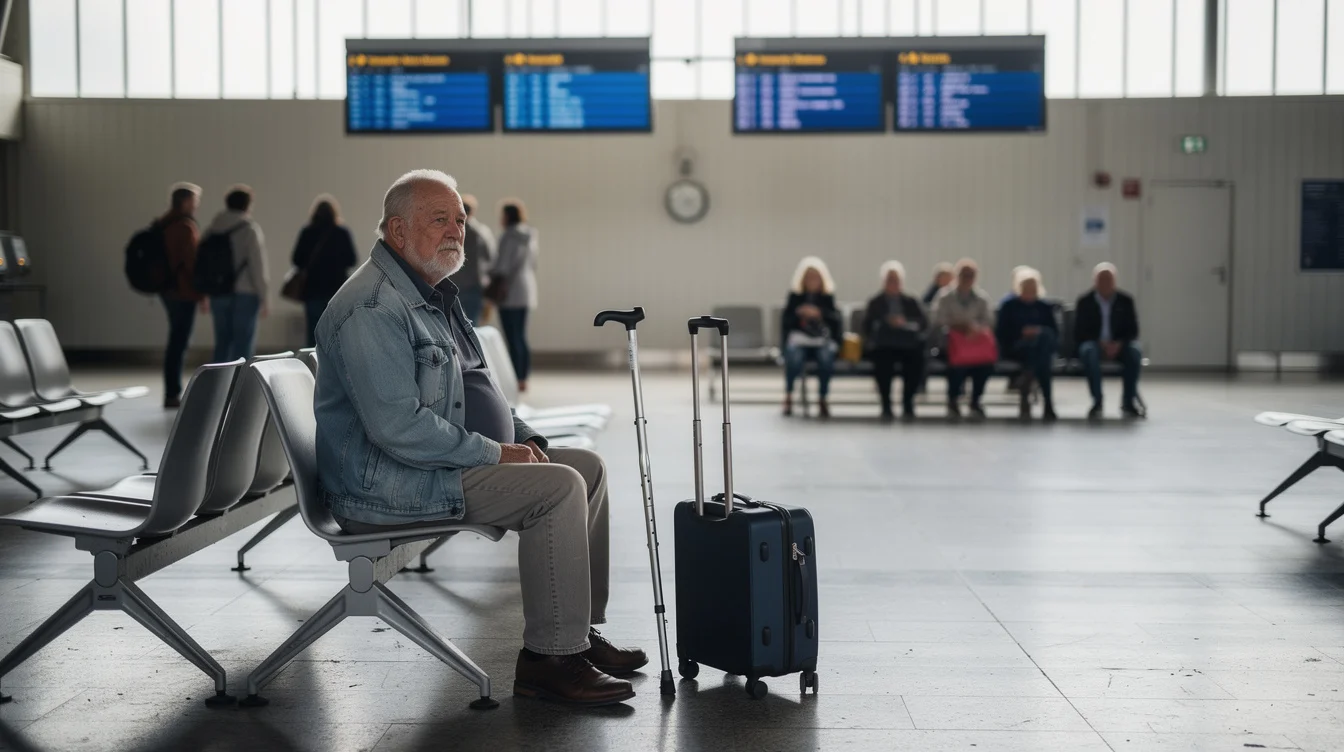
The danger begins when discreet stops describing one available choice and starts defining good assistive design. If the highest compliment is that an object does not look like a mobility aid, the category itself remains an embarrassment. Design has improved the disguise while leaving the insult intact.
Graham Pullin’s book Design Meets Disability challenges the assumption that disability-related products should be governed only by clinical priorities or attempts at invisibility. Its larger provocation is useful here: assistive objects can participate in culture, taste and identity. They need not apologise for existing.
The Alternative Limb Project, founded by Sophie de Oliveira Barata, makes this position tangible through expressive prosthetic work. It is not a direct functional comparison with luggage or walking support, and no traveller should be expected to turn their body into a public artwork. Its relevance is the permission it creates: assistance can be conspicuous, personal and desirable without pretending to be something else.
Against that background, the language surrounding Moove On deserves as much scrutiny as the object. Does discretion mean that users gain control over their presentation? Or does it promise relief from being associated with disability? Those claims are not interchangeable. Advertising a product as luggage that also provides support may broaden choice. Advertising it as freedom from looking like someone who needs support would simply repackage ageism as sophistication.
CONTRA: A Better Suitcase Cannot Repair a Hostile Station
There is also a political trap in the beautifully resolved personal object. A portable resting perch may help someone navigate a terminal with inadequate seating. It must not become an alibi for leaving that terminal unchanged. When every access failure becomes a consumer-product opportunity, the traveller acquires another responsibility while the operator escapes one.
Disability justice organisations such as Sins Invalid foreground interdependence rather than treating unsupported independence as the sole desirable outcome. Applied to travel, that perspective exposes a weakness in the familiar promise of doing everything alone. A successful journey can involve an aid, accessible infrastructure, assistance from staff and help from other people. These are not lesser versions of autonomy.
There are harder product questions too. How does a combined object behave when its luggage compartment is full or empty? How is stability maintained when someone rests? Can users understand its support and seating functions without relying on discreetness becoming ambiguity? What happens if an airline requires the luggage to be checked? These are evaluation questions, not documented defects in Moove On; the supplied source context does not answer them. As with an expandable shoe that still has to fit today, versatility cannot substitute for meeting the body’s immediate needs.
The design standard should therefore be demanding: discretion must never outrank dependable support, clear operation or access to assistance. Rimini’s proposition deserves attention precisely because it opens this argument. But its cultural success should not be measured by how completely the mobility aid disappears. It should be measured by whether travellers gain meaningful options—including the option to need support openly, without penalty.
FAQ
What is Lorenzo Rimini’s Moove On?
Moove On is a design developed with travellers aged 75 and over that combines luggage storage, walking support and an integrated resting perch. The source describes its discreet approach to assistive-product aesthetics, but does not establish commercial availability or independently tested performance.
Why might someone prefer a discreet mobility aid?
They may value privacy, a familiar travel aesthetic or fewer separate objects to manage. Discretion can support control over self-presentation. That preference should be respected without implying that visible mobility aids—or the people using them—are less desirable.
Does combining luggage and walking support make a product universally accessible?
No. Different users need different levels and types of support. Suitability would depend on factors such as stability, handling, dimensions, luggage load and the individual’s requirements. Participation by older travellers is valuable, but cannot substitute for appropriate evaluation.
How should designers balance discretion and disability visibility?
By offering meaningful aesthetic choices while making function, safety and usability non-negotiable. Users should influence both the product and its marketing. Neither concealment nor conspicuous self-expression should become an obligation, and personal equipment should complement—not replace—accessible public infrastructure.
If a mobility aid gives someone more freedom by becoming less visible, is that progress on their terms—or evidence that the world still refuses to meet them openly?
Get the Mainifesto weekly — curated design debates, speculative ideas and the week's best articles every Saturday.
Editorial Perspectives
Questions and counterpoints developed by the Mainifesto editorial desk to extend the discussion.
Perspective 1
The flâneur’s cane was both support and social accessory; this supposed opposition between dignity and disguise is rather tired. I’m for Moove On’s discretion: choosing how one appears in public is a freedom, not an obligation to make one’s needs legible to strangers.
Perspective 2
I’m against treating camouflage as the breakthrough here. In a hotel, a guest shouldn’t need luggage that doubles as support to navigate a long queue or a lobby without seating. Spend the money fixing that experience before congratulating the product for making it bearable.
Perspective 3
Combining luggage and mobility support makes sense only if it works when the case is empty, fully packed, or rolling across uneven paving. I’d want stability tests, user trials, and a repair plan for the wheels and handle before celebrating the silhouette. Discretion can be a benefit, but it can’t compensate for unreliable support.