A Beautiful Public Toilet Still Has to Be Easy to Find
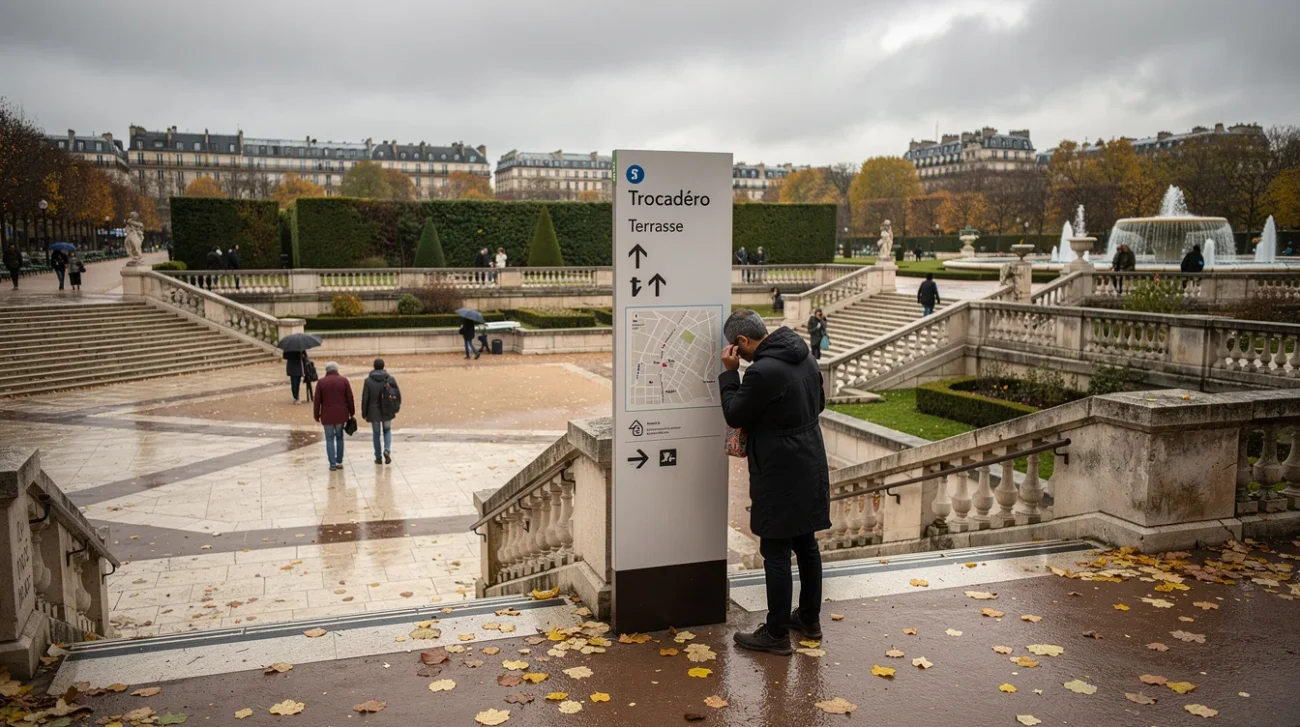
A Beautiful Public Toilet Still Has to Be Easy to Find
A public toilet is not successful when an architecture photographer finds the best angle. It is successful when someone who urgently needs it finds the entrance. That distinction should govern how we judge Chartier-Corbasson Architectes’ conversion of a neglected underground passage beneath Paris’s Trocadero Gardens into a public restroom. Reclaiming overlooked infrastructure is a compelling architectural proposition. Making an essential service depend on discovering overlooked infrastructure is another matter.
Dezeen’s November 11, 2026 report presents the transformation through the promise of elevating the ordinary. The available source summary establishes the location, architect and former use, but not the full entrance strategy, step-free route or maintenance arrangements. Those omissions are not evidence that the project fails. They are a reason to resist declaring it a public success on architectural refinement alone.
The provocation is simple: the most important part of this interior may be outside it. A sign at a garden junction, an unmistakable threshold and a dependable accessible route can determine whether the investment serves the public or merely improves a space that much of the public never discovers. Beauty matters. But in public toilet design, beauty must answer to the emergency of an ordinary body.
Reclaiming Space Is Not the Same as Providing Access
There is a strong case for working with what the city already has. An abandoned passage represents excavated ground, existing structure and a location already embedded in public space. Reuse can avoid some impacts of constructing an entirely new facility, although any environmental claim would require evidence about structural work, waterproofing, ventilation and ongoing energy use. Underground space is not automatically low-impact simply because it already exists.
Chartier-Corbasson’s intervention belongs within a larger architectural argument against treating the existing city as disposable. Lacaton & Vassal’s transformations of housing, including the Grand Parc Bordeaux project with Frédéric Druot and Christophe Hutin, demonstrate how retained buildings can acquire new value through careful intervention. But that comparison also reveals a crucial difference: housing residents know where their building is. A public restroom must repeatedly introduce itself to strangers.
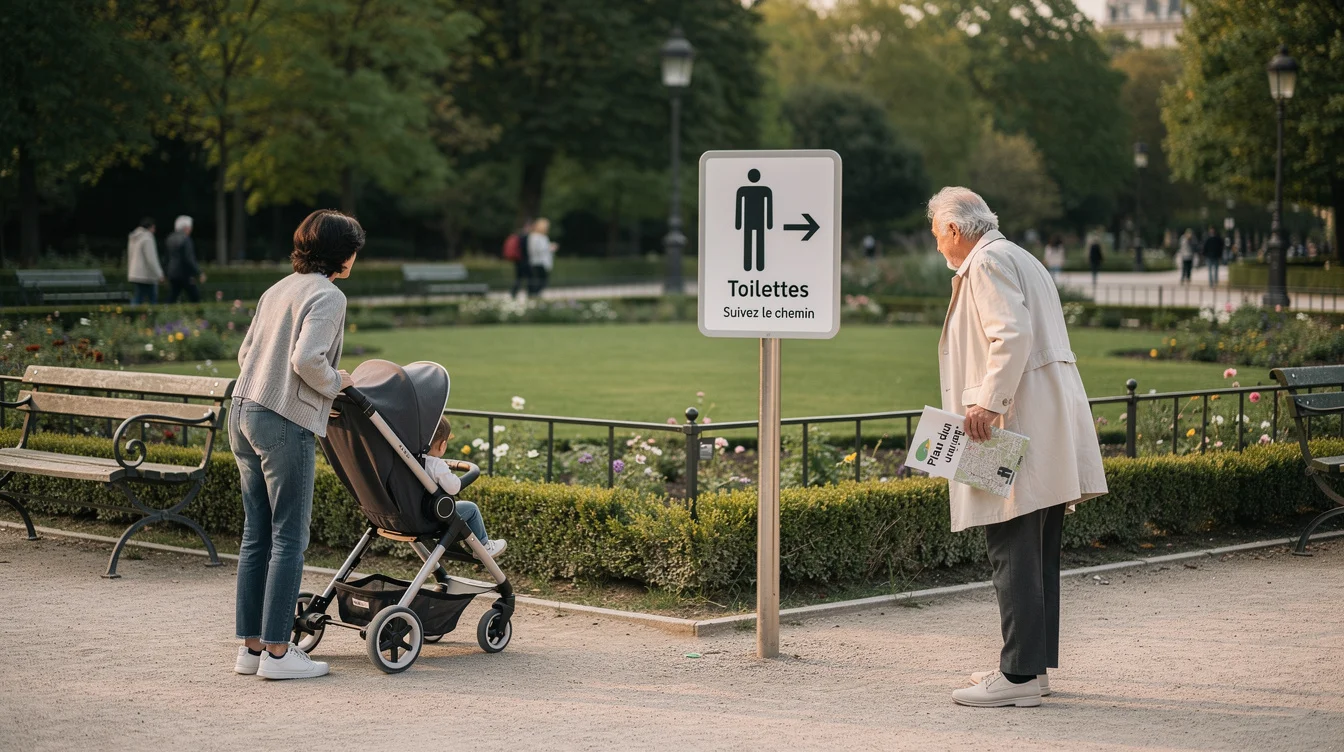
At the Trocadero Gardens, those strangers may include tourists orienting themselves around the Eiffel Tower, parents managing children and older visitors rationing their walking distance. The reuse proposition therefore needs two drawings: the architect’s account of the recovered interior and the visitor’s route from the garden to a usable cubicle. If the second drawing is unresolved, the first is not enough.
The Entrance Must Win the Competition for Attention
Wayfinding is often treated as graphics applied after architecture has made its major decisions. For an underground toilet, that hierarchy is backwards. The facility has to announce itself before a visitor commits to the wrong path, passes the entrance or assumes a stairway belongs to maintenance infrastructure. An elegant sign positioned at the bottom of a descent is information delivered too late.
Paris offers an instructive contrast in Hector Guimard’s Métro entrances. Their power is not simply ornamental: they give an underground network a recognisable presence above ground. Contemporary toilets need not borrow Art Nouveau ironwork, but they should borrow the conviction that subterranean public infrastructure deserves a visible civic address. Transport for London’s Legible London pedestrian wayfinding system offers another reference: information works when it supports decisions across a route, rather than appearing as one isolated marker.
For the Trocadero conversion, the test should start at actual pedestrian decision points. Can someone approaching from different directions identify the toilet without consulting a phone? Are opening hours and any charges legible before descending? Does the accessible entrance appear on the same signs as the principal entrance? A useful evaluation would ask first-time users to find the facility and record wrong turns, hesitation and backtracking. These are design outcomes, not failures of visitor attention.
A Stair Is Not a Neutral Threshold
Putting a public necessity underground creates a vertical obligation. A staircase may be straightforward for one visitor and an absolute barrier for another. Wheelchair users are the obvious constituency, but the issue also includes people using walking aids, visitors with temporary injuries, carers accompanying someone else and adults manoeuvring pushchairs. Accessibility cannot be reduced to an accessible cubicle somewhere beyond an inaccessible journey.
Architect and accessibility advocate Selwyn Goldsmith’s work, including Designing for the Disabled, helped establish that buildings should be assessed against the people conventional design excludes. Applied here, that principle means examining the complete route: gradients, landing spaces, door operation, lighting, handrails and the relationship between accessible and general entrances. The available source context does not establish how the Trocadero project resolves these matters; they remain questions for a proper assessment, not grounds for inventing deficiencies.
A lift, if used, would need reliable operation and a clear contingency when unavailable. A ramp, if provided, would need to work as a practical route rather than a lengthy detour disguised as inclusion. A step-free symbol is a promise about a journey. If that journey depends on finding an attendant, interpreting obscure instructions or travelling substantially farther than everyone else, the promise has been weakened.
Maintenance Is Architecture Repeated Every Morning
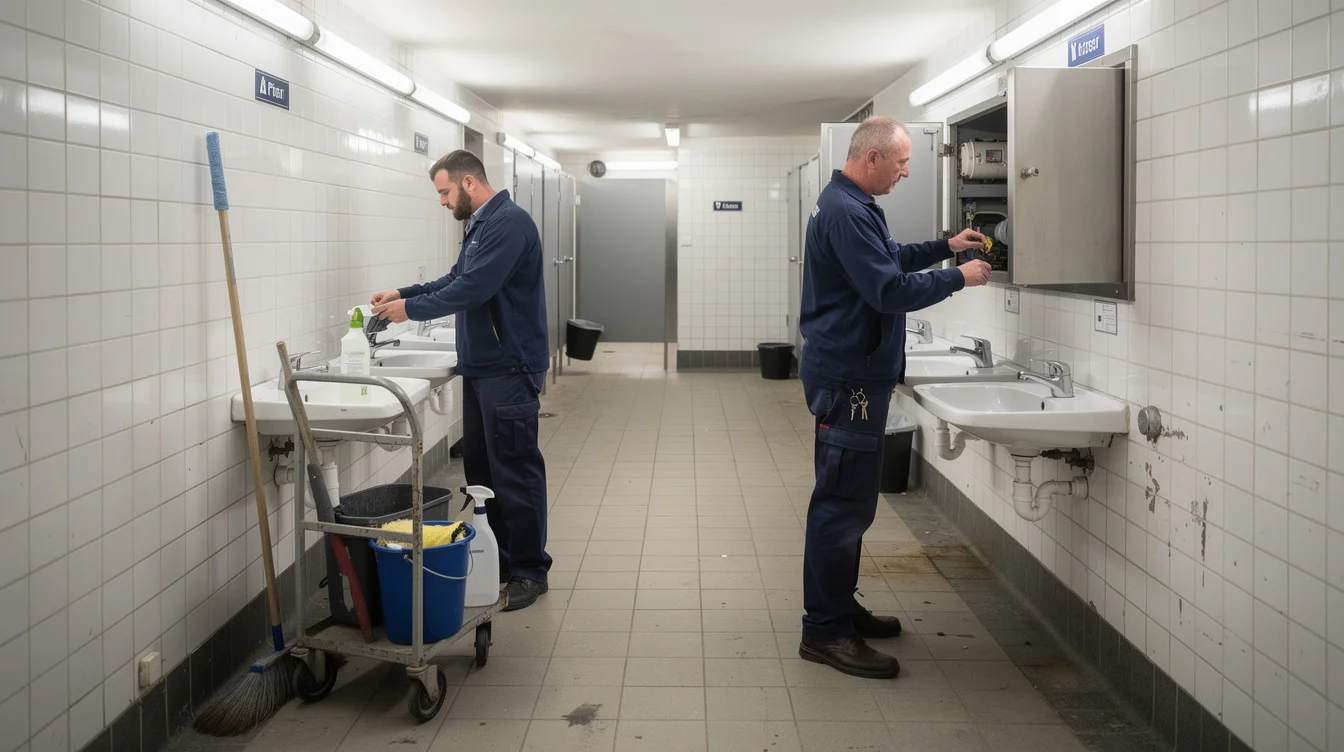
The decisive critic of a public restroom is often the person cleaning it. That worker encounters what a completion photograph cannot show: corners that trap dirt, fittings that are difficult to replace, doors that absorb punishment and service access that turns a minor repair into a closure. Below ground, water ingress and ventilation also demand scrutiny. These are risks to investigate in this building type, not reported faults in Chartier-Corbasson’s project.
The Tokyo Toilet initiative provides a useful comparison because it placed public restrooms by designers including Shigeru Ban, Tadao Ando and Fumihiko Maki within a programme that explicitly foregrounded cleaning and upkeep. Its lesson is not that Paris needs another collection of signature objects. It is that design ambition and operational responsibility must be presented together. A famous name cannot replenish soap or shorten the time between a failed fitting and its replacement.
For Trocadero, a serious public-benefit assessment would ask who operates the facility, how cleaning responds to visitor peaks, where supplies are stored and whether components can be serviced without closing the entire restroom. It would also ask whether workers have safe, adequate conditions. A maintenance budget is not an administrative footnote to architecture; it is one of the materials from which public reliability is built.
Judge the Toilet After the Opening Photographs
None of this requires toilets to be visually impoverished. Attractive public facilities can communicate respect, counter the expectation of neglect and make an everyday bodily need less stigmatised. Architectural care is valuable precisely because toilets are so often treated as expendable. But care must extend beyond the visible surfaces to the user who cannot find the door and the cleaner who cannot reach a service panel.
Denise Scott Brown and Robert Venturi’s attention to signs and ordinary landscapes offers a useful corrective to the fantasy that good architecture always explains itself. Sometimes the most civic gesture is an emphatic, conventional toilet pictogram. Sometimes a conspicuous marker serves the city better than a perfectly discreet entrance. Public infrastructure should not require architectural literacy.
Chartier-Corbasson’s conversion deserves attention for recovering neglected space. Whether that recovery delivers its full public value should be established through post-occupancy evidence: how easily first-time visitors find it, whether step-free access remains available, how frequently the facility closes and how quickly faults are resolved. Publish those results alongside the photographs. The stronger architectural position is not that an ordinary function has been made extraordinary. It is that an essential service has become easier to use, without asking anyone to admire it first.
FAQ
What has Chartier-Corbasson converted beneath the Trocadero Gardens?
The practice has transformed a neglected underground passage beneath the Paris gardens into a public restroom, according to Dezeen’s November 11, 2026 report. The source summary does not establish the detailed access arrangements or operating model.
Why is wayfinding especially important for underground public toilets?
The facility itself may be invisible from normal walking routes. Signs must identify it before visitors pass the entrance, communicate practical information and distinguish the step-free route where necessary. People should not need a smartphone or local knowledge to find an essential service.
What makes an underground toilet genuinely accessible?
Accessibility requires a continuous usable journey from public paths to the toilet, not just an accessible cubicle. Step-free access, manageable doors, sufficient manoeuvring space, clear information and dependable operation all matter. Any access equipment also needs maintenance and contingency planning.
How should a public toilet project be evaluated after opening?
Combine first-time visitor wayfinding tests with accessibility reviews, user feedback and operational records. Examine cleanliness, closure frequency, repair times and staff working conditions. Photographs can demonstrate spatial quality, but they cannot establish whether the service remains available and usable.
When an essential public service moves underground, how much visual prominence should the city surrender to make sure everyone can find and use it?
Watch the Mainifesto Short
Get the Mainifesto weekly — curated design debates, speculative ideas and the week's best articles every Saturday.
Editorial Perspectives
Questions and counterpoints developed by the Mainifesto editorial desk to extend the discussion.
Perspective 1
Paris has spent centuries turning infrastructure into street furniture; the métro entrance is hardly an obscure precedent. If these toilets disappear beneath a perfectly composed pavement, we have confused civic elegance with erasure. The right to the city includes finding the lavatory without an architectural education.
Perspective 2
Underground toilets are a service network, not just a design commission: signage, step-free access, drainage and maintenance all have to work together. In Beirut, Dubai or Paris, the blunt question is who gets stranded when one component fails. Give the entrance enough street presence to be unmistakable, and fund what keeps it usable.
Perspective 3
If someone has to ask where the toilet is, the entrance is already underperforming. Spend the visual space on clear signs, visible opening hours and an obvious accessible route; that's a better return than another immaculate photo of an empty pavement.
Perspective 4
I'd test the approach from nearby crossings with first-time visitors, wheelchair users and people with low vision before declaring the entrance discreet rather than hidden. Measure wrong turns and the time it takes to reach a usable cubicle, not just whether people notice a sign. The city should surrender as much visual quiet as those tests show it needs to.
Perspective 5
We could model sightlines and pedestrian routes to place entrances and signs where people actually make decisions, then check the model with users. But what are we optimizing: an uncluttered streetscape, or the certainty that someone in distress can find help? I'd want that certainty treated as a design constraint, not a graphic added at the end.