
Can You Outsource a Ritual Without Losing Its Meaning?
Can You Outsource a Ritual Without Losing Its Meaning?
You have just said something dangerously optimistic. The presentation will go perfectly. The flight will leave on time. Nothing else could possibly break. You reach for wood, find only glass and plastic, and encounter a distinctly contemporary possibility: perhaps an app could handle the superstition.
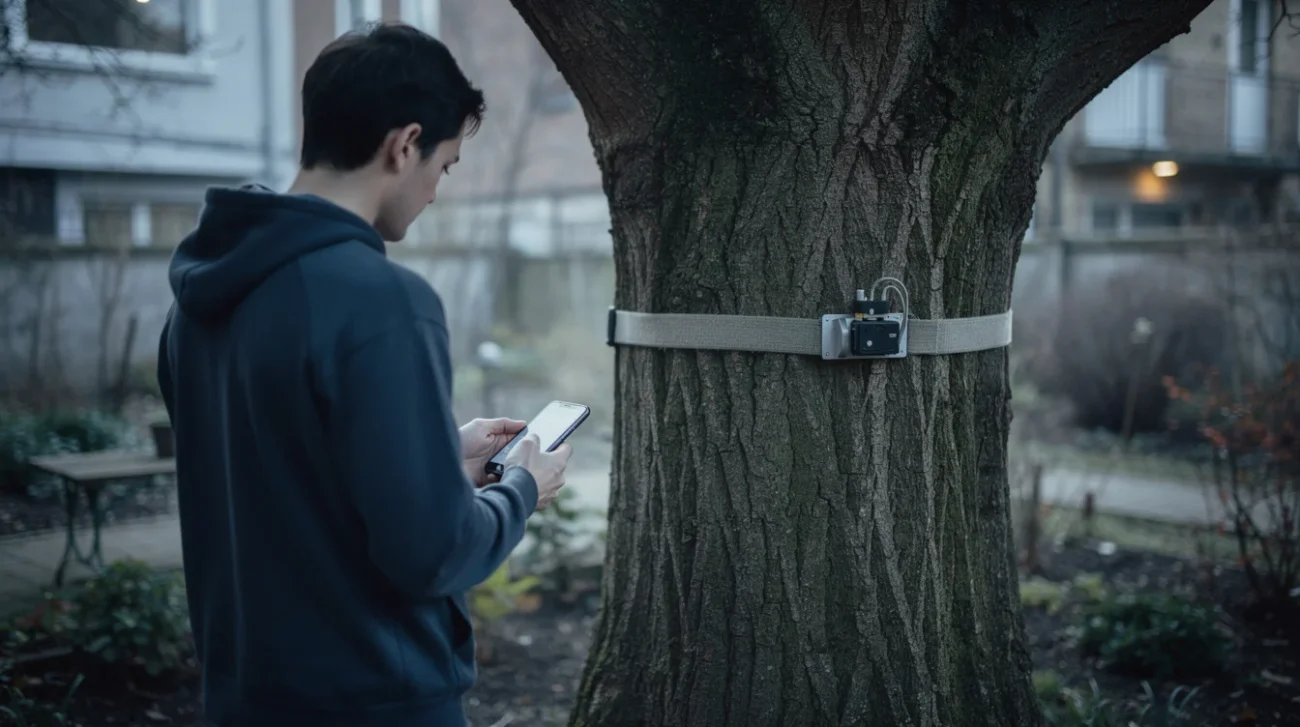
Designers Shashwath Santosh and Nithin Eluvathingal have made that proposition tangible. Their conceptual device, described in Dezeen’s October 5, 2026 report, is a small “knocker” that attaches to a tree and can be activated remotely through a smartphone app. It knocks on wood when wood is out of reach. The premise is playful; the design problem it exposes is not.
Product design has become exceptionally good at confusing less effort with a better experience. A remote wood-knocker pushes that assumption towards absurdity. If the knock happens but your hand never meets the wood, has the ritual been completed—or merely its mechanical specification?
This is not a question about whether knocking on wood actually changes anyone’s luck. It is a question about what an object promises to deliver. The machine can supply an impact. Whether that impact supplies reassurance, participation or meaning is a different brief altogether.
The Knock Is Not Just an Output

In functional terms, knocking on wood looks almost embarrassingly simple: make contact with a wooden surface. But a familiar gesture can contain several events at once. You interrupt your speech. You acknowledge uncertainty. You move your body. Someone nearby recognises the joke, shares the anxiety or joins in. The wood matters, but so does the interruption.
The remote knocker separates these components. Your intention stays with you; the physical contact happens elsewhere. That separation makes it a useful example of critical design, whether or not the designers claim that label. Like the speculative objects associated with Anthony Dunne and Fiona Raby, its value lies less in solving an unquestioned need than in making the need look strange.
Consider Philippe Starck’s Juicy Salif for Alessi. The citrus squeezer is famously more than a neutral instrument: its sculptural presence turns a kitchen task into a conversation about what a utensil should be. Santosh and Eluvathingal’s proposition applies a similarly productive disturbance to convenience.
The provocation is sharper because the task is so small. Saving someone a strenuous procedure is easy to defend. Saving them a brief, expressive gesture forces a harder question: was the gesture actually the thing they wanted?
Convenience Is Not the Enemy. Substitution Is.
It would be lazy to conclude that a ritual becomes authentic only when performed manually. Bodies have different capacities. People are separated by distance, illness, work and borders. A design culture that romanticises physical effort can turn meaningful participation into an exclusive club.
A person with limited hand movement might find a remote trigger genuinely enabling. The choice between a smarter toothbrush and one more people can hold raises a similar question about what counts as a useful improvement. Someone joining a family celebration by video call is not necessarily participating less sincerely than the relatives around the table. The screen can preserve a relationship that distance would otherwise interrupt. Mediation is not automatically abandonment.
The useful distinction is between removing an obstacle to participation and removing participation itself. An accessible control can let someone choose the moment, initiate an action and share its consequences. An automated system that performs the same action on a schedule may preserve the visible event while dropping the person’s attention from the loop.
The knocker sits directly on this fault line. Pressing an app control could become a new ritual: deliberate, comic and personally meaningful. But the app cannot establish that meaning simply by confirming that wood was struck. Designers should stop treating successful execution as proof of a successful experience. Those are separate tests, and each needs evidence.
Some Friction Is the Product
The kitchen offers a useful comparison. With a Bialetti Moka Express, making coffee involves filling, assembling, heating and waiting. An automatic coffee machine reduces many of those demands. Neither method has a monopoly on good coffee or a meaningful morning. Yet for someone who values the sequence, eliminating it does not improve the same experience. It creates a different one.
The same distinction appears in music. A record player asks you to select a sleeve, handle a disc and lower a stylus. Streaming can provide immediate access without that choreography. For some listeners, the physical sequence creates attention; for others, it is needless maintenance. The mistake is not choosing streaming. The mistake is assuming both arrangements organise listening identically.
Friction deserves evaluation, not automatic deletion. Some effort is exclusionary or tedious. Some effort establishes pace, commitment and anticipation. A difficult clasp may simply be bad design; the pause before lighting a birthday candle may be essential to the occasion.
The wood-knocker therefore asks product teams to identify what their users are trying to preserve. Is it contact with a material? A moment of acknowledgement? A shared joke? Without that distinction, optimisation can remove the very reason an object entered someone’s life.
Design the Connection, Not Just the Command
A remote ritual should be judged by the relationship it sustains, not by the distance over which it operates. That changes the design brief. Instead of asking only whether an app can trigger a mechanism reliably, ask whether the participant understands what happened, feels responsible for initiating it and wants to repeat the experience.
For the knocker, possible experiments might include live sound from the impact, a deliberately held control rather than an accidental tap, or a shared activation between two people. These are proposed directions, not reported features. Each would test a different hypothesis: that hearing, duration or companionship carries some of the meaning displaced by remote operation.
More feedback is not automatically better. A celebratory animation could turn a private reassurance into generic app theatre. A streak counter could replace a spontaneous gesture with an obligation. Habit metrics would measure repetition, not explain what the repetition means.
Even the tree deserves attention. A device attached to a living trunk introduces questions about fixing methods, repeated impact and maintenance. Any developed version should address those questions rather than treating a living organism as convenient infrastructure. The broader issue of supporting an object beyond its initial operation also arises when asking why a repairable lamp needs more than replaceable parts. Outsourcing an action does not outsource responsibility for where, how and on what it happens.
The Real Brief Is What Must Remain
There is a revealing asymmetry in contemporary product culture. Teams can specify the seconds saved by a shortcut more easily than the significance lost through it. A shorter interaction looks persuasive in a presentation. An experience that asks someone to linger can look like a problem awaiting correction.
Research into ritual needs a different vocabulary. Observe what people refuse to skip. Ask which preparations they enjoy and which they resent. Test accessible alternatives with the people who need them, rather than assuming that either automation or manual performance represents everyone’s ideal. Look for attachment, agency and shared recognition—not merely completion rates.
Santosh and Eluvathingal’s knocker is compelling because it does not need to settle these issues to expose them. Its modest action makes the standard promise of smart products suddenly unstable. “We can do this for you” sounds less persuasive when doing it was the point.
The next frontier of product design should not be making every action disappear. It should be knowing which actions deserve to remain. Remote convenience earns its place when it opens a meaningful practice to someone. It becomes a hollow substitution when it delivers the event while quietly removing the experience.
FAQ
What is Santosh and Eluvathingal’s wood-knocking device?
It is a conceptual, smartphone-controlled device that attaches to a tree and knocks on wood remotely. Shashwath Santosh and Nithin Eluvathingal use the familiar superstition to explore what happens when a physical gesture can be performed from afar.
Does automating a ritual necessarily destroy its meaning?
No. Meaning can survive mediation or develop around a new interaction. The important question is whether automation preserves what participants value, such as intention, attention or connection, rather than merely reproducing the ritual’s visible action.
How can remote controls make rituals more accessible?
They can enable participation when mobility, dexterity or distance makes direct physical action difficult. Good design preserves meaningful choice and involvement, ideally through development with the people who will use those controls.
How should designers decide which effort to remove?
They should distinguish burdens from valued participation through observation, interviews and prototype testing. Time saved is useful evidence, but so are users’ accounts of agency, enjoyment, attachment and the parts of a practice they would miss.
If an object can perform your ritual perfectly without your physical participation, what must it preserve for you to still call that ritual yours?
Get the Mainifesto weekly — curated design debates, speculative ideas and the week's best articles every Saturday.
Editorial Perspectives
Questions and counterpoints developed by the Mainifesto editorial desk to extend the discussion.
Perspective 1
I’d pay to automate the heating, not necessarily the knock on wood before signing a contract. If the device lets someone participate who physically couldn’t otherwise, it earns its keep; if it just saves an able hand two seconds, I’m not sure what problem we’ve solved.
Perspective 2
A perfect knock is a manufacturing specification, not a ritual. But don’t fetishise the hand: we’ve long paid others to light candles and say prayers on our behalf. The app must preserve an act of intention, or we’re left with Beckett’s repetition minus the person waiting.