
Who Designs the Exit Plan for a Megaproject?
The stadium disappears. The deadline does not.
A spectacular stadium can vanish from a development programme. A World Cup cannot quietly disappear with it. That is the uncomfortable distinction exposed by reports that Saudi Arabia has indefinitely shelved Neom Stadium, which was planned to host matches during the 2034 tournament. Reporting published by Dezeen on 5 October 2026, citing Reuters and two sources, describes the plans as shelved indefinitely. That remains a reported decision, not a publicly documented cancellation settlement. It does not establish which facilities might replace the stadium or how the wider venue programme would change.
But the architectural question is already urgent. Who designs the moment when a megaproject stops being deliverable? The architect who produces the image? The developer who commissions it? The organising body that relies on its completion? Or nobody, until the timetable makes the decision for them?
Cancellation is not necessarily evidence of stupidity. Continuing an unjustifiable project can be far worse. The scandal is a planning culture that treats retreat as unthinkable while presenting speculative construction as a dependable public commitment. Neom Stadium’s reported shelving should trigger something more useful than another round of render-bashing: a demand that the exit plan become part of the original design brief.
A tournament needs seats, not belief
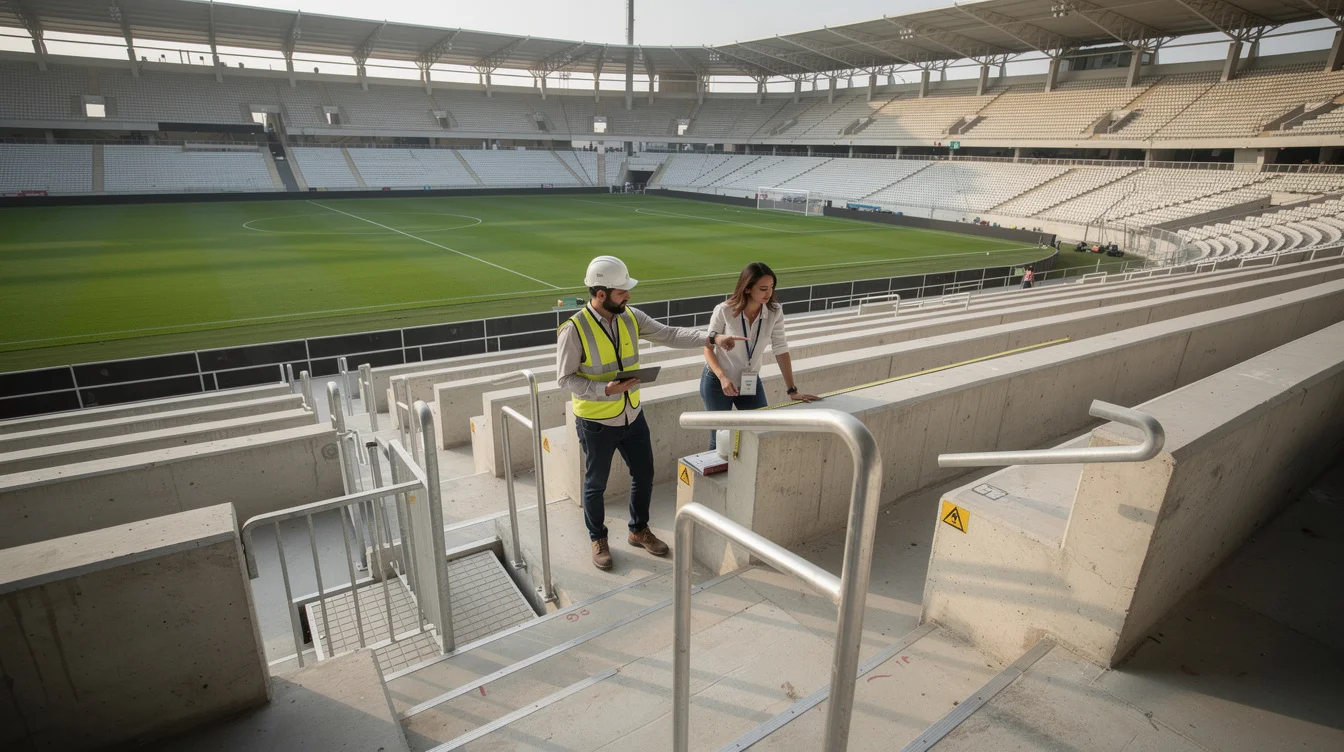
World Cup architecture operates under two different clocks. The development clock can accommodate postponement, redesign and an indefinitely deferred opening. The tournament clock cannot. Players arrive, broadcasters schedule coverage and spectators book journeys. A venue must function as a system of access, security, hospitality, maintenance and evacuation, not merely achieve an impressive silhouette.
South Africa’s 2010 World Cup left several cities managing expensive stadium legacies. Cape Town’s stadium became an enduring example of the difficulty of matching an exceptional event building to ordinary operating demand. Brazil’s Arena da Amazônia in Manaus, built for the 2014 tournament, sharpened the same question: what makes a venue viable after the global audience leaves? Neither example means that every tournament stadium fails. Both show why delivery and long-term use must be evaluated together.
Saudi Arabia’s 2034 programme should therefore be judged through more than its most ambitious proposals. The relevant test is whether the tournament remains deliverable if an individual project is delayed or removed. A credible bid should survive the loss of its most photogenic building. If one extraordinary venue is indispensable, its exceptional ambition becomes a structural risk. If it is dispensable, that redundancy should be explained before construction commitments accumulate, not discovered during a retreat.
The fallback must be a project, not a sentence
“Alternative venues will be available” is not a fallback strategy. It is reassurance without design. A credible reserve venue needs an identified site or existing stadium, a condition survey, a costed upgrade scope, an approvals pathway and a realistic delivery schedule. Transport capacity matters as much as seating capacity. Moving matches to another city redistributes pressure across airports, hotels, training facilities and local streets.
Saudi Arabia has existing football infrastructure, including King Abdullah Sports City in Jeddah. That does not automatically make any particular stadium an approved substitute for Neom. It does make a serious evaluation of existing assets more rational than assuming every programme change requires another architectural announcement. The fallback could involve refurbishment, temporary seating or reallocating fixtures across venues already in the tournament plan, subject to governing-body approval and operational assessment.
London 2012 offers a useful, imperfect reference. Its basketball arena demonstrated that temporary event capacity could be treated as a deliberate design commission. Conversely, the Olympic Stadium’s complicated conversion into a football venue showed how expensive “legacy” becomes when future use is not adequately resolved.
The reserve option deserves engineers, architects and an operating model. A contingency allowance cannot compensate for a venue that exists only as a line in a risk register.
Phase the money before the spectacle
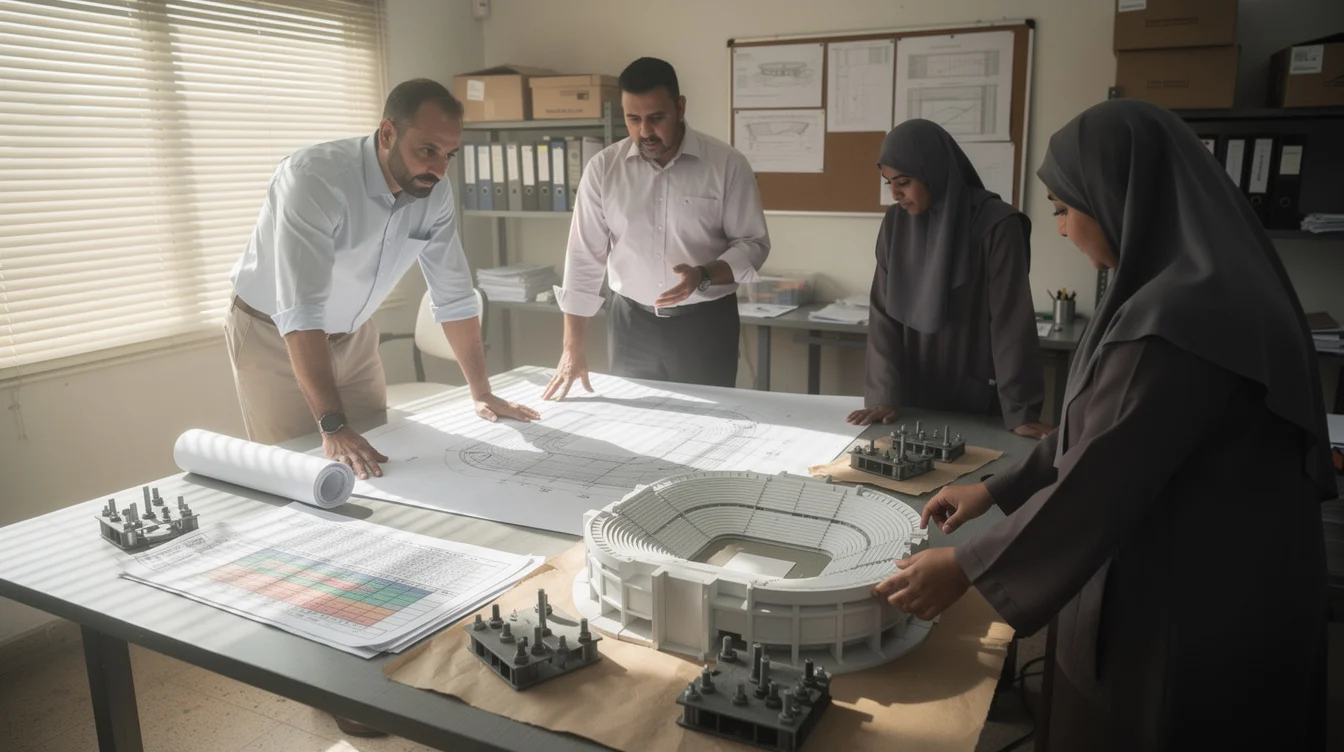
Megaprojects are often described as phased because they are divided into construction packages. That is not the same as limiting exposure. A genuinely phased investment releases money only when evidence supports the next commitment. Early approvals might fund surveys, design development and transport studies. Later gates should require independently tested costs, construction methods, procurement capacity and a credible operating plan.
Each phase should also have value if subsequent phases never happen. A useful road connection, a community sports facility or a serviced district can survive a reduced programme. Infrastructure tailored exclusively to an unbuilt destination may not. The question is not simply how much has been constructed, but how much remains useful when the masterplan shrinks. The same principle applies to streets that thrive beyond shopping: their public value need not depend on the original commercial premise.
Hamburg’s Elbphilharmonie, designed by Herzog & de Meuron, illustrates why eventual cultural success does not erase the need to scrutinise cost escalation and governance. Its popularity after opening is not a transferable guarantee that every troubled landmark should proceed. Equally, stopping a project solely because costs have risen may sacrifice genuine future value. Investment gates need evidence, not automatic austerity.
For a World Cup venue, the final gate must come early enough to activate the reserve option. An exit right that expires before anyone can safely use it is not a safeguard. It is contractual decoration.
Give somebody the authority to stop
The uncomfortable answer to the title question is that architects cannot design the exit alone. They can test alternative programmes, detail reversible assemblies and identify what can be retained. They cannot independently reallocate tournament matches, renegotiate finance or guarantee contractor payments. Those responsibilities belong to the commissioning and delivery system, and they need named owners.
A serious exit strategy would assign the client responsibility for financial exposure, the organising body responsibility for tournament continuity, and designers responsibility for technically credible reduced or alternative schemes. An independent review should test the assumptions behind continuation. Public authorities should require disclosure of liabilities wherever public money, infrastructure or guarantees are involved. The people authorising the next expenditure should not be the only people judging whether it remains justified.
Montreal’s Olympic Stadium, associated with architect Roger Taillibert, remains a warning against separating the memorable object from its prolonged financial consequences. Architecture’s authorship is celebrated at the unveiling; responsibility becomes much harder to locate when bills persist.
The exit plan must also reach beyond the balance sheet. Workers need outstanding wages settled and contracts lawfully resolved. Suppliers need clear termination arrangements. Part-built sites require stabilisation, security and environmental management. Cancellation does not erase obligations; it changes their form. No project should be allowed to disappear administratively while leaving its consequences on the ground.
Design ambition that can survive subtraction
There is an architectural precedent for treating restraint as expertise rather than defeat. Lacaton & Vassal’s transformations of existing housing, including the Grand Parc Bordeaux project with Frédéric Druot and Christophe Hutin, show how an ambitious design position can begin by refusing unnecessary demolition. Their lesson is not that a stadium should resemble a housing retrofit. It is that the brief itself is open to challenge.
Applied to megaprojects, that means asking whether a smaller permanent venue, an upgraded existing stadium or a redistributed programme could deliver the actual obligation. It also means designing components for reuse without pretending that disassembly guarantees a buyer. Qatar’s Stadium 974, conceived around modular construction and shipping containers for the 2022 World Cup, offers a relevant design reference. Its dismantlable concept should not be confused with proof that every promised reuse outcome will materialise.
The reported shelving of Neom Stadium is therefore neither sufficient evidence that the entire 2034 programme is unworkable nor a trivial adjustment to be waved away. It exposes the question every spectacular proposal should answer before approval: what happens if this does not happen? The mature megaproject is not the one that promises never to retreat. It is the one whose retreat does not become everybody else’s emergency.
FAQ: Megaproject exit plans
Has Neom Stadium definitely been cancelled?
Dezeen’s 5 October 2026 report, citing Reuters and two sources, says the plans have been shelved indefinitely. That wording does not establish permanent cancellation, a final contractual settlement or an approved replacement venue.
What should a megaproject exit plan contain?
It should specify decision triggers, responsible authorities, termination costs, worker and supplier obligations, site stabilisation and options for reusing completed work. For a tournament venue, it also needs a deliverable fallback and a deadline for activating it.
Would requiring fallback venues double construction costs?
Not necessarily. A fallback can involve assessing and preparing an existing venue rather than building a duplicate. Surveys, approvals and reserved upgrade capacity cost money, but they can limit exposure to emergency construction later.
Do exit strategies discourage ambitious architecture?
They discourage ambition that relies on hiding its consequences. Reversible construction, useful intermediate phases and alternative operating models give designers room to experiment without making the whole programme dependent on one outcome.
Should a megaproject be allowed to win approval before its backers can show, publicly and credibly, how they would stop it?
Watch the Mainifesto Short
Get the Mainifesto weekly — curated design debates, speculative ideas and the week's best articles every Saturday.
Editorial Perspectives
Questions and counterpoints developed by the Mainifesto editorial desk to extend the discussion.
Perspective 1
Before approval, I’d want a costed fallback venue, clear stop points and a plan for any infrastructure left behind. Phasing only reduces risk if each completed phase has a useful life without the next one.
Perspective 2
A fallback stadium is useless if it depends on the same funding and delivery bottlenecks as the original. The public plan needs to name who can pull the plug, who absorbs the loss and what happens to workers and contracts—not just where the match moves.
Perspective 3
We still approve these projects as monuments and discuss their failure as an accounting problem. Cedric Price treated a building’s lifespan as a design question decades ago; asking how a stadium might cease to be necessary is hardly an attack on architectural ambition.
Perspective 4
We model crowd flows and structural loads in extraordinary detail; why not test cancellation at every construction stage? I’d make approval depend on those scenarios being public, including which components could actually be reused and at what cost.
Perspective 5
I wouldn’t demand a fully engineered backup before anyone can start feasibility work, but approval to build is another matter. Before major contracts are signed, show the cancellation bill, a workable alternative venue and who’s paying for both.