
When the Furniture Is Heritage, Can the Home Still Change?
When the Furniture Is Heritage, Can the Home Still Change?
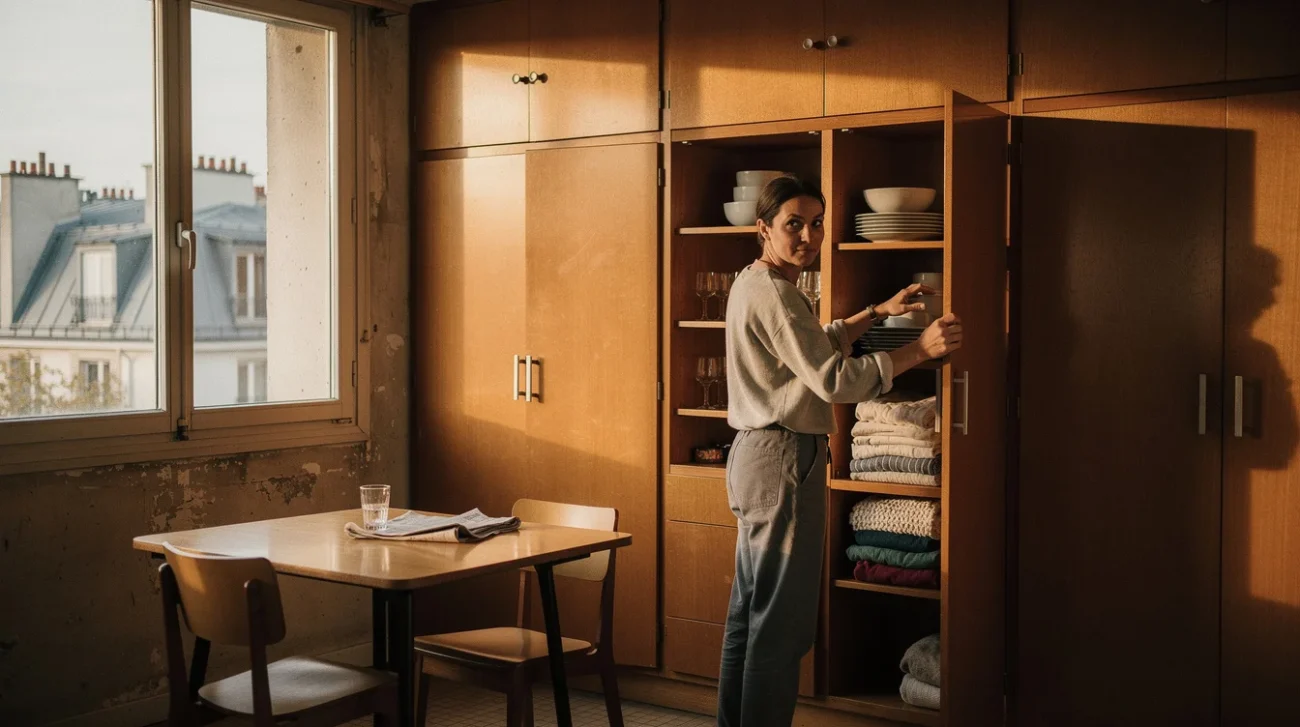
A cupboard is usually yours to remove. Give it an architectural pedigree, however, and its hinges become a matter of cultural responsibility. The survival of Charlotte Perriand’s built-in interiors inside a Paris residential tower completed in 1960, designed by architect Édouard Albert and collaborators, brings that uncomfortable distinction into focus. As reported by designboom, the preserved rooms show furniture, structure and everyday life conceived together within an early French residential high-rise. Their significance lies not simply in desirable objects, but in the relationships between them.
That does not establish what legal protections apply to any particular apartment, or whether its occupants face restrictions. It does expose the central argument of built-in interior conservation: when authorship extends into storage, partitions and working surfaces, where does architecture end and a resident’s freedom begin? There are two serious answers. Neither permits the comforting fiction that preservation is merely a technical exercise.
PRO: Preserve the Interior, Not Just the Collectible
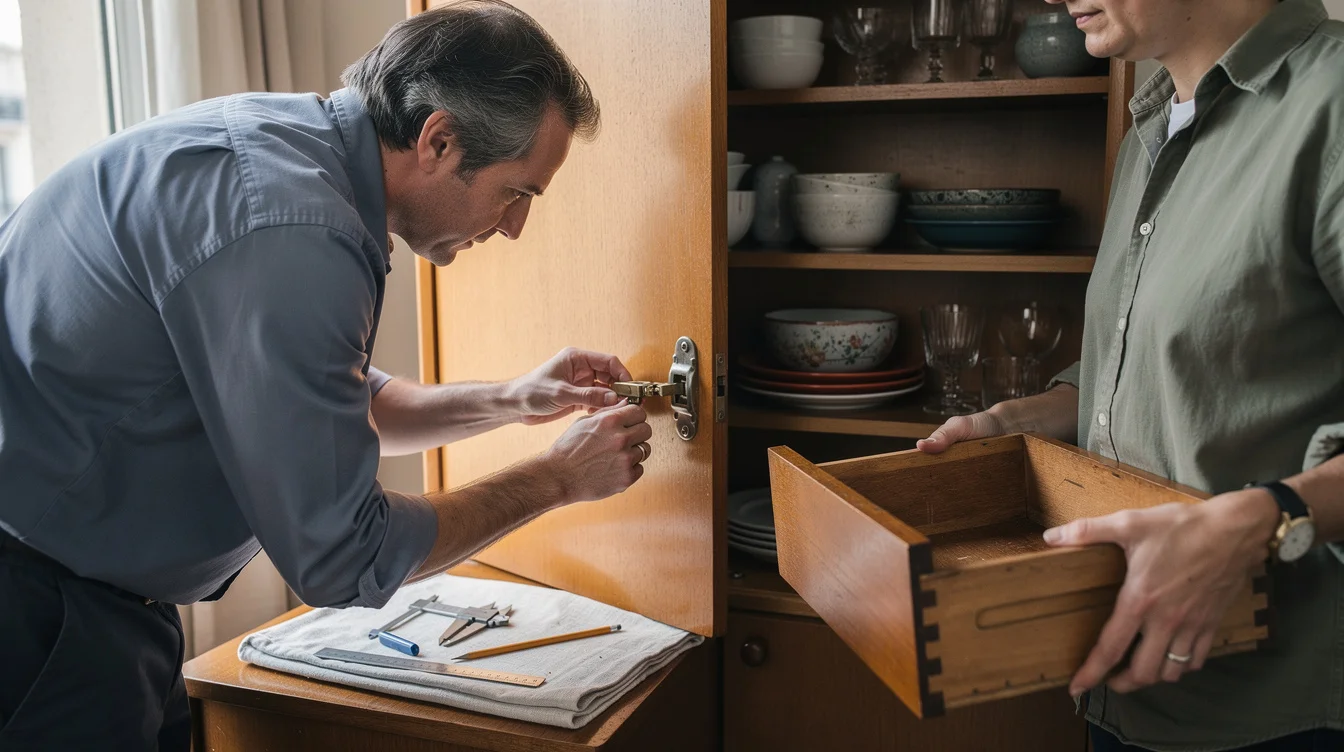
An integrated interior is a spatial argument, not a shopping list. Removing its fittings while retaining its shell can be as destructive as keeping a book’s cover and replacing its pages. A built-in cupboard determines the depth of a room, the direction of movement and the amount of furniture needed elsewhere. A surface positioned between activities can make a compact dwelling work without another enclosed room. These relationships are harder to exhibit or auction than a chair, but they are often the more consequential design achievement.
Perriand’s work makes this particularly clear. At Les Arcs, the French ski resort she helped shape from the late 1960s, compact accommodation depended on coordinated planning, equipment and furniture. Economy of space was not an unfortunate constraint to conceal with styling; it was a design problem tackled across scales. Her surviving Paris interiors deserve attention in that same register: not as celebrity décor, but as evidence of how domestic life could be organized.
Eileen Gray’s E-1027 at Roquebrune-Cap-Martin offers a related lesson. Storage, adjustable furniture and carefully considered bodily routines complicate any attempt to separate architecture from furnishing. Preserve only the walls and the intelligence of the dwelling becomes less legible. For conservation, the relevant unit may be the whole arrangement rather than the individually valuable component.
PRO: Ordinary Use Leaves Extraordinary Evidence
The strongest preservation case concerns evidence that cannot be recovered once discarded. An original fitting records dimensions, construction methods, material economies and expectations about its users. A worn handle can indicate repeated contact; altered shelving can reveal a household’s negotiation with the initial scheme. Conservation should not automatically erase these traces to produce a photogenic impression of opening day.
Margarete Schütte-Lihotzky’s Frankfurt Kitchen, developed in 1926, demonstrates why this evidence matters. Its integrated layout made domestic work an explicit subject of architectural reform. Surviving examples allow historians to examine not just its celebrated efficiency, but also the assumptions embedded in that efficiency: who worked there, what movements were anticipated, and how tightly tasks were prescribed. A newly manufactured approximation may explain the concept, but it cannot carry the same material testimony.
The environmental argument strengthens this position. Removing serviceable cupboards to install fashionable replacements wastes materials and often substitutes shorter-lived components. Preservation can be a discipline of repair rather than reverence. For a significant Perriand ensemble, that might mean retaining original joinery, repairing hardware and routing new services through less sensitive areas where technically feasible.
But society cannot demand such care while treating its costs as a private inconvenience. If an interior delivers public cultural value, conservation advice, specialist repairs and financial support should follow. Heritage responsibility without assistance is an unfunded commission imposed on whoever happens to live there.
CONTRA: A Home Is Not an Architect’s Permanent Instruction
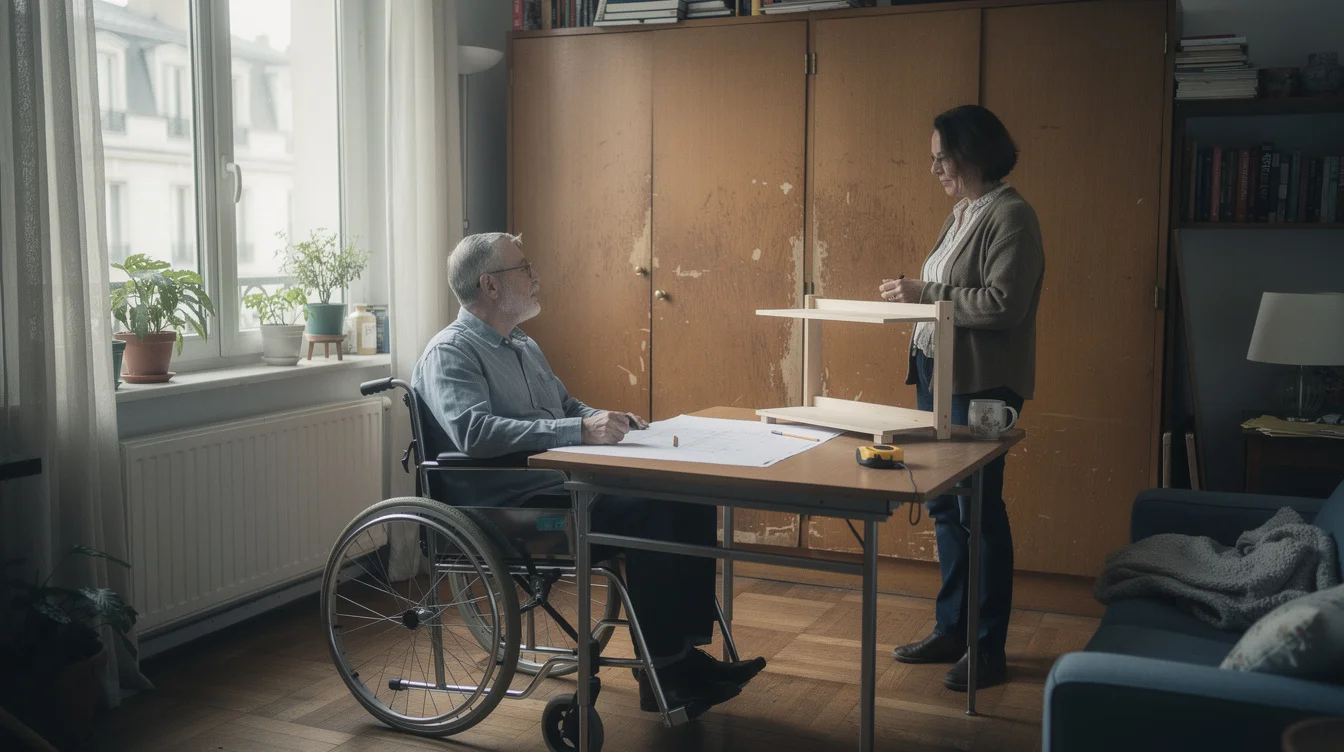
A preserved arrangement can also preserve an obsolete demand on the body. Storage that suited one household may be inaccessible to a wheelchair user. A work surface may be uncomfortable for someone of a different height. A carefully coordinated kitchen may accommodate neither an essential appliance nor the circulation space required by a carer. These are not failures of taste. They are reasons a home must change.
None of these conditions should be presumed to describe the surviving Paris rooms. They are the practical tests any conservation proposal must pass. It is easy to defend an original cupboard from an editorial desk; harder to defend it to the resident who cannot reach its contents. Cultural importance does not turn a physical barrier into an acceptable daily burden.
The Rietveld Schröder House in Utrecht provides a useful counterpoint. Designed in close collaboration with Truus Schröder-Schräder, its celebrated movable partitions made changing spatial relationships central to the architecture. Yet the preservation of an ingenious mechanism is not the same as preserving a resident’s power to decide how to live. A museum can demonstrate flexibility on a guided visit. A household needs to exercise it without asking permission.
Domestic authorship is therefore never singular. Architects establish conditions; residents continuously revise them. Conservation becomes intellectually dishonest when it treats the designer’s contribution as culture and every subsequent household decision as damage.
CONTRA: Protect the Idea Without Freezing Every Component
John Habraken’s distinction between long-life building supports and changeable domestic infill offers a productive challenge. His 1961 book, later published in English as Supports: An Alternative to Mass Housing, argued for a distribution of control rather than a finished environment imposed from above. Perriand’s integrated interiors pose an almost inverse problem: what happens when the infill itself becomes the protected achievement?
The answer should be selective conservation, not an automatic right to strip everything out. Establish which relationships and components carry exceptional significance. Identify where alteration would genuinely destroy evidence, and where it would simply offend a preference for visual consistency. An important storage wall might remain while an adjoining service zone is upgraded. A reversible insert might improve access without cutting original timber. Where removal is necessary, measured records and responsible storage can reduce loss, although neither substitutes fully for survival in place.
Lacaton & Vassal’s housing transformations, including the Grand Parc project in Bordeaux with Frédéric Druot and Christophe Hutin, show another preservation ethic: retain existing buildings while expanding residents’ possibilities. These projects do not resolve the conservation of authored furniture, but they establish a useful priority. Keeping architecture should make more life possible, not less.
A credible policy would therefore be negotiated, component-specific and attentive to affordability. It would distinguish a rare, substantially intact ensemble from a heavily altered example. And it would admit that accessibility can outweigh completeness. The most serious threat to domestic heritage may be a protection regime so inflexible that only wealthy enthusiasts can inhabit it.
FAQ: Who Gets to Change a Significant Interior?
What makes built-in furniture different from freestanding furniture?
Built-ins can define circulation, room boundaries and usable space. Their importance may depend on their exact position and relationship to the building, so removing them can change the architecture rather than simply its decoration.
Does a famous designer’s involvement automatically prohibit alterations?
No. Restrictions depend on the jurisdiction, the property’s legal status and the precise scope of any protection. Cultural significance and legal designation are different questions. Owners should check applicable requirements before commissioning work.
Can a significant interior accommodate accessibility upgrades?
Often, but solutions require an assessment of both the resident’s needs and the interior’s significance. Reversible adaptations and changes to less sensitive components may help. Where those measures are insufficient, permanent alteration can be justified; accessibility should not be treated as an optional amenity.
Are replicas an adequate replacement for original fittings?
Replicas can communicate appearance or recover a lost spatial relationship, but they do not retain original material evidence. Their use should be documented clearly, and replacement should not become an easy excuse to discard repairable originals.
If preserving an architect’s complete vision limits a resident’s ability to live well, which parts of that vision should we be willing to lose?
Watch the Mainifesto Short
Get the Mainifesto weekly — curated design debates, speculative ideas and the week's best articles every Saturday.
Editorial Perspectives
Questions and counterpoints developed by the Mainifesto editorial desk to extend the discussion.
Perspective 1
If residents have to fight the furniture to use their own home, I’m for changing it—even if that means losing part of Perriand’s composition. Keep the defining pieces, but let storage, lighting and seating earn their place through daily use, not just pedigree.
Perspective 2
I’m against dismantling a rare integrated interior simply because its layout is inconvenient for the current resident. Test reversible adaptations first: once you separate the furniture from the spatial arrangement, you may preserve the objects while losing what made the design worth protecting.
Perspective 3
You need to distinguish between a home with heritage value and a museum someone is expected to maintain at their own expense. Set out what cannot change, allow sensible upgrades elsewhere, and fund the conservation obligations rather than pretending they cost nothing.
Perspective 4
Before removing a cabinet, look at its joints, its worn edges and how its depth shapes the room—those details are often the design, not decoration. I’d sacrifice an original upholstery fabric that can no longer do its job before cutting apart well-made joinery, and document whatever is replaced.