
Why a Robotics Company Wants to Look Low-Tech
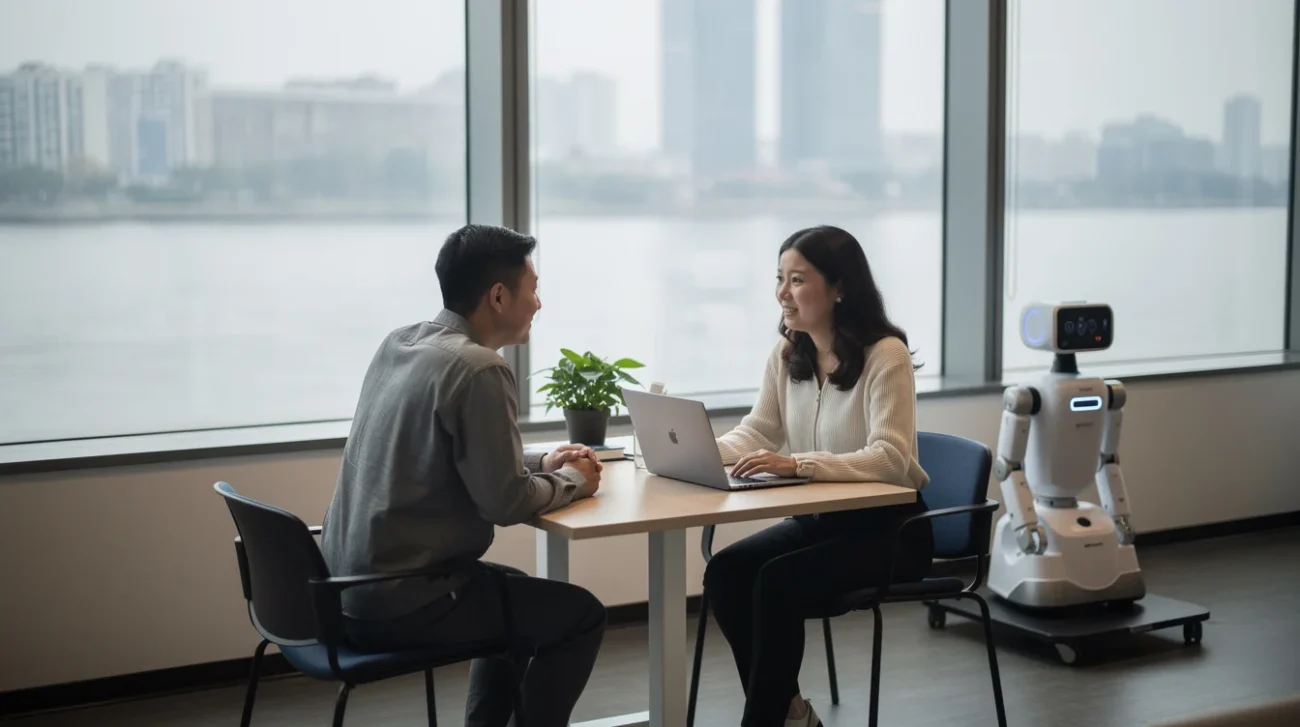
The most revealing instruction in a robotics company’s design brief might be the least futuristic one: give the space a “low-tech feel.” That was the request behind Bothaus, HCCH Studio’s small reception and exhibition space on the lower floor of Sudo Technology’s office and robotics laboratory in a tower along Shanghai’s Yangpu waterfront. Intended for the embodied-intelligence company and its invited users, it occupies a consequential threshold: where a technical organisation becomes a social encounter.
The brief deserves more than applause for avoiding science-fiction clichés. It proposes that advanced technology should become less conspicuous as it enters everyday life. But less conspicuous to whom, and on whose terms? There are two ways to read this interior: as an antidote to technological theatre, or as a more sophisticated version of it.
PRO: Stop making the future look like a showroom
The strongest argument for Sudo’s brief is that the conventional visual language of innovation has become intellectually lazy. Blue light, luminous dashboards and immaculate surfaces announce technological importance without necessarily communicating anything useful. Like museum-like retail spectacle, they turn a visitor into an audience before a conversation has begun. An embodied-intelligence company has good reason to reject that script: machines operating in physical environments must eventually coexist with ordinary habits, not perpetual product launches.
Mark Weiser and John Seely Brown’s writing on calm technology offers a useful distinction. Technology need not occupy the centre of attention continuously to remain available and intelligible. Applied to an interior, this suggests that orientation, comfort and conversation should not be subordinated to demonstrations. A reception space can let someone arrive before asking them to admire.
There is an architectural precedent in SANAA’s Rolex Learning Center at EPFL in Lausanne. Its continuous, undulating interior puts movement, proximity and informal occupation at the centre of an institution dedicated to knowledge. It does not need to resemble a computer to accommodate technical intelligence.
Bothaus should not be equated formally with that project. The connection is a design priority: an advanced institution does not owe visitors an aggressively advanced-looking room. Rejecting that obligation can be a serious act of hospitality rather than an exercise in nostalgia.
PRO: Familiarity can make room for better questions
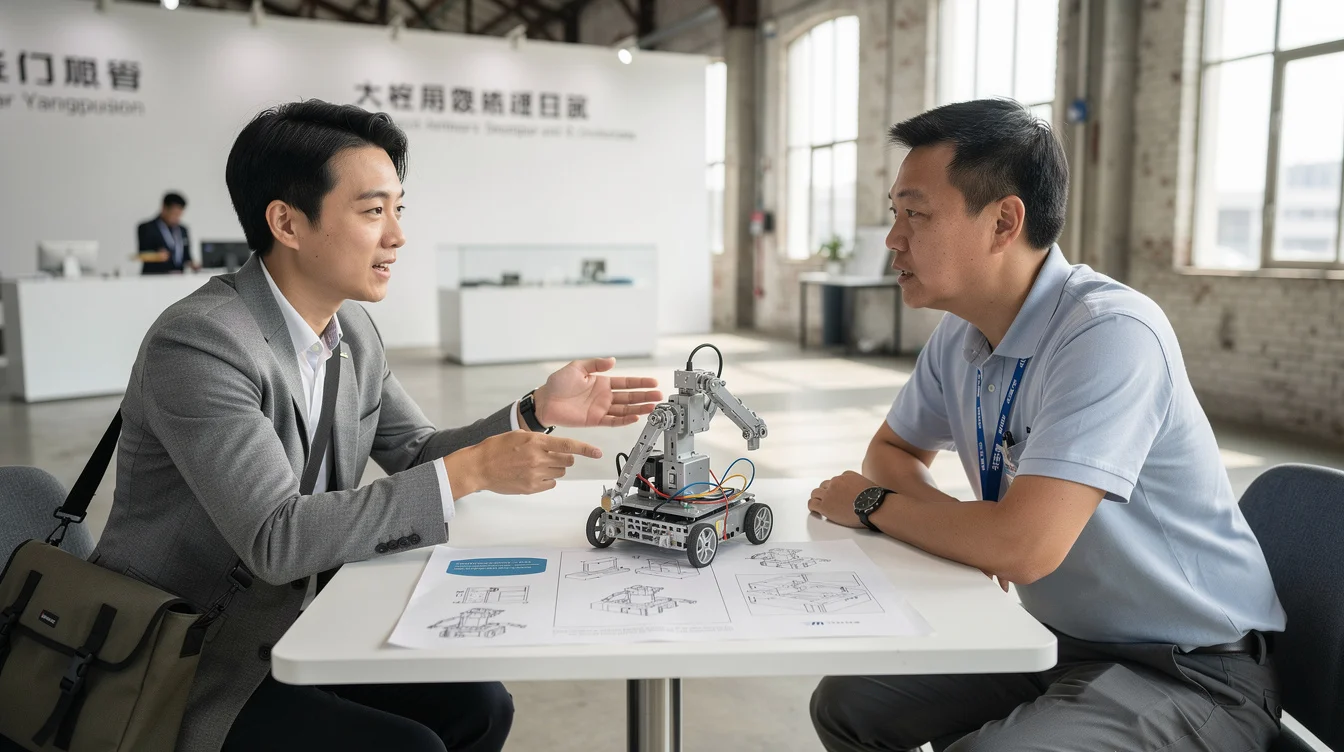
A reception and exhibition space is not a laboratory, and judging it as one would miss its purpose. Bothaus serves invited users at the edge of Sudo’s workplace and robotics research environment. Its first task can reasonably be to support introductions, demonstrations and discussion. A visitor who does not feel technically fluent should still be able to ask an awkward question.
Charles and Ray Eames understood that accessibility need not mean intellectual surrender. Their Mathematica: A World of Numbers… and Beyond exhibition, developed for the California Museum of Science and Industry in 1961, used physical models and engaging displays to make abstract ideas approachable. The lesson is not to copy its objects. It is to recognise that curiosity often begins with an encounter scaled to the body rather than a declaration of expertise.
For a robotics reception space, that principle could mean seating that supports a discussion after a demonstration, explanations within comfortable reading distance, or a clearly marked opportunity to watch a machine repeat a task. These are possibilities suggested by the brief, not documented features of Bothaus.
The distinction matters. “Low-tech” can describe the visitor’s interface with an organisation, not the organisation’s technical ambition. If an unshowy room helps someone ask what a robot cannot do, it has achieved more than a spectacular lobby that leaves everyone politely impressed. Familiarity earns its place when it increases participation.
CONTRA: Reassurance is not an explanation
The opposing argument begins precisely where that defence becomes comfortable. A room can make people feel informed without informing them. An approachable scale, domestic associations or an absence of visible apparatus may lower social anxiety, but none explains how an embodied-intelligence system perceives its surroundings, handles uncertainty or responds when something goes wrong. Emotional accessibility and technical legibility are different design achievements.
Apple’s retail interiors provide a telling comparison. Their uncluttered tables and approachable product displays remove many of the barriers associated with buying computers. As in retail spaces designed to sell belonging, the welcoming atmosphere is part of the proposition. Yet the simplicity of the encounter does not itself explain the systems behind a device: data practices, repair constraints or the infrastructure supporting its services. This is not proof that simplicity deceives. It is proof that simplicity cannot carry the burden of disclosure alone.
The same risk becomes sharper around robotics because physical action raises questions that a pleasing atmosphere cannot answer. What can the machine detect? Where may it move? Who intervenes? Is a demonstration autonomous, remotely assisted or tightly scripted? These are questions to ask of embodied-intelligence exhibitions generally, not allegations about Sudo’s systems.
The source account establishes the low-tech brief; it does not establish how these questions are addressed at Bothaus. That gap should remain visible in any interpretation. We can welcome an interior’s refusal of spectacle without awarding it transparency on the strength of its mood.
CONTRA: Invisible technology still needs visible limits
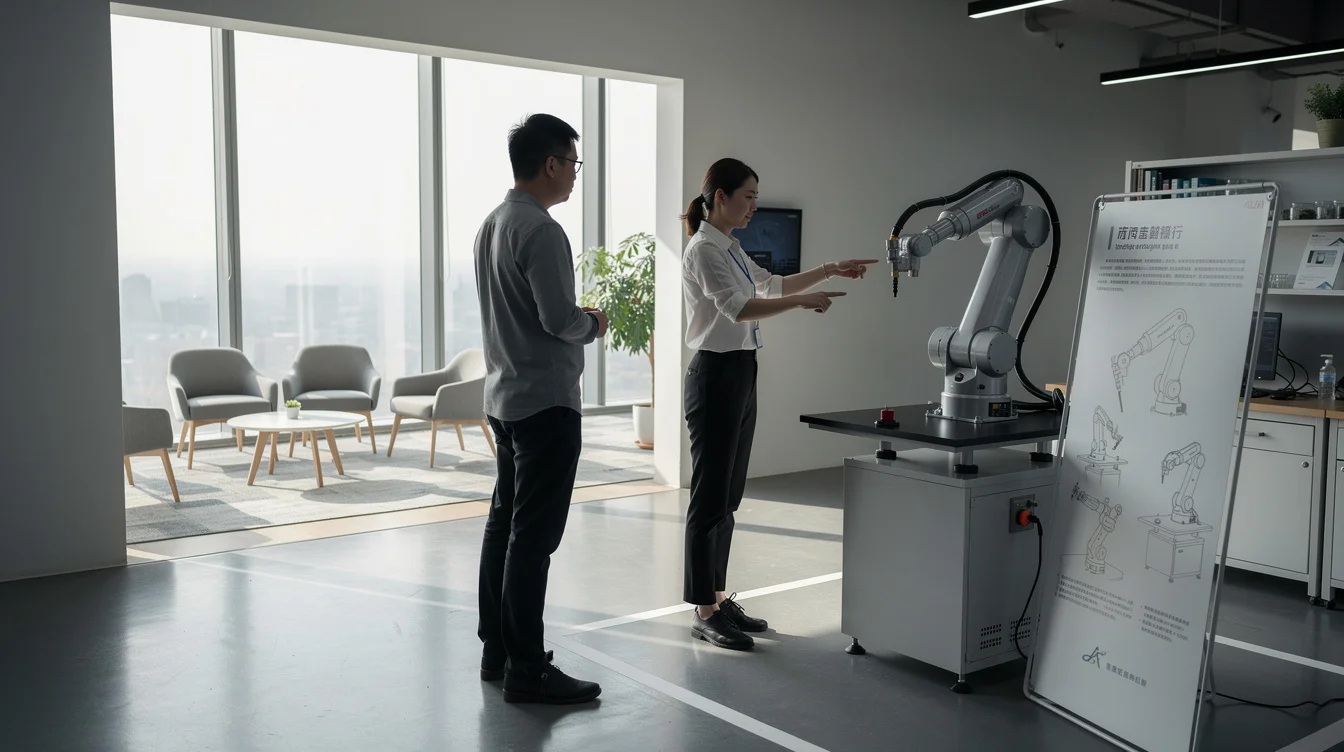
The idea of technology disappearing into everyday life is seductive because it makes friction sound like a design failure. But some friction is useful. A pause before entering a robot’s operating area, a conspicuous recording notice where recording occurs, or an explanation of a demonstration’s limits can interrupt an elegant experience for an excellent reason. Not every reminder of machinery is visual clutter.
Cedric Price’s unrealised Fun Palace, developed with theatre director Joan Littlewood, offers a productive counterpoint. Its proposed adaptability depended on an explicit framework of equipment, movement and change. Technology was not simply an atmosphere of progress; it was part of the proposition users would encounter. One need not reproduce its exposed apparatus to take the underlying point: the terms of participation should be readable.
For Bothaus and comparable spaces, a stronger brief would pair low-tech feeling with high-clarity interpretation. A demonstration could identify what is automated and what requires assistance. An exhibition could show a failure case alongside a successful task. Any relevant sensing boundary could be explained at the point where visitors encounter it. Such measures need not turn a reception room into a control centre.
The architect’s challenge is not to make robotics look harmless, but to make an encounter with it understandable. The low-tech interior becomes defensible when its calm supports scrutiny. Without that second obligation, it risks being a showroom with the showroom aesthetics removed.
FAQ: Low-tech interiors and embodied intelligence
What does a “low-tech feel” mean in this project?
It is the client’s stated ambition for Bothaus, HCCH Studio’s reception and exhibition space for Sudo Technology. It describes a desired experience, not evidence that the space uses little technology or particular traditional materials.
What is embodied intelligence?
Broadly, it is intelligence developed or expressed through interaction between a physical body and its environment. In robotics, that brings sensing, movement and real-world consequences into the discussion, rather than treating intelligence solely as screen-based computation.
Can an approachable interior also explain complex technology?
Yes, but approachability must be paired with interpretation. Clear demonstration boundaries, accounts of system limitations and opportunities to question staff can make a comfortable setting genuinely informative. Atmosphere alone cannot do that work.
Does a low-tech aesthetic make robotics more trustworthy?
No aesthetic establishes trustworthiness. A welcoming interior can support conversation, but confidence should rest on demonstrable capabilities, honest communication of limits and meaningful safeguards. Spatial design should help visitors assess those qualities, not substitute for them.
If a robotics company makes its technology feel ordinary before making its operation understandable, has design opened the door to participation—or quietly lowered our guard?
Get the Mainifesto weekly — curated design debates, speculative ideas and the week's best articles every Saturday.
Editorial Perspectives
Questions and counterpoints developed by the Mainifesto editorial desk to extend the discussion.
Perspective 1
I’m for giving robotics an ordinary setting; buildings have absorbed unfamiliar machines for centuries without becoming showrooms for them. A familiar room lets people enter on their own terms, provided “approachable” includes the neighbors—not just the clientele a polished new address hopes to attract.
Perspective 2
I don’t buy low-tech interiors as a shortcut to trust. A surface that invites your hand tells you something about its finish, not about what the robot beside it senses or records; craftsmanship shouldn’t be asked to vouch for a system nobody has explained.
Perspective 3
Getting someone through the door is a real design win, but it’s only the first conversion. I’d test whether visitors leave Bothaus knowing what the robots do and how to interact with them—not just whether they liked the room.
Perspective 4
A room can feel calm while leaving you unsure where to look. I’d want the lighting to make the robot’s movements and the visitor’s place beside it easy to read; atmosphere helps, but it shouldn’t soften away the cues people need.