
Urban Renewal Without the Grand Plan
City-making is leaving the era of heroic masterplans
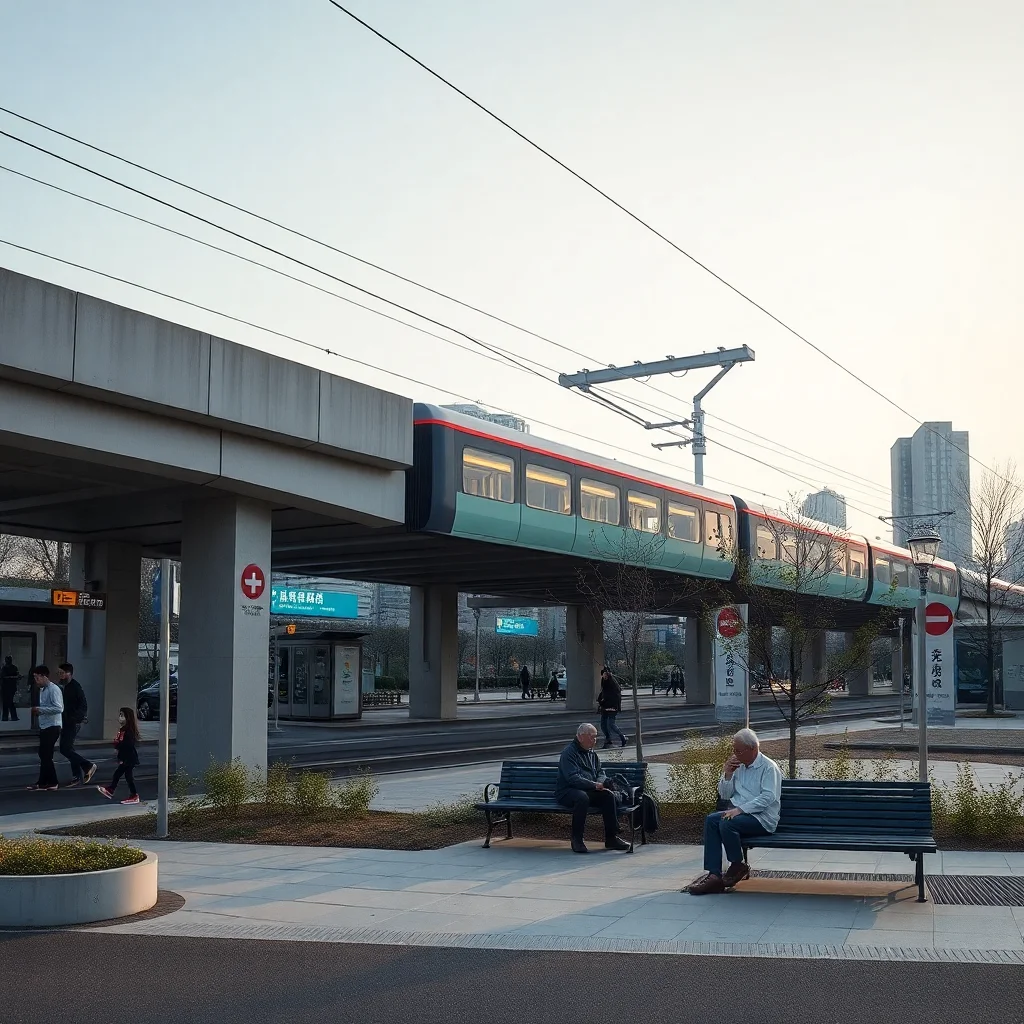
The old promise of urban renewal was seductively simple: draw one sweeping plan, clear the mess, and deliver a better city in a single gesture. That fantasy is collapsing under its own weight. In Shanghai, the environmental renewal around Caoxi Road Metro Station shows a different logic at work: not one grand reveal, but a phased sequence of adjustments, beginning with a pocket park and advancing toward the recently completed “Happy Spot under the Light Rail.” This is not a timid compromise. It is a more intelligent model of city-making, one that accepts that urban life is messy, slow, and constantly renegotiated.
The significance is political as much as spatial. Masterplans tend to pretend that cities are stable enough to be redesigned all at once. They are not. The most resilient public-space projects today behave more like systems of care: they test, revise, and expand. In that sense, Shanghai’s approach belongs in the same conversation as tactical urbanism in New York, the incremental waterfront repairs of Rotterdam, and the public-space micro-repairs long championed by designers like Jan Gehl and the late Christopher Alexander, who understood that everyday use matters more than abstract form.
1. Start with the smallest possible public gain
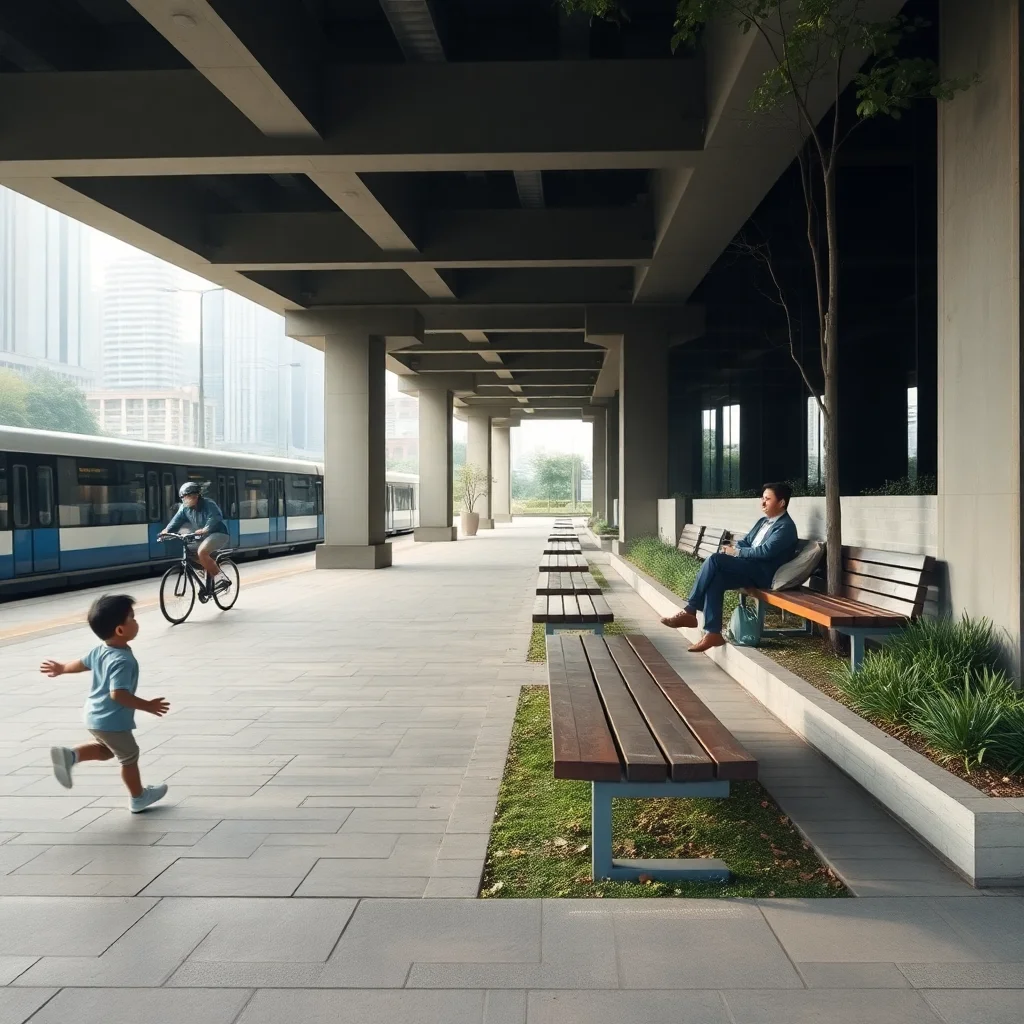
A pocket park is not a consolation prize. It is often the only move that can produce immediate civic value without waiting for capital to catch up. The first phase at Caoxi Road, the “Caoxi Road Pocket Park,” demonstrated a basic but radical idea: improve one overlooked fragment and let it change the emotional temperature of the whole district. That is how neglected infrastructure becomes legible again.
This strategy echoes the early logic of Alejandro Aravena’s incremental housing, though translated into public space rather than domestic units. The point is the same: begin with what can be done now, then leave the system open to growth, adaptation, and public feedback. Urban renewal should not be judged by the size of its first footprint, but by how much agency it creates for the next step.
2. Treat infrastructure edges as civic real estate
The space beneath transit lines is not leftover land. It is one of the most undervalued urban assets in the city. The area under the light rail near Caoxi Road could easily have remained a service gap, a residual zone defined by noise, shade, and neglect. Instead, it was reimagined as usable public ground, which means the project shifts from infrastructure as separator to infrastructure as host.
That reversal is crucial. Cities have long treated rail corridors as barriers, but contemporary public-space design increasingly sees them as opportunities for stitching neighborhoods back together. Think of the High Line’s revaluation of industrial leftover, but without the overdetermined spectacle. Or consider the more modest intelligence of underpass parks and linear commons in cities from Seoul to Copenhagen. The best of these projects do not “solve” infrastructure; they domesticate it. Similar thinking can be seen in Cluj-Napoca Waterfront Urbanism and Civic Life, where public access and everyday use reshape the meaning of leftover urban edges.
3. Design for use, not just image
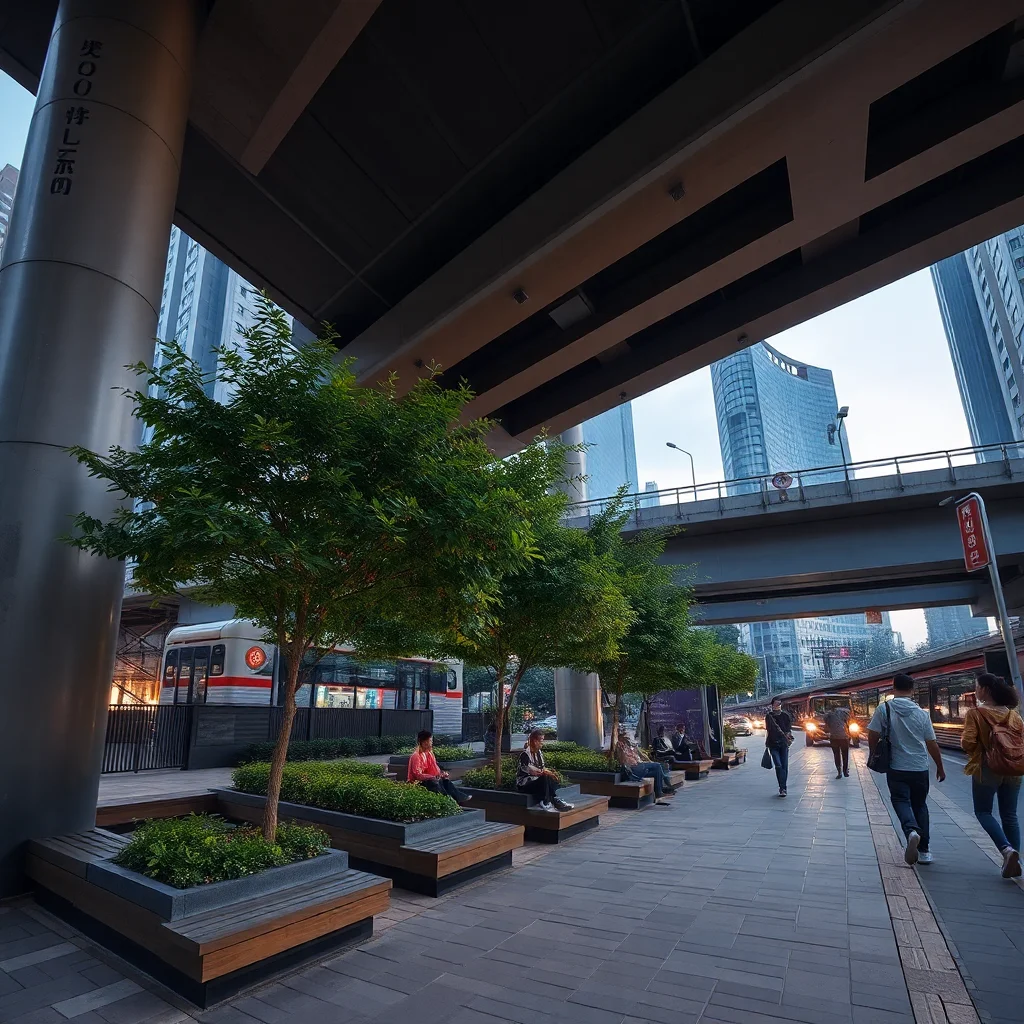
Public space fails when it performs better on renderings than in real life. The danger of iconic renewal is that it chases instant recognizability, which often produces brittle spaces that cannot tolerate boredom, weather, or repetition. The Happy Spot under the Light Rail matters because it suggests a different hierarchy: shade, seating, circulation, and proximity to daily routines come before formal drama.
This is where the project aligns with the practical urbanism of Gehl Architects and the social-spatial thinking behind Jane Jacobs’ defense of the street. A good public place is not mainly an image; it is a set of permissions. Can you sit without buying? Can children linger? Can older residents cross safely? Can commuters become neighbors for ten unexpected minutes? If the answer is yes, the space is already doing architectural work more important than spectacle. The same critique of image-first thinking runs through When Architecture Becomes Atmosphere, which examines how perception can override practical urban performance.
4. Build in phases so the city can correct you
Phasing is not a delay tactic; it is a design method. The Caoxi Road area was planned holistically in 2022, but implemented incrementally, with the pocket park completed first and the second phase only later. That sequence matters because it allowed the project to absorb changing conditions rather than freeze them into a single irreversible masterstroke. Good urbanism should be able to learn in public.
Phased delivery also resists one of the most damaging myths in architecture: that certainty is a virtue. In reality, certainty often means blindness. Projects like Toronto’s Bentway, Seoul’s Cheonggyecheon, or Barcelona’s superblocks succeeded not because they were perfect from day one, but because they created visible benefits quickly and then expanded the logic of change. In a period of economic volatility and climate pressure, phasing is not lesser ambition. It is the only sane ambition.
5. Use low-cost moves to unlock high-value behavior
Small interventions can trigger disproportionate social returns. A bench can create a pause. A path can change desire lines. A patch of planting can soften the psychological hostility of a transport edge. These are not decorative details; they are behavioral instruments. The most effective renewal projects often spend less on singular form and more on the conditions that make ordinary life easier.
That does not mean austerity should be romanticized. It means value is not always proportional to expense. Some of the most influential public-space transformations — from Paris’s pedestrianized riverbanks to the neighborhood plaza experiments in Bogotá — demonstrate that reallocation of space can matter more than expensive icon-making. The lesson for architecture is uncomfortable but necessary: a modest budget, if intelligently deployed, may outperform a major commission obsessed with visual signature. For another look at restrained ambition, see The Next Luxury Is Slowness in Architecture, which argues that patience itself can become a spatial value.
6. Make renewal reversible, not irreversible
The smartest urban interventions are the ones the city can live with, adapt, or even undo. This is the opposite of the old monumentality that assumed permanence was proof of success. In reality, cities need room to adjust. A reversible framework allows a district to test program, refine circulation, and respond to population change without being trapped by a totalizing first move.
That principle is increasingly urgent in an era of climate uncertainty, demographic churn, and shrinking public budgets. If a public-space renewal cannot accommodate changing transit patterns, new patterns of use, or community criticism, then it is not a solution; it is a liability. The Happy Spot under the Light Rail is compelling precisely because it points away from finality and toward responsiveness. It suggests that the future of public-space renewal may belong not to the heroic object, but to the adaptable toolkit.
Why this matters now
The deeper thesis is simple: cities no longer need to be saved by one authoritative hand. They need frameworks that can be assembled, tested, and improved in real time. Shanghai’s phased renewal around Caoxi Road shows how a neglected district can be transformed through a chain of small, deliberate acts that accumulate into a larger civic effect. This is less glamorous than the masterplan, but far more credible.
Architecture’s next public role may be to stop pretending it can pre-script urban life. The real challenge is to produce spaces that are open enough to evolve and disciplined enough to hold a coherent identity. That is a harder task than drawing a dramatic line on a site plan. It is also a more honest one.
- FAQ: What is incremental urban renewal?
It is a strategy that improves a city in stages rather than through one totalizing redevelopment plan. Instead of waiting for a big-budget intervention, designers make smaller moves that can be tested, refined, and expanded. - FAQ: Why do pocket parks matter in dense cities?
Pocket parks create immediate public value on leftover or neglected land. They offer shade, seating, circulation, and social visibility, often catalyzing further investment in surrounding blocks. - FAQ: How is phased renewal different from temporary urbanism?
Temporary urbanism is often experimental and short-term, while phased renewal is designed to become part of a longer transformation. The temporary test may be the first step, but the goal is a durable civic framework. - FAQ: What is the main risk of grand masterplans?
They can overpromise, flatten local complexity, and produce spaces that look coherent on paper but fail in daily life. Their biggest weakness is that they often cannot adapt once reality changes.
Get the Mainifesto weekly — curated design debates, speculative ideas and the week's best articles every Saturday.
Editorial Perspectives
Questions and counterpoints developed by the Mainifesto editorial desk to extend the discussion.
Perspective 1
This is the part of urbanism that actually works: modest moves, tested over time, with enough flexibility to respond to how people use a place. Grand masterplans still sell well because they photograph well, but they often lock cities into assumptions that are out of date before the ribbon cutting.
Perspective 2
Cities keep rewarding spectacle because spectacle is easy to brand and easier to sell to decision-makers than a slow, messy process. But from a user-experience point of view, a pocket park that people actually use beats a heroic plan that looks impressive in renderings and underdelivers on the ground.
Perspective 3
The small-intervention model makes financial sense because you can phase it, learn from it, and avoid betting everything on one expensive gesture. Spectacle survives because politics likes a single headline project, even when the better return is in boring, incremental improvements that keep the district functioning.