
Hunstanton School and the Second Life Dilemma
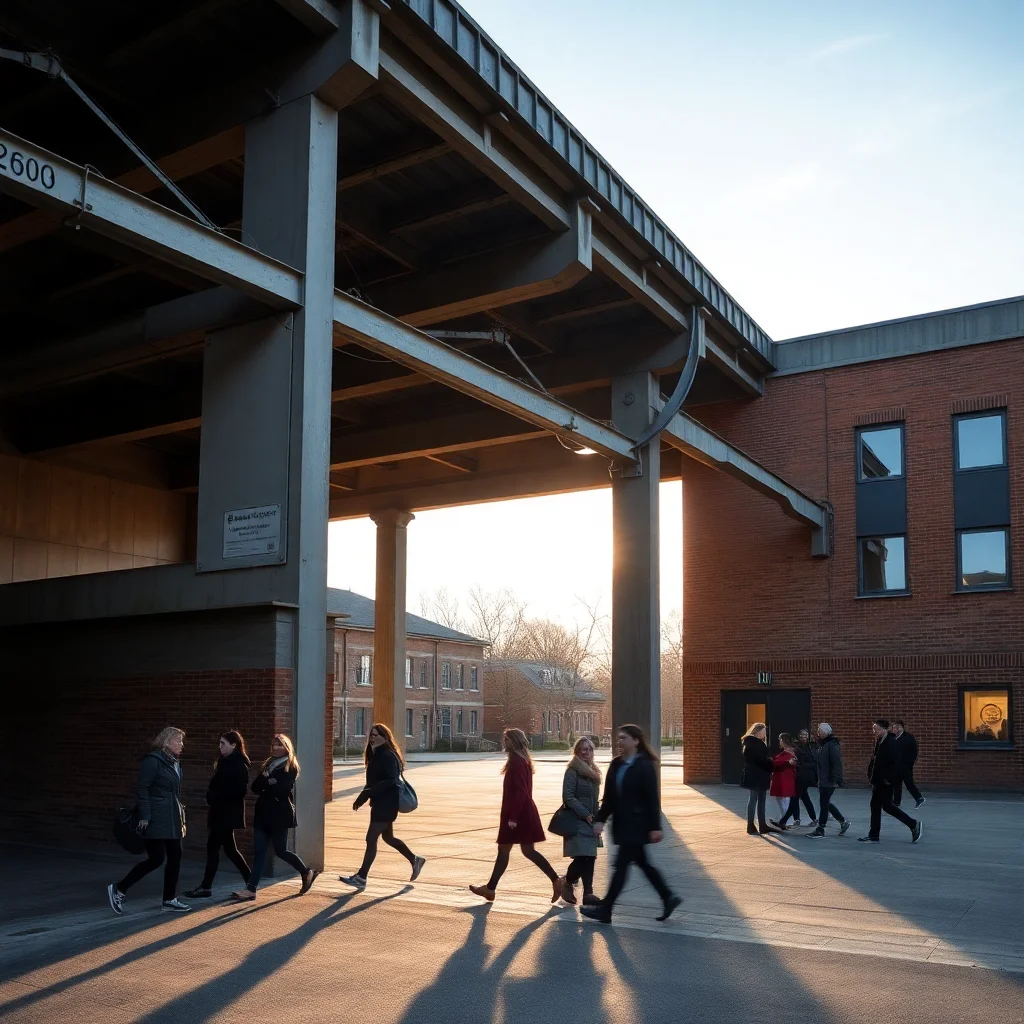
Hunstanton School is not a museum piece. That is the point.
When Smithdon High School in Norfolk re-enters public conversation, the temptation is to treat it as a sacred relic: a canonical work by Alison and Peter Smithson, one of the clearest statements of New Brutalism in Britain, and a building whose steel frame, brick infill and unapologetic service routes taught generations of architects how honesty could become a form of drama. But school buildings are not cathedrals. They are workplaces, social infrastructures, and legal liabilities. They have to hold assemblies, withstand damp coats, meet safeguarding expectations, and satisfy budgets that are almost always hostile to architectural purity. That is why Hunstanton’s renewal matters far beyond one building in King’s Lynn.
The current challenge is familiar across postwar Britain: how do you preserve an architectural landmark without embalming it? The Smithsons were never interested in nostalgia. Their work, from Robin Hood Gardens to the Economist Building, was about the rough truth of occupation, about architecture as a lived framework rather than a polished image. Hunstanton School was radical because it exposed its structure and services, refused decorative disguise, and treated the ordinary routines of education as worthy of a bold tectonic expression. Any renewal that turns that into a sanitized heritage tableau has already misunderstood the building. For a broader take on how conservation can evolve without becoming a freeze-frame, see Restoration Beyond Freezing History.
Yet the alternative is equally dangerous: to use “adaptation” as a license for vandalism. The question is not whether the school should change. It must. The question is whether change can be disciplined enough to keep the work legible, so that the Smithsons’ authorship remains visible even as the building meets contemporary standards for safety, accessibility and performance.
PRO: a landmark earns respect by remaining in use

The strongest argument for renewal is brutally simple: an educational building that no longer works as a school is not being preserved, it is being abandoned. The architecture of use is the only preservation strategy with moral authority. If Hunstanton is to survive as more than a pilgrimage site for architects, it has to continue absorbing daily life—students, teachers, weather, noise, repairs, queues, and all the incidental friction that gives a school its meaning.
That is precisely where New Brutalism becomes relevant again. Brutalism has always been accused of severity, but in its best examples it is an ethic of candour. Consider the Barbican Estate, still debated but intensely inhabited; or De La Warr Pavilion, where careful restoration has protected a modern icon while allowing public life to intensify around it. The lesson is not that modernist buildings should be frozen. It is that their value often depends on continued performance. A school that is emptied for the sake of perfect conservation betrays the social ambition that gave it purpose.
Hunstanton’s second life can therefore be read as a repair of the original contract. The Smithsons proposed a building that made education visible. Renewal can extend that principle by making maintenance visible too: upgraded services, better environmental performance, safer circulation, and more humane interiors need not erase the structure’s discipline. In fact, a sensitive intervention can clarify what is structural, what is infrastructural, and what is merely obsolete.
That is also why debates about public buildings increasingly sound like debates about systems rather than style. Architecture is no longer judged only by image but by how it mediates people, rules, and everyday exchange. In that sense, schools now operate a lot like buildings that behave like interfaces: they must translate between bodies, technologies, and institutions without losing their identity.
PRO: authorship can survive if the hierarchy is respected
There is a common lie in conservation: that respecting a building means leaving it unchanged. In practice, architecture survives through hierarchy. Some parts are sacred because they define the work; others are negotiable because they were always secondary. The Smithsons understood this better than many later preservationists. Their projects often staged a deliberate contrast between primary structure and mutable occupation, between framework and infill, between permanence and contingency.
In a school like Hunstanton, that suggests a principled method. The main structural idea—the frame, the proportions, the relationship between solids and voids—should be treated as non-negotiable. But internal arrangements, technical systems, glazed components, thermal upgrades, furniture and some service routes can be reconsidered if they support the building’s continued use. This is not compromise; it is architectural literacy.
Look at other contested modern buildings that have benefited from a strong reading of authorship. The Royal Festival Hall underwent repeated renewal, not because every intervention was ideal, but because the core identity of the place remained comprehensible. Or take Barbican Concert Hall, where contemporary improvements have had to negotiate an existing language of concrete, acoustics and public circulation. The successful projects do not pretend the old and new are identical. They stage a conversation, and the old voice still leads.
At Hunstanton, that conversation must be especially disciplined. The school’s fame means every misplaced detail will be read as ideology. Replace the wrong window profile, and suddenly the building becomes a simulation of itself. Introduce heavy-handed compliance elements, and the building risks losing the tension between precision and roughness that made it iconic. A renewal worthy of the Smithsons would be exacting enough to protect that tension, not sentimental enough to dissolve it.
CONTRA: heritage language can become a cover for architectural cowardice

The opposing position is just as forceful: too often, the promise of “careful renewal” masks timid architectural thinking. Under the banner of preservation, institutions can smother a building in caution until it becomes visually numb and operationally bland. The result is a heritage project that preserves an image rather than an idea. That is the real threat to Hunstanton: not demolition, but over-management.
Educational buildings are among the most aggressively standardized spaces in public architecture. Fire regulations, safeguarding policies, acoustic targets, daylight standards, accessibility requirements and energy benchmarks all push toward sameness. In such a context, “respecting authorship” can become a euphemism for leaving dysfunctional arrangements untouched because they are original. But originality is not automatically virtue. Some modernist schools perform poorly by contemporary standards because their spatial clarity came at the expense of comfort, inclusion or adaptability. To insist that every old decision is untouchable is to confuse history with wisdom.
There is also an ethical objection to the cult of the master architect. The Smithsons’ significance is undisputed, but a school is not an altar to two names. It is a public institution shaped by staff, students and local budgets across decades. If renewal can improve safeguarding, visibility, accessibility and environmental resilience, then refusing those improvements in the name of authorship would be a kind of aesthetic egoism. Architecture does not earn reverence simply because it is famous.
This is where some heritage projects fail: they overprotect the idea of a building at the expense of the community that uses it. The result is a museum logic imposed on a living institution. A school cannot be managed like a conservation display. It needs messy practicality, not curatorial purity. If renewal means adding interventions that are visually less elegant but socially more responsible, that may be the more honest modernism.
And if the question is how to reconcile usefulness with climate responsibility, architects increasingly look beyond one-off gestures toward systems that can adapt over time. That is why the discussion around reuse now overlaps with broader questions posed by vernacular forms and climate technology, where performance and tradition are treated less as opposites than as resources for one another.
CONTRA: the Smithsons’ legacy can survive only through productive friction
But the case against overly reverential conservation is not a license for simplification. If Hunstanton becomes just another refurbished educational facility with a token “Brutalist” facade, the building’s intellectual force is lost. The danger is not only aesthetic flattening but historical amnesia. The Smithsons matter because they refused to make architecture polite. They wanted buildings that registered the rawness of public life. A renewal that hides friction behind seamless finishes would betray the very radicalism it claims to protect.
That is why the most interesting route is neither pure restoration nor opportunistic modernization, but productive friction: letting old and new remain visibly distinguishable while working together. In other contexts, architects such as Caruso St John, Aires Mateus, and David Chipperfield have demonstrated that intervention can be both respectful and unmistakably contemporary. Their best work avoids mimicry. It does not counterfeit history; it edits it with precision. Hunstanton deserves that level of intelligence.
There is a bigger cultural issue here too. Britain remains addicted to a false binary: either a modern building is celebrated as untouchable iconography, or it is “upgraded” until its character disappears. This is lazy thinking. Architecture lives in degrees of continuity. The real challenge is not to keep everything original, but to decide what kind of original we are trying to preserve: material authenticity, spatial intent, civic meaning, or all three. At Hunstanton, those values do not align perfectly. That is exactly why the project is significant.
If educational reuse can solve this without turning the Smithsons into a logo, it will prove something important: that Brutalism is not valuable because it is old, but because it still has something to say about public life. The school’s second life will be justified not by sentiment, but by the intensity of the arguments it keeps provoking.
What Hunstanton teaches us about reuse
- Preservation is a design problem, not a museum gesture. The point is to keep the building intelligible in use, not to lock it behind historical glass.
- Authorship matters, but so does operation. The Smithsons’ spatial intelligence should be defended, yet practical upgrades cannot be treated as betrayal by default.
- Visible change can be honest change. New interventions should be readable as contemporary work rather than disguised as the original fabric.
- Safeguarding is not an aesthetic detail. Educational buildings must meet today’s standards for visibility, access and circulation, even when that complicates the composition.
- Reuse is the only conservation strategy with social credibility. A school that continues to educate is preserving more than material; it preserves civic purpose.
- Brutalism survives through argument. If a building still forces difficult decisions, it is still culturally alive.
FAQ
Why is Hunstanton School so important to architecture?
Designed by Alison and Peter Smithson, it is one of the foundational works of New Brutalism. Its exposed structure, direct material expression and unapologetic school-by-schoolroom realism made it a manifesto in built form.
What does “second life” mean in this context?
It means adapting the building so it can continue functioning as a school under current standards, rather than preserving it as a static monument. The aim is continued use, not decorative survival.
Can modern upgrades respect the original design?
Yes, if they are disciplined. The key is to protect the building’s essential spatial order and visual hierarchy while allowing technical and regulatory improvements where necessary.
Why do Brutalist schools create such strong debate?
Because they combine architectural idealism with hard practical realities. Their rawness can look heroic to some and hostile to others, which makes every retrofit a fight over meaning as well as method.
So the real issue is not whether Hunstanton changes, but who gets to decide what counts as fidelity: the architect’s original intent, the institution’s present needs, or the public’s desire to keep a landmark exactly as memory made it?
Get the Mainifesto weekly — curated design debates, speculative ideas and the week's best articles every Saturday.




Elena March May 16, 2026
Preservation should protect what makes a building intelligible and valuable, not freeze every dimension in place. If Hunstanton can meet current safety, accessibility, and teaching needs without losing its legibility, that is not betrayal — it is responsible stewardship.
Karim Haddad May 16, 2026
This is how heritage gets flattened into branding: keep the silhouette, strip out the use, and call it respect. If a landmark cannot adapt to today’s codes, budgets, and social realities, then the preservation policy has already failed the public.
Tom Brightwell May 16, 2026
Buildings have to earn their keep, especially schools. I’d rather see a carefully altered Hunstanton that works properly and lasts another fifty years than a pristine relic that becomes too expensive or awkward to use.
Ricardo Estévez May 17, 2026
Original form matters, but so does the building’s life in the world; the trick is not treating those as opposites. Good restoration keeps the historical argument visible while making sure the place still serves people without becoming a luxury object.