
Child-Friendly Retail Design: Who Is Being Persuaded?
When a Shop Is Designed for Children, Who Is It Persuading?
A children’s shop can welcome a child without respecting their autonomy. That distinction disappears remarkably quickly beneath the language of exploration, discovery and play. Retail borrows these words from education, then puts them to work in an environment whose commercial purpose remains unchanged: selling things. The architectural question is not whether a shop can be delightful. It is whether delight gives children room to act—or makes them more effective participants in a transaction they do not fully understand.
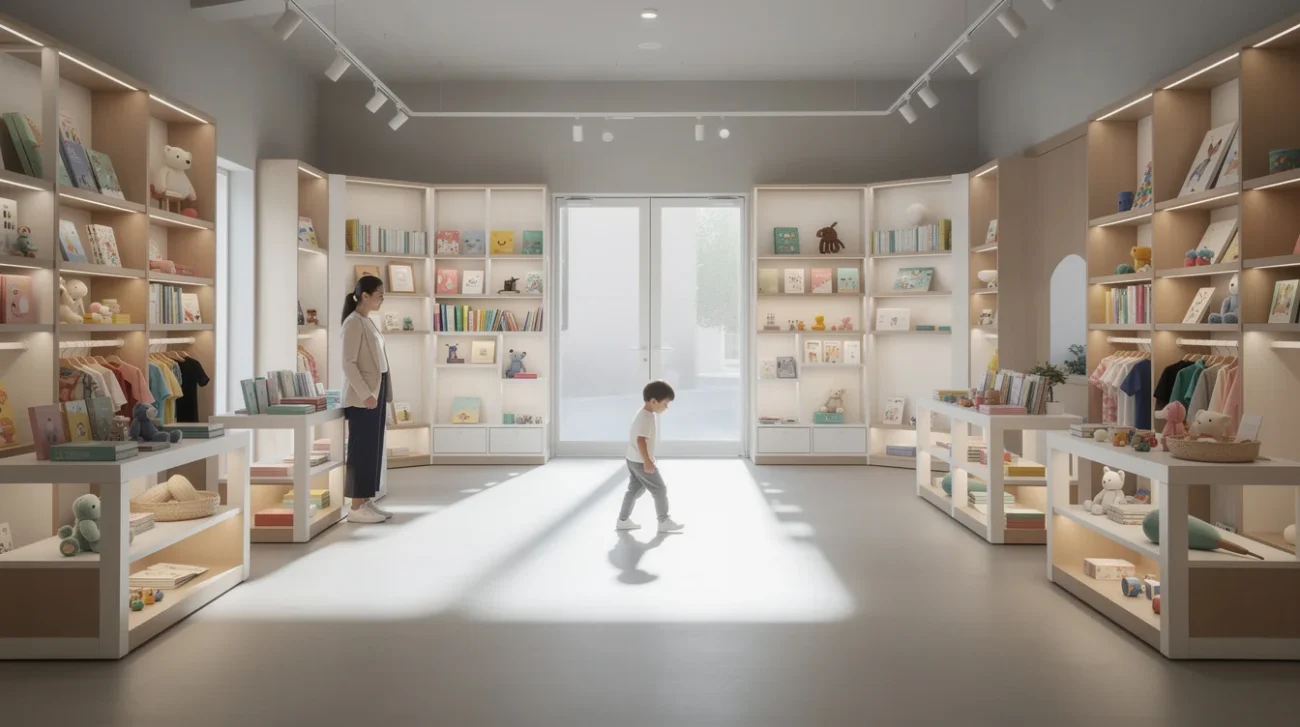
MANERA atelier’s U-shaped Store offers a sharp case through which to ask that question. As described in ArchDaily’s project summary, the children’s store explores the relationship between retail, scenography and architecture through a flexible environment organized around a central void. Those are the documented starting points, not proof of either manipulation or emancipation. But they expose the central contradiction of child-friendly retail design: the same spatial invitation can support independent curiosity and serve commercial persuasion.
The provocation is simple. A shop should not earn the label “child-friendly” merely because children want to stay there. It should earn it by accommodating things a retailer cannot readily monetize—including distraction, refusal and leaving empty-handed.
The Central Void Is Not Commercially Innocent
A central void sounds like a concession: valuable floor area withheld from merchandise. In a shop, where display capacity matters, that can be a meaningful architectural choice. An unoccupied center might allow children to pause, invent a game or orient themselves without immediately confronting another product. It can introduce breathing room into an environment otherwise structured by selection and purchase.
Yet emptiness can also work as a visual instrument. A stage needs space between its audience and its scenery. A clear center can make surrounding displays more legible, consolidate attention and turn merchandise into the perimeter of a small theatrical world. The void does not need to contain goods to contribute to selling them.
Aldo van Eyck’s postwar Amsterdam playgrounds provide a useful counterpoint, not a direct precedent claimed for MANERA. Their sandpits, climbing structures and elementary forms offered invitations without prescribing a single narrative. Crucially, the activity did not culminate in checkout. Transplant similarly open-ended spatial cues into retail and their institutional purpose changes.
For U-shaped Store, the ethical issue therefore lies less in the presence of emptiness than in its permissions. Can the center host an activity unrelated to the merchandise? Or is it primarily an attractive viewing position from which the shop’s commercial scenery becomes irresistible?
Flexibility for Whom?
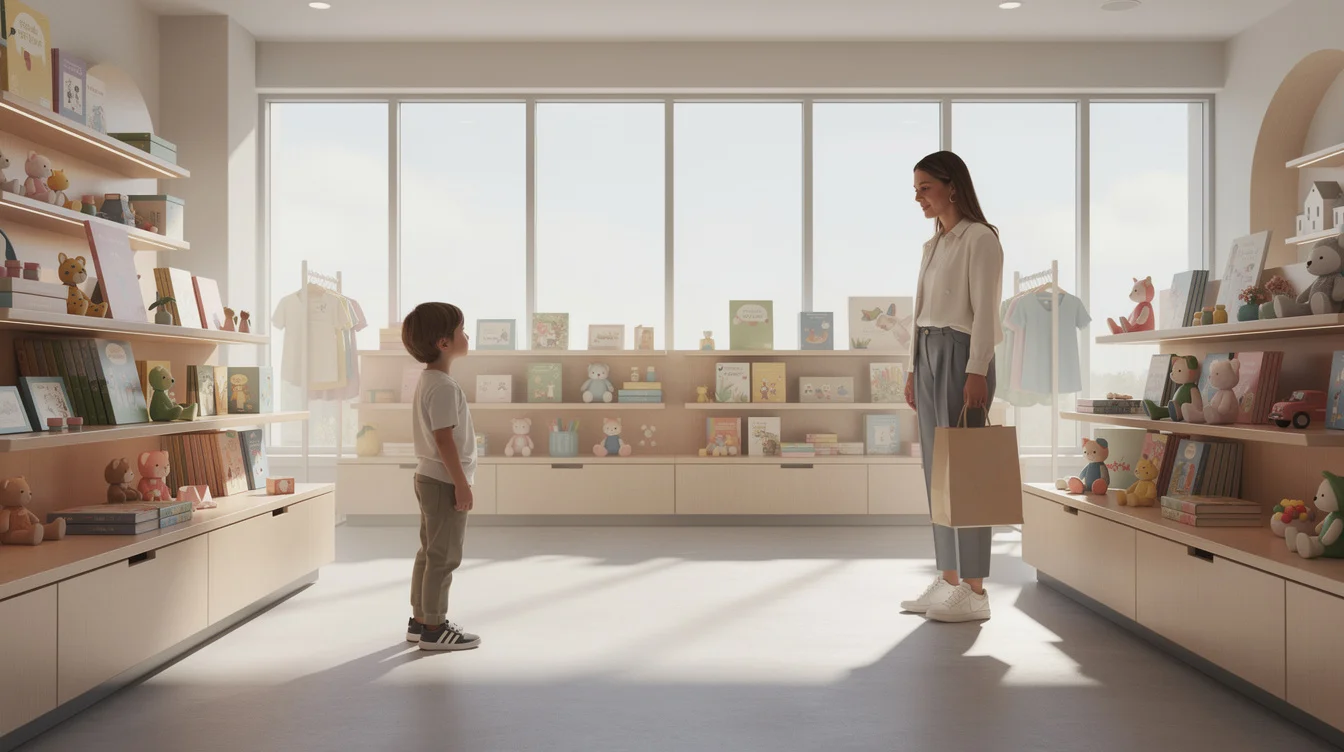
Flexibility is among architecture’s most flattering words. It suggests generosity, adaptability and freedom from rigid prescriptions. But a flexible shop may simply be one that can rearrange its sales pitch efficiently. Seasonal collections arrive; the scene changes; customers encounter a fresh invitation to consume. Adaptability benefits the operator without necessarily giving the child any additional agency.
The available project summary identifies MANERA’s environment as flexible, but does not establish who controls that flexibility or how it works in daily operation. As in senior living, where feeling at home is not the same as having control, that distinction matters. A layout rearranged by staff to foreground a product is different from a setting in which children can choose among genuinely different activities. Both may look informal in photographs. Only one necessarily expands the child’s options.
Maria Montessori’s “prepared environment” offers a more demanding reference. Accessible materials and child-scaled furnishings support independent selection within a carefully structured educational setting. The adult still designs the choices, but those choices serve developmental work rather than a sales target. A low shelf in a shop may borrow the same physical language while reversing its purpose.
Consider two hypothetical configurations of a flexible retail interior: one preserves a clear, product-free resting area; the other fills that area with promotional displays during peak trading. The architecture permits both. Its ethical value depends on which use the business protects when generosity becomes inconvenient.
Scenography Has Two Audiences
A children’s store addresses at least two audiences at once. Children encounter scale, movement, color and objects. Adults interpret those encounters as evidence: this place understands my child; this brand values imagination; this purchase might support development. The child’s enthusiasm can become persuasive material directed at the person holding the payment card.
That does not make enthusiasm false. It makes its commercial context important. Scenography can sell an adult a picture of enlightened parenting while offering a child an engaging afternoon. The transaction acquires a moral halo: buying appears less like consumption and more like care.
LEGO House in Billund, designed by BIG, illustrates how powerfully architecture can connect creative activity with a branded universe. It is an experience destination, not an equivalent of MANERA’s shop, and the distinction should remain clear. Nevertheless, it demonstrates that genuine imaginative engagement and commercial brand-building are not opposites. They can reinforce each other.
The useful question for MANERA’s scenographic approach is therefore not whether the experience is “authentic.” An experience can be authentic and persuasive simultaneously. The sharper question is whether adults can recognize the sales environment through the theatrical invitation—and whether children can enjoy that invitation without their enjoyment becoming a demand to purchase. Architecture should not make parental refusal feel like the destruction of a carefully staged adventure.
Judge the Store by What Happens When Nobody Buys
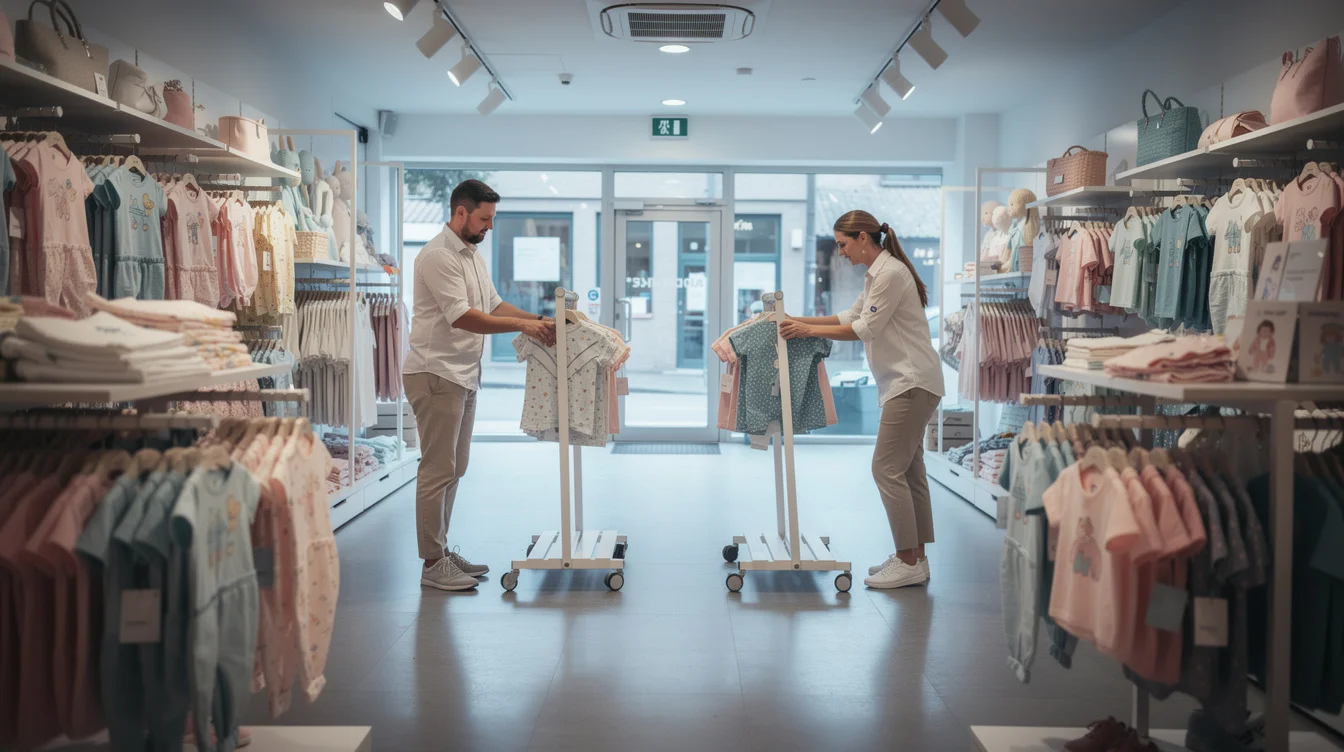
Photographs cannot resolve these questions. A beautifully empty center reveals little about staff expectations, dwell-time pressures or what happens when a child plays for twenty minutes and leaves with nothing. The supplied account of U-shaped Store provides no basis for attributing particular sales tactics to MANERA or the operator. It does, however, justify asking for a different standard of evaluation.
Start with refusal. Can a family take a short route out without negotiating a sequence of tempting displays? Can an adult sit with a tired child without being treated as an obstructive non-customer? Can a child disengage from the scene, rather than being continuously invited to touch, choose or perform enthusiasm? The same principle underlies accessible supermarket checkouts that do not rush customers: accommodating different needs means allowing people to set their own pace.
IKEA’s Småland play areas offer a revealing operational comparison. By separating supervised play from the shopping floor, the retailer acknowledges that children’s activity and adults’ purchasing need not occupy precisely the same space. That separation does not remove commercial benefit; childcare can make shopping easier. It does make the relationship more explicit.
A stronger assessment of MANERA’s central void would examine similarly practical conditions: accessible circulation, places to pause, sensory demands and staff tolerance of non-purchasing use. These are questions for observation, not claims about features documented in the project. The decisive evidence is behavioral: what forms of occupation remain welcome when they stop helping sales?
A Child-Friendly Shop Must Allow Disinterest
The answer is not to strip children’s stores of imagination. Sterile interiors are not ethically superior, and boredom is not protection against advertising. Good spatial design can reduce stress, improve orientation and make everyday errands more manageable for families. Selling children’s products is not, by itself, the offense.
The offense is presenting every commercial invitation as a gift to childhood. Designers should distinguish between making a shop usable for children and making children useful to the shop. The first concerns comfort, access and dignity. The second recruits curiosity as unpaid commercial labor, turning the child into a product demonstrator, an enthusiastic audience and sometimes an advocate pressing an adult to buy.
MANERA’s flexible layout and central void make that distinction unusually available for debate. Their promise lies in the possibility of an interior that does not determine every action. Their risk lies in the ease with which openness can become another sales technique. Neither outcome is guaranteed by the plan.
What deserves protection is not emptiness as an aesthetic effect, but space whose use does not have to justify itself commercially. Preserve the pause during busy periods. Allow curiosity to wander away from stock. Treat an empty-handed departure as an acceptable conclusion. Otherwise, “child-friendly” becomes a sophisticated description of a shop that has learned to persuade the whole family.
FAQ
What is MANERA atelier’s U-shaped Store?
It is a children’s store described in ArchDaily as exploring retail, scenography and architecture. Its defining organizational ideas include a flexible environment and a central void. Those features ground this critique; they do not establish how customers are treated in practice.
Why does a central void matter in retail design?
It can provide orientation, breathing room and space for unprogrammed activity. It can also improve views of surrounding merchandise. Its ethical significance depends on whether it supports uses beyond browsing and buying, rather than simply making the sales environment more compelling.
When does encouraging curiosity become commercial persuasion?
The boundary is crossed when exploration is systematically directed toward products or purchase requests while being presented as independent play. The two can overlap, so designers should examine who controls activities, what alternatives exist and whether disengagement remains easy.
How can a children’s shop be more ethically designed?
Provide accessible routes, opportunities to rest and a straightforward exit. Avoid making all activity product-dependent. Just as importantly, establish operating practices that welcome non-purchasing visitors: architectural generosity means little if staff are expected to convert every moment of play into a sale.
If a child-friendly shop cannot welcome a child who plays, loses interest and leaves without buying, who was its generosity really designed for?
Watch the Mainifesto Short
Get the Mainifesto weekly — curated design debates, speculative ideas and the week's best articles every Saturday.
Editorial Perspectives
Questions and counterpoints developed by the Mainifesto editorial desk to extend the discussion.
Perspective 1
Watch what staff do when a child plays for twenty minutes and the family buys nothing—that’s the real user-experience test. A shop needs sales, but if every welcome depends on conversion, don’t call the play space generous.
Perspective 2
I’d look at the edges, joints and finishes around that central void: can children actually touch things, or is curiosity only welcome at a distance? Craftsmanship earns its place when it can take scuffs and be repaired, not when staff have to keep saying ‘careful.’
Perspective 3
I’d want to know how long the play elements last, what they’re made from and whether they can be reused when the shop changes. Welcoming a child who leaves empty-handed matters, but so does avoiding a disposable fit-out built to sell more disposable things.
Perspective 4
A central void can offer a pause, but it can also put a child on display. I’d look for somewhere quieter, away from bright merchandise, where losing interest is allowed and a parent can simply sit.