
Can Playing at Maintenance Make Real Workers Visible?
Can Playing at Maintenance Make Real Workers Visible?
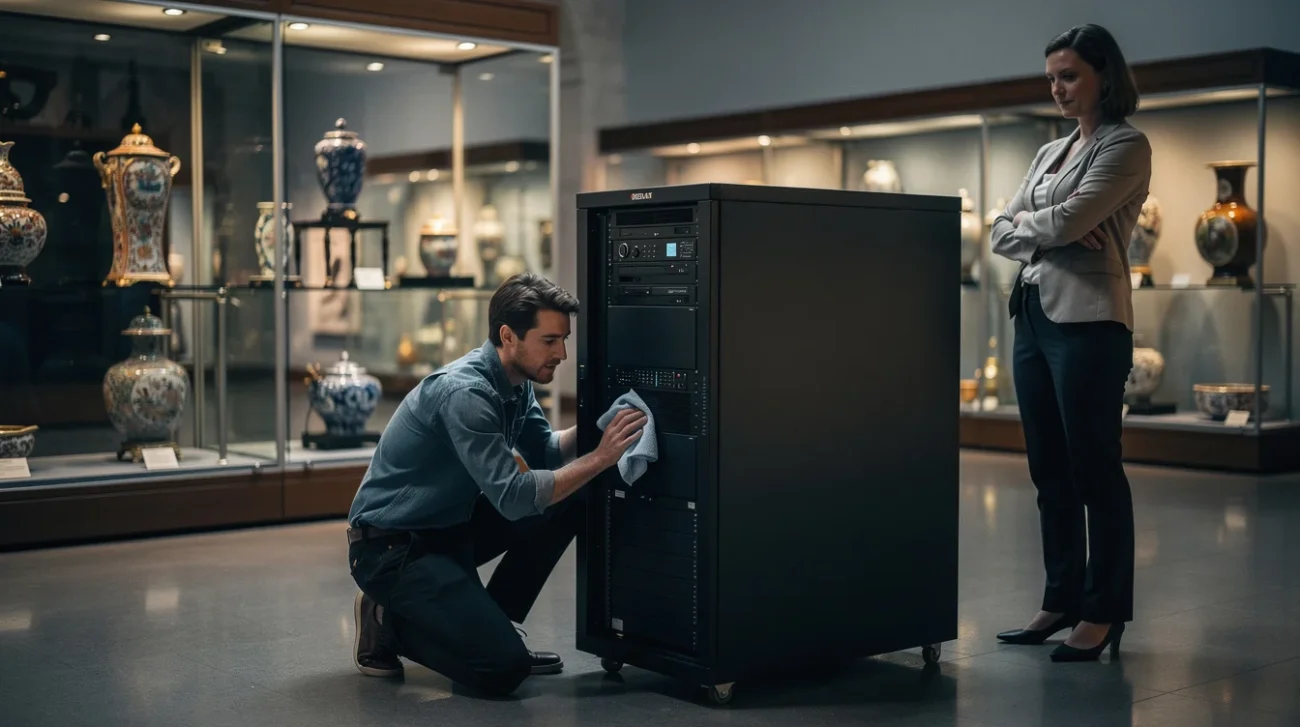
The cloud has a cleaning schedule. So does the museum. Both institutions encourage us to admire what they deliver while overlooking the people who keep delivery possible. Playfool’s interactive installation at London’s V&A interrupts that arrangement by casting visitors as data-centre cleaners. As described by designboom, its playful cleaning routine draws attention to the often-overlooked labour sustaining digital infrastructure and cultural collections.
That is a sharp premise, not an automatic political victory. A visitor can enjoy performing maintenance without learning much about the person paid to do it. Equally, a modest physical task can puncture the fantasy that digital culture runs itself. The question is not whether cleaning belongs in a museum. It is whether the museum makes the worker visible alongside the work.
PRO: Maintenance Deserves the Leading Role

Design culture has a chronic preference for beginnings: the launch, the opening, the immaculate installation photograph. Maintenance belongs to everything that happens afterwards, when an object loses its novelty but retains its demands. Giving the cleaner the starring role changes the narrative. The visitor is no longer an inventor, collector or technological conqueror. Their job is to keep something going.
That reversal has a formidable artistic precedent. Mierle Laderman Ukeles’s 1969 Manifesto for Maintenance Art challenged the division between celebrated creative production and the repetitive activities that sustain life. In Touch Sanitation, undertaken in 1979–80, she shook hands with New York City sanitation workers and thanked them for keeping the city alive. Maintenance was not a metaphor floating above workers’ lives; recognition involved meeting the people doing it.
Playfool’s premise operates through a different mechanism: temporary participation rather than direct encounter. Its potential lies in relocating attention. A server ceases to be an abstract gateway to frictionless services and becomes something dependent on material surroundings and human intervention. At the V&A, that lesson also turns back towards the institution itself. Display cases, collection storage and exhibition spaces do not remain usable through curatorial intention alone. Cleaners, technicians, conservators and facilities staff perform distinct tasks, but all complicate the myth of the self-sufficient cultural object.
PRO: A Small Routine Can Change What Visitors Notice
Games can teach relationships through action rather than explanation. A wall label can announce that infrastructure requires care; an interactive routine can make care the condition of proceeding. That distinction matters in a museum, where visitors may skim extensive interpretation but remember what their own hands were asked to do.
Steven J. Jackson’s essay Rethinking Repair offers a useful framework: begin with breakdown, erosion and the work of keeping systems functioning, rather than treating innovation as the default centre of technological life. Read through that lens, a cleaning game is not necessarily a trivial substitute for engineering education. It can introduce a different account of technology—one organised around dependency rather than novelty.
The strongest defence of Playfool is therefore modest but consequential. A brief installation cannot reproduce a working life, and it should not pretend to. It can, however, change the questions a visitor asks afterwards: who maintains the equipment behind a streamed film? Who cleans the gallery after closing? Which tasks disappear from the photograph of a supposedly autonomous machine?
Simplification can be an invitation rather than a deception. A map does not need to reproduce a territory to reveal a route through it. If playing at maintenance makes the visitor notice actual maintenance elsewhere, the experience has achieved something that another spectacular digital installation may never attempt: it has redirected admiration towards continuity, not disruption.
CONTRA: Completing the Task Is Not Knowing the Job
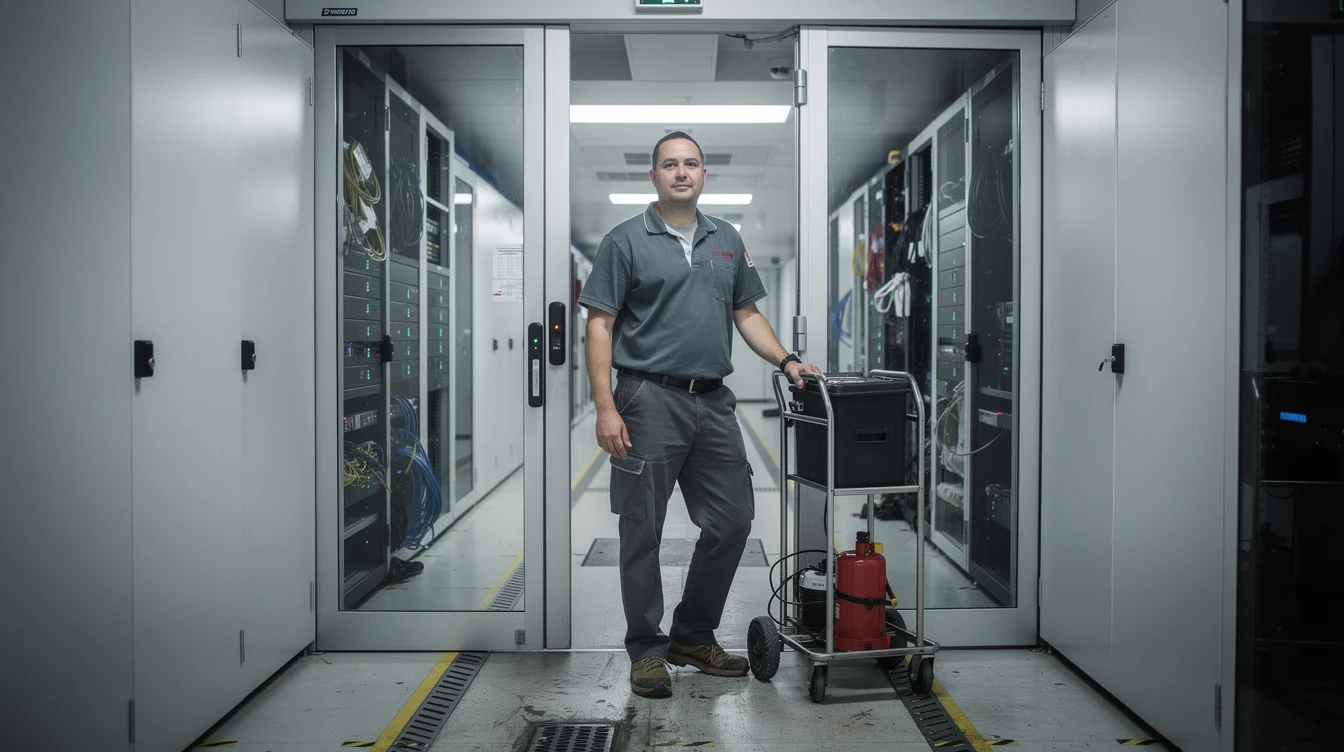
The opposing case begins with the same word: simplification. What gets removed when maintenance becomes playable? Potentially everything that makes it employment rather than an agreeable activity: a supervisor’s demands, a contractor’s staffing decisions, inconvenient hours, physical fatigue, uncertain scheduling and the economic consequences of refusing a task. These are questions to investigate, not conditions established here about workers at the V&A or any particular data centre.
A museum visitor can walk away. A worker’s freedom to do so is shaped by wages, contracts and the need to keep earning. That difference is not peripheral to the experience; it structures it. Performing a cleaning gesture may reveal what a task involves while concealing what it means to have that task assigned repeatedly, under someone else’s control.
PowerWash Simulator, developed by FuturLab, demonstrates how compelling cleaning can become when organised around visible progress and achievable completion. Its pleasures are real. But the pleasure of making a surface clean does not necessarily produce solidarity with a cleaner. It may simply establish maintenance as another satisfying consumer experience.
This is the danger for a museum installation: a visitor leaves feeling that they understand workers because they have briefly enjoyed a stylised version of their activity. The institution has produced confidence where it should have produced curiosity. The cleaner becomes visible as a role while remaining absent as a person with expertise, preferences and demands.
CONTRA: Recognition Needs More Than a Playable Uniform
Games are capable of addressing this problem. Blackbird Interactive’s Hardspace: Shipbreaker places the absorbing work of dismantling spacecraft inside a narrative about corporate power, debt and collective resistance. Its relevance is not that a museum installation should imitate a commercial game’s length or drama. It demonstrates that working conditions can enter the frame alongside the work itself. The enjoyable task and the employment relationship need not be separated.
The available source description establishes Playfool’s cleaning premise and its attention to hidden labour; it does not establish how extensively the installation addresses pay, contracting, worker testimony or workplace power. That limit matters. It would be unfair to declare those elements absent, but equally careless to treat the premise alone as proof of meaningful worker representation.
A more demanding exhibition model would let maintenance workers influence the interpretation and be paid for that contribution. It could distinguish routine cleaning from specialist technical work, explain who controls schedules, and give visitors a route from simulated participation to actual testimony. Within a museum, interpretation could also acknowledge the people maintaining the exhibition itself, where they consent to being identified.
The standard should be more than “visitors noticed cleaning”. Did they encounter workers’ knowledge? Did they learn who benefits from maintenance remaining invisible? Did the institution expose any of its own dependencies? Without that second layer, a maintenance game risks laundering inequality through good feelings. We applaud ourselves for valuing care while leaving the allocation of money, authority and credit untouched. Play becomes politically persuasive precisely when it stops allowing recognition to stand in for change.
FAQ: Maintenance, Museums and Play
What is Playfool’s installation at the V&A about?
It is an interactive game installation that casts visitors as data-centre cleaners. Its playful cleaning routine highlights the often-overlooked labour involved in maintaining digital infrastructure and cultural collections.
Can a cleaning game build respect for maintenance workers?
Yes, by showing that apparently seamless systems depend on continuing human effort. But understanding a task is not the same as understanding employment conditions. Worker perspectives and contextual interpretation can help bridge that gap.
How does this relate to maintenance art?
Mierle Laderman Ukeles made maintenance central to her artistic practice, challenging the hierarchy between creative production and sustaining work. Her direct engagement with sanitation workers offers a demanding precedent for projects seeking to recognise hidden labour.
What would make this kind of exhibition more accountable?
Paid worker participation, consent-based testimony, clear distinctions between different maintenance roles, and information about employment arrangements would strengthen it. Museums should also examine whether their own working practices support the respect their exhibitions invite visitors to express.
If a museum lets us enjoy being the cleaner for a moment, what must it reveal about the job before that pleasure becomes solidarity rather than another service workers provide?
Get the Mainifesto weekly — curated design debates, speculative ideas and the week's best articles every Saturday.
Editorial Perspectives
Questions and counterpoints developed by the Mainifesto editorial desk to extend the discussion.
Perspective 1
I’m for it: making maintenance playable is a useful way to show that a building’s performance depends on people, not just clever systems. But put the hourly pay, staffing levels and cleaning contract beside the game—visitors should see what keeping the place running actually costs, and who absorbs the squeeze.
Perspective 2
I don’t think a pleasurable turn as the cleaner builds respect for cleaning work. You can leave when the task stops being interesting; the worker must repeat it, tired or not. I’d rather hear workers describe the judgement their job requires than have that knowledge repackaged as a museum diversion.
Perspective 3
I’d want to know whether the installation makes room for the cleaner’s eye: noticing residue, choosing the right cloth, knowing which surface won’t tolerate a chemical. That’s material knowledge, not just a sequence of gestures. Let workers explain those decisions—and pay them for that expertise—or visitors may leave thinking the job is as simple as the game.