
Afsluitdijk: Flood Defence Must Let Life Through
The Dam That Must Keep Water Out—and Let Life Through
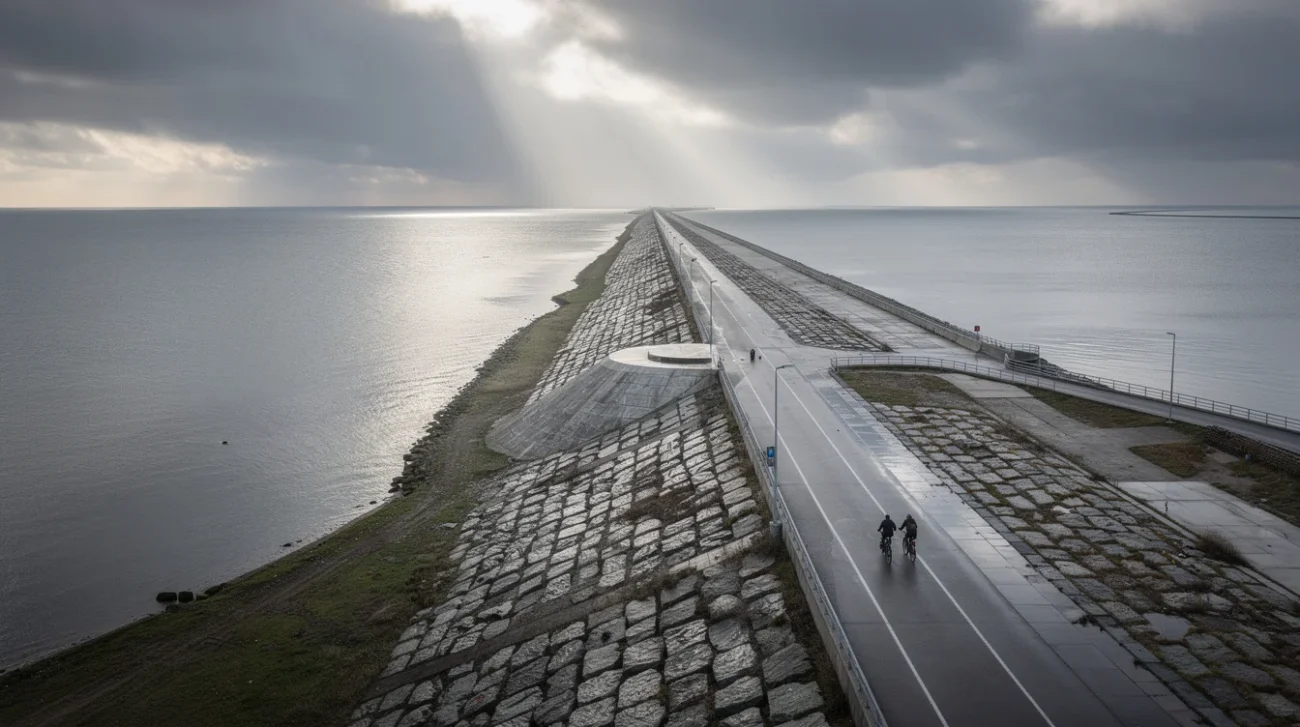
The Afsluitdijk is an architecture of refusal. Built between 1927 and 1932, the 32-kilometre Dutch dam turned an exposed inland sea into a controlled freshwater landscape, protecting territory from North Sea storm surges while interrupting an ecological continuum. Its success depended on separation. Its next chapter asks whether that separation can become more discriminating.
Dezeen’s October 2026 report on Benthem Crouwel’s revamp describes the addition of a migratory fish passage and a cycle route. The architectural work belongs to a much larger infrastructural undertaking; neither flood protection nor ecological performance should be attributed to one studio alone. But the design question is unmistakable: can infrastructure reject dangerous water while admitting the living systems that water carries? There are two forceful answers—and a comfortable green compromise is not one of them.
PRO: A Barrier Can Become an Ecological Interface
The strongest argument for the Afsluitdijk fish passage is that habitat repair belongs inside the machinery of protection, not beside it as compensation. The dam separates the tidal, saline Wadden Sea from the freshwater IJsselmeer. For migratory fish, that boundary interrupts journeys between feeding, nursery and spawning habitats. European eels need connections between inland waters and the sea; other species navigate different routes and life stages. A planted embankment cannot substitute for those movements.
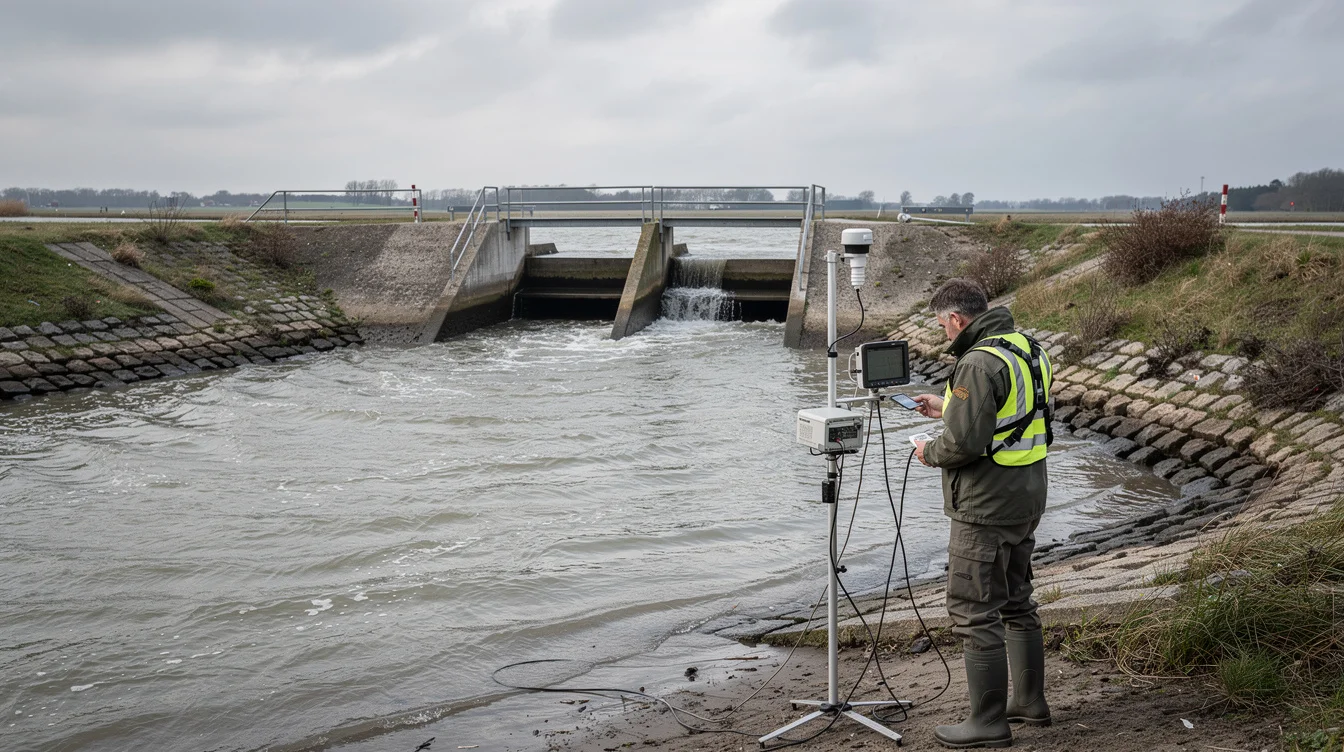
The Fish Migration River initiative at Kornwerderzand addresses this discontinuity through a more gradual connection than a blunt opening in a wall. Its underlying ambition is crucial: give fish a navigable transition while managing saltwater intrusion into the freshwater lake. This is selective permeability, not indiscriminate openness. Channel geometry, currents, salinity gradients and operating controls become ecological design tools.
The precedent is not simply the conventional fish ladder. A ladder suited to strong swimmers can exclude smaller fish or species with different behaviours. At the Haringvliet barrier, the Dutch Kier programme has used partial opening of sluices under suitable conditions to improve fish migration. It demonstrates that connectivity is also an operational decision. Architecture can shape the interface, but water managers must keep making it work. The achievement is not a photogenic hole through a dam; it is a route that organisms can find and negotiate.
PRO: Make Repair a Measurable Infrastructure Duty
This approach changes the brief. Instead of asking how to soften the appearance of a defensive structure, the client asks what ecological functions it must provide. Engineers already specify tolerances for loads, overtopping and mechanical reliability. Habitat connectivity deserves comparably explicit requirements, even if biological outcomes are less predictable than structural calculations.
Those requirements should distinguish species and life stages, identify migration seasons and measure passage in both directions. They should examine whether fish locate an entrance, survive the journey and reach useful habitat beyond it. A counter recording thousands of fish is not enough if the route disproportionately serves already abundant species or delivers animals into another obstruction. Connectivity is a network property, not a feature attached to one construction contract.
The Netherlands’ Room for the River programme offers a related shift in infrastructural thinking. At Nijmegen, relocating a dike and creating a secondary channel expanded the space available to water rather than relying solely on a higher defensive line. It is not a fish-passage template, but it shows that protection can be redesigned around processes rather than treated as an immutable object.
The new cycle route adds another opportunity: make the working landscape legible. Benthem Crouwel’s architectural contribution can help people encounter flood defence as a maintained system, not an abstract guarantee. Public access earns ecological value only when it reveals the repair work without compromising it. As with the question of whether a cool city remains a public city, environmental improvement and public benefit must be evaluated together.
CONTRA: A Managed Opening Is Not a Restored Estuary
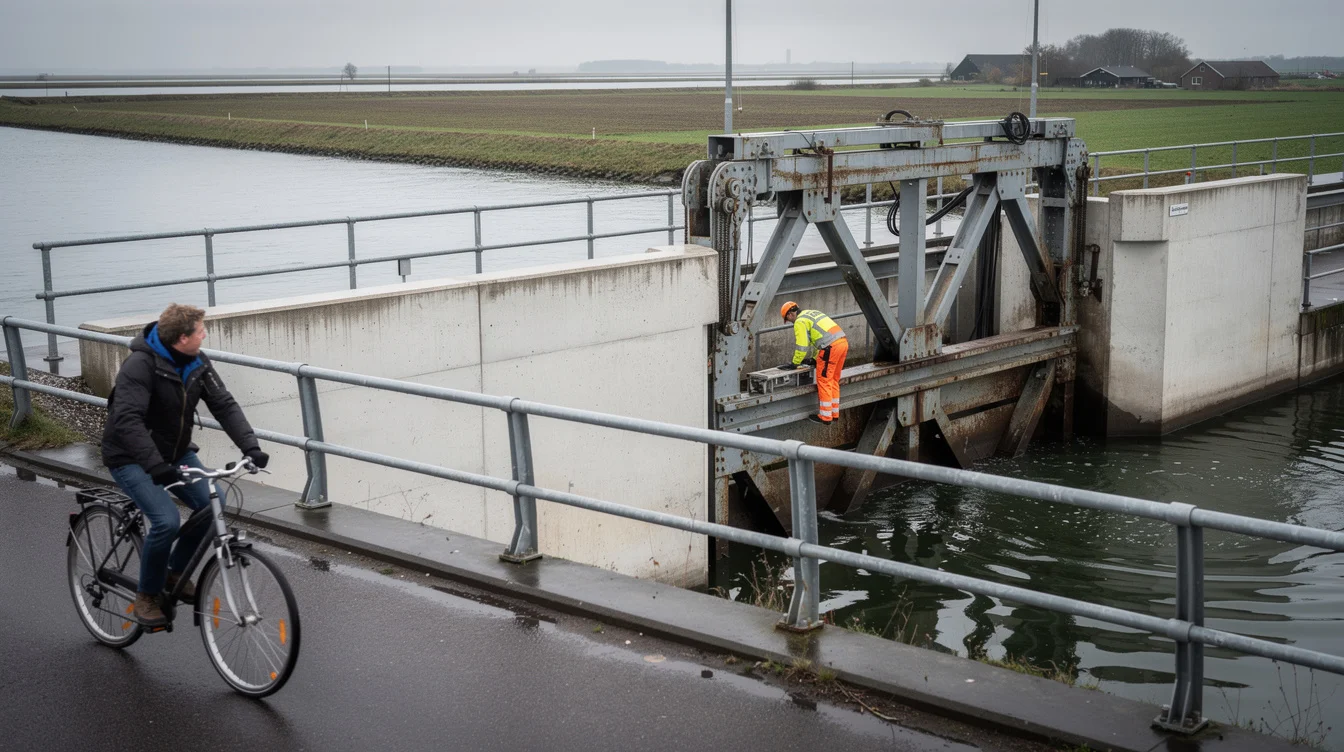
The strongest objection is that selective permeability can make a fundamentally extractive arrangement look reconciled. The Afsluitdijk did not merely block individual fish. Its construction transformed tidal exchange, salinity, sediment movement and habitats across an enormous water body. A migration passage may repair one connection while leaving most of that transformation intact. Calling it restoration without naming the limits would inflate a targeted intervention into an ecological absolution.
There is also an unavoidable hierarchy. During dangerous conditions, protection must take precedence. During periods when freshwater supplies are under pressure, managers may face tighter constraints on admitting salt. Climate change can intensify both storm risks and freshwater scarcity. The passage’s ecological usefulness therefore depends not just on its physical form but on how often, when and under what conditions it operates.
The Eastern Scheldt storm-surge barrier offers a sobering Dutch comparison. Its normally open gates preserve tidal exchange, yet the wider Delta Works altered the estuary’s hydrodynamics and sediment balance. Intertidal habitat losses associated with sediment imbalance show that retaining a connection does not necessarily retain a functioning ecosystem.
That is the uncomfortable lesson for designers: a technically sophisticated compromise can still produce ecological decline. A beautiful section drawing showing fish, gradients and gates establishes an intention. It does not establish population recovery, resilient food webs or a self-sustaining habitat.
CONTRA: The Green Feature Can Outlive Its Accountability
Architectural culture is especially vulnerable to confusing visible provision with demonstrated performance. A cycle route can be photographed immediately. An entrance structure can become a signature image. Successful migration, by contrast, requires seasonal evidence, specialist interpretation and years of monitoring. The publication cycle rewards completion; ecology tests what happens afterwards. The same caution underlies debates about building reuse beyond the timber halo: a green feature is not a verdict on the whole project.
Consider the Elwha River in Washington State, where two dams were removed between 2011 and 2014. Reopening the river enabled fish recolonisation while releasing sediment and initiating extensive habitat change. That project is not a transferable prescription for removing a Dutch sea defence: the consequences for settlements and water management are radically different. It is, however, a useful counterexample to the assumption that every barrier should remain and acquire a bypass. Sometimes connectivity requires subtraction, not a more elaborate interface.
For the Afsluitdijk, the immediate challenge is accountability. Who funds monitoring after the architectural commission ends? Who changes gate operations when migration data disappoint? Who adjudicates conflicts between freshwater management and ecological passage? Without durable answers, habitat repair risks becoming an opening-day promise with no effective owner.
The architectural brief should therefore include long-term access for maintenance, replaceable equipment and room to adjust channels or entrances. Procurement should attach resources and responsibilities to ecological outcomes. The defensible position is conditional support: build the connection, but refuse to let its existence stand in for its success. A barrier with a fish passage remains a barrier—and must keep proving the passage matters.
FAQ: Flood Defence and Ecological Connectivity
What does the Afsluitdijk protect?
The dam helps protect the Netherlands from North Sea storm surges and separates the Wadden Sea from the IJsselmeer. It forms part of a wider flood-defence and water-management system, rather than providing protection on its own.
How can fish pass without allowing uncontrolled seawater in?
A managed passage combines channel design and hydraulic controls to provide migration opportunities while limiting unwanted saltwater intrusion. Its effectiveness depends on currents, salinity conditions and operating rules—not simply the presence of an opening.
Does a fish passage restore the original ecosystem?
No. It can reconnect migration routes, but it does not automatically recover former tidal habitats, sediment processes or species populations. Passage monitoring must be paired with assessment of habitat quality and conditions elsewhere along migration routes.
What should architects contribute to selective permeability?
Architects can integrate ecological routes, maintenance access and public circulation into the infrastructure’s spatial design. They must work with hydraulic engineers, ecologists and operators, ensuring that visual coherence never takes priority over habitat performance.
If habitat repair is a core infrastructure duty, who should have the authority to demand changes when a celebrated fish passage fails to deliver?
Watch the Mainifesto Short
Get the Mainifesto weekly — curated design debates, speculative ideas and the week's best articles every Saturday.
Editorial Perspectives
Questions and counterpoints developed by the Mainifesto editorial desk to extend the discussion.
Perspective 1
Repairing the habitats a dam disrupted belongs in its restoration brief, not in a separate goodwill project. I support treating that repair as a core duty, with an independent ecological authority able to require changes—and fishing communities at the table, not displaced by a newly marketable waterfront.
Perspective 2
I’m not convinced a celebrated fish passage earns the label of habitat repair: optimising a route through a barrier is not the same as restoring an ecosystem. Before granting another agency redesign powers, where are the species-specific baselines, seasonal migration data and evidence of successful reproduction rather than just crossings?
Perspective 3
A fish passage that photographs well but doesn’t help fish is a failed product, however strong the launch campaign. Give an independent regulator the power to trigger corrections against published ecological targets, and make the owner budget for them from day one.
Perspective 4
The Dutch hydraulic tradition made controlling nature a civic achievement; now the same monument must advertise reconciliation with it. The fish passage is an elegant gesture, but gestures are the easy part: ecological regulators, not the institutions celebrating the design, should decide when it needs changing.
Perspective 5
If habitat repair is part of the job, put measurable outcomes and a funded correction process in the brief before anyone tenders. An independent regulator should be able to require remedial work when those outcomes aren’t met, with responsibilities agreed up front rather than fought over after the opening.