
Public Art You Can Play: Who Gets to Make the Rules?
Public Art You Can Play: Who Gets to Make the Rules?
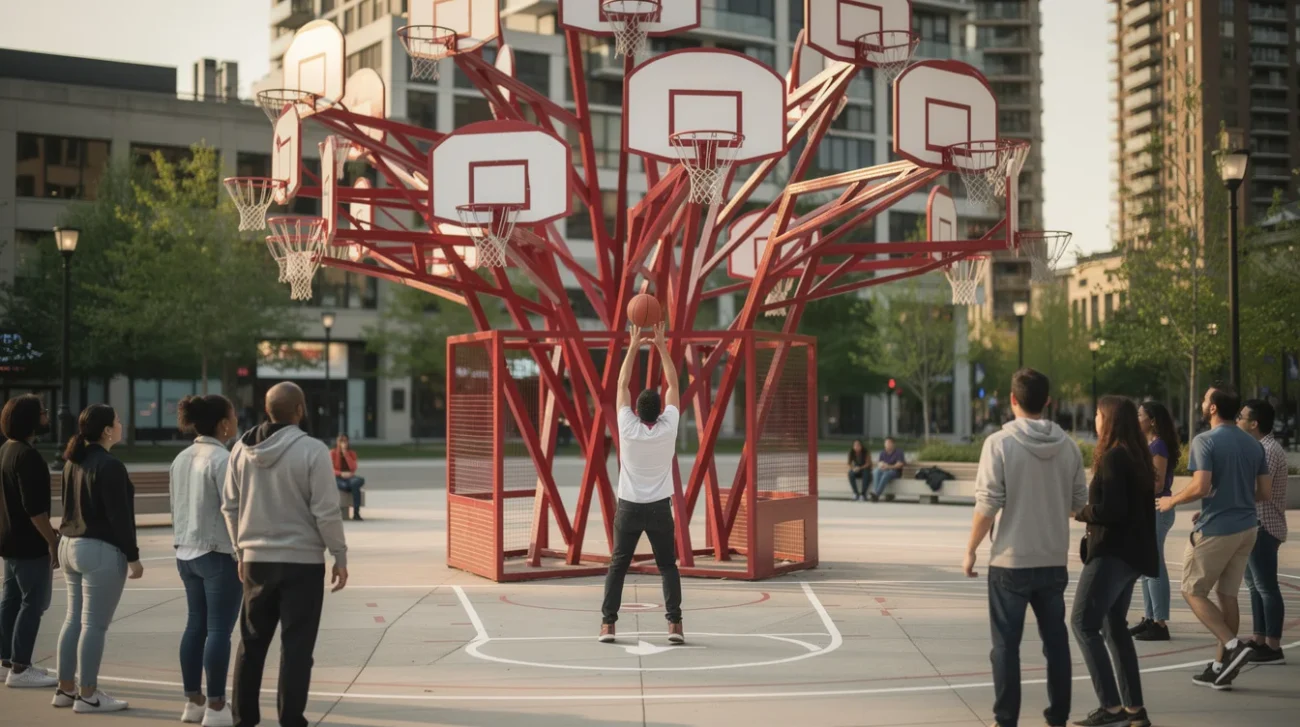
Public art usually offers a suspicious bargain: everyone may look, but touching requires permission. Alexandre Arrechea’s branching red sculpture in Toronto overturns that arrangement. As reported by designboom in its coverage of the Lassonde Art Trail, more than twenty playable basketball hoops extend from the work. The sculpture is not simply an image of recreation. It invites the physical activity that many artworks are protected against.
That invitation changes the commission’s obligations. A hoop needs more than an audience: it needs usable space, upkeep and an answer to who plays next. The available source establishes the work’s playable premise, not its operating arrangements. What follows is therefore an argument about what such a project should deliver—not a claim that its managers have already succeeded or failed. Interactivity is a design feature. Publicness is a negotiated condition.
PRO: Playing Is a Stronger Invitation Than Looking
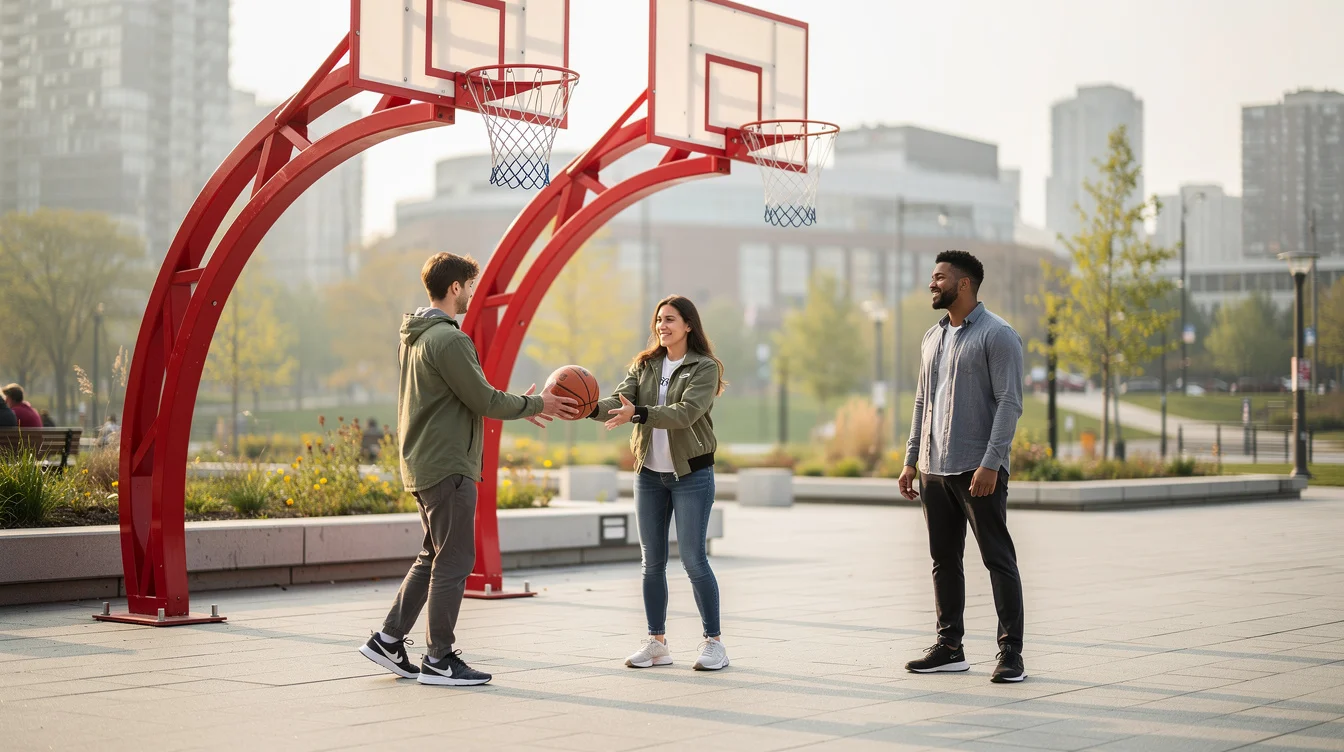
Arrechea’s proposition has real force because it makes bodily participation part of the artwork rather than an exception to its rules. A visitor does not need an explanation of sculptural symbolism to recognise a basketball hoop. Shooting, missing, retrieving and passing become ways of engaging with the work. Interpretation can begin in movement rather than in the language of an exhibition label.
The branching arrangement also challenges the familiar court’s hierarchy. Basketball normally directs attention towards two baskets and a defined contest. More than twenty hoops suggest a less settled field: several shooting games, improvised targets or practice without a full team. Whether those activities can safely happen simultaneously depends on spacing and the surrounding surface. Nevertheless, multiplying targets offers the possibility of distributing attention instead of organising everyone around the strongest players.
There is a useful precedent in Isamu Noguchi’s playground thinking, including Playscapes in Atlanta’s Piedmont Park. Noguchi treated landforms and sculptural elements as invitations to bodily discovery, not merely equipment with a single prescribed action. Arrechea’s hoops bring a more recognisable sporting language to that relationship between form and use. The point is not that rules disappear. It is that users gain room to invent some of them.
That is a meaningful redistribution of creative authority: the artist establishes a framework, while participants help determine what an encounter becomes.
PRO: Infrastructure Can Make Publicness Enforceable
Treating the sculpture as sports infrastructure could strengthen that invitation by turning goodwill into service commitments. A commission brief could require published access hours, a clearly identified operator, inspection procedures and a maintenance budget that survives the opening photographs. Those are not administrative distractions from the art. They are what keep its central proposition available.
Consider Superkilen in Copenhagen, designed by BIG, Topotek 1 and Superflex. Its combination of recreation, landscape and objects associated with different places makes public space legible through multiple activities rather than one monumental encounter. The relevant lesson is not that variety guarantees harmony. It is that seating, circulation and opportunities to linger deserve as much design attention as the visually dominant object.
For a basketball sculpture, that means considering the complete visit. Can someone using a wheelchair reach a shooting position on a firm, continuous surface? Is there space to turn without entering another player’s landing area? Can a person rest nearby without being exposed to stray balls? Different hoop positions might expand opportunities, but their number alone says nothing about the accessibility of the approach.
An operator could also provide free ball loans, beginner sessions and protected periods for informal shooting, developed with local users. None should be assumed to exist here; they are practical tests of the concept. If participation is the artwork’s promise, equipment, access and everyday welcome belong inside the cultural budget, rather than being left for visitors to supply.
CONTRA: An Invitation Can Conceal a New Exclusion
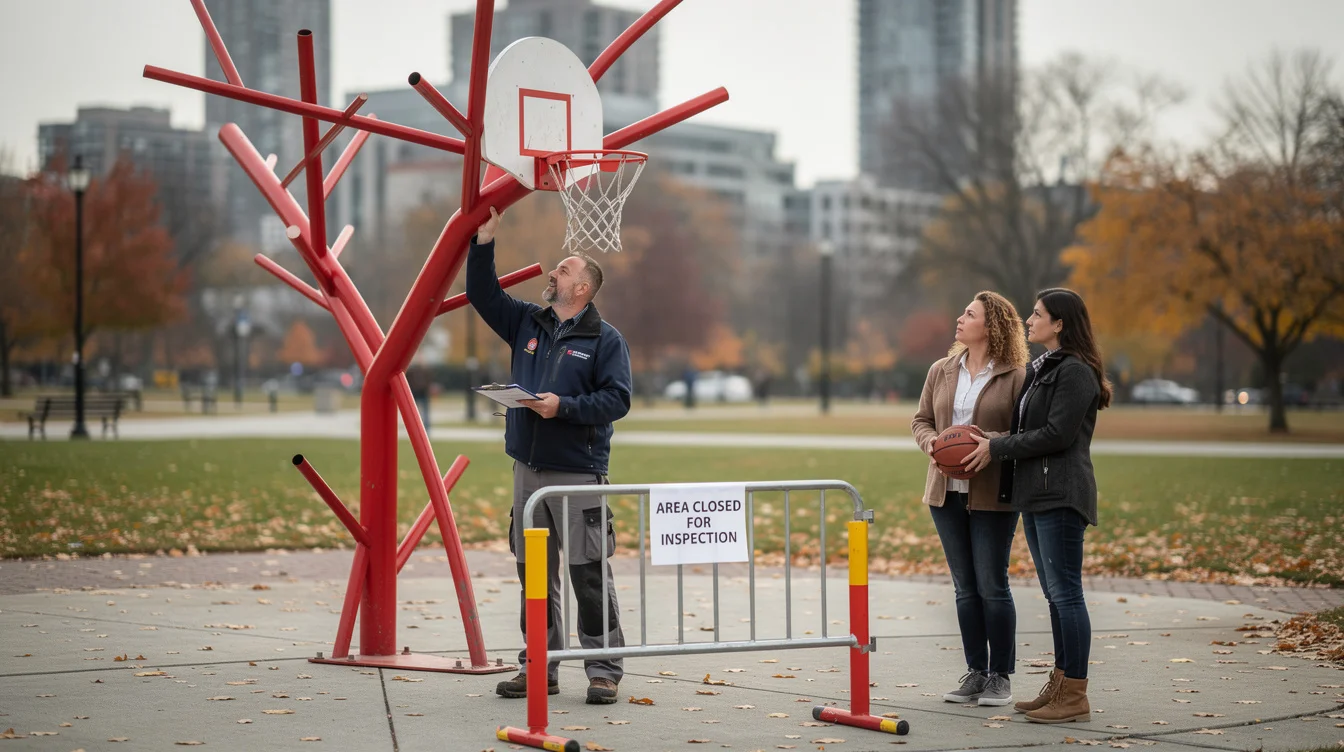
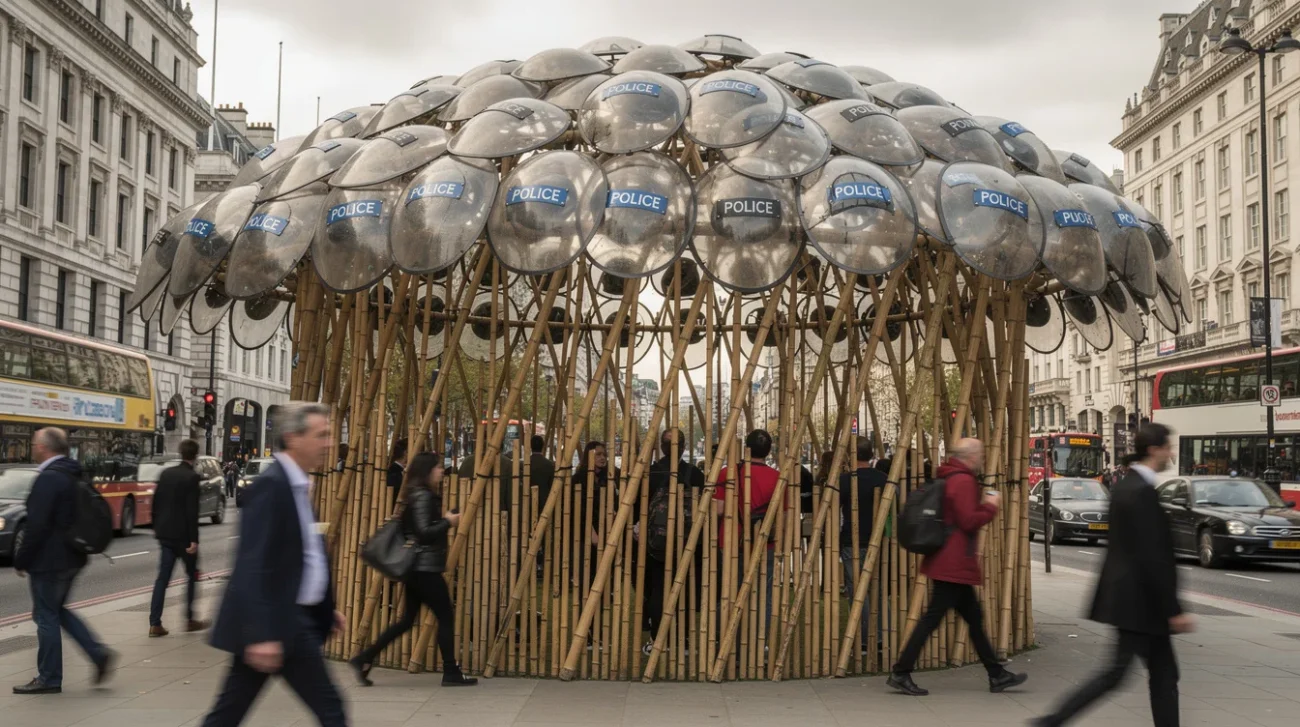
The strongest objection is that playable art can look more democratic than it behaves. As the debate over who feels welcome beneath a roof made of police shields suggests, a public invitation is not necessarily experienced equally. A hoop is instantly recognisable to many people, but recognition is not confidence. Experienced players can establish an unofficial territory through speed, noise and familiarity. A newcomer may technically have permission to participate while having no plausible way to enter the game.
The colourful Pigalle Duperré basketball court in Paris, reworked through collaborations involving Pigalle and Ill-Studio, offers a useful visual comparison. It demonstrates how powerfully a sports surface can become a design image. It should not, however, be used as evidence that visual distinction settles the distribution of playing time. The same distinction applies in Toronto: photographic enthusiasm cannot tell us whether a hesitant teenager, an older beginner or a disabled visitor feels entitled to stay.
Nor does multiplying hoops necessarily multiply usable capacity. Balls can cross between shooting areas; retrieval routes can interrupt other activities. People watching the sculpture may occupy space that players need, while players may make close observation uncomfortable. These are spatial conflicts, not failures of civic character.
A genuinely public artwork must accommodate refusal as well as participation. Someone should be able to enjoy the sculpture without joining a game, purchasing equipment or accepting an avoidable risk of impact. The promise of shared space becomes hollow if the most physically assertive use automatically receives priority.
CONTRA: Someone Must Pay for the Rules
Once play is invited, wear cannot be dismissed as misuse. Hoops, connections, finishes and surrounding surfaces require inspection appropriate to their actual use. Toronto’s seasonal conditions add questions about ice, drainage and when safe operation requires closure. The precise regime needs qualified assessment; it cannot be inferred from a photograph or from the word “playable.”
Art conservation and recreation management may also disagree. A replacement component might restore function while changing the work’s appearance. Preserving an original element might require taking a hoop out of service. Commissioning agreements should anticipate that tension, establishing how the artist, conservator and operator approve repairs. Otherwise, the public receives an invitation that can be quietly withdrawn whenever responsibility becomes inconvenient.
Richard Serra’s Tilted Arc, removed from New York’s Federal Plaza in 1989 after a bitter dispute, remains a reminder that artistic intention cannot settle every claim on public space. That tension also informs the question of who owns the view of a monument. Arrechea’s participatory premise is very different, but the governance question persists: who has standing when the artwork’s preferred encounter conflicts with other uses?
Booking systems can favour organised groups; unrestricted access can favour regulars. The answer is not simply more rules, but rules people can inspect and challenge: limits on exclusive use, published reasons for closures, and a process for revising arrangements. Resident input should include nonplayers and compensate sustained advisory work. If nobody funds this negotiation, “interactive” risks becoming a polished name for unmanaged competition. Playable art deserves ambition, but its public value must be demonstrated after installation, not declared at unveiling.
FAQ: What Does Playable Public Art Owe Its Users?
What makes Arrechea’s Toronto sculpture playable public art?
According to designboom’s report, more than twenty playable basketball hoops extend from its branching red form. Physical use is therefore part of the premise, rather than an unauthorised interaction. The report’s summary does not establish detailed access arrangements or operating rules.
Does a playable artwork automatically qualify as accessible?
No. Accessibility depends on the whole encounter, including approach routes, surfaces, manoeuvring space, resting places and opportunities suited to different abilities. A large number of hoops does not by itself demonstrate that disabled visitors can participate meaningfully.
Who should maintain an artwork that doubles as sports infrastructure?
The commissioning agreement should identify an accountable operator and a funded maintenance plan. Artists and conservators should help establish acceptable repairs, while qualified recreation and safety specialists assess functional conditions. Visitors should not have to discover which department is responsible when something fails.
How can competing uses be managed without overregulating play?
Start with clear, limited rules on shared access, exclusive bookings and temporary closures. Preserve time for spontaneous use, separate circulation from active play where feasible, and regularly review arrangements with players and nonplayers. Rules should remain contestable rather than becoming permanent privileges for established groups.
When an artwork invites us to play, who should have the final say over its rules: the artist, the operator or the people sharing the space?
Get the Mainifesto weekly — curated design debates, speculative ideas and the week's best articles every Saturday.
Editorial Perspectives
Questions and counterpoints developed by the Mainifesto editorial desk to extend the discussion.
Perspective 1
I’m for playable public art: a sculpture that supports everyday use can earn its materials and its place. But that case needs evidence—who actually gets to play, how often repairs are needed, and whether worn parts can be replaced without replacing the whole work. The people sharing the space should shape access rules, with the operator accountable for upkeep.
Perspective 2
I’m skeptical of making sculpture double as a playground; an invitation to shoot hoops isn’t automatically an invitation to belong. Before celebrating participation, ask whether the object works well in the hand and under repeated use, not just in photographs. The artist should retain a say in how the work is encountered, but shouldn’t promise play that the site cannot sustain.
Perspective 3
What interests me is how every game becomes a new version of Arrechea’s work—but participation alone doesn’t make it democratic. I’d give the people sharing the space the final say on everyday play rules, with the operator setting clear safety limits. Like an interactive installation, it needs a way to revise those rules when the loudest users start crowding everyone else out.
Perspective 4
If you invite people to play, a broken hoop or an unexplained closure is a service failure, not an interesting ambiguity. The operator needs final responsibility because someone has to fund repairs, manage complaints and keep access predictable. Judge success by repeat use across different groups, not opening-week foot traffic.