

Glass Buildings Turn Adjustable: Privacy as Control

Glass Was Supposed to Liberate Us. Instead, It Made Privacy a Product.
For decades, glass architecture was sold as a moral improvement: brighter, lighter, more democratic, more honest. From the modernist curtain wall to the domestic glass box, transparency became shorthand for progress. But the lived reality of glass has always been messier. It exposes workers to feeling watched, turns homes into fishbowl interiors, and forces occupants to respond with blinds, curtains, fritted patterns, shrubs, and strategic furniture placement. The promise of openness has long depended on a second system of concealment.
That is why adjustable privacy glass matters now. A company like Cardinal Glass Industries is betting that the next major upgrade in building envelopes will not be stronger or thinner, but smarter: on-demand opacity built directly into the pane. The pitch is seductive. Keep the clean aesthetics of contemporary architecture. Keep the daylight. Keep the views. Then, at the touch of a button or through automated controls, erase exposure. In one stroke, the building becomes both transparent and private, contemporary and cautious. But the question is not whether this technology works. The question is what kind of social contract it quietly installs.
PRO: A Better Response to the Failure of the Open Plan

Supporters of adjustable privacy glass argue that it solves a real and increasingly embarrassing problem: most glass buildings are bad at being inhabited. Open-plan offices foster distraction and performative busyness. Ground-floor homes in dense cities become stage sets for passersby. Healthcare, hospitality, education, and workplace interiors often require fluctuating degrees of visibility, yet conventional partitions are crude and permanent. Smart glazing offers a fluid alternative. Electrochromic and other switchable systems can tint or clear according to occupancy, sun load, or user preference, making the building responsive rather than rigid.
This is not a fantasy of the future. The language of adaptive envelopes has already entered serious architecture through projects such as the California Academy of Sciences with its climate-aware roof strategy, The Edge in Amsterdam with its tech-driven workplace systems, and various high-performance civic buildings that use dynamic facade control to manage glare and privacy. In interiors, the logic is even more persuasive: conference rooms that become opaque for confidential meetings, hospital spaces that shield patients without heavy curtains, residential facades that preserve daylight while refusing the total exposure that glass walls often impose. The building stops demanding a fixed relationship between inside and outside.
In this reading, adjustable transparency is liberating. It acknowledges that privacy is not a permanent condition but a situational need. That is a more realistic conception of contemporary life than the old modernist fantasy of total openness. People do not want to be seen all the time. They want control over when they are visible, to whom, and under what circumstances. A responsive glass layer can provide that control without sacrificing the visual and environmental benefits that made glass so desirable in the first place.
PRO: The Technology Gives Occupants Back Some Agency
There is also a psychological argument, and it is stronger than it first appears. Traditional glass architecture often strips occupants of agency by outsourcing privacy to external devices: curtains, blinds, shades, films, furniture, even social etiquette. Adjustable privacy glass folds the choice into the building itself. In theory, the user is no longer forced into a defensive architecture of add-ons. Instead, the envelope acknowledges the changing rhythms of work and life. Morning sun can be admitted. Afternoon glare can be softened. A home can host public-facing hospitality in one moment and domestic intimacy in the next.
This matters especially in settings where openness has become an ideological demand. Many workplaces now perform transparency as a culture signal, as if visible interiors automatically produce trust. But trust is not generated by forcing everyone into view. It is generated by meaningful boundaries. In that sense, switchable glass could be read as a correction to the most theatrical excesses of startup-era design, where exposed meeting rooms, open kitchens, and transparent staircases often functioned less as democratic space than as discipline-by-design. Adjustable glass does not abolish the architecture of visibility; it lets occupants modulate it. That is a significant improvement over permanent exposure.
It also has practical implications for urban housing, where residents increasingly confront the tension between panoramic views and privacy. High-rise living has made the classic curtain wall feel less glamorous and more coercive. A dwelling that can shift from open to shielded may offer a humane compromise. In that sense, the technology is not anti-architecture. It is an attempt to repair architecture’s oldest overreach: the assumption that transparency is always good because transparency looks good.
That repair language is important, because architecture has been moving toward more systemic answers to environmental and behavioral problems for some time. As When Design Stops Optimizing and Starts Resetting argues, the best design response is not always more control, but a better balance between performance and lived experience.
CONTRA: Adjustable Transparency Does Not Remove Control. It Hides It.
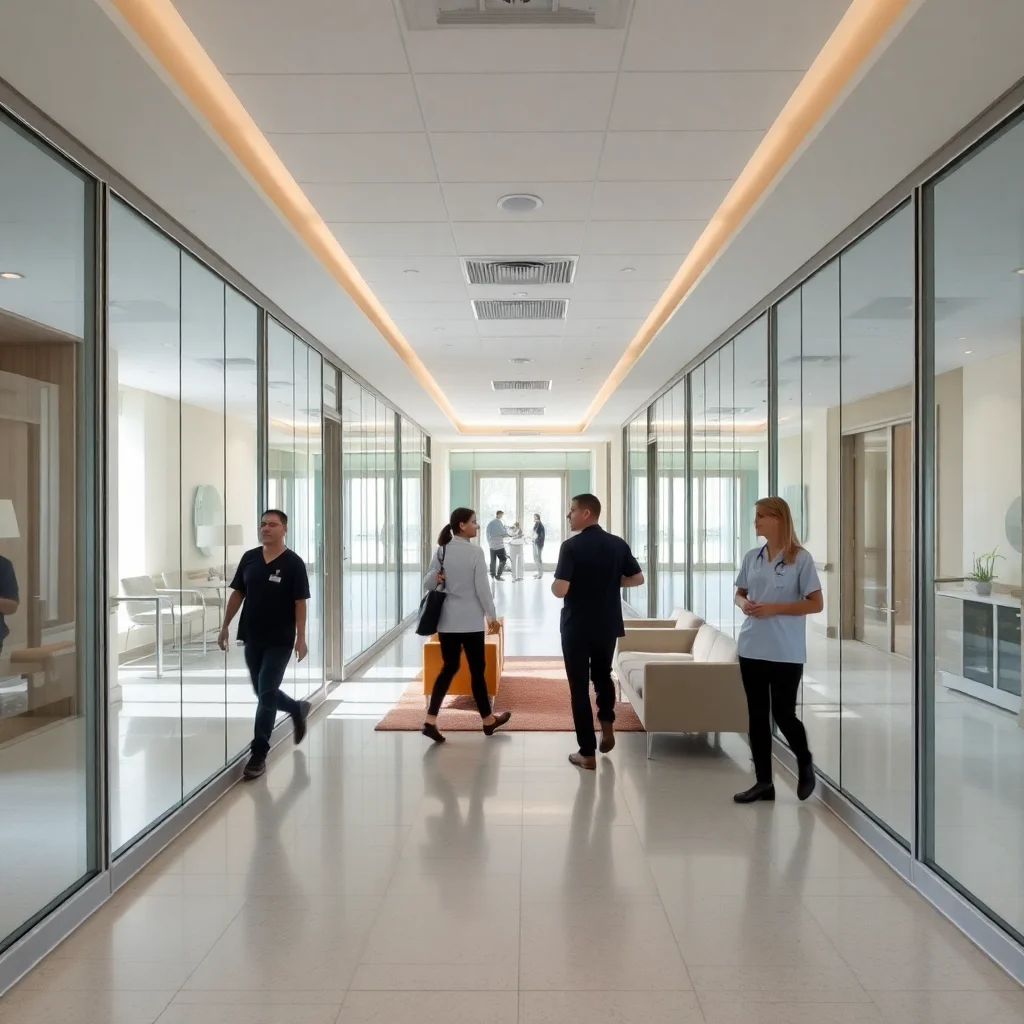
And yet the same technology can be read as an elegant mask for a deeper problem. Adjustable privacy glass does not eliminate surveillance culture; it aestheticizes it. Instead of visible barriers, users receive a seamless interface. Instead of a curtain signaling retreat, the building itself decides when concealment is permitted, when it is optimized, and when it is overridden by sensors, schedules, or building management systems. The softness of the result does not make it less political. It simply makes control harder to notice.
This is the real unease behind the new privacy layer. Once transparency becomes adjustable, it can also become administrable. The building can learn patterns, anticipate occupancy, and standardize behavior under the language of convenience. What appears to be user empowerment can easily slide into environmental paternalism: the facade tells you when to dim, when to hide, when to be available. In smart buildings, every convenience can double as data collection. If the glass knows when you are in a room and how long you keep it opaque, then the privacy layer is no longer just a barrier. It is also an instrument of behavioral management.
That is why the technology feels so politically charged. It arrives at a moment when architecture is already saturated with systems that optimize the body: occupancy sensors, app-based access, climate automation, workplace analytics, and digital building twins. Adjustable glass seems benign because it concerns sightlines, but visibility is never only visual. It is organizational. It determines who is accountable, who is exposed, and who gets to disappear from view. The more elegant the control, the more easily it passes as comfort. The same logic of invisible systems shaping experience is at work in Is AI Becoming Architecture’s Junior Partner?, where automation quietly reshapes authorship, agency, and decision-making.
CONTRA: The Aesthetics of Privacy May End Up Serving the Same Old Glass Ideology
There is another reason to be suspicious. The new privacy layer may simply preserve the old architectural fetish for glass by giving it a cleaner alibi. Instead of asking whether every facade should be transparent, developers can now say yes and promise to fix the consequences later through switching technology. That is not a real revision of architectural values; it is a technical workaround that allows the ideology of openness to continue unchallenged. The building remains image-driven. The glass remains the star. Privacy becomes a feature rather than a principle.
This is where the work of designers and architects who have challenged transparency becomes useful. Think of the measured opacity in Lacaton & Vassal’s housing renovations, where winter gardens and generous thresholds matter more than spectacle. Think of Lacaton, Vassal, and Druot’s insistence that comfort, flexibility, and dignity should outrank formal purity. Or think of Peter Zumthor, whose architecture often treats enclosure not as repression but as atmosphere, depth, and texture. These positions suggest that privacy is not something architecture should add after the fact. It should be designed as a spatial condition from the beginning.
Switchable glass can still be part of that conversation, but only if it is framed honestly. It is not a neutral upgrade. It is a negotiation between competing values: daylight and retreat, performance and autonomy, legibility and refusal. The danger lies in pretending those conflicts have been solved by a smart pane. They have not. They have merely been moved into a more elegant interface.
What Adjustable Glass Reveals About the Future of Buildings
The rise of adjustable privacy glass exposes a wider truth about contemporary architecture: the building is becoming less a static object than a continuous management system. Materials are now expected to sense, decide, and adapt. That can produce real benefits, especially when climate, density, and use patterns are unstable. But it also means the politics of architecture are migrating from form to software. The envelope is no longer just a boundary; it is a protocol.
That shift should make us wary. If the most celebrated glass buildings of the twentieth century were accused of being too exposed, the next generation may be accused of something subtler: being too compliant. Their surfaces will not simply reveal the interior. They will regulate it. Adjustable transparency can be a humane correction to the overexposed glass box, but it can also normalize the idea that visibility should always be available for optimization. In that sense, the new privacy layer is not a finish. It is a governance strategy.
- Responsive and useful: Adjustable glass can reduce glare, support changing program needs, and give users real control over when a space should be open or shielded.
- Soft control disguised as convenience: The same systems can become tools for monitoring and behavioral management, especially when tied to building automation and data collection.
- Not a substitute for good design: Privacy should not be outsourced to a smart pane alone; architects still need to design thresholds, setbacks, and spatial layers that make exposure optional rather than inevitable.
- The real debate is ideological: Adjustable transparency asks whether architecture should celebrate visibility as a default condition or treat it as one setting among many.
The new privacy layer is therefore both a promise and a warning. It promises to humanize glass architecture without abandoning its lightness and clarity. But it also warns that the future of transparency may be less open than it looks. Once opacity becomes programmable, the question is no longer whether buildings can reveal or conceal. It is who gets to decide, when, and for whose benefit. Are we witnessing a genuine upgrade in architectural freedom, or the next refinement of surveillance aesthetics wearing a friendlier face?
Get the Mainifesto weekly — curated design debates, speculative ideas and the week's best articles every Saturday.
Editorial Perspectives
Questions and counterpoints developed by the Mainifesto editorial desk to extend the discussion.
Perspective 1
I see switchable glass as a more humane way to let occupants negotiate exposure on their own terms. The interesting part is that transparency stops being a fixed architectural ideology and becomes a responsive layer, which is exactly where adaptive design should be heading. The real question is whether we can design the control logic so it serves people first, not just building management.
Perspective 2
This still feels like aesthetics dressed up as flexibility. In manufacturing terms, you’re adding cost, failure points, maintenance cycles, and a whole control system just to simulate what curtains or shading already do well. If the glass is always being mediated by software, I’d argue control has become more visible, not less.
Perspective 3
I like the idea because it treats privacy as something dynamic, not a fixed privilege baked into the plan. In hot, dense cities, being able to tune transparency could reduce the need for constant physical barriers and make shared buildings feel less hostile. But if it’s controlled by facilities staff instead of the people inside, then it’s just surveillance with a smarter face.