
Cheap Housing, Expensive Distance: Santiago’s Dilemma
Cheap Housing, Expensive Distance: The Cost Beyond the Front Door
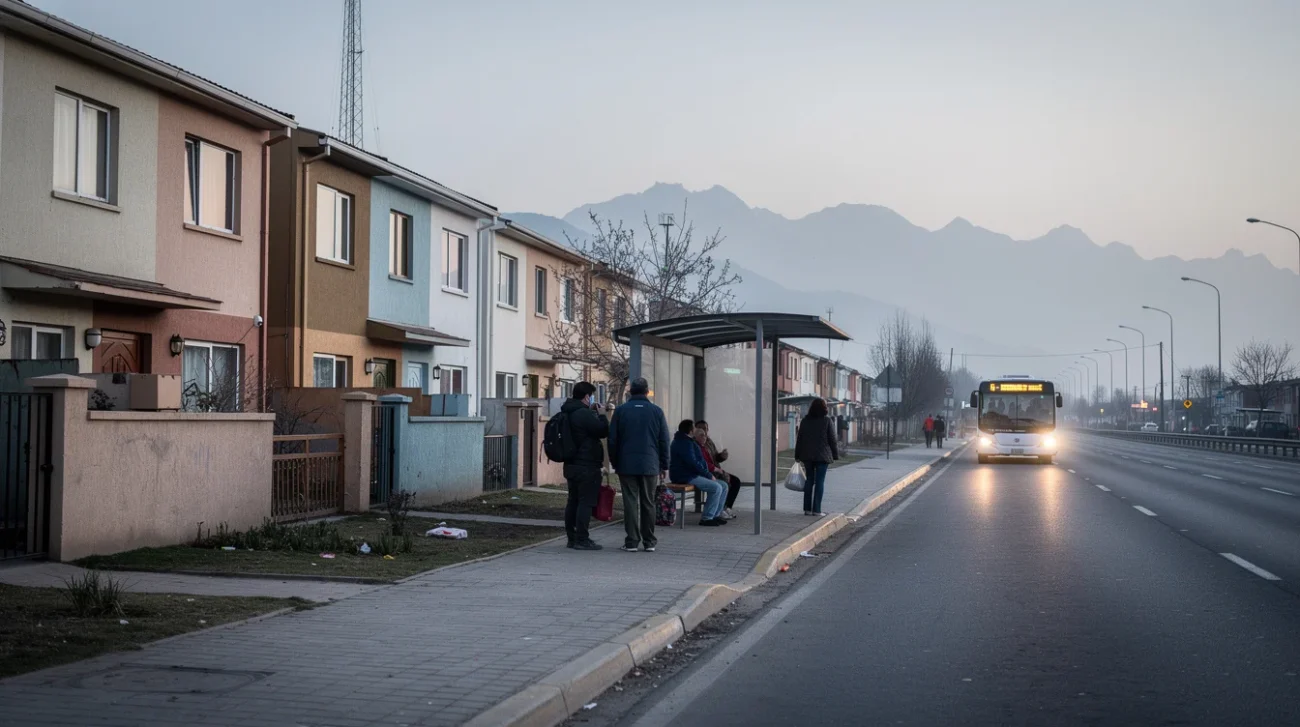
A cheap apartment can come with an expensive address. Not prestigious-expensive, but two-buses-before-work expensive; missed-clinic-appointment expensive; no-time-to-see-your-children expensive. Santa Rosa Social Housing, by FAR frohn&rojas, provides a starting point for confronting this contradiction in Santiago. The project’s published context identifies the underlying pressure: rising land prices have pushed much social housing towards peripheral settlements, often disconnected from social and technical infrastructure. That context does not establish residents’ actual travel costs or the project’s performance. It does establish the question architecture must answer: affordable for whom, over what distance, and across whose budget?
PRO — Pay More for Land, Buy Access to the City
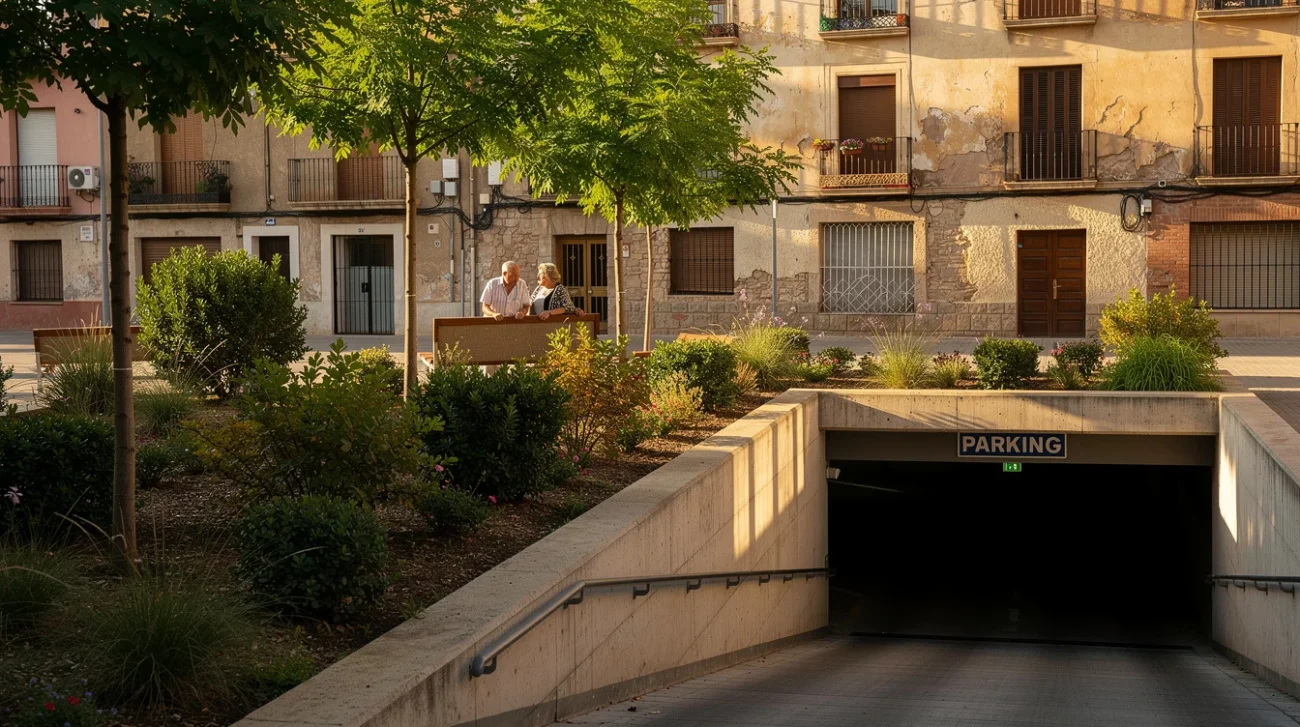
The strongest argument for social housing within established urban areas is not aesthetic compactness. It is access to things already paid for: streets, drainage, schools, clinics, public transport and the dense web of ordinary businesses that makes daily life possible. A higher land price can purchase proximity to these collective investments. Treating that price solely as an obstacle ignores what the address includes. Projects such as Plaza Salamero’s park above a car park offer a related reminder that urban land can support overlapping uses rather than a single function.
ELEMENTAL’s Quinta Monroy in Iquique offers a useful Chilean precedent, although it is not a Santiago project. Its strategy retained residents on a centrally located site and used incremental housing to reconcile limited resources with that location. The lesson is not that every household should receive an unfinished dwelling. It is that location can be an architectural resource worth protecting, rather than the first variable sacrificed to the spreadsheet.
Read through the issue raised by Santa Rosa, this becomes a public-policy challenge. Acquisition costs should be compared with the cost of reproducing urban services elsewhere, not simply with another plot’s asking price. Land near existing infrastructure is not automatically good value, but neither is undeveloped land automatically cheap. One price is visible at purchase; the other arrives through separate departments and subsequent governments.
PRO — Count the Commute as Part of the Housing Bill
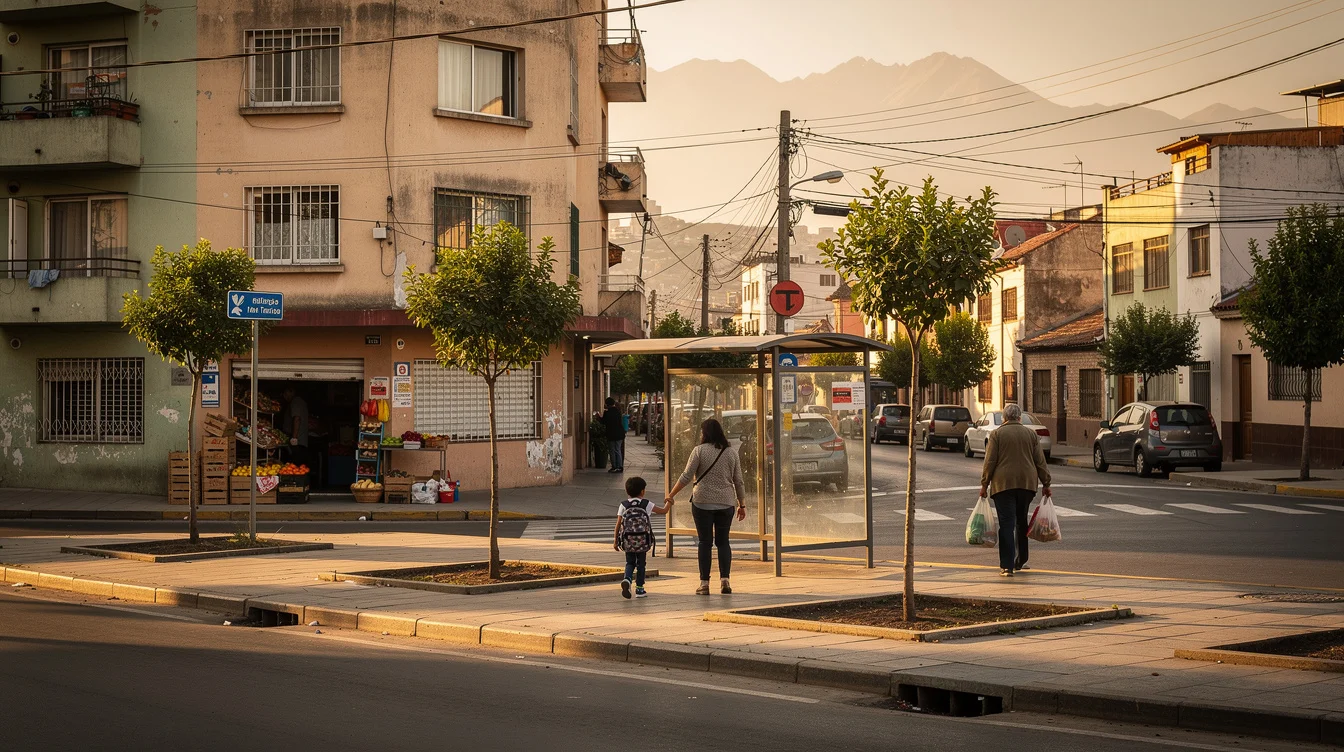
Social housing affordability should include the journey required to keep earning the money that sustains the household. Santiago’s Metro and integrated bus network can connect distant neighbourhoods to opportunity, but a line on a transport map does not measure the walk to the stop, the wait, crowding or the reliability of the final connection. Nor does it capture a parent’s journey from home to school to work.
Consider an explicitly hypothetical comparison: one location adds 45 minutes each way to a resident’s working-day travel. Across 220 working days, that is 330 additional hours annually. Even where integrated fares limit the extra cash cost, the time penalty remains. For shift workers, poor service outside peak periods can also mean paying for an alternative or declining a job.
Urban thinker Jane Jacobs understood neighbourhoods as overlapping systems of everyday activity, not isolated buildings. That insight becomes brutally practical here. A nearby childcare provider or an accessible clinic can matter more to household resilience than a slightly larger floor plan. Evaluation should therefore publish both money and time: housing payments, transport expenditure, essential-trip durations and service reliability. A subsidised home should not demand an unpaid second shift of travelling.
PRO — Stop Exporting Costs Across Public Budgets
Peripheral development can appear efficient because the housing programme does not pay every bill it creates. A transport agency funds additional service. A municipality maintains longer streets. Utilities extend networks. Households absorb travel time. The original project remains within budget while the urban system pays for its apparent discipline. The debate over whether cities can shrink without leaving people behind raises a parallel question: how should infrastructure adapt without transferring the burden to residents?
The history of housing concentration in Bajos de Mena, in Santiago’s Puente Alto municipality, makes the consequences of peripheral disadvantage difficult to dismiss. It should not be reduced to a single story of transport failure, nor should its residents be treated as passive victims. But it demonstrates why the housing estate cannot be evaluated independently of neighbourhood investment and connections to the wider city.
Vienna’s use of public land policy and subsidised housing offers a contrasting reference: affordability is shaped before a building is designed, through decisions about land and development. Santiago need not copy Vienna’s institutions to adopt the underlying principle. Publicly controlled sites and early acquisition can help preserve locations for housing before future accessibility is fully capitalised into prices. The provocative conclusion is straightforward: spending more on a well-located site may be fiscal restraint, not extravagance. The relevant balance sheet belongs to the city, not one construction contract.
CONTRA — Established Infrastructure Is Not Spare Infrastructure

The case for better-located housing becomes complacent when it assumes the existing city has unlimited capacity. A school nearby may have no places. A sewer may require upgrading. A Metro station can be geographically close while its trains are crowded and its pedestrian approaches hostile. Buying an expensive site does not buy guaranteed access to every service surrounding it.
Pedro Donoso and other established Santiago corridors illustrate the kind of urban setting where this distinction matters: adjacency to an existing street network is only the beginning of an accessibility assessment. Site selection must examine actual service capacity, safe crossings, universal access and connections to the destinations residents use. It cannot substitute a radius drawn on a map for evidence.
There are also genuine construction penalties. Small or irregular plots, demolition, uncertain ground conditions and work beside occupied buildings can raise costs and delay delivery. Lacaton & Vassal’s transformation projects in France, including Grand Parc Bordeaux with Frédéric Druot and Christophe Hutin, demonstrate the value of working with existing urban fabric. They also remind us that this requires a specific technical strategy. “Build within the city” is a direction, not a complete delivery model.
CONTRA — Rejecting the Edge Can Mean Housing Fewer People
With a fixed immediate budget, higher land expenditure can reduce the number of homes delivered unless funding, density or development arrangements change. For households facing overcrowding, insecure tenure or inadequate accommodation, waiting for an ideal location has a cost too. An editorial preference for urban proximity should not erase the urgency of having a safe home.
ELEMENTAL’s Villa Verde in Constitución provides another useful reference, without serving as proof that peripheral development succeeds. Its incremental approach accommodates future household expansion, exposing a legitimate demand that compact housing debates sometimes overlook. Families may value adaptable space, room for relatives or the ability to support home-based work. These are not frivolous preferences to be corrected by architects.
Nor is Santiago a city with one universal destination. Employment and family networks are distributed unevenly across the metropolitan area. An outer location can be useful to a household whose work and support networks are nearby, while an apparently central apartment can disrupt those relationships. The fair comparison is therefore not centre versus edge in the abstract. It is accessibility for identifiable households against a realistic alternative. Peripheral housing deserves rejection when it imposes isolation, not merely because it sits far from a cartographic centre.
CONTRA — The Periphery Can Work, but the Promise Must Be Funded
New districts can combine housing with transport, schools, services and employment. The problem is not expansion itself; it is expansion organised around the assumption that public infrastructure will eventually catch up. Stockholm’s Vällingby, conceived around housing, work and a centre connected by rail, remains a useful planning reference. It is not a template to transplant, but evidence that an urban edge can be planned as more than a dormitory.
For Santiago, a credible peripheral proposal should identify who finances infrastructure, when it opens, who operates it and what happens if housing is occupied first. Promised transport should be assessed through funded service commitments and realistic delivery risks, not a dotted line in a sales diagram. Essential services need staffing and operating budgets, not merely reserved plots.
This sets a demanding but fair test. Compare candidate locations over the same period, including construction, infrastructure, maintenance, transport operations and household expenditure. Report travel time separately so that lower wages do not make poorer residents’ hours appear less important. If an outer site delivers reliable access and adequate homes at lower combined cost, it deserves support. If its savings depend on residents absorbing distance indefinitely, the public has not saved money. It has reassigned the bill.
FAQ — What Should Housing Affordability Actually Measure?
Why use Santa Rosa Social Housing as the starting point?
Its published context directly identifies Santiago’s conflict between rising land prices and peripheral housing disconnected from infrastructure. It frames the debate, but does not by itself supply evidence about residents’ actual transport spending or travel times.
How should transport enter an affordability assessment?
Compare housing payments and recurring transport expenditure alongside door-to-door travel times for work, education, care and healthcare. Include service frequency, reliability and accessibility. Publish time separately from money rather than hiding both inside one opaque score.
Is housing near a Metro station necessarily well located?
No. Station proximity matters only alongside safe access, affordable fares, useful operating hours and connections to relevant destinations. Nearby schools and clinics also need sufficient capacity. Accessibility is a functioning relationship, not a distance alone.
When can cheaper peripheral land be the better public choice?
When its acquisition savings exceed the additional long-term costs without imposing unacceptable travel burdens. That requires funded infrastructure, credible service delivery and comparison with real alternatives, including the cost of delaying urgently needed homes.
Should Santiago accept fewer homes on better-connected land today, or demand that every cheaper peripheral scheme fund the access its residents will need tomorrow?
Get the Mainifesto weekly — curated design debates, speculative ideas and the week's best articles every Saturday.
Editorial Perspectives
Questions and counterpoints developed by the Mainifesto editorial desk to extend the discussion.
Perspective 1
I would accept fewer homes on connected land: Lefebvre’s right to the city was hardly a right to spend one’s life reaching it. Santiago should stop mistaking the production of housing units for the construction of urban life—a rather old planning error.
Perspective 2
I’m against accepting fewer homes as the default answer; households left waiting pay a price too. Require peripheral schemes to fund credible access from first occupancy, then compare total public costs and residents’ travel times—not just land prices.
Perspective 3
A cheap home with an exhausting commute is a bad product, whatever the handover photos look like. Show me the door-to-door journey to work, school and groceries, and put the cost of making those trips workable into the investment case.
Perspective 4
Price the transport obligation into the deal before anyone buys the peripheral land, not after the homes are occupied. If the scheme no longer stacks up, the land wasn’t cheap enough—and if the connection depends on an unfunded public project, don’t count it as connected.