
Who Pays the Human Cost of a Beautiful Building?
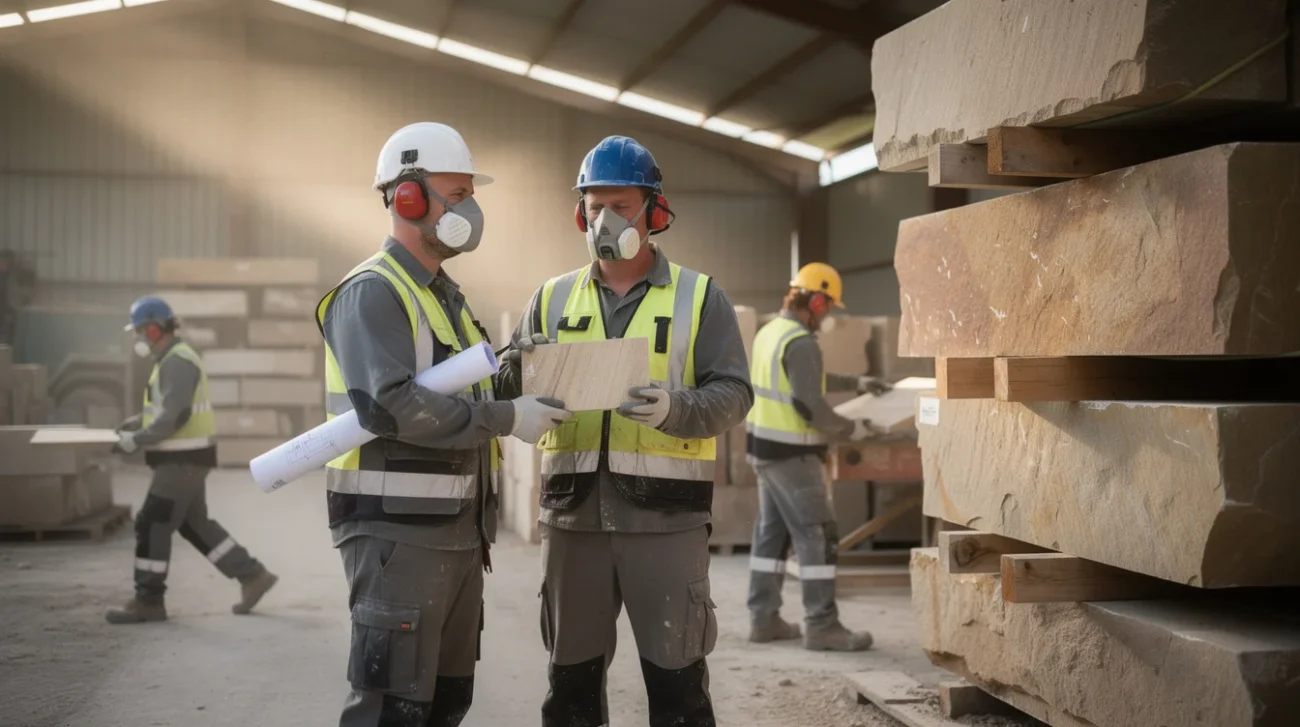
A stone lobby can be immaculate and its procurement indefensible. The architect sees veining, the contractor sees delivery dates, the client sees an asset. Somewhere upstream, a worker may see a debt that never shrinks, wages withheld or a threat that makes leaving impossible. These realities can occupy the same material. Architecture’s mistake is to treat only the visible one as a design problem.
Architectural Digest’s reporting on forced labour in construction supply chains identifies a failure the profession can no longer file under somebody else’s expertise: specifying a product does not establish how it was made. A sample proves appearance. A technical sheet establishes declared performance. Neither tells you whether the person who extracted, fired or processed it could refuse the work.
A building should not be celebrated as responsible when its material provenance stops at the showroom. That does not mean every architect can personally investigate every quarry. It means responsibility must become a funded, contractual process rather than an ethical preference that disappears during value engineering.
The specification is not the supply chain
Consider a sandstone paving package. The architect names a finish and supplier; the supplier purchases from an exporter; the exporter aggregates output from processing yards and quarries. The invoice may identify the country of dispatch without revealing the extraction site. A perfectly legible specification can therefore conceal an almost illegible production system.
The US Department of Labor’s List of Goods Produced by Child Labor or Forced Labor identifies risks by commodity and country, including construction-relevant goods such as bricks and stone. Its entries distinguish between child labour and forced labour; the two must not be casually conflated. Such lists are screening tools, not proof that every producer in a listed country abuses workers. Equally, an unlisted product is not automatically safe.
In South Asian brick production, documented debt-bondage risks show why the distinction matters. A recruitment advance can become a mechanism of coercion when deductions, manipulated accounts or threats prevent workers from leaving. Low wages alone do not establish forced labour; the absence of meaningful freedom does.
The architectural response should therefore be neither a blanket geographical boycott nor complacent acceptance of a distributor’s assurances. It should be targeted investigation into the actual production chain.
Beauty already has a procurement politics

Architecture knows how to demand evidence when it considers the issue important. Stone undergoes testing. Fire-rated assemblies require documentation. Structural substitutions trigger review. Yet labour conditions often arrive as a generic supplier code of conduct, signed once and rarely interrogated. The imbalance is not technical inevitability. It is a hierarchy of concern.
Grace Farms Foundation’s Design for Freedom initiative has challenged that hierarchy by making forced-labour risk in building materials a design and procurement question. Its institutional setting is instructive: Grace Farms in New Canaan, Connecticut, is associated with SANAA’s celebrated River building. Architectural prestige offers a platform for asking what prestige usually leaves outside the frame.
Theaster Gates’s 2022 Serpentine Pavilion, Black Chapel, was a Design for Freedom pilot project. Its relevance is methodological, not a licence to declare that a pilot label guarantees every worker’s circumstances. A high-profile cultural commission can make tracing materials part of architectural experimentation rather than an administrative inconvenience.
These examples expose the weakness of the usual defence: that designers have no leverage. They have leverage over specifications, tender questions and acceptable substitutions. What they often lack is an appointment, budget and client mandate that require them to use it.
What approval should actually require
Approval should require a documented, risk-based due-diligence record—not a supplier’s promise of perfection. Before a high-risk material package is released for purchase, the project team should know the manufacturer, production facility and relevant upstream sources. For stone, that may mean the processing yard and quarry; for brick, the kiln. Unknown links should be recorded as unresolved risks, not quietly converted into presumed compliance.
The evidence must address employment as well as geography: recruitment arrangements, worker-paid fees, wage deductions, identity-document retention and freedom to leave. Purchase orders and shipping records help trace goods. They cannot, by themselves, demonstrate freedom from coercion.
Independent worker engagement matters because a scheduled audit can miss intimidation, coached answers and excluded subcontractors. Confidential interviews conducted without management present, in languages workers understand, are more useful than another photograph of a tidy factory floor. Even these methods require safeguards against retaliation.
An environmental product declaration is not a labour-rights certificate. Just as off-grid living is not the same as low-impact design, evidence of one kind of performance cannot establish another. Certification can contribute evidence, but only within its actual scope. The approval record should identify what was checked, by whom, when, and what remains uncertain. The architect need not become a labour inspector; a suitably qualified investigator must enter the project team where the risk warrants one.
The real test arrives during value engineering
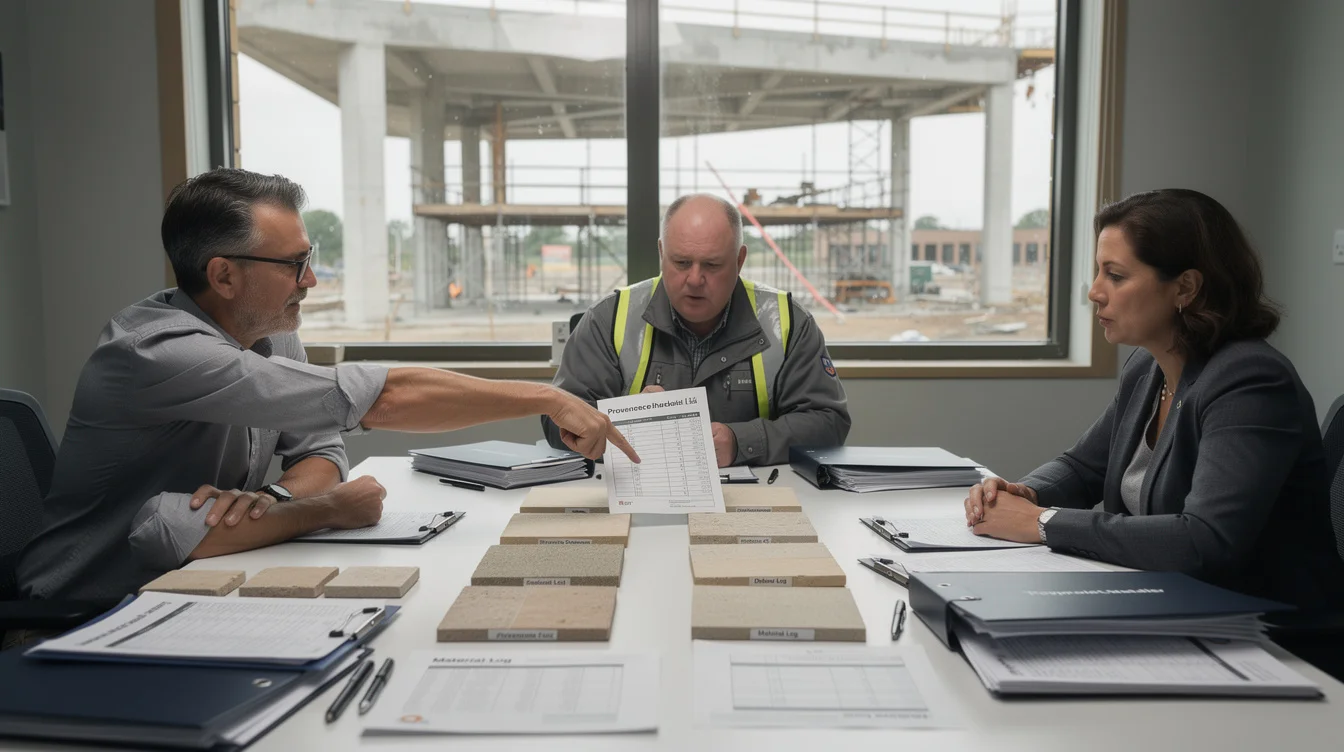
Imagine a civic library with a specified sandstone floor. Three weeks before procurement, a cheaper alternative appears. Its distributor offers an identical finish and a shorter lead time but cannot identify the quarry. Under conventional value engineering, the substitution looks attractive. Under credible ethical construction procurement, it is incomplete.
The right response is not necessarily to abandon stone. It could be to verify the alternative, retain the original supplier if its evidence is stronger, select a traceable reclaimed material or redesign the floor. Each option carries consequences. Reclaimed stone still needs scrutiny of its recovery and processing conditions; “reused” is not a universal ethical exemption.
This is why labour verification must begin during concept design and supplier engagement, not when a truck is booked. Framework agreements can prequalify suppliers. Tender schedules can state evidence requirements. Specifications can require equivalent due diligence for substitutions, preventing a carefully researched material from being replaced by an opaque product after design approval.
Contracts should name who can suspend a package, what evidence permits release and how delay costs are allocated. Without those decisions, the person raising the concern becomes the apparent cause of the delay. The actual cause—an inadequately investigated supply chain—escapes scrutiny.
Who pays when doing better costs more?
The client should fund a credible procurement process as a project cost, just as it funds surveys and testing. Consultants need fees for tracing and reviewing materials. Contractors need time and staff to manage evidence. Suppliers must invest in their own due diligence rather than selling opacity as a competitive advantage. Liability for a particular failure should follow contractual duties, conduct and applicable law—not a convenient search for the weakest participant.
Not every ethical sourcing decision increases the purchase price. Earlier orders, fewer finishes and simpler assemblies can create room for verification. But pretending responsible procurement is always cost-neutral is another evasion. Sometimes the project must spend more, accept less decorative ambition or open later. The debate over unfinished housing and unpaid resident work raises a related question: has a design saved work, or merely shifted it onto someone else?
The cost must not be passed down to workers through lower wages, recruitment charges or abrupt abandonment. Discovering abuse should trigger a worker-centred remediation plan: specialist support, protection against retaliation and measures addressing withheld pay or recruitment debt where relevant. Disengagement may be necessary, but cancellation alone does not repair harm.
A client demanding a signature staircase while refusing a modest investigation budget is making a design decision. It is choosing the staircase over the information needed to assess its human cost. Architects should describe that choice without euphemism.
Responsibility needs an approval gate, not a manifesto
Law already challenges the idea that supply-chain distance eliminates responsibility. Section 307 of the US Tariff Act prohibits imports made wholly or partly with forced labour, subject to its statutory framework and enforcement. The UK Modern Slavery Act’s supply-chain transparency provisions require statements from qualifying commercial organisations. These are different instruments: an import prohibition is not a disclosure requirement, and publishing a statement does not establish that a product is abuse-free.
Professional practice should go beyond collecting statements. Appointment documents should allocate due-diligence tasks; procurement programmes should include verification milestones; clients should receive a clear record of unresolved risks. Where severe concerns remain unaddressed, material approval should be withheld under an agreed contractual process. That is a proposed professional standard, not a claim that every jurisdiction already requires it.
Designers also need limits they can defend. No honest team can guarantee complete visibility across every tier of a complex building. It can demonstrate proportionate investigation, disclose gaps and refuse to disguise missing evidence as certainty.
Architecture’s next ethical frontier is not another visual language of care. It is the unphotogenic discipline of knowing enough to approve—and having the authority to say no.
FAQ
Does specifying a material make an architect responsible for forced labour upstream?
It creates professional leverage and an ethical responsibility to ask proportionate questions. Legal liability depends on jurisdiction, contracts and conduct. Architects should agree their verification duties explicitly rather than assume either unlimited responsibility or complete exemption.
What is the minimum evidence a project should request?
For higher-risk packages, request supplier and production-site identities, relevant upstream sources, traceability records and evidence addressing recruitment and working conditions. Record independent checks, unresolved gaps and the person authorised to decide whether procurement can proceed.
Can certification prove that a material is free from forced labour?
Not conclusively. Schemes differ in scope, audit quality and coverage of subcontractors and recruitment. Certification is useful evidence when relevant, but should be assessed alongside traceability, worker engagement and a functioning remediation process.
Who should pay for verification and remediation?
Clients should budget for project-level verification, while suppliers and contractors resource their own obligations. Responsibility for remediation depends on the harm, business relationships and applicable duties. Costs should not be recovered from affected workers.
If a building can meet its budget only by leaving the origins of its materials unexamined, should it be allowed to proceed unchanged?
Watch the Mainifesto Short
Get the Mainifesto weekly — curated design debates, speculative ideas and the week's best articles every Saturday.
Editorial Perspectives
Questions and counterpoints developed by the Mainifesto editorial desk to extend the discussion.
Perspective 1
A material passport is only as credible as the supplier willing to name the quarry, factory and labour broker behind it. Architects need evidence beyond the first-tier vendor, but clients and major contractors must fund that scrutiny; they control the purchasing power. Otherwise, a clean specification can still conceal coercion several borders away.
Perspective 2
No, it shouldn't proceed unchanged: if the numbers work only because nobody asks where the stone came from, the budget isn't credible. Cut the imported finishes or simplify the façade before cutting sourcing checks, and put those checks in the client's budget from day one. Discovering the problem after placing orders is how you turn an ethical obligation into an expensive scramble.
Perspective 3
I'd want to know what counts as verification before accepting another supplier's ethical-sourcing certificate. Start with higher-risk materials, require traceable evidence and give the architect contractual authority to reject substitutions that don't meet the same standard. An undocumented origin isn't proof of forced labour, but it isn't a sound basis for approval either.