
World Cup Fan Zones Reshape Civic Space
1. The World Cup Has Become a Pop-Up City
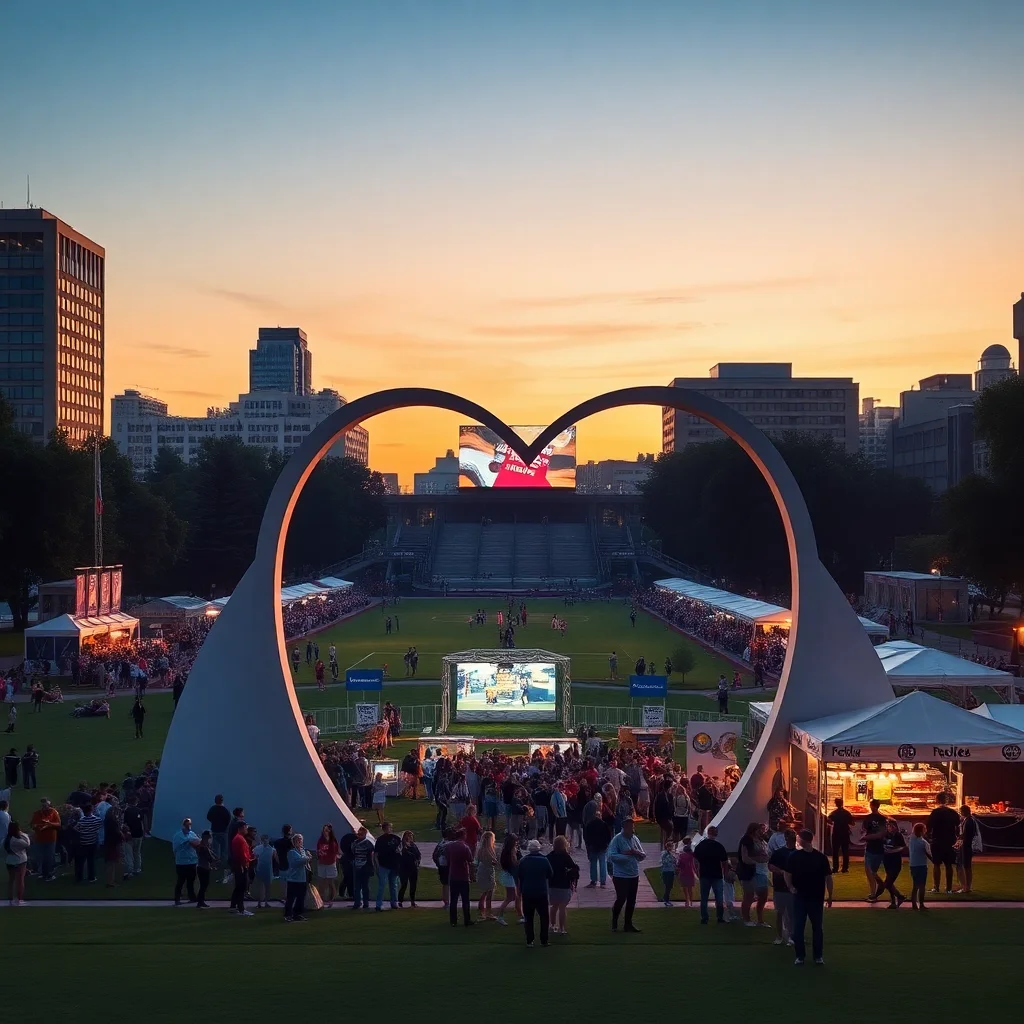
The 2026 World Cup is being sold as a tournament, but in architectural terms it reads like a temporary urbanism experiment with global funding and local consequences. The official FIFA Fan Festival zone in Kansas City, designed by Populous on the south lawn of the National WWI Museum and Memorial, is not simply a place to watch a match; it is a test of how a city can manufacture collective belonging at speed. With heart-shaped gateways, projection areas, security thresholds, food vendors, and branded open ground, these fan environments behave like short-lived civic districts, complete with circulation patterns, crowd hierarchies, and emotional choreography.
This is the crucial shift: mega-events no longer just occupy the city, they prototype it. Fan zones, public screens, and plaza takeovers now operate as mobile civic design kits, deployed to absorb crowd energy while rebranding the city as welcoming, modern, and globally legible. The deeper question is brutally simple: if a place only becomes public when a broadcaster arrives, was it ever civic space at all?
2. Kansas City Shows the New Formula: Symbol, Screen, Crowd
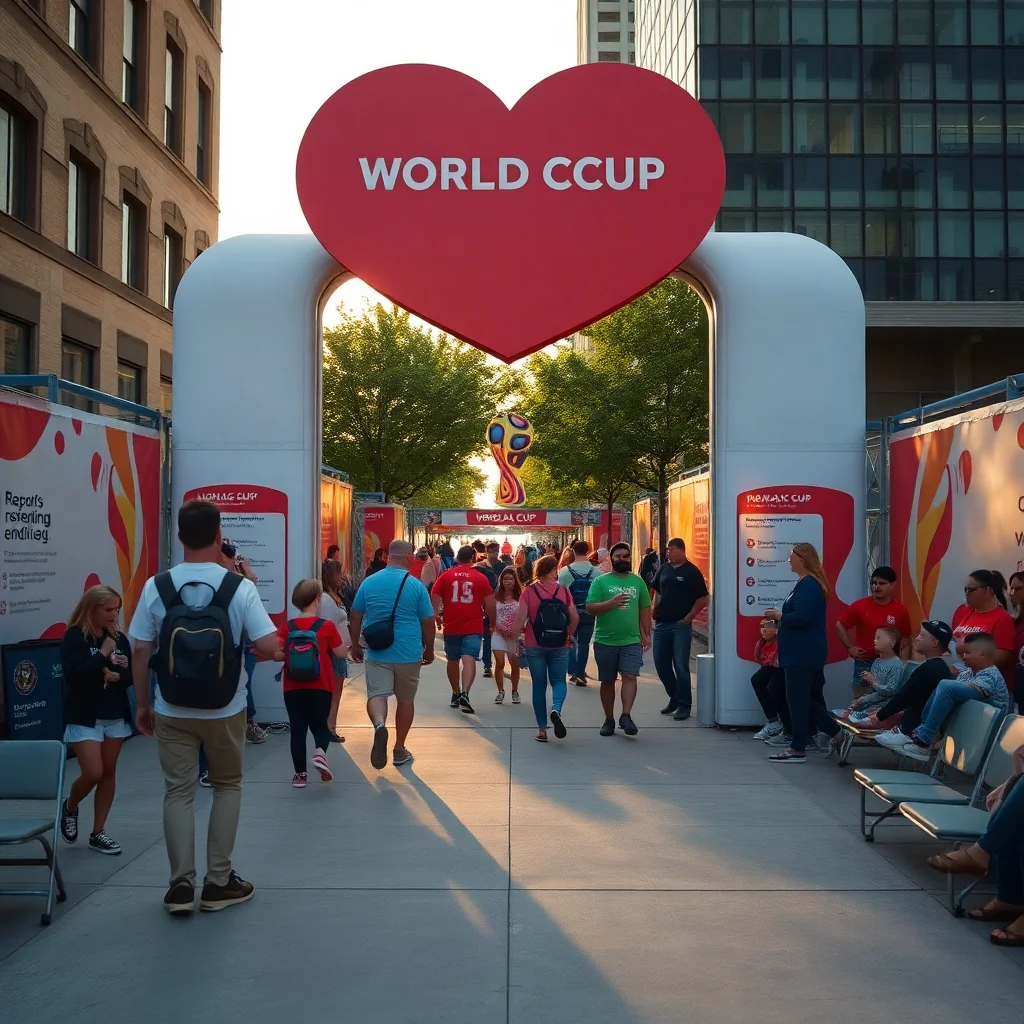
Populous’s Kansas City fan area is telling because it combines three ingredients that now define event urbanism. First, symbolism: the heart-shaped gateway turns entry into a visual signature, compressing identity into a single recognizable frame. Second, the screen: the whole site is organized around the spectacle of mediated sport, meaning the architecture is less a container than a device for synchronized attention. Third, the crowd itself becomes the real material, because the publicness of the space depends on density, duration, and shared anticipation.
This formula is not unique to Kansas City. London has long converted Trafalgar Square into a football commons; Paris regularly transforms the Champ de Mars and other central sites into event grounds; Berlin’s Fan Mile has become a canonical example of how civic infrastructure can be temporarily re-scripted for mass emotion. The architecture here is less about permanence than legibility. Cities want an image they can circulate: one emblematic gateway, one broad lawn, one giant screen, one sea of people. The public realm becomes a content generator.
3. Fan Zones Are the Most Honest Form of Event Architecture
For all their branding, fan zones are unexpectedly honest. They admit that the contemporary city often struggles to produce spontaneous assembly, and they respond by staging it. Unlike traditional squares, which rely on civic habits accumulated over decades, the fan zone is explicit about its purpose: consume, gather, cheer, disperse. That clarity can be liberating. It cuts through the nostalgia that too often surrounds public space and acknowledges that many cities now need designed permission to gather at scale.
There is precedent in other spectacular public installations. Temporary pavilions at the Serpentine, the transformation of Olympic parks after the Games, and the long afterlife debates around Barcelona 1992 and London 2012 all show how event architecture frequently outlives its own moment only if it can be folded back into civic use. In this sense, the fan zone is a design stress test. It asks whether a field of spectators can become a genuine public realm rather than just a managed crowd condition with better lighting.
4. The Case For: A Catalyst for Shared Urban Life
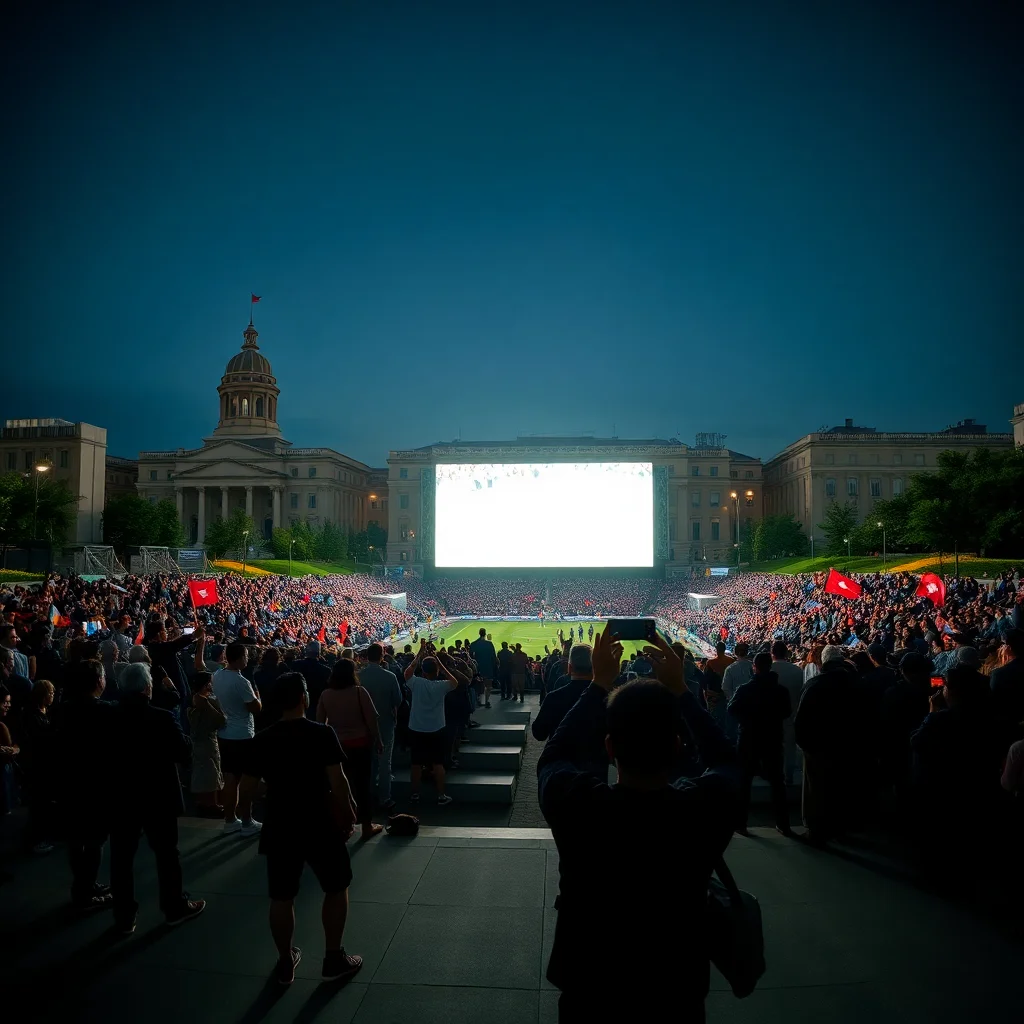
The strongest argument in favor of these zones is that they can create a new civic grammar for cities that have lost confidence in shared space. In a fragmented urban culture, a well-designed fan area can do what many plazas fail to do: attract multiple publics, offer free access, and generate collective intensity across class, age, and neighborhood boundaries. The best examples do not feel like fenced-off viewing pens; they feel like temporary commons, where the city briefly remembers how to assemble.
Designers understand this power. Event landscapes by firms such as Populous, Herzog & de Meuron, and HOK often use the same tools found in better civic architecture: edges that soften entry, generous circulation, shade, permeability, and a readable central focus. In ideal conditions, these spaces can encourage walking, lingering, and incidental encounter. They can also elevate the ordinary urban ritual of watching together, which in many cities has been replaced by atomized living-room consumption. When done well, the fan zone is not anti-urban theater; it is a rehearsal for civic optimism.
That optimism also depends on comfort, especially in outdoor settings where heat and exposure shape whether people stay or leave. The most successful temporary gathering spaces often borrow from the logic of shade as urban infrastructure, using canopies, trees, and overhead cover not as decoration but as a basic condition for public life. In a fan zone, such elements can be the difference between a scripted crowd and a livable commons.
5. The Case Against: Civic Theatre With a Short Half-Life
But the criticism is equally strong, and architects should not hide from it. Mega-event public space is often civic only while the cameras are rolling. It produces a carefully managed image of openness while relying on exclusionary logistics: ticketing, policing, surveillance, brand control, and behavior regimes that would be intolerable in an ordinary square. The crowd is welcomed, but only within a tightly scripted perimeter. This is not democracy; it is hospitality with conditions.
The deeper problem is what happens after the tournament. Too many event landscapes leave behind either emptiness or overdesigned leftovers that cannot sustain everyday use. The history of spectacle districts is crowded with cautionary tales: the Olympic footprint, the fenced fan mile, the plaza that was beautiful when saturated with attention and dead when the attention moved on. If a World Cup fan zone cannot translate into local ownership, flexible programming, or unbranded public use, then it has merely converted civic life into a temporary marketing asset.
6. Projection Zones, Plazas, and the Politics of Afterlives
The rise of public screens matters because projection changes what a city can mean. A screen creates simultaneity: strangers become a synchronized audience, and the urban fabric becomes a vessel for remote event time. Yet screens also expose the fragility of public space, because once the broadcast ends the architecture must either keep functioning or disappear. This is where the real design challenge lies: afterlives.
Some cities have learned to build for afterlife, not just appearance. The Olympic Park in London was always judged by whether it could shift from mega-event stage set to ordinary district. Superkilen in Copenhagen demonstrated how public space can survive by absorbing local use, not just visual acclaim. Even Milan’s temporary Salone del Mobile installations often reveal more about civic appetite than permanent plazas do, because they invite people to use the city differently for a limited but intense period. The lesson for the World Cup is blunt: if fan zones cannot evolve into plazas, markets, performance grounds, or shaded social fields, they remain urban special effects.
That question of what survives after the spectacle echoes broader debates about whether cities should build for permanence or embrace change as a core material condition. It is one reason the discussion around decay as design material has become so relevant: the most credible public environments are often those that can age, adapt, and absorb new uses rather than remain frozen in their event-day form.
7. The Real Design Question: Can Public Space Keep Its Claim?
The 2026 World Cup will not be remembered only for goals, but for how cities staged togetherness. Kansas City’s fan area, like the wider constellation of festival zones across the host countries, reveals a new reality: civic space is increasingly designed under the pressure of collective emotion. That can be empowering, because architecture finally has to deal with actual crowds, not abstract users. It can also be dangerous, because cities may confuse temporary intensity with lasting public value.
The measure of success should therefore be unsentimental. Did the space allow people who do not usually meet to occupy it together? Did it support movement, pause, and disagreement rather than just compliance? Did it leave behind habits, routes, and civic confidence after the final whistle? Mega-events are now urban design laboratories, but laboratories should produce knowledge, not just images. The World Cup will tell us whether public space can still generate genuine civic life when the spectacle is over — or whether the city has become dependent on borrowed attention to feel alive.
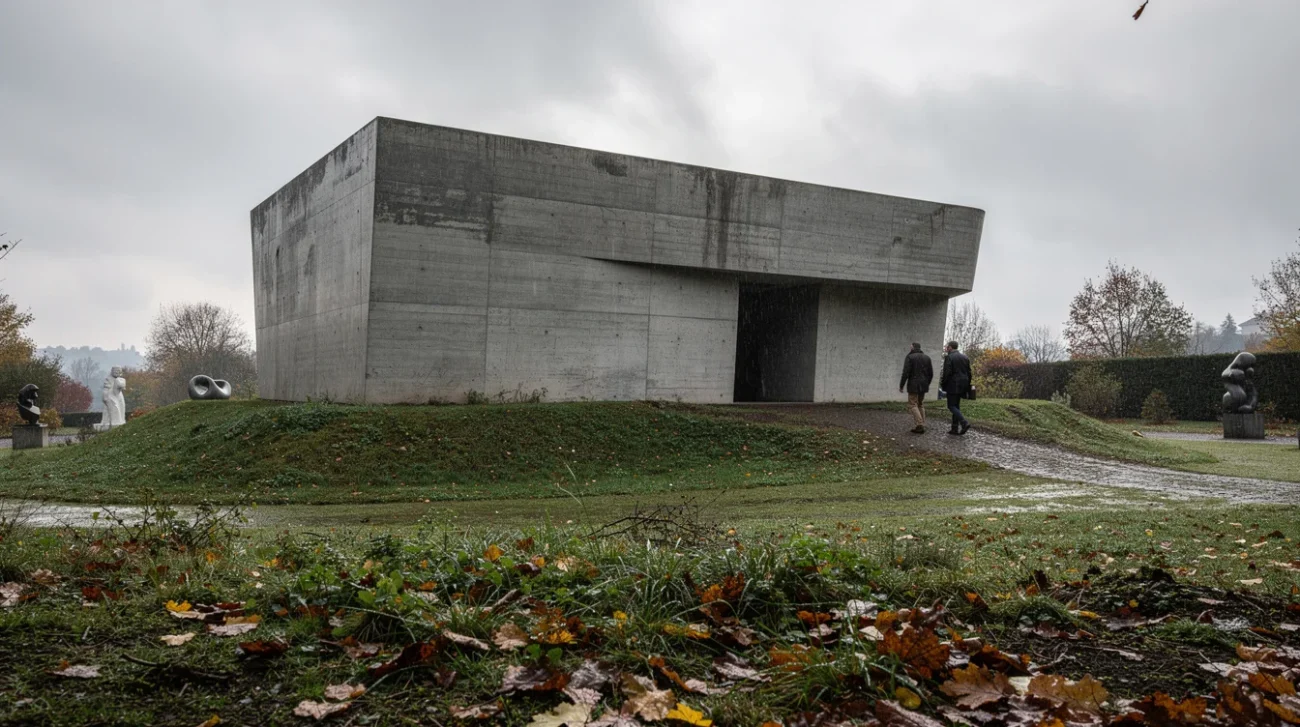
- Temporary intensity: Fan zones can activate spaces that are dormant for most of the year, proving that cities still need designed occasions for gathering at scale.
- Managed publicness: These zones often come with security, branding, and behavioral controls that complicate any claim to democratic openness.
- Design afterlife: Their true value depends on whether they can convert from event infrastructure into everyday civic room.
- Urban image-making: Cities use them to circulate a polished identity, but image alone cannot sustain public life.
- Collective emotion: The World Cup turns crowds into a design problem, forcing architects to choreograph joy, waiting, and release.
- Civic test: After the cameras leave, the only question that matters is whether the space still belongs to the city.
FAQ
What is a World Cup fan zone in architectural terms?
It is a temporary public environment designed to host crowds, screens, circulation, security, food, and social gathering around a major sporting event. Architecturally, it behaves like a pop-up civic district rather than a simple viewing area.
Why are fan zones important to cities?
They allow cities to stage large-scale collective experiences in a controlled environment. Done well, they can activate underused land and create shared urban moments that feel civic rather than purely commercial.
What is the main criticism of these spaces?
That they simulate public life without guaranteeing it afterward. They often depend on branding, policing, and event programming, then disappear or fall silent once the tournament ends.
Can temporary event spaces become lasting civic assets?
Yes, but only if they are designed for flexible afteruse, local ownership, and everyday accessibility. Otherwise they remain impressive but short-lived urban theatre.
Get the Mainifesto weekly — curated design debates, speculative ideas and the week's best articles every Saturday.
Editorial Perspectives
Questions and counterpoints developed by the Mainifesto editorial desk to extend the discussion.
Perspective 1
The real test isn’t whether the fan zone looks good for six weeks, it’s whether the space still works on a rainy Tuesday in November. Too many cities treat public realm as event infrastructure first and civic infrastructure second, and that gets expensive fast.
Perspective 2
This reads like a live experiment in temporary urbanism, where intensity can reveal latent spatial qualities but also mask weak civic fundamentals. If the city only becomes public under spectacle, I’d argue the design succeeded tactically but failed structurally.
Perspective 3
From a user standpoint, the fan zone wins because it gives people a clear reason to show up, and that matters more than theory. But if the space can’t convert that footfall into a reason to return afterward, then it’s just a very expensive pop-up.
Perspective 4
Mega-events expose how little many cities invest in everyday public life, then they dress it up as a design victory. The spectacle doesn’t save civic space; it just concentrates money, security, and attention long enough to make the absence visible.
Perspective 5
I’d say it reveals both things: design can absolutely activate a place, but only if the underlying public realm already has a civic logic. If the city feels public only during the World Cup, that’s not proof of design power so much as proof that the baseline was too weak.