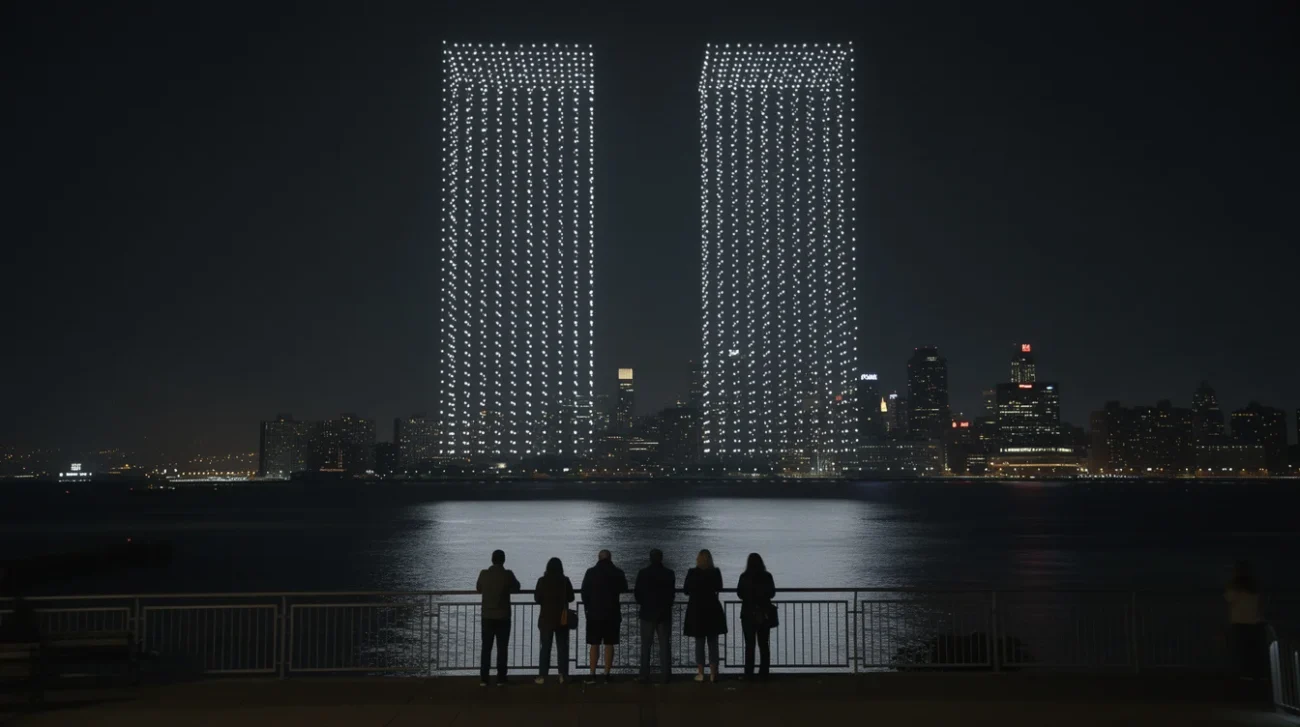

Immersion Beyond Pixels in Exhibition Design
PRO: The best immersive exhibitions don’t simulate reality; they choreograph belief
For a decade, “immersive” has been the laziest word in exhibition culture: a marketing solvent sprayed over expensive projections, mirror rooms and vaguely spiritual soundtracks. Too many shows mistake sensory saturation for intelligence. They give you moving images, then ask you to confuse motion with meaning. The result is a trade in visual adrenaline that burns bright, sells hard and is forgotten before you have finished your train ride home.
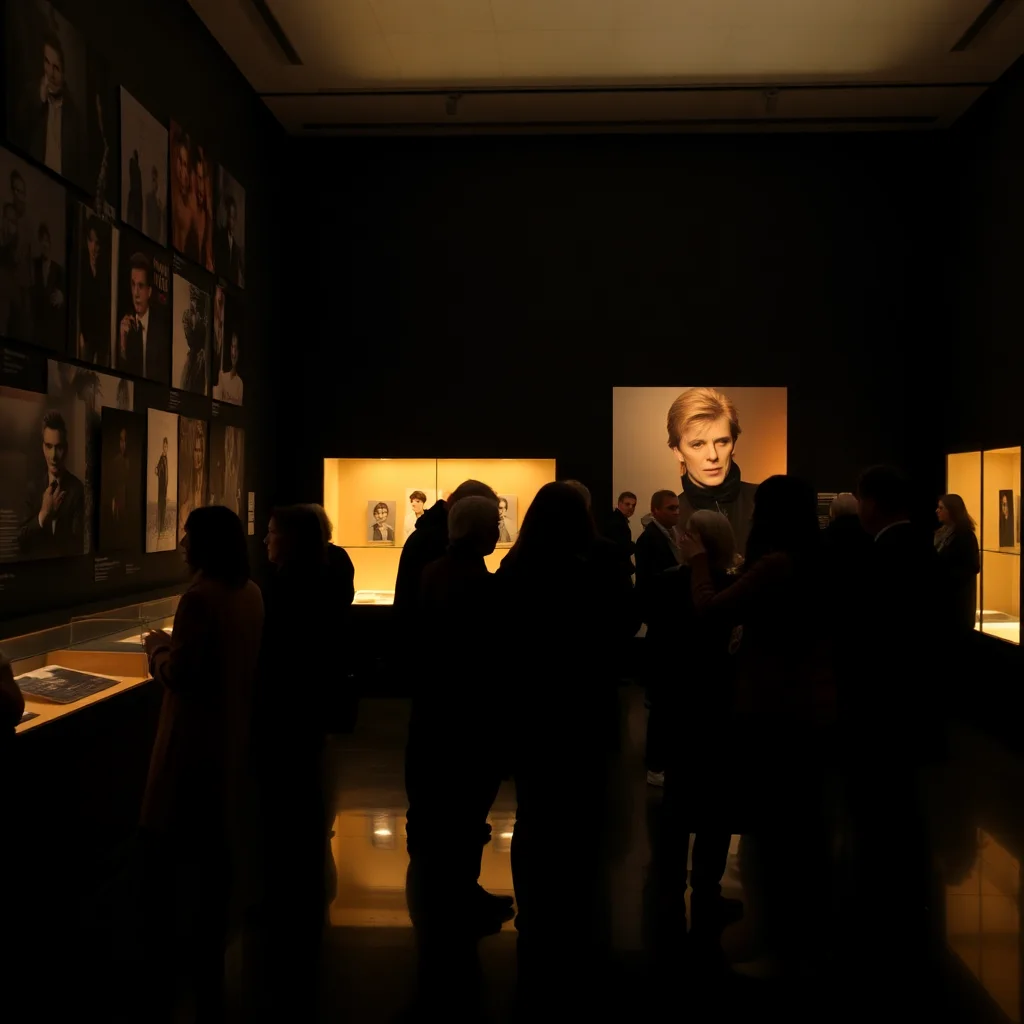
The London David Bowie exhibition, You’re Not Alone, points to a better model. Its force is not that it overwhelms visitors with digital spectacle for its own sake, but that it uses immersion as a curator’s tool: atmosphere first, then narrative, then memory. That distinction matters. The most persuasive rooms in an exhibition are not the ones that shout the loudest; they are the ones that make the body slow down, orient itself and start to read space as story. Bowie, a figure who built entire identities out of pose, sound, light and performance, is the perfect subject for this shift. His world was never just visual. It was staged presence.
That logic also helps explain why so many contemporary shows borrow from ambient labyrinth festivals and other spatial spectacles: the most memorable environments are often those that turn movement itself into part of the narrative. When the room is composed well, the visitor does not merely look; they navigate, anticipate and remember through the body.
The old gimmick economy is collapsing under its own emptiness

We know the template by now. A show borrows the language of art but behaves like event production: wall-to-wall projections, algorithmic light washes, a thudding playlist, and enough “experience design” to make the ticket price feel justified. The problem is not technology. It is the absence of curatorial nerve. In the hands of weak teams, digital media becomes a decorative proxy for content, a cheap way to avoid doing the harder work of selection, sequencing and spatial dramaturgy.
That is why some immersive exhibitions feel weirdly disposable. They are engineered for the social post, not for the mind. They treat the audience as content carriers rather than witnesses. And because the novelty is so obviously front-loaded, the emotional afterlife is thin. You remember the queue, the lighting cue, the selfie. You do not remember an argument.
This is where the Bowie show lands differently. If the staging works, it is because the exhibition understands that immersion should deepen an archive rather than distract from it. Bowie’s career already contains a built-in lesson for curators: image is not decoration, it is infrastructure. His personas, from Ziggy Stardust onward, were never merely costumes; they were systems of meaning. A serious exhibition should not wallpaper that history with digital confetti. It should build a spatial rhythm that allows visitors to feel the pressure of reinvention.
CONTRA: Spectacle alone is a trap, and “immersive” has become a lazy substitute for curating
The strongest criticism of immersive shows is that they often smuggle in a false promise of access. The pitch suggests proximity to genius, but what you usually get is a mediated haze. Instead of encountering objects, manuscripts, garments or ephemera, visitors are encouraged to float inside a branded mood. The work is flattened into atmosphere, and atmosphere is sold back as revelation.
This matters because exhibitions are not only entertainment; they are forms of public interpretation. A good show can teach you how to look, what to compare, where to pause. When digital effects dominate, those interpretive tasks are outsourced to software. The visitor is no longer invited to think through material evidence. They are bathed in it.
Design history has already shown the cost of this mistake. The most memorable exhibition environments—from the disciplined theatricality of many museum retrospectives to the sharp spatial sequencing seen in architectural biennales—do not rely on novelty for their authority. They rely on control. Even when they use video, projection or interactive media, those elements are subordinate to a larger spatial argument. The point is not “look what technology can do”; the point is “look how space changes what you know.”
That is why the Bowie retrospective is interesting as a cultural event, not merely a fan attraction. Bowie himself understood that modern audiences are not won through volume alone. They are won through framing. A glance, a cut, a silhouette, a shift in costume, a stage distance: these are all curatorial acts. The exhibition succeeds only if it respects that intelligence and avoids the clumsy assumption that more pixels equal more presence.
PRO: Bowie proves that immersion works when it is architectural, not decorative
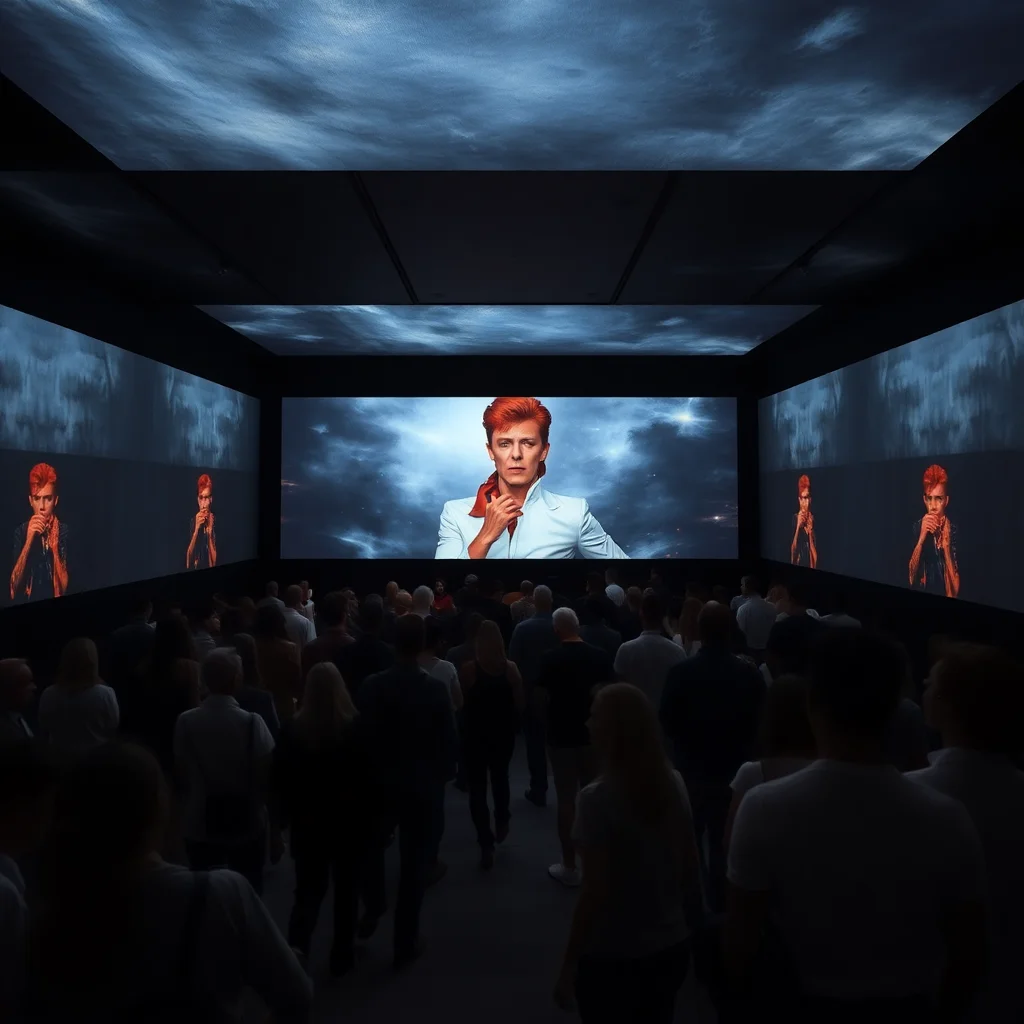
The difference between empty immersion and meaningful immersion is often architectural rather than technological. A room can stage an idea. Circulation can build suspense. Light can make chronology feel unstable. Sound can create thresholds instead of wallpaper. These are not gimmicks; they are narrative instruments. In the best exhibitions, visitors do not simply “consume content.” They move through a composed sequence of moods, each one sharpening the next.
That is the promise the Bowie exhibition seems to keep. A retrospective on an artist like Bowie should not feel like a linear biography with captions. It should feel like entering a mind that kept changing its own rules. That means handling transitions carefully. The early rooms might foreground experimentation and collision; later spaces can broaden into myth, celebrity and fragmentation. The visitor should sense that the exhibition is not trying to explain Bowie once and for all. It is trying to preserve the instability that made him culturally magnetic.
There are precedents for this kind of curatorial intelligence. Think of exhibitions that use darkness, compression, acoustics and selective reveal to create a bodily reading of material. Think of museum installations where a single object, lit and isolated properly, has more power than a dozen screens. Think of fashion exhibitions that understand silhouette as spatial event. In all these cases, immersion is not a gimmick layered on top of curating; it is the way curating becomes physical.
That same concern with form and framing can be seen in reimagined Bauhaus silhouettes, where historical reference is not copied but reworked into a new visual grammar. The lesson is similar: structure matters more than surface, and the strongest contemporary displays are those that let form carry meaning.
This matters to architecture and design culture because the contemporary audience has become fluent in environments. We live in lobbies, feeds, branded interiors and algorithmic surfaces. A weak exhibition competes by exaggerating that language until it turns cartoonish. A strong one does the opposite: it gives you a controlled environment in which attention can recover its depth. That is not anti-tech. It is pro-meaning.
CONTRA: The danger is that museums will copy the effect without copying the discipline
Success is always dangerous in culture. Once a show proves that atmosphere sells, institutions start imitating the vibe while ignoring the rigor. The market quickly learns how to counterfeit seriousness. Suddenly every exhibition wants a “journey,” every gallery a soundtrack, every object a projection partner. What begins as a corrective becomes another formula.
That is the real risk of the Bowie moment. It may encourage curators and producers to believe that immersive design itself is the answer, when in fact the answer is editorial judgment. The technology can be brilliant, but only if it is in service of evidence, pacing and argument. Otherwise, the museum becomes a theme park with better typography.
There is also a class problem buried in all this. Immersive events often charge premium prices while offering an experience that privileges theatrical consumption over scholarship. They are built to be admired quickly, photographed compulsively and consumed as lifestyle proof. That makes them culturally slippery. The more they talk about accessibility and inclusion, the more they can behave like luxury entertainment for audiences already comfortable with cultural branding.
Bowie’s exhibition avoids this trap only if it resists flattening his work into a mood-board of eras. The artist was not a set of stylish surfaces. He was an operator of symbols, a student of pop circulation and a tactician of reinvention. Any show about him that leans too hard on digital wow-factor will miss the point. Presence is earned through context, not generated by software.
Why the future belongs to curatorial intelligence, not just technical ambition
The smartest exhibitions of the next decade will likely be hybrids: part archive, part stage set, part spatial essay. But the key word is still essay. The exhibition must argue. It must choose what to reveal and what to withhold. It must use technology as one register among many, not as a substitute for authorship.
This is where the Bowie retrospective becomes more than a one-off hit. It models a cultural correction. After years of immersive excess, audiences are beginning to recognize the difference between being dazzled and being moved. Dazzle is temporary. Moved is durable. Dazzle lives on your phone; moved lives in your memory and in the stories you tell later.
For art and design events, that distinction is decisive. The future will not belong to the brightest screen or the largest projection wall. It will belong to the exhibitions that understand that space itself can think. Those that can stage presence, not just pixels, will build credibility because they respect their subjects, their audiences and the intelligence of the room.
Immersion is not the problem. Bad immersion is the problem. The Bowie exhibition suggests that when curators trust atmosphere, sequencing and embodied attention, they can produce something far more powerful than novelty: an experience that lingers because it was never just trying to impress you.
FAQ
What makes an exhibition immersive without being gimmicky?
It uses space, light, sound and pacing to support an argument or narrative, rather than using them as decorative effects. Immersion works best when visitors feel guided through meaning, not trapped inside a novelty machine.
Why is the Bowie exhibition being discussed as a model?
Because Bowie’s career was already about constructed identities, atmosphere and performance. A strong retrospective can translate that into spatial storytelling instead of relying on projection-heavy spectacle.
Are digital tools a bad thing in exhibitions?
No. Digital tools are useful when they clarify context, animate archives or create emotional rhythm. They become a problem when they replace curatorial judgment and reduce the exhibition to an audiovisual stunt.
What should institutions learn from the success of immersive shows?
They should learn that audiences want bodily, memorable experiences—but not at the expense of substance. The real lesson is to invest in sequencing, interpretation and atmosphere, not just technical production.
- PRO: Immersion can intensify interpretation when it is built from curatorial intelligence, not digital noise.
- CONTRA: Spectacle easily becomes a shortcut that flattens art into mood and merchandise.
- PRO: Bowie demonstrates that presence, like performance, is staged through rhythm and context.
- CONTRA: The industry risks copying the aesthetic of depth without doing the intellectual work.
- PRO: The most durable exhibitions are remembered in the body, not just on a phone screen.
Get the Mainifesto weekly — curated design debates, speculative ideas and the week's best articles every Saturday.
Editorial Perspectives
Questions and counterpoints developed by the Mainifesto editorial desk to extend the discussion.
Perspective 1
Yes — if the room doesn’t hold your body, your attention, and a little silence, I’m not sure “immersion” is the right word. Digital spectacle can be part of the palette, but the real work is in light, pacing, texture, and the way a visitor feels moved through space.
Perspective 2
I’d stop using “immersion” as a marketing shortcut for screens and projections. Those setups often bring high energy use, short lifespans, and a lot of waste for a feeling that could be made more convincingly with material, sound, and narrative restraint.
Perspective 3
I’d retire the word when it’s being used to dress up a tech demo, because audiences can tell the difference. What matters is whether people stay longer, remember more, and talk about the experience afterward — if pixels do that, fine, but the label should earn its keep.