
Can a Bathroom Become a Precision Object?
The bathroom is no longer a soft room
For decades, the bathroom was treated as architecture’s most forgiving interior: a room of tolerances, trims, and practical compromises disguised by tiles and chrome. That era is ending. Today, the bathroom is being redesigned as a precision bathroom—an object whose seams, slopes, material junctions, and spatial logic are expected to perform with the rigor of industrial design and the intelligence of architecture. What once read as a private domestic afterthought is becoming the place where the discipline of the whole building is tested.
This shift is not about polishing the surface until it gleams. It is about engineering a room so exact that comfort is achieved through control: ultra-flat basins, flush thresholds, hidden drainage, monolithic shower volumes, and fittings that seem to disappear into the wall. The bathroom has become a field for obsessive detailing because the demands are unforgiving. Water is relentless, humidity is corrosive, and human use is messy. In that pressure cooker, precision is not a stylistic preference; it is survival.
Look at the direction of contemporary product design. Agape’s work with Benedini Associati has long framed bathroom fixtures as sculptural and architectural rather than merely sanitary. Duravit’s collaborations with designers such as Philippe Starck and, more recently, industrially minded series like the ME by Starck and Luv collections, push toward thinner profiles and cleaner integration. Antoniolupi has made an entire identity out of seamlessness, from minimalist washbasins to wall-spanning systems that turn the room into a composed surface. The message is clear: the bathroom is leaving behind decoration and moving toward calibrated form.
Precision begins where water meets geometry
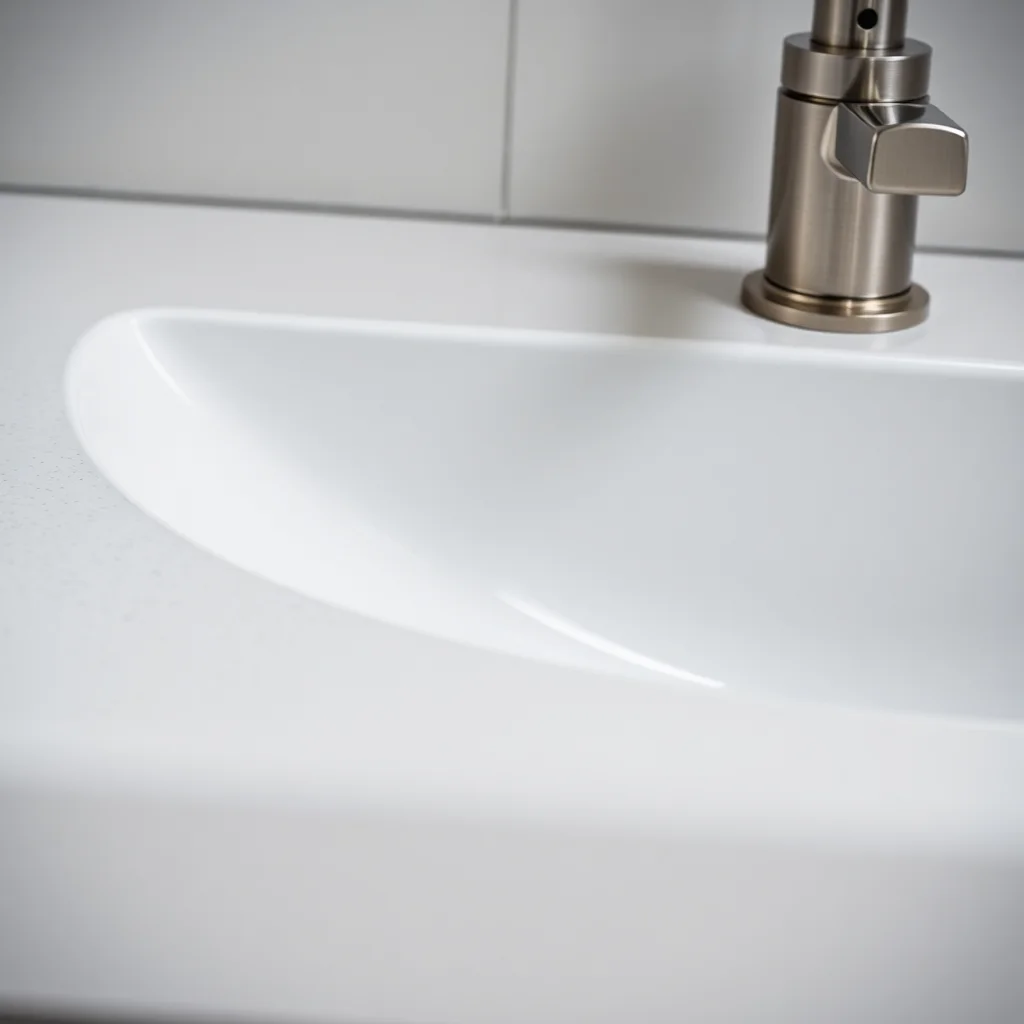
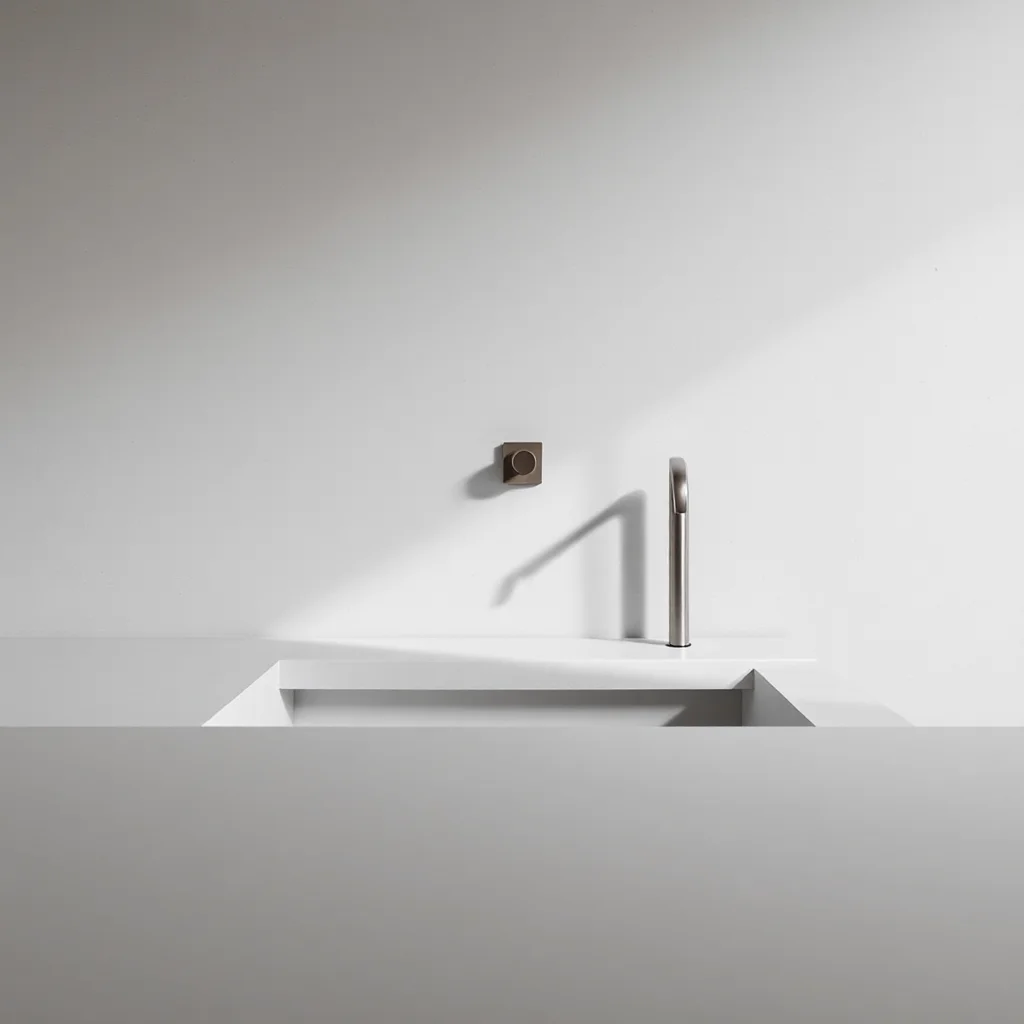
The great revelation of contemporary bathroom design is that the room is not really about objects at all; it is about geometry under pressure. A sink is not successful because it looks elegant in a photograph, but because its basin depth, edge thickness, splash behavior, and tactile legibility are balanced with almost surgical care. A shower is not memorable because of a moody finish, but because the floor falls imperceptibly to a drain, the enclosure reads as a spatial boundary, and the experience feels frictionless. In this sense, the precision bathroom is closer to a piece of instrumentation than a domestic scene.
This is where engineered systems matter. Linear drains, flush access panels, large-format slabs, and concealed fixings have transformed the room into a layered assembly of technical decisions. Companies like Kaldewei have made enamel steel tubs that feel almost impossibly crisp in section, while Bette has turned steel enamel into a material argument for durability, hygiene, and edge clarity. These are not just products; they are positions on what the bathroom should be. Their exactness resists the old idea that bathrooms must feel lush to feel luxurious. Instead, they suggest that luxury now lies in the absence of visual noise.
The influence of architectural minimalism is obvious, but this is not simply a descendant of white-box aesthetics. The real lineage runs through the precision culture of Swiss and Japanese design, through the furniture-like restraint of Naoto Fukasawa, and through the infrastructural clarity of architects who refuse to separate beauty from construction logic. When a bathroom achieves true precision, it behaves less like a room decorated after the fact and more like a built proposition.
Why architects are using bathrooms as laboratories
Bathrooms have become testing grounds because they compress multiple architectural problems into one small, unforgiving space. They demand waterproofing, acoustics, ventilation, ergonomics, lighting, maintenance access, and sensory calm, all within a tight envelope. That concentration makes them ideal for experimentation. If a designer can make a bathroom rigorous, they can often make a whole building more intelligent.
Consider the impact of prefabrication and modular thinking. In hospitality and housing alike, bathroom pods have advanced the conversation from surface finish to total assembly. When a bathroom arrives as a coordinated unit, every junction matters: the alignment of tile to panel, the tolerances between fixture and enclosure, the performance of membranes hidden behind the finish. Architects from high-end residential studios to large-scale developers increasingly specify these systems because they reduce error and compress construction time. The room becomes a prototype of industrialized building.
Even in bespoke interiors, the same logic is spreading. Floor-to-ceiling stone sheets, resin surfaces, and ultra-thin ceramic panels reduce the visual clutter of grout and trim. GRAFF, VOLA, and Dornbracht have long understood that faucets can read as precise instruments rather than ornamental hardware. Dornbracht’s Tara and IMO families, for example, embody the idea that a tap can be a disciplined line in space, not just a utility. Precision here is not sterile; it is compositional. It lets the eye rest because the room has been resolved.
And yet the deeper reason architects are obsessed is that the bathroom is one of the few domestic spaces where the performance standard is immediately legible. If it leaks, stains, fogs, or traps dirt, the room fails. There is no conceptual cover story powerful enough to save bad detailing. The bathroom punishes sloppy thought, which is exactly why it is now the most honest room in the house.
The cult of flatness is not just aesthetic
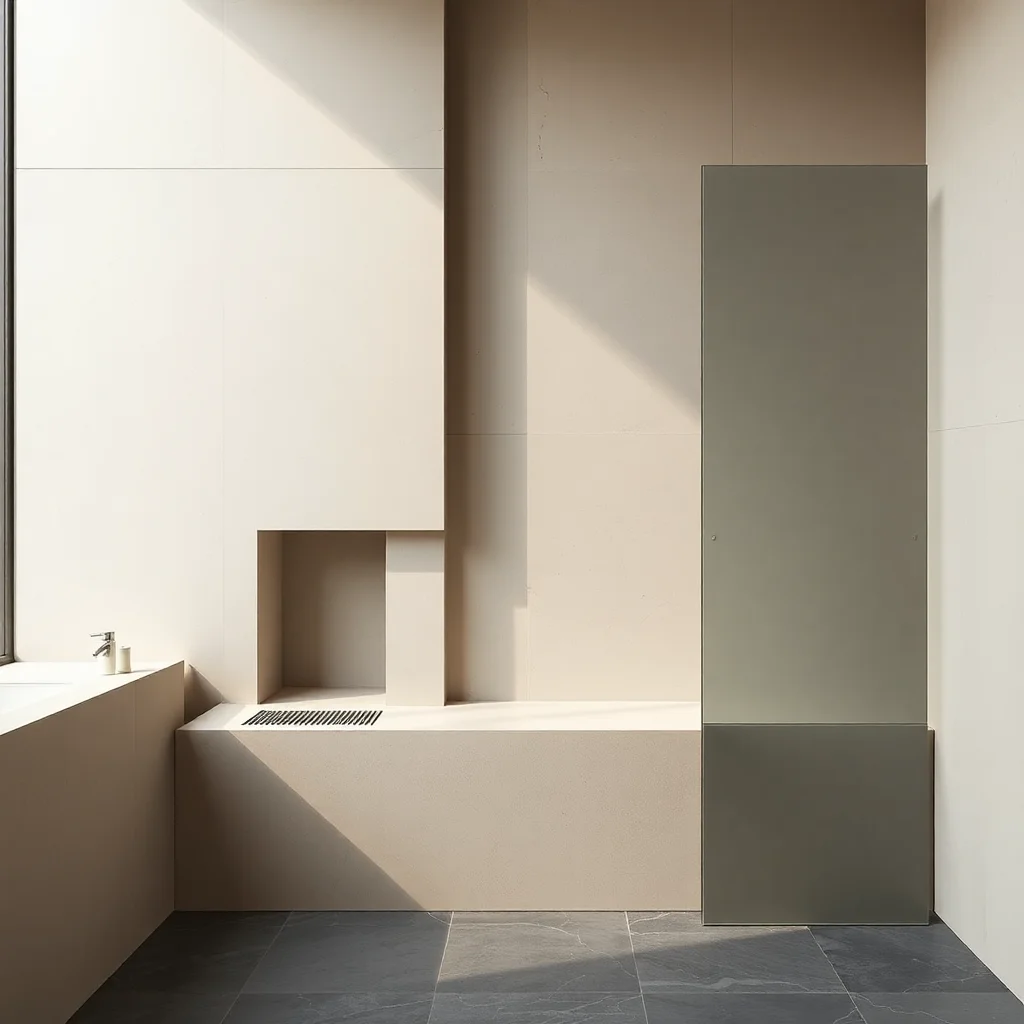
One of the strongest signals of the precision bathroom is the obsession with flatness. Ultra-flat basins, wafer-thin trays, frameless screens, and level transitions promise a world without interruption. But this is not merely a visual trend driven by Instagram-friendly minimalism. Flatness is a technical ethic. It reduces places where grime accumulates, simplifies maintenance, and makes the room read as a single calibrated field rather than a collage of parts.
Rimless toilets, now increasingly standard in premium projects, reflect the same logic: the elimination of hidden edges where residue collects. Large-format porcelain and sintered stone surfaces similarly reduce joints, while microcement and tadelakt-inspired finishes seek a continuous tactile field. The appeal is obvious, but the stakes are higher than aesthetics. Designers are using flatness to create bathrooms that age better, clean faster, and remain visually coherent under everyday wear.
Still, flatness carries a political dimension. It signals control, and control can easily become coldness. The precision bathroom risks becoming an interior of moral rigor, where every object seems to demand disciplined behavior from the user. That is the danger of engineering taken as ideology: when the room becomes too perfect, it can stop feeling hospitable. The best projects avoid this trap by pairing exact detailing with tactile softness—wood accents, warm metals, textured stone, or carefully calibrated light. Precision, at its best, should frame comfort rather than annihilate it.
Think of how Boffi, especially in kitchen and bath crossovers, has advanced the notion of the bathroom as a coherent system rather than a set of isolated objects. Their work proves that minimal seams can still produce emotional weight if the proportions are right and the materials carry enough depth. Precision is not the enemy of atmosphere. It is the condition that allows atmosphere to survive without chaos.
Spatial flexibility is the new status symbol
If the old luxury bathroom was a fixed script—bathtub here, vanity there, shower in the corner—the new one is increasingly adaptable. Spatial flexibility is becoming a marker of sophistication because contemporary living no longer accepts rigid domestic scripts. The bathroom must accommodate routines, aging, guests, wellness rituals, and changing household structures. Precision, paradoxically, is what makes flexibility possible.
Architects are responding with layouts that can shift emphasis rather than function. A wet-room model, for instance, allows bathing, showering, and cleaning to occupy one continuous waterproofed volume, freeing the plan from rigid partitions. In smaller apartments, integrated storage walls and sliding panels turn the bathroom into a spatial system rather than a locked container. In larger homes, double basins, bench-like ledges, and concealed laundry functions make the room behave more like a service landscape.
This flexibility is especially visible in high-end European and Japanese interiors, where the distinction between furniture, architecture, and infrastructure is deliberately blurred. In Japan, the bathtub has long been treated as a site of ritual precision, a place where bodily care is structured by exacting sequences. Contemporary Western designers are absorbing that lesson and translating it into rooms that are less about display and more about calibration. The bathroom becomes not a scene to be seen, but a system to be used.
That shift matters because it changes who the room is for. The precision bathroom does not simply flatter the owner’s taste; it acknowledges multiple modes of inhabitation. It is designed for routine and change, not for one frozen image of domestic perfection. In that sense, precision is the enemy of nostalgia and the ally of real life.
Can precision still feel human?
This is the central question, and it is where the argument gets sharp. The more bathrooms become engineered objects, the more they risk becoming emotionally indifferent. A room that is too exact can feel like a laboratory, a hotel, or a showroom—inhabited but not lived in. The challenge is not to abandon precision, but to prevent it from flattening the room’s sensuality.
Some of the most compelling bathrooms today solve this by allowing one element to break the grid. A stone basin with visible veining. A brass fitting that will patinate over time. A timber vanity that absorbs warmth into an otherwise mineral room. Even the great minimalist firms understand this. The room needs one or two moments of resistance, because total control can become theatrical in the worst way. What makes precision persuasive is not perfection, but proportion.
That is why the bathroom’s future will not be defined by maximal technology alone. It will be defined by design intelligence: by whether the room can combine exacting assembly with sensory intelligence, maintenance logic with emotional range, and standardization with specificity. The finest bathrooms will not announce themselves through luxury cues. They will reveal themselves through how effortlessly they work, how quietly they endure, and how little they ask of the user beyond trust.
So yes, a bathroom can become a precision object. But if it becomes only that, it will have missed the point. The real achievement is to make precision feel inevitable rather than oppressive, to let engineering disappear into experience. That is the new frontier of interior design: not decoration, not even comfort, but calibrated living.
FAQ
What makes a bathroom a “precision object”? A precision bathroom is defined by exact tolerances, seamless material transitions, efficient maintenance, and spatial clarity. It behaves like a carefully engineered system where performance and appearance are inseparable.
Are minimalist bathrooms always more precise? No. Minimalism can be merely visual, while precision depends on construction quality, drainage logic, durability, and ergonomic detail. A visually stripped bathroom can still be technically sloppy.
Which materials best support precision bathroom design? Large-format porcelain, sintered stone, enamel steel, microcement, and high-performance composites are common because they reduce joints and improve durability. But material choice must always align with detailing and maintenance strategy.
Does precision make bathrooms less comfortable? Not necessarily. When handled well, precision removes friction and makes the room easier to use. It becomes a problem only when control replaces tactility, warmth, and human scale.
So what kind of room should the bathroom become?
The bathroom is no longer content to be a private utility wrapped in pretty finishes. It is becoming architecture at its most compressed, where precision, material intelligence, and spatial adaptability are no longer optional extras but the core of the design argument. The question is whether designers will use that rigor to deepen daily life—or to sterilize it.
Can the most exacting room in the house also be the most generous?
Get the Mainifesto weekly — curated design debates, speculative ideas and the week's best articles every Saturday.
Editorial Perspectives
Questions and counterpoints developed by the Mainifesto editorial desk to extend the discussion.
Perspective 1
A bathroom can absolutely become a precision object, but only if the detailing is driven by use, not just by a desire for neatness. The generous part comes from good proportions, clear circulation, and materials that age well — precision should make the room easier to inhabit, not more brittle.
Perspective 2
I buy the case for better-engineered bathrooms, because failures here are expensive and very visible. But once you start layering in bespoke systems and exotic finishes, the question is whether that precision survives the maintenance bill.
Perspective 3
The most exacting bathroom is only worth it if a guest feels instantly oriented and comfortable. Precision works when it disappears into the experience — good lighting, storage, acoustics, and surfaces that hold up under constant use.