
Can the Aeron Stay Iconic in Hybrid Work?

PRO: The icon survives by changing, not by fossilising
The updated Aeron is not a betrayal of the original; it is proof that an icon can still participate in culture rather than merely haunt it. Herman Miller has taken the chair that became shorthand for the corporate knowledge economy and given it what the present demands: fresher colourways, greener materials, and a more inclusive sizing system. That is not cosmetic housekeeping. It is a rare instance of a legacy product refusing the museum treatment and insisting on relevance in the hybrid era, where the office is no longer a fixed place but a negotiated condition between home, studio, and networked workspace.
The Aeron has always been more than an ergonomic device. When Bill Stumpf and Don Chadwick introduced it in the 1990s, they helped define what a serious office object looked like at the height of design’s fascination with performance, transparency, and systems thinking. The Pellicle suspension, the sculpted frame, the disciplined refusal of upholstery: these were not just features, they were a visual argument that the modern workplace should be engineered rather than upholstered in the language of comfort. In that sense, the chair already operated as culture—an emblem of a managerial worldview, of consultancies, start-ups, architecture firms, and the controlled ambition of late-20th-century capitalism.
But culture does not stay still, and neither should the object that once embodied it. In the age of hybrid work, the chair is asked to do something the 1990s office never anticipated: to function in domestic interiors, shared studios, flexible desks, and video-call backdrops where work must coexist with ordinary life. A product that was once optimized for a single institutional environment now has to cross thresholds. If the Aeron remains recognisable while incorporating less extractive materials and more body types, it does what the best design has always done—adapt without surrendering its identity.
The case for quiet reinvention is stronger than nostalgia
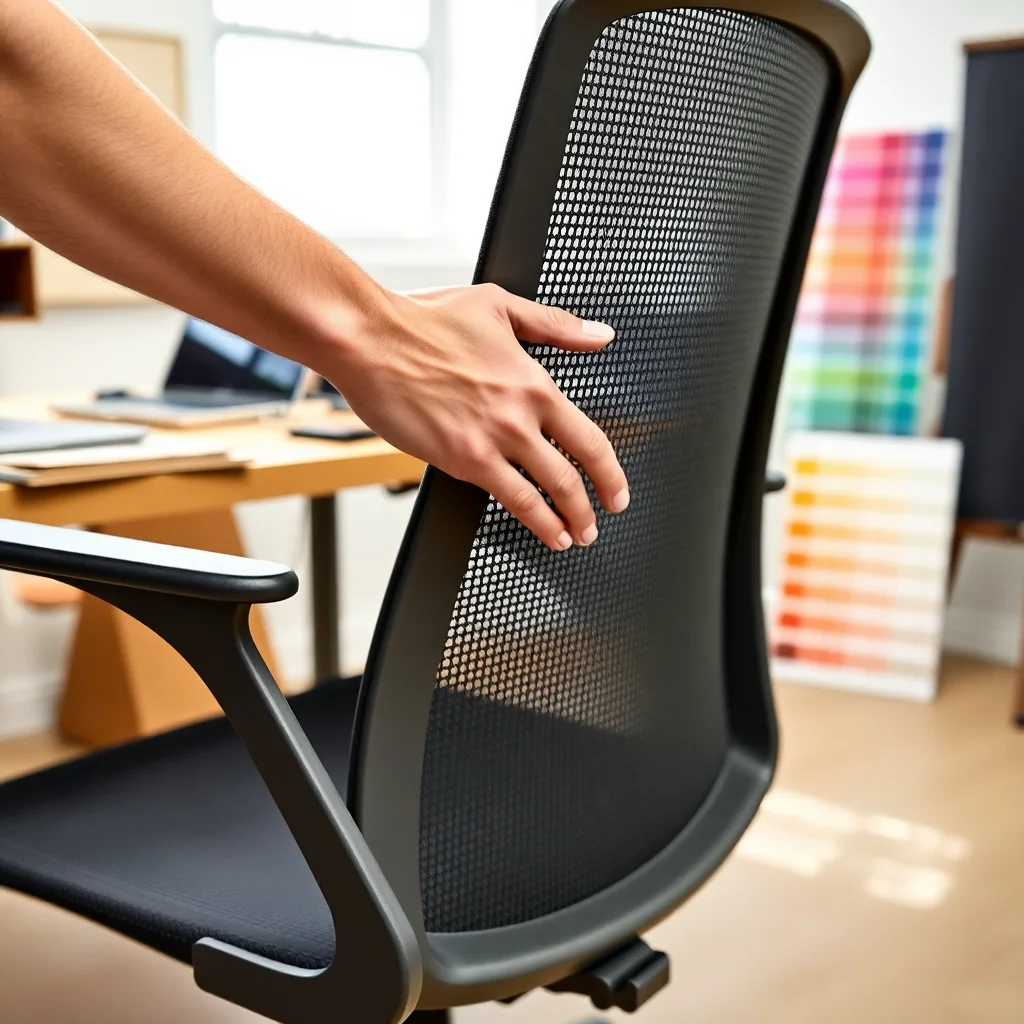
There is a seductive but lazy argument that every iconic object should be left untouched, as if time itself were a design credential. That logic is sentimental, not serious. Furniture made for a mass market cannot be preserved as a relic of a heroic moment and still claim ethical authority in the present. Inclusive sizing matters because bodies are not abstract. Greener materials matter because the office, once a symbol of progress, now carries the environmental debts of decades of fit-outs, relocations, and disposability. If the Aeron was once a sign of sophistication, its updated version must also be a sign of accountability.
Design history gives us plenty of examples of products that became more culturally resilient by evolving rather than freezing. Think of the Eames Shell Chair, endlessly adapted across base options and finishes without losing its underlying logic, or Arne Jacobsen’s 7 Chair, whose ubiquity became an argument for versatility rather than decline. Even contemporary office systems such as Vitra’s Figura or Steelcase’s ongoing ergonomic platforms have shown that refinement can be a form of authorship. The point is not novelty for its own sake. The point is to keep the object aligned with the conditions that justify its existence.
This is where the Aeron’s update is more intelligent than a superficial “refresh.” New colours are not merely mood management for architects and procurement departments; they signal a shift away from the black-and-grey monoculture of the old office and toward a world in which work is distributed across domestic, civic, and improvised settings. Greener materials, similarly, are not a marketing garnish. They acknowledge that the iconic office chair now has to answer questions about lifecycle, sourcing, and circularity that did not carry the same urgency in the era when the open-plan office was still sold as an unqualified future.
And inclusivity is not an optional social layer. In ergonomic design, one size has always meant one body, and one body has usually meant the body of power. A chair with broader size options is a small but telling correction to the exclusions embedded in modern office culture. It says the chair should serve more than the default worker—more than the tall male executive silhouette that haunted so much 20th-century workplace design.
CONTRA: Every update risks blunting the force that made it iconic
Yet the opposite argument is not sentimental either; it is a warning about dilution. Icons derive authority from clarity, from the sense that every line and material choice has become inevitable through repetition and collective recognition. The Aeron is powerful because it is instantly legible. It is the rare office chair that crossed from procurement catalogues into broader cultural memory, appearing in design magazines, architecture studios, startup offices, and the visual shorthand of power. Change too much, and the object risks becoming merely another “premium ergonomic chair,” which is the corporate design equivalent of a band reissuing its classic album with unnecessary remixes.
This fear is especially acute because the Aeron’s original identity was so precise. Stumpf and Chadwick did not design it to blend in; they designed it to articulate a specific moment in American product design when technical honesty, material innovation, and institutional ambition converged. The chair’s fame was built on its refusal to mimic domestic furniture. It looked like the office of the future, not the living room of the present. If every update is framed as improvement, the original radicality can be softened into generic comfort language—the very thing the Aeron once resisted.
There is also a larger cultural issue. When heritage products are constantly updated, they can become brands of perpetual reassurance, forever repositioned to match contemporary values without ever being allowed to age honestly. This is the logic of luxury fashion capsules and heritage car models: keep the silhouette, soften the edges, add sustainability language, preserve the aura. The danger is that design’s most meaningful objects become managed identities rather than artifacts with a point of view. The Aeron should not be forced into a bland consensus where every historical edge is smoothed for market comfort.
Consider what happens when design museums and manufacturers collaborate too neatly. A product can become canonised so thoroughly that innovation is treated as vandalism, but the reverse is equally true: endless tasteful updates can empty a design of its original voltage. The chair then becomes a neutral asset, a line item with better ethics, not a cultural object with friction. That would be a loss. The office chair is not supposed to be innocent. It is supposed to reveal something about work, power, and the body’s accommodation to systems larger than itself.
For that reason, the debate around the Aeron sits alongside broader conversations about why iconic objects still rule design culture, even when their forms are endlessly copied and reissued. The chair’s authority depends on that fragile balance between familiarity and surprise.
The real question is not whether to update, but how visibly

The sharpest position is therefore neither preservation nor reinvention, but discipline. Legacy objects should evolve, but they should not pretend that evolution erases history. The updated Aeron works best when it is read as a modernisation of function and responsibility rather than a reinvention of its soul. That means keeping the chair’s recognisable structural intelligence intact while making the ethical and ergonomic corrections that the present demands. The changes should feel consequential, not theatrical.
This is where product design becomes cultural criticism. A chair can either accept the premise that the hybrid workplace has transformed the meaning of comfort, inclusion, and material responsibility—or it can cling to the mythology of the office as an unchanged machine. Herman Miller has chosen the former, and that choice deserves credit precisely because it is not flashy. It accepts that design authority in 2026 comes not from heroic discontinuity but from the ability to update a canonical object without turning it into a trend piece.
Still, the update should not be sold as if it resolves the tension. It doesn’t. The Aeron remains iconic because it carries the memory of a specific workplace ideology, and that memory is part of its power. But icons survive by allowing new meanings to accumulate without fully overwriting the old ones. In that sense, the revised Aeron is less a new chair than a test case: can a workhorse object remain culturally charged while becoming more humane, more responsible, and more adaptable? If the answer is yes, then quiet reinvention is not compromise. It is the only way legacy design stays alive.
That same logic applies to the question of material value more broadly, especially in a moment when people are asking whether recycled materials can become luxury again without losing their ethical meaning. The Aeron’s greener construction makes that tension tangible rather than abstract.
What the Aeron teaches us about office culture now
The deeper lesson is that the office chair has not become less important in hybrid work; it has become more politically loaded. When work is dispersed, the chair enters the home and carries the office with it. It becomes a domestic intrusion and a personal infrastructure at once. That makes its design decisions more visible and more consequential. A greener foam, a revised frame, a broader size range: these are no longer backstage details. They shape the daily politics of who gets supported, who gets seen, and whose labour is anticipated by design.
So yes, the Aeron can still be a cultural object—but only if we stop imagining culture as fixed aura. Culture is negotiation. Culture is the argument between legacy and relevance, between a chair that once defined the office and a chair that must now move across multiple kinds of work. The Aeron’s update matters because it refuses to let the icon become a fossil. But it also reminds us that reinvention is never innocent. Every improvement changes the story the object tells about power, class, and the body.
In that sense, it belongs to the same design conversation as when waste becomes luxury material, where the challenge is not simply to recycle form, but to rebuild value without erasing the evidence of how that value was made.
In the end, the strongest design objects are the ones that can absorb a new era without pretending the old one never happened.
FAQ
Why is the Aeron chair considered a cultural object?
Because it moved beyond office furniture to become a visual symbol of corporate modernity, design literacy, and the knowledge economy. Its silhouette became instantly recognisable in studios, startups, and architecture offices.
What changed in the updated Aeron?
The updated version introduces new colours, greener materials, and greater size inclusivity. These changes position the chair for the realities of hybrid work and contemporary sustainability expectations.
Does updating an icon weaken its status?
Not necessarily. If the update is disciplined and respectful of the original design logic, it can strengthen the icon by keeping it relevant. The risk comes when updates become so aggressive that they erase the object’s identity.
Why does inclusive sizing matter in office chair design?
Because ergonomic design has often been built around a narrow default body. Broader size options acknowledge that work support should serve more people, not just a historically privileged fit.
Conclusion
The Aeron proves that legacy furniture does not have to choose between reverence and relevance. But the update also exposes a harder truth: every modernisation asks what part of an icon is essential and what part is simply inherited habit. That is a productive discomfort, not a defect.
Get the Mainifesto weekly — curated design debates, speculative ideas and the week's best articles every Saturday.
Editorial Perspectives
Questions and counterpoints developed by the Mainifesto editorial desk to extend the discussion.
Perspective 1
Icons don’t stay iconic by freezing in amber; they survive by absorbing new manufacturing realities without looking apologetic. If the Aeron can reduce material, improve repairability, and still read instantly as the Aeron, that’s evolution, not dilution.
Perspective 2
The problem with “quiet updates” is that they often become corporate camouflage: a fresh sustainability halo wrapped around the same old prestige object. Once an icon starts chasing relevance too visibly, it risks becoming like a museum label rewritten by marketing.
Perspective 3
An object earns authority through accumulated use, not through staying identical forever. If the Aeron changes carefully, the chair can keep its spirit; if it changes for trendiness, it loses the patience that made it worth keeping in the first place.
Perspective 4
Icons should evolve, because sustainability isn’t a stylistic option anymore. A chair that can be lighter, lower-carbon, and easier to service while still carrying its cultural weight is doing the future a favor.
Perspective 5
From a building and procurement point of view, I care less about preserving myth than whether the chair performs, lasts, and makes financial sense over time. If Herman Miller can update the Aeron without wrecking comfort or maintenance, that’s sensible, not sacrilegious.