
The Living Room as a Trap: Domestic Trust on Camera
The Living Room as a Trap: Designing Domestic Trust for the Camera
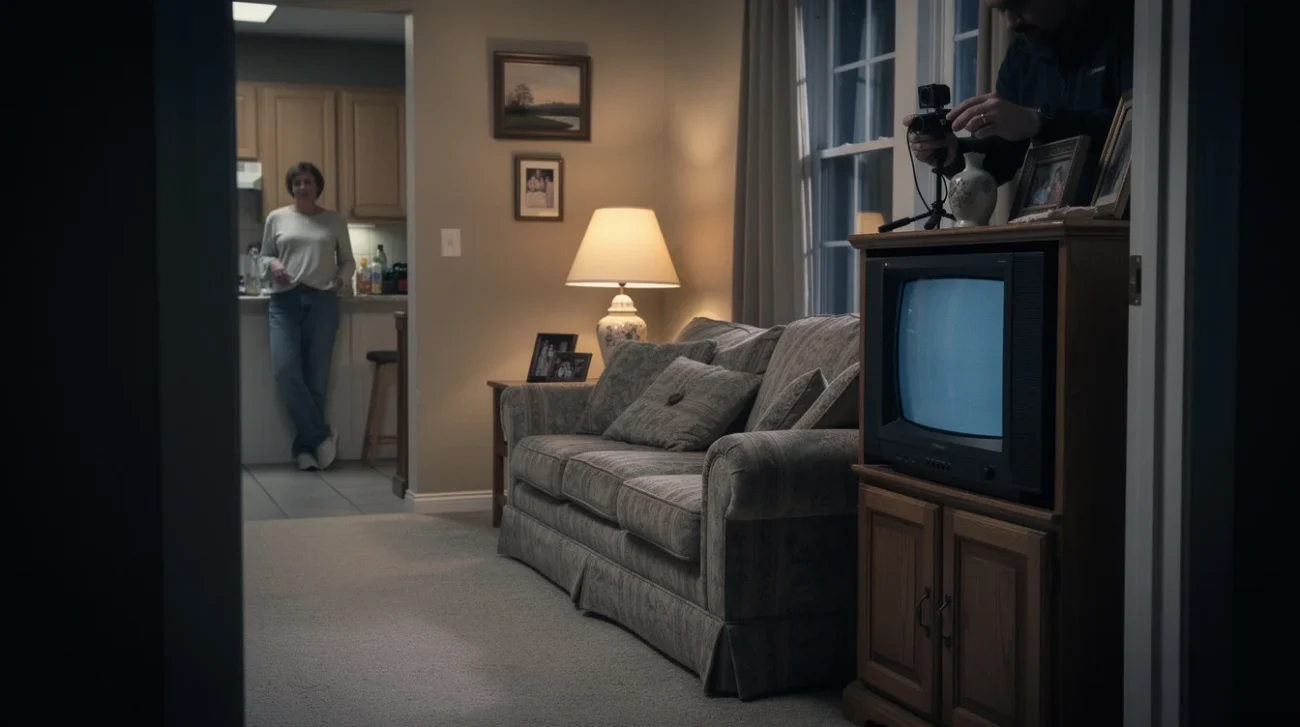
The most effective surveillance room does not look like a surveillance room. It looks like somewhere you can put down your jacket. A sofa establishes a social script; a lamp makes the space feel inhabited; a kitchen counter offers an apparently ordinary place to wait. Domestic trust begins before anyone speaks.
Wallpaper’s account of Primetime, Lance Oppenheim’s thriller starring Robert Pattinson, places production designer Alex DiGerlando’s recreated early-aughts interiors alongside hidden cameras and photographic references. Its subject is the television world associated with presenter Chris Hansen and To Catch a Predator. The important design question is not whether these rooms reproduce a period convincingly. It is whether their familiarity reveals the machinery of televised exposure—or helps that machinery disappear.
PRO: Familiarity Makes the Apparatus Legible
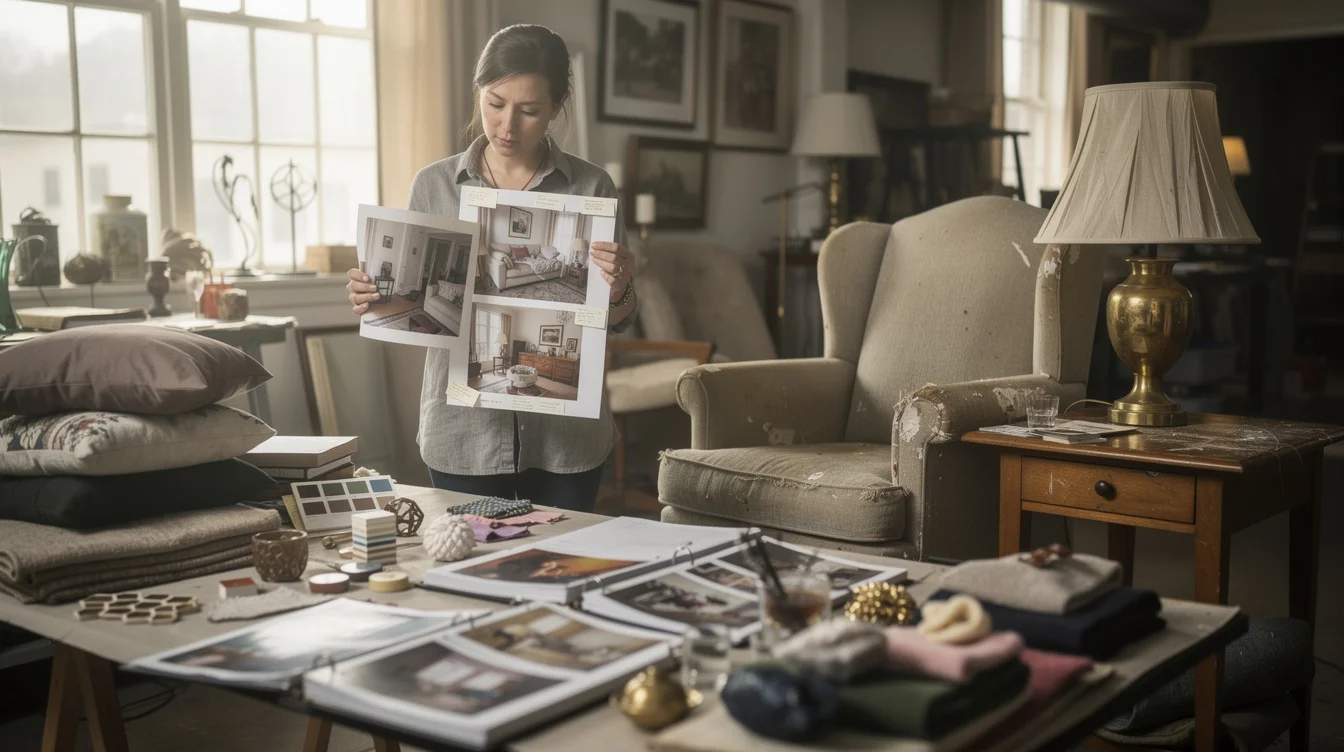
Read generously, this approach to production design dismantles an architectural superstition: that the appearance of home guarantees the conditions of home. Privacy is not a property of upholstery. It depends on who controls access, recording and circulation. A room can retain every recognizable sign of domestic life while operating under the rules of a studio.
The early-aughts setting matters because its visual familiarity can lower our guard. Consider the vocabulary available to such a reconstruction: bulky entertainment furniture, beige carpeting, framed family photographs, layered curtains and a sofa arranged around a television. These are illustrative period possibilities, not an inventory of DiGerlando’s documented set. Their shared function is more important than their individual style: they suggest accumulated use rather than a freshly prepared encounter.
A minimally furnished room invites inspection. A plausibly inhabited room supplies explanations. The cabinet belongs to the television; the framed photograph belongs to a family; the curtain belongs to the window. Each object seems accounted for before its actual role is questioned.
This is where photographic reference can become more than a period checklist. It offers a way to study ordinary arrangements that a designer might otherwise overcompose: furniture bought at different times, awkward gaps, objects without aesthetic justification. Such details suggest a domestic history that a fresh interior cannot simply erase. The useful achievement is not nostalgic accuracy but credible inattention. A room that appears undesigned can be the most tightly directed space in the film.
PRO: The Set Gives Architecture a Dramatic Role
The collision between reassurance and threat also makes spatial organization visible. To an occupant, a sofa offers a seat. To a viewer who knows about the recording apparatus, it can establish a fixed position within a field of observation. A doorway promises ordinary circulation while also determining entrances, exits and the timing of revelation. The same plan supports two incompatible readings.
Alfred Hitchcock’s Rear Window offers a useful precedent, although its surveillance arrangement is different. Its courtyard turns windows into framed performances and makes the spectator’s access inseparable from architectural form. Peter Weir’s The Truman Show takes the problem further: domestic and civic reassurance become the operating surface of a broadcast environment. Neither comparison establishes a direct influence on Primetime. Both clarify the design problem at stake.
DiGerlando’s assignment, as framed by the source, belongs within this productive tension. The room must remain plausible as a room while becoming readable as an apparatus. Too much menace destroys the deception; too much comfort risks making the apparatus invisible to the audience.
The strongest version of this strategy would let ordinary spatial relationships carry the disturbance. A view across a counter, a seat facing an entrance or a passage between rooms can organize suspense without theatrical warning signs. Production design becomes an argument about unequal knowledge. One person understands the setting as hospitality; another understands it as coverage. Viewers are forced to recognize that the difference lies not in the furniture but in access to information.
CONTRA: Exposure Can Become Another Alibi
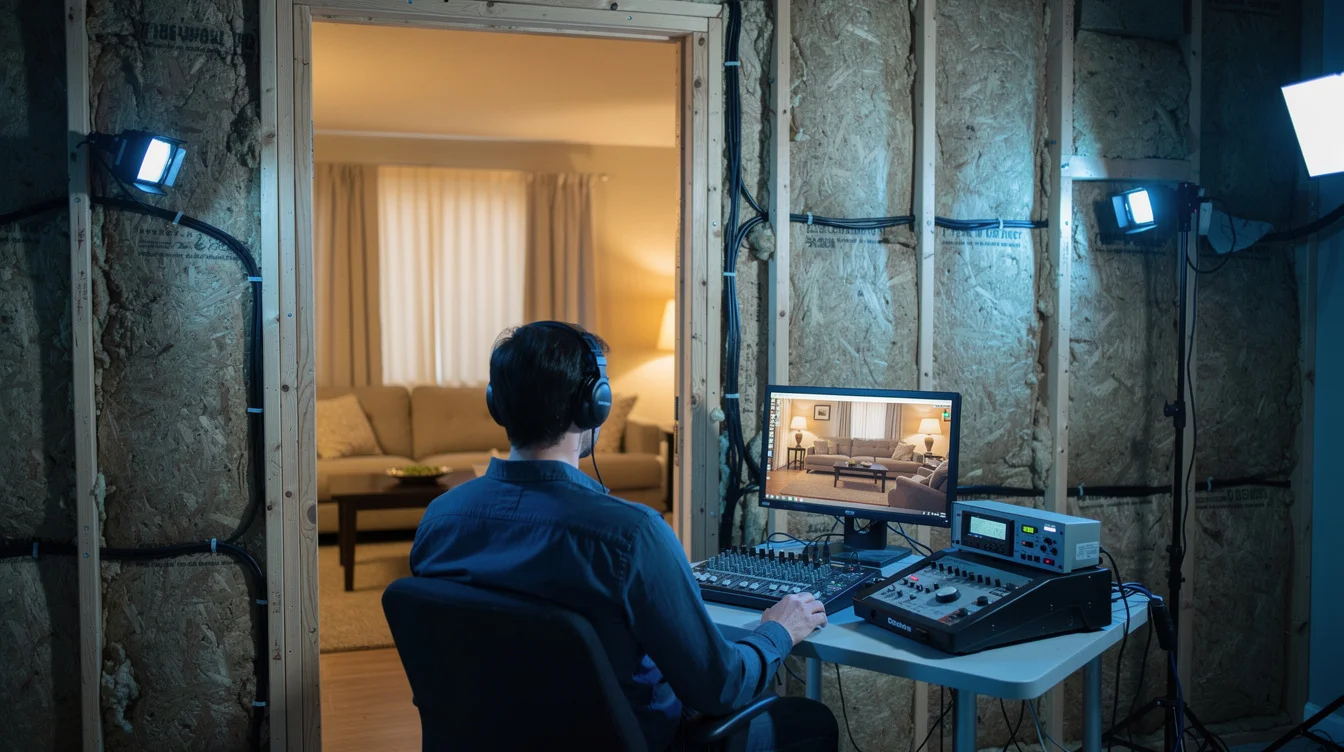
But revealing the mechanism does not necessarily challenge its power. A film can show us that a living room is a trap while still delivering the pleasures of trapping someone. The audience’s superior knowledge can become a reward rather than a problem. We congratulate ourselves for seeing through the domestic fiction while enjoying the asymmetry that makes it work.
This is the ethical weakness of the seductive surveillance set. Every successfully concealed device can become a demonstration of ingenuity. Every reassuring detail can be admired as clever misdirection. The design’s achievement then risks overwhelming the question of who controls the encounter and its subsequent representation. Recognizing manipulation is not the same as refusing it.
Michael Haneke’s Caché offers a sharp counterpoint. Its recordings make the domestic exterior troubling without providing a stable, comfortable position from which to master the act of watching. The image becomes an unresolved demand on the viewer, not simply evidence delivered for consumption. That distinction matters when evaluating any thriller built around exposure.
For Primetime, the critical test is therefore not how convincingly the room hides cameras. It is what the film asks viewers to do with their privileged sight. Does the production design interrupt our confidence in the image, or merely intensify anticipation? A beautifully reconstructed interior can make coercive conditions intelligible. It can also make them irresistibly watchable. Technical disclosure alone is no guarantee of ethical distance.
CONTRA: The Trap Extends Beyond the Furniture
There is another danger in treating the living room as the principal villain: it can localize a system that extends far beyond the set. Recording equipment matters, but so do selection, editing, distribution and the institutional authority attached to an image. The room stages an encounter. It does not determine, by itself, what that encounter will mean once broadcast.
Beatriz Colomina’s Privacy and Publicity provides a useful architectural framework here. Her account places modern architecture in relation to media rather than treating buildings as autonomous objects. From that perspective, a domestic interior is never adequately understood through its plan and furnishings alone. Its representations also participate in its public life.
Dan Graham’s Present Continuous Past(s), with its mirrors and delayed video feedback, makes another relevant distinction tangible: occupying a space and encountering an image of yourself occupying it are different experiences. Surveillance is not simply an extra pair of eyes. It changes the temporal and social conditions under which a room is inhabited.
Contemporary smart doorbells, indoor cameras and voice assistants bring this argument beyond period cinema, though their purposes and consent arrangements vary substantially. A reassuring enclosure can contain outward-facing data relationships. The lesson is not that every connected home is a television sting. It is that domestic privacy cannot be specified as a look. If Primetime’s interiors become merely a recognizable early-aughts aesthetic, their most unsettling implication is lost: familiar surroundings offer no reliable account of where their images will travel.
FAQ: Domestic Trust and the Hidden-Camera Interior
What does domestic trust mean in production design?
It is the expectation of ordinary social behavior produced by familiar domestic cues. Furniture, lighting and signs of habitation suggest how to act, but they cannot guarantee privacy, consent or safety.
Why are early-aughts interiors important to Primetime?
They situate the television world described in Wallpaper’s source account. Critically, period familiarity can make a constructed environment appear unremarkable, allowing viewers to examine how reassurance and concealed recording coexist.
How can one room feel safe to an occupant and threatening to a viewer?
The difference is knowledge. An occupant may read a chair as hospitality, while an informed viewer reads its position as part of a recording setup. The object stays the same; its apparent purpose changes.
What can interior designers learn from hidden-camera sets?
Visual comfort and actual privacy are separate design responsibilities. Where recording systems are present, clear disclosure, meaningful consent and control over captured material matter more than an aesthetic that merely feels protective.
If a room looks like home but answers to a camera, who has the right to define what kind of space it really is?
Get the Mainifesto weekly — curated design debates, speculative ideas and the week's best articles every Saturday.
Editorial Perspectives
Questions and counterpoints developed by the Mainifesto editorial desk to extend the discussion.
Perspective 1
The article gets the mechanism right: familiar furniture lowers people’s guard, and that’s a design outcome, not an accident. In hospitality, we build trust to earn repeat business; if the room is built to capture someone for broadcast, call it a set, not a home.
Perspective 2
I’m not convinced the camera gets to define the room entirely. A low lamp, softened sound, the place someone chooses to sit can still make it feel like home—and the person living that moment has a claim on what the space means, even if the broadcast ignores it.