

Design Exhibition Costs: Who Can Afford Visibility?
When Visibility Costs £900 a Square Metre, Who Gets to Shape Design?
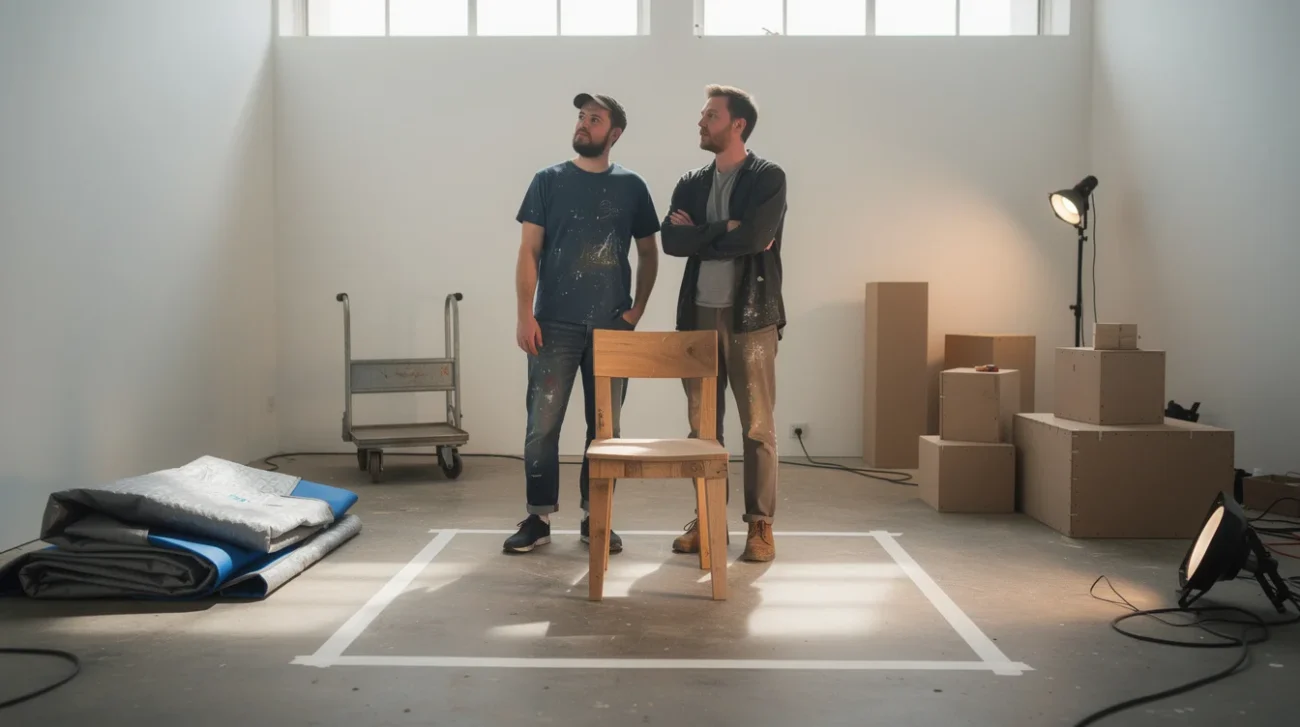
A square metre is barely enough room for a chair and the space to walk around it. Yet for one design collective, that footprint came with a £900 exhibition quote. Before the object could attract a curator, a buyer or an editor, its makers would have to buy their way into view.
In its September 2026 survey of young London design galleries and grassroots platforms, Dezeen reports that Design Everything received the quote to exhibit at an emerging-design show during London Design Festival 2024. The distinction matters: this was a quote from a show taking place during the festival, not evidence of a festival-wide tariff. Nor does the supplied account establish what the fee included.
Nevertheless, the number exposes a structural contradiction. A platform promising to discover emerging talent can simultaneously select for the resources needed to appear there. When purchasing power becomes an entrance criterion, an exhibition is not simply displaying design. It is helping decide who gets to be a designer.
The price tag is also a curatorial decision
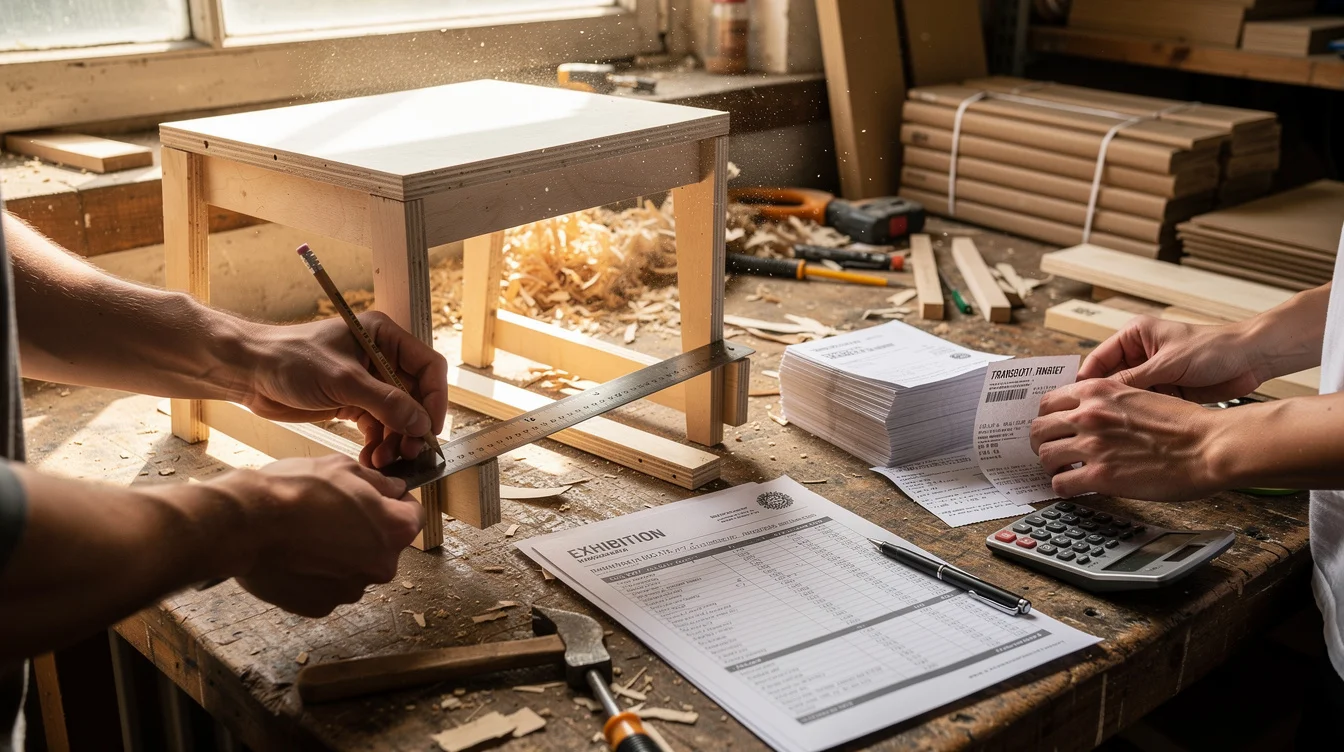
At that quoted rate, four square metres would cost £3,600, assuming a straightforward per-area calculation. That is before any additional expenses not included in the package: fabrication, transport, installation, accommodation or the income lost while staffing a stand. A reasonable-looking footprint can become an unreasonable financial commitment before a single visitor arrives.
Organisers have real costs. London space, technicians, insurance, publicity and front-of-house labour do not materialise through enthusiasm. Charging exhibitors is not automatically exploitation. The problem begins when a commercial transaction is presented as an uncomplicated act of cultural generosity.
Consider two hypothetical applicants: a furniture graduate financing prototypes through hospitality shifts, and a similarly talented graduate with family-funded workshop access. An identical fee treats them equally on paper while giving them radically different opportunities in practice. Instalment plans change the payment schedule; they do not erase that difference.
The consequences reach beyond individual careers. Expensive exhibition space can favour compact, saleable objects over spatial experiments, community projects or work requiring explanation rather than immediate purchase. This is a risk built into the model, not a claim about the unnamed show’s actual selection. A cost structure can perform curatorial work without ever appearing in a curator’s statement.
London needs alternatives, not just smaller gatekeepers
Dezeen’s focus on Design Everything and other young platforms identifies something worth defending: cultural infrastructure need not arrive fully institutionalised. Collectives, temporary exhibitions and small galleries can create opportunities that established fairs overlook. They can also give designers more control over how their work is discussed. The wider question of whether a Pan-African architecture festival can redraw the cultural map offers another lens on how new platforms might shift cultural authority.
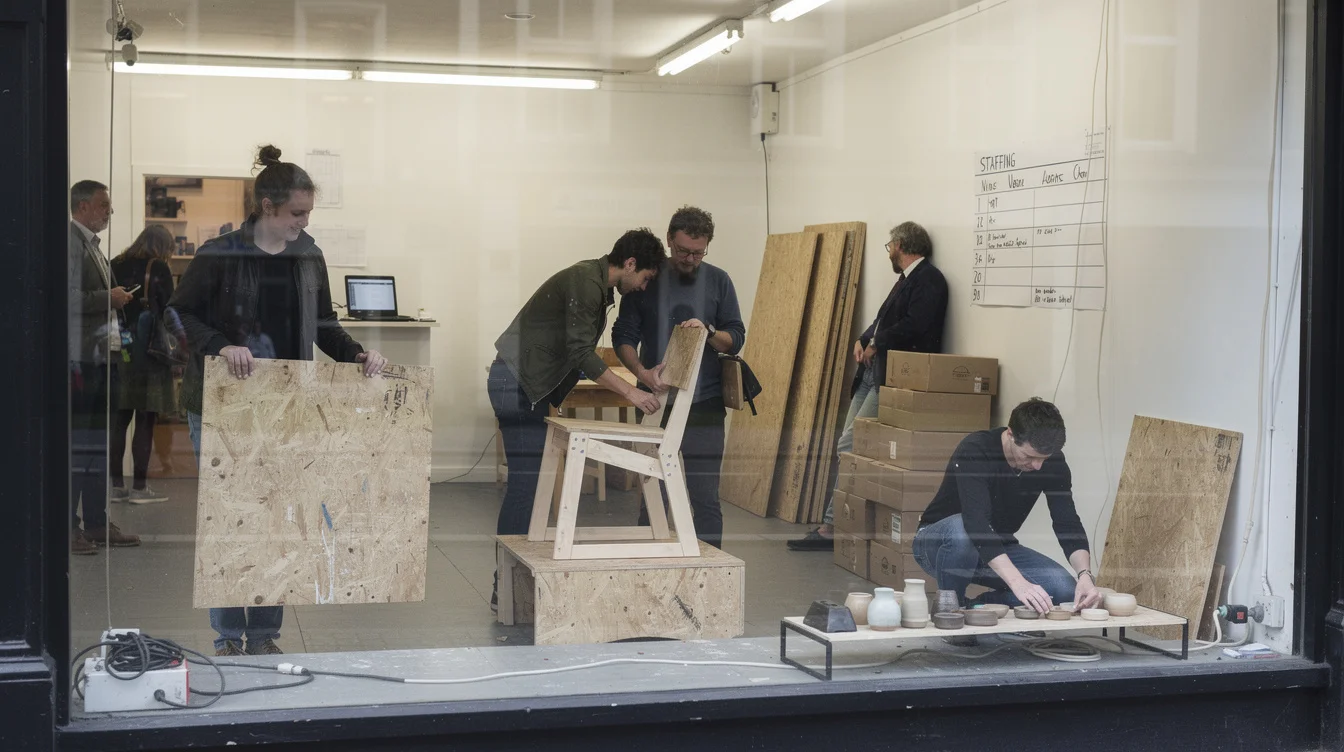
But independent ownership does not guarantee accessible participation. A collective can reject an expensive stand and still need to finance a room, build plinths, print invitations and persuade people to visit. Unless income comes from somewhere else, those costs return to the makers as subscriptions, contributions or unpaid work.
London’s established independent gallery ecology offers useful comparisons rather than automatic solutions. SEEDS, for example, operates across design and art, showing how a gallery context can position experimental objects outside the conventional trade-show booth. That curatorial latitude matters. It tells us little, by itself, about which designers can afford to participate or how risk is divided.
The question to ask of Design Everything—and of any alternative—is therefore not whether its programme feels fresher. It is whether the platform changes the conditions of entry. Without published terms, neither an energetic installation nor an anti-establishment identity proves that access has been redistributed.
The hidden invoice arrives in working hours
Self-organisation can replace a visible fee with an invisible invoice. Someone writes the funding application. Someone borrows the van, patches the wall and spends Sunday answering visitors’ questions. If that labour is unpaid, the exhibition has not become cost-free. Its subsidy has changed address.
This is particularly consequential for designers with caring responsibilities, limited savings or jobs that cannot be done remotely. An invitation requiring five days of installation and invigilation may exclude them as effectively as a substantial bill. Calling the arrangement collaborative does not resolve the exclusion.
London’s shared production infrastructure suggests a more useful vocabulary. Blackhorse Workshop and BLOQS are examples of places organised around access to making facilities. They are not substitutes for exhibition platforms, and access still has conditions and costs. Their relevance is the visibility of the resource being shared: tools, workspace and technical capacity.
An exhibition collective should be equally explicit. Is it sharing storage, transport, fabrication support, buyer contacts or staffing? Or is it merely sharing the obligation to work for free? Mutual aid can genuinely reduce costs when resources circulate. It becomes a branding exercise when the same people repeatedly provide the labour while others accumulate the visibility.
What expensive visibility can leave out
Design history supplies a warning against confusing polished presentation with cultural importance. Enzo Mari’s 1974 Autoprogettazione proposed furniture assembled from standard timber using accessible construction methods. Its force lay in instructions, participation and a challenge to passive consumption—not simply in the desirability of a finished collectible. That emphasis on agency through making also connects to the debate over a hand-made future in an age of automation.
Martino Gamper’s 100 Chairs in 100 Days, completed in 2007, made recombination and sustained experimentation central to the work. Neither project proves that experimental design is cheap to produce or exhibit. Both demonstrate that design’s intellectual value can reside in a process that a tightly packed sales environment struggles to communicate.
When the exhibition bill must be recovered quickly, designers have a rational incentive to show work that sells quickly or promises commissions. That can mean reducing material risk, bringing smaller objects or withholding research whose value is difficult to price. The fee does not dictate an aesthetic, but it can exert pressure on one.
A genuinely alternative London platform would create room for these less immediately recoverable investments: repair demonstrations, open construction systems, material failures and prototypes that remain unresolved. It would not demand that every participant arrive with a photogenic product capable of financing its own public appearance.
Redistribution needs a budget, not a manifesto
There are several credible ways to change the equation. A gallery can cover production and exhibition costs, then recover investment through agreed commissions. This transfers some upfront risk away from designers, although a sales-dependent model can still favour commercially legible work. The commission, payment schedule and ownership of unsold objects should be clear before participation.
A subsidised platform can pay exhibition fees and offer fabrication grants. That creates access only if applications are proportionate and money arrives when costs arise. Reimbursement after an event still requires participants to possess the cash in advance. A nominally generous scheme can therefore retain a liquidity barrier.
A cooperative model can pool transport, equipment and staffing while giving exhibitors voting rights over spending. Here, fairness requires an agreed valuation of labour and alternatives for people unable to volunteer. Equal contributions are not necessarily equitable contributions.
Institutional hosts and sponsors can provide space or underwriting, but those arrangements also need scrutiny. Who controls selection? Can designers criticise the sponsor’s industry? Which obligations survive after the show closes? Moving the bill away from exhibitors is progress; hiding a new dependency is not. Every model has compromises. The responsible platform makes them inspectable rather than aestheticising them away.
Stop counting exposure. Start accounting for access
The simplest test is disclosure. Before celebrating a platform as a discovery engine, ask it to publish participation charges, commissions, available support, expected working hours and the timetable for payments. Add selection criteria and explain whether financial assistance is assessed separately from curatorial merit.
Then examine outcomes without pretending that every valuable encounter becomes a sale. Did participants receive paid commissions? Were expenses recovered? Did someone gain workshop access, institutional support or a sustained professional relationship? Aggregate reporting can answer these questions without exposing individual designers’ private finances.
Editors have responsibilities here too. Coverage of an emerging scene should not merely reproduce its language of disruption. It should ask who declined an invitation because they could not afford it. The missing exhibitor is part of the story, even when there is no installation to photograph.
The £900 quote is a trigger for scrutiny, not proof that every paid exhibition fails its participants. London needs galleries and grassroots organisers willing to take risks. But the defining risk should not always belong to the person with the smallest bank balance. A platform earns its claim to discover talent when it can reach beyond those already able to purchase discovery.
FAQ
Was £900 per square metre an official London Design Festival fee?
The supplied Dezeen account says Design Everything was quoted that rate by an emerging-design show during London Design Festival 2024. It does not establish a festival-wide fee or specify everything included in the quote.
Are free exhibitions genuinely accessible?
Not necessarily. Designers may still pay for fabrication, delivery, insurance and travel, or contribute substantial unpaid labour. Accessibility depends on the complete commitment, including when money is needed and whether participants can decline staffing duties.
How can grassroots platforms reduce designers’ financial risk?
They can secure external underwriting, share equipment and transport, pay participation fees and offer production support upfront. Transparent budgets and designer representation in spending decisions help ensure that collective organisation actually distributes resources and power.
What should designers ask before accepting an exhibition invitation?
Request written terms covering charges, commissions, staffing, insurance, damage, transport, payment dates and cancellation. Ask what support is guaranteed and how previous participants benefited. A promise of exposure is not a substitute for an explanation of the exchange.
If London’s design platforms want credit for discovering talent, what costs—and what power—should they be required to take off designers’ shoulders?
Get the Mainifesto weekly — curated design debates, speculative ideas and the week's best articles every Saturday.



Olivier Dubois September 12, 2026
The old Salon had its jury; this version adds a property tariff. At £900 per square metre, talk of ‘discovery’ is rather tiresome: Bourdieu would recognise the conversion of economic capital into cultural legitimacy. If platforms want curatorial credit, they should fund participation and share selection power with designers, rather than merely waive a fee for a favoured few.
David Lim September 12, 2026
A fee waiver doesn’t solve access if fabrication, freight and a week in London still fall on the designer. Could platforms publish the full participation budget and give exhibitors control over a funded pool for those costs? I’d also want to know who never applies—we can’t measure access using only the people who made it through.
Sara Kowalski September 12, 2026
A well-made joint or a carefully finished edge takes time that doesn’t appear in the square-metre quote. Platforms should cover installation, insurance and proper handling, so a maker isn’t paying for visibility while worrying about someone chipping six weeks of work. And designers need the right to refuse display arrangements that turn their pieces into props.
Mei Chen September 13, 2026
£900 per square metre is only the first line in the spreadsheet; crating, freight, customs and replacement samples can change the decision entirely. If a platform sells access to industry, it should fund that logistics layer and report qualified buyer introductions and paid orders, not just footfall. Designers should also keep their contact lists rather than have every useful relationship mediated by the organiser.
Yuki Sato September 13, 2026
I can make fewer pots well or more pots quickly, but an exhibition deadline doesn’t make the kiln more forgiving. A platform that claims to discover makers should pay for transport and insurance, and let us decide how much work we can responsibly show. I distrust visibility that requires a new collection and a stream of posts before anyone has spent a minute looking at the clay.