

Schools as Civic Infrastructure in Shenzhen
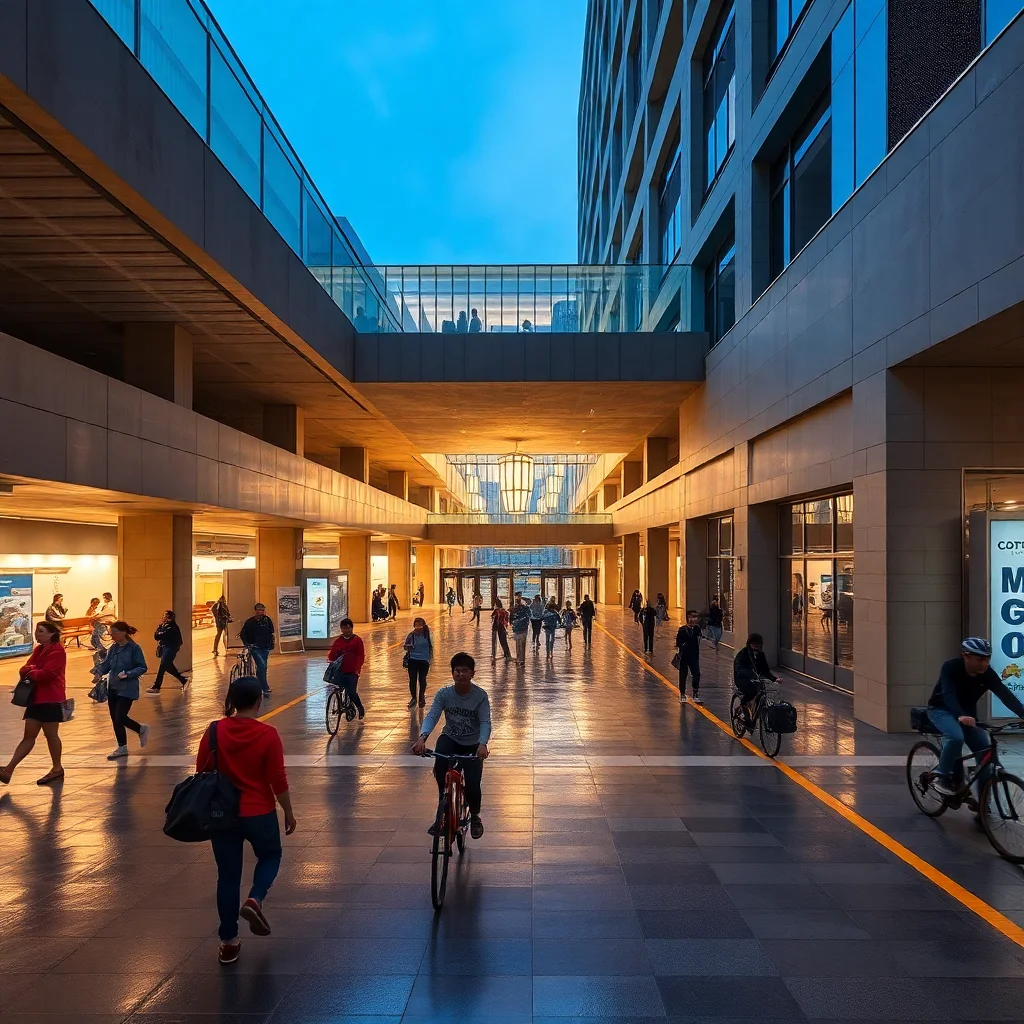
The school is no longer the point
Shenzhen Mingwan School matters less as a standalone educational building than as evidence of a larger spatial shift: the campus is becoming civic infrastructure. In Qianhai-Dachan Bay Port Zone, Block 05 West folds together a private school, a nine-year public school, a community activity center, and a comprehensive transit hub into one coordinated architectural organism. That is not just efficient planning. It is a political statement about what cities now expect buildings to do.
For decades, the school was imagined as a sealed social container: teach inside, release outside, repeat. But contemporary urban life has made that model feel impoverished. Children need mobility systems, sports facilities, informal learning environments, after-school care, and community contact. Parents need transit. Neighbors need access to shared amenities. The school becomes the excuse for a broader social machine. The real design question is no longer how to isolate education from the city, but how to let it metabolize the city without collapsing into chaos.
Perkins&Will’s response at Mingwan is notably unsentimental. Rather than producing a single iconic gesture, the scheme relies on clarity, massing discipline, and programmatic stacking. In a district shaped by Tencent’s wider campus logic, this kind of architecture is less about image than orchestration. It suggests a future in which buildings are judged not by their autonomy, but by how well they coordinate everyday life.
Education is becoming a public utility
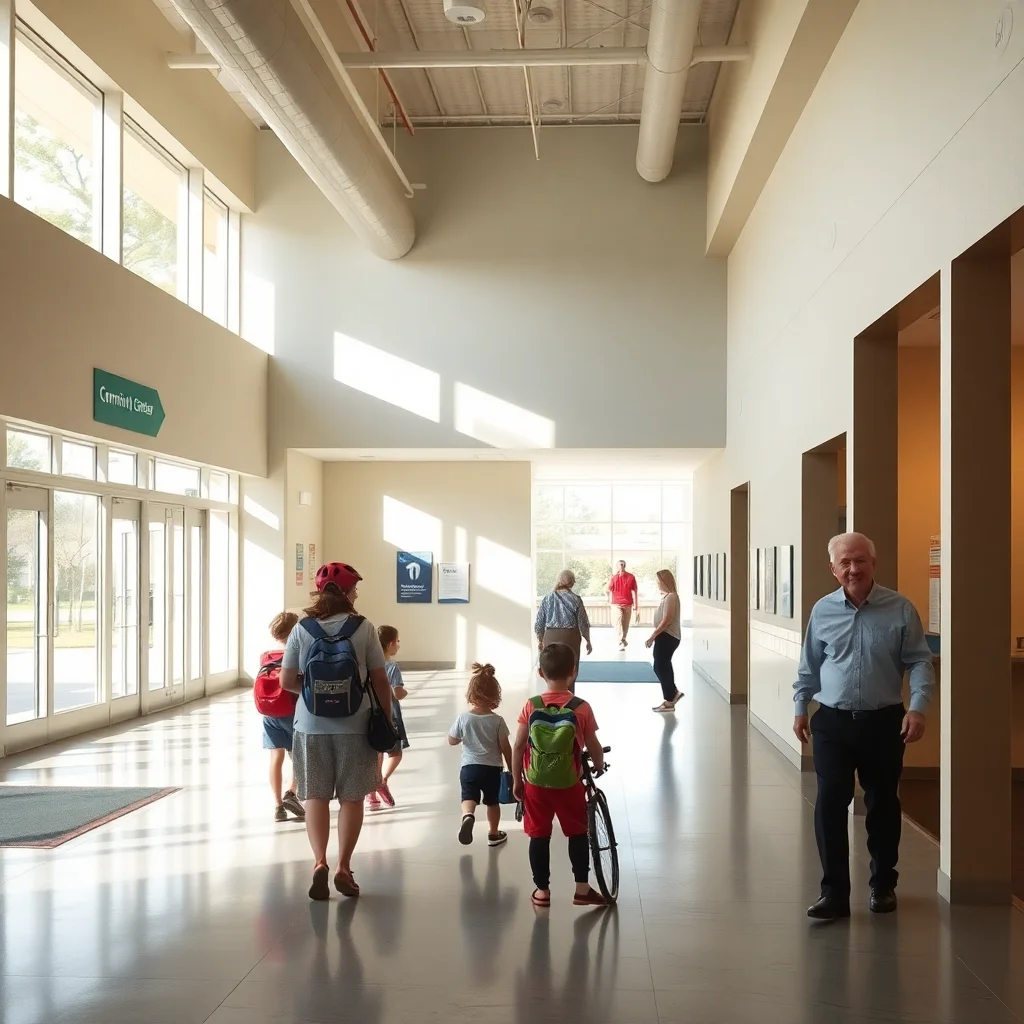
What makes Mingwan School provocative is not that it is “mixed-use” in the conventional sense. Mixed-use often becomes a euphemism for adding retail to everything and calling it urbanism. Here, the integration is more consequential: schooling is paired with transit, culture, and sport because these are no longer separable systems in a dense metropolitan district. Education is being recast as a public utility embedded in a broader civic network.
This logic has precedents, but few are as direct. Alejandro Aravena’s ELEMENTAL projects reframed housing as an expandable civic framework; Lacaton & Vassal have repeatedly argued that generosity, not austerity, is the basis of public architecture; and in school design, projects like the Vittra Telefonplan School in Stockholm or the Siemens School centers in Germany have pushed learning into spatial hybrids rather than rigid classrooms. Yet Mingwan takes the next step: it does not merely blur learning spaces, it ties educational life to transit and neighborhood services at the scale of a district block.
That is crucial because the city itself has changed. In fast-growing urban zones like Shenzhen, the old diagram of separate institutions is too slow, too wasteful, and too socially thin. A school that shuts at 3 p.m. is an underperforming civic asset. A campus that supports sports, community gatherings, and transport flow becomes a temporal machine, productive across the full day and across multiple publics. This is not an architectural trend. It is a restructuring of urban governance through building form. Similar arguments have emerged in projects that treat everyday program as shared civic capacity, such as big-box buildings turned into civic infrastructure, where the value lies in how a large footprint can be repurposed for collective use.
Why the campus model is returning with force
The campus was once associated with insulation: the university enclave, the corporate park, the suburban school. Today it is returning under a different mandate. In dense Asian megacities especially, the campus is being reinvented as a vertical and horizontal civic field, where multiple institutions share infrastructure rather than duplicate it. The result is not a withdrawal from the city, but a more tactical entanglement with it.
Mingwan School sits within Tencent’s broader Qianhai-Dachan Bay campus, where five neighborhood blocks suggest a new urbanism of clustered programs. This matters because the old single-purpose block is increasingly unsustainable. Schools need pick-up/drop-off logic, safe pedestrian circulation, indoor sports areas, assembly spaces, and sometimes boarding accommodation. Communities need venues for events and daily services. Transit hubs require volume, legibility, and flow. Put together, these demands produce a building type that is neither school, mall, nor station, but all three in carefully calibrated proportion.
The architectural risk is obvious: if everything is combined, nothing may feel specific. But Perkins&Will’s project appears to resist that collapse through formal restraint. Instead of over-describing each function, it gives the ensemble a legible order. That restraint is not neutral; it is strategic. When a campus becomes infrastructure, clarity becomes a public ethic. Confusion is not democratic. It is exclusionary.
The hidden agenda: adjacency as urban policy
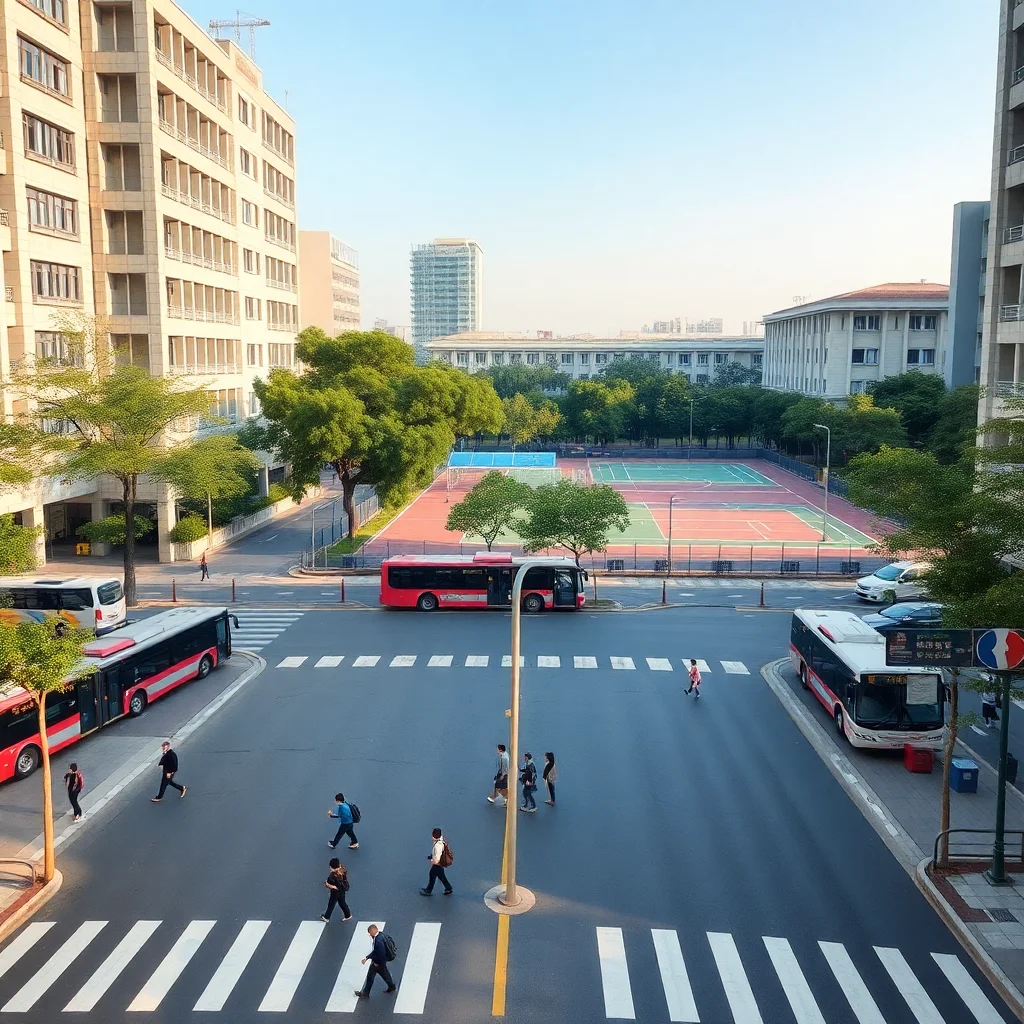
The most radical aspect of this model is adjacency. When a school shares boundaries with transit, community life, and sport, the building stops being a destination and becomes a connector. Children arriving in the morning encounter commuters. Residents passing through after work encounter learning spaces. Sports facilities become social condensers instead of isolated amenities. The architecture produces interaction by design, not by branding.
That does not mean all overlaps are desirable. There is a fine line between productive porosity and managed surveillance. The contemporary campus can easily become a privatized district in disguise, where “community access” is permitted only at predetermined times and under curated conditions. Shenzhen’s developers and design teams know this tension well. The same infrastructural intelligence that allows a campus to support public life can also be used to control it.
That is why the project should be read critically. It is not enough to celebrate multi-program architecture as inherently progressive. The question is who benefits from the sharing, who controls the thresholds, and whether the public spaces are genuinely public. Architecture critic Reinier de Graaf has often warned that mixed-use can obscure power relations rather than resolve them. Mingwan’s promise lies precisely in exposing that dilemma. It shows a campus model capable of civic generosity, while reminding us that generosity must be spatially and politically designed.
From school building to urban operating system
To understand why this matters, think less like an architect and more like a systems designer. An operating system coordinates multiple tasks, permissions, and interfaces without calling attention to its own mechanics. The emerging campus does the same. It aligns arrival and departure patterns, educational schedules, evening programs, mobility networks, and neighborhood use into one legible framework. The building is no longer an object; it is a protocol.
That protocol is already visible in other contexts. The Scandinavian school as civic center, the Chinese superblock as multi-functional ecology, the European transit-oriented development scheme: all point toward architecture that performs governance through spatial organization. But Shenzhen’s version is sharper because it is not accidental. It is explicitly about responding “systematically” to combined district needs. That word matters. Systematic design is the opposite of decorative urbanism. It implies that the building is asked to think.
There is also a cultural dimension. Full-time education from kindergarten through high school, with boarding for senior students, suggests that learning is being treated as a continuum rather than a sequence of separate institutions. This is an idea with deep implications. It privileges continuity, interdisciplinary practice, and personalized learning environments. It also makes architecture responsible for pedagogical atmosphere, not merely classroom count. The building becomes the hidden syllabus.
What this means for the next decade of architecture
Shenzhen Mingwan School is not a one-off novelty. It is a prototype for how cities may increasingly commission architecture: as a compound infrastructure that absorbs functions once spread across separate parcels. That shift will change the role of the architect. The task is no longer to design a beautiful building for a known use, but to design a resilient framework for overlapping publics and shifting schedules.
Expect three consequences. First, more educational projects will be judged by their ability to support wider civic life, not just academic outcomes. Second, massing and circulation will become the real battlegrounds of design, because program overlap lives or dies by movement logic. Third, architecture will be forced to negotiate new ethical questions about access, privatization, and collective ownership.
The bold claim here is simple: the next great school is not a school at all. It is a civic infrastructure node that teaches, hosts, moves, and convenes. Shenzhen is showing us a future in which the campus is less a campus than an urban operating system. That future may be efficient, generous, or deeply contested. Most likely, it will be all three.
- FAQ: Why is Shenzhen Mingwan School important architecturally? It demonstrates a shift from isolated school buildings to multi-use civic infrastructure, combining education with transit, sport, and community functions in one integrated urban block.
- FAQ: What makes this different from ordinary mixed-use design? Ordinary mixed-use often adds commercial layers. Mingwan is more structural: it aligns public mobility, learning, and neighborhood services as a single system of shared circulation and access.
- FAQ: Is this model only relevant in China? No. Dense cities worldwide are facing the same pressures—limited land, overlapping public needs, and demand for buildings that remain active beyond office or school hours.
- FAQ: What is the biggest risk of campus-as-infrastructure planning? The biggest risk is privatized “publicness,” where access is carefully managed and civic generosity becomes a controlled experience rather than a true urban commons.
Get the Mainifesto weekly — curated design debates, speculative ideas and the week's best articles every Saturday.

Ricardo Estévez June 28, 2026
What interests me here is not the novelty of mixing uses, but the old civic role schools once carried before we fenced them off into single-purpose objects. The hard question is who benefits when a campus becomes a neighborhood anchor: if the surrounding community is priced out or policed out, the “public” is just a branding exercise.
Olivier Dubois June 28, 2026
This has the familiar sheen of the total urban system, that late-modern fantasy of seamlessness. But the public is never abstract; it is produced by rules, thresholds, and exclusions, so the real design problem is less spatial integration than who is allowed to linger, gather, and interfere.
David Lim June 28, 2026
I like the idea of the campus as an operating system, because it forces us to think in networks instead of isolated plots. But the metrics matter: access patterns, peak loads, permeability, and governance all decide whether the school is genuinely civic or just a more efficient machine with better branding.
Tom Brightwell June 28, 2026
The concept works only if it stays legible and affordable to run. Once you start stacking transit, sport, and community uses onto a school, the question becomes operational discipline: who pays, who maintains it, and whether the thing still works on a Tuesday afternoon when nobody is filming it.