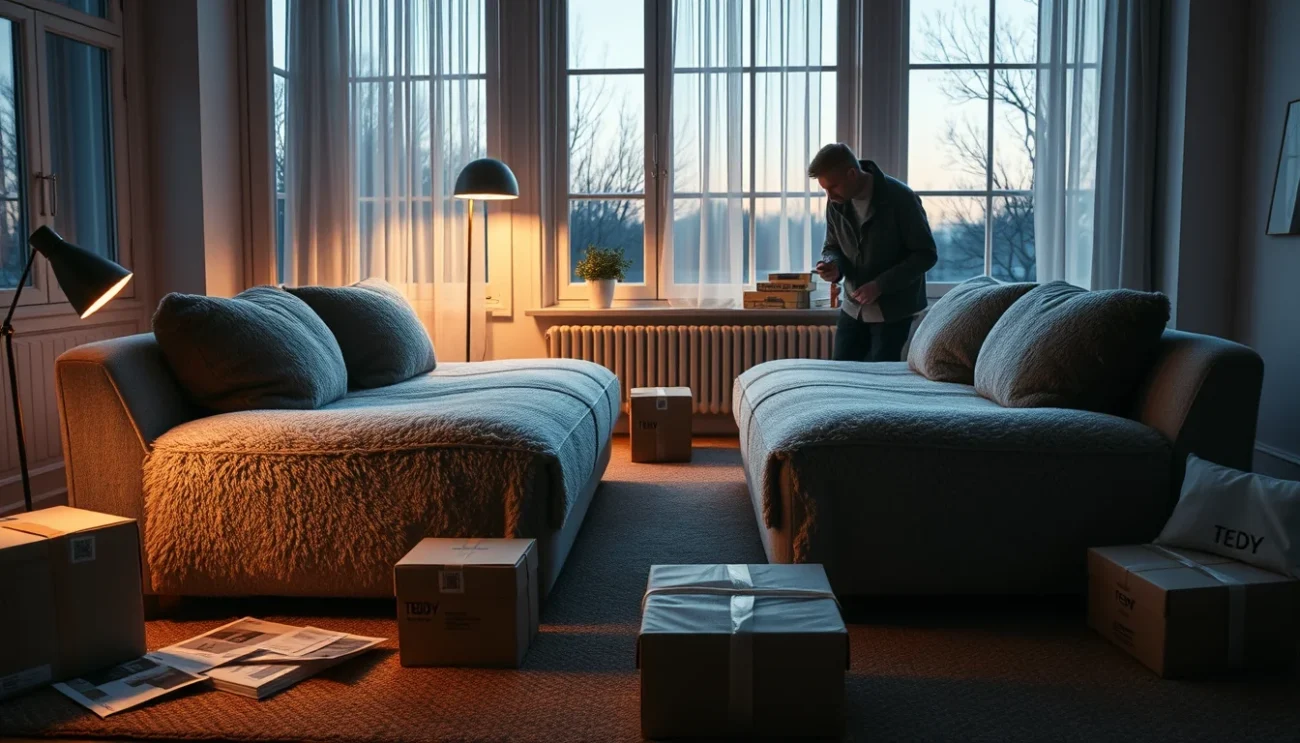

The Guest Room That Arrives in a Box
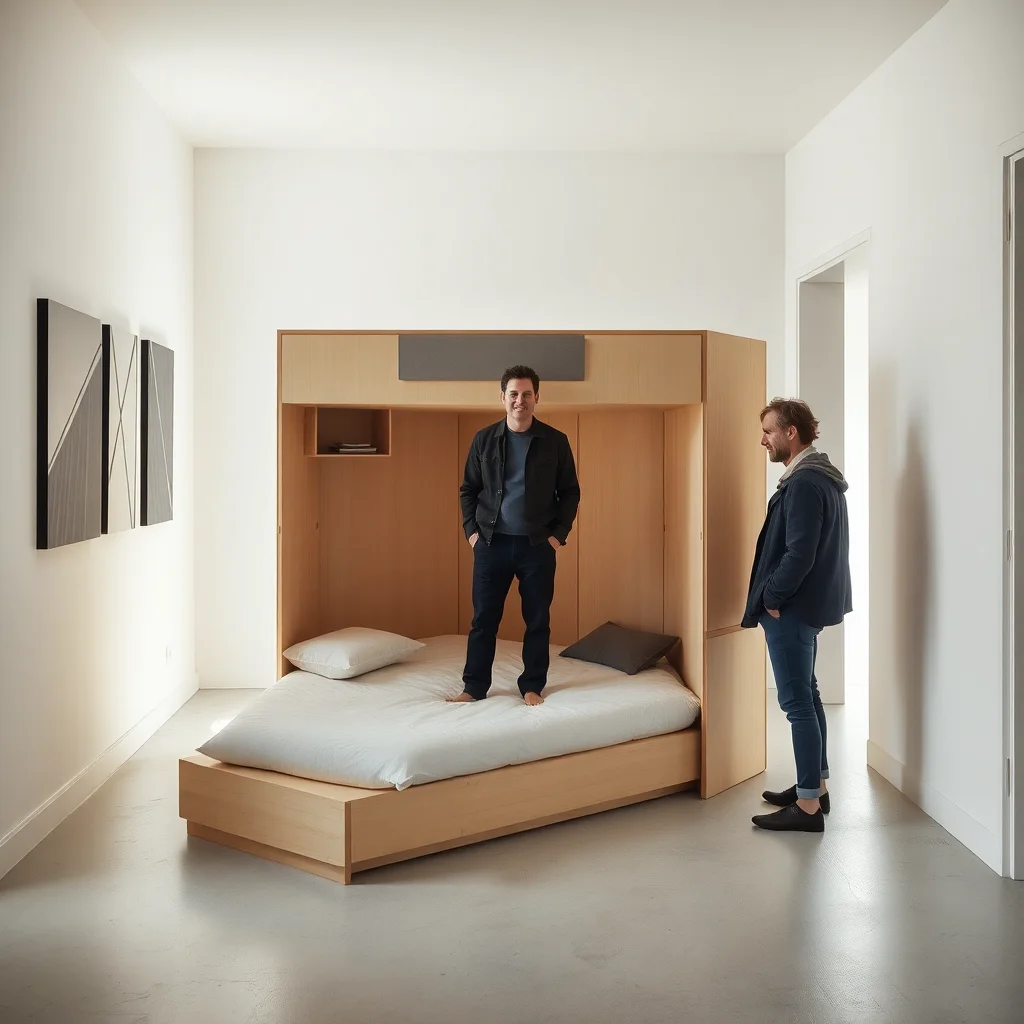
The Guest Room Is No Longer a Room
The most interesting domestic invention of the moment is not a smarter sofa, a thinner table, or another minor miracle of flat-pack logistics. It is the quiet, unnerving proposition that a guest room can arrive in a box and unfold into existence only when needed. Thélonious Goupil’s Bienvenue for Campeggi does exactly that: a compact plywood shell that opens into a spare room you do not actually have. It is witty, but the joke lands with a sting. What looks like a piece of furniture is really an argument about how contemporary life is being organized by pre-engineered domestic modules.
We have spent decades celebrating flexibility, modularity, and multifunctionality as if they were neutral virtues. They are not. In shrinking apartments, compact urban housing, and increasingly hybrid lives, furniture has started to absorb the role once played by architecture itself: it partitions, shelters, hides, and stages behavior. The guest room is the perfect example because it exposes the fantasy at the heart of hospitality. Most homes can no longer afford a room dedicated to occasional visitors, so the market offers a substitute: a deployable, temporary architecture that performs generosity without requiring square footage. The question is whether this is liberation, or simply the aestheticization of scarcity.
Bienvenue matters because it is honest about the condition it serves. It does not pretend that smallness is chic. It translates shortage into design intelligence, and in doing so it joins a larger lineage of domestic improvisation, from Joe Colombo’s Total Furnishing Unit to modern kitchenette capsules and the micro-living fantasies presented at Salone del Mobile and in the most pragmatic corners of Milan Design Week. The difference is that today this logic is no longer exceptional. It is becoming the default infrastructure of urban life.
Seen this way, compact domestic design begins to overlap with other strategies of spatial repair. In projects that ask how rooms can do more without becoming visually heavy, the interior is no longer a backdrop but an active mechanism. That is part of what makes when interiors become repair mechanisms such a useful adjacent idea: it frames design as a way of fixing daily life rather than merely decorating it.
From Object to Infrastructure
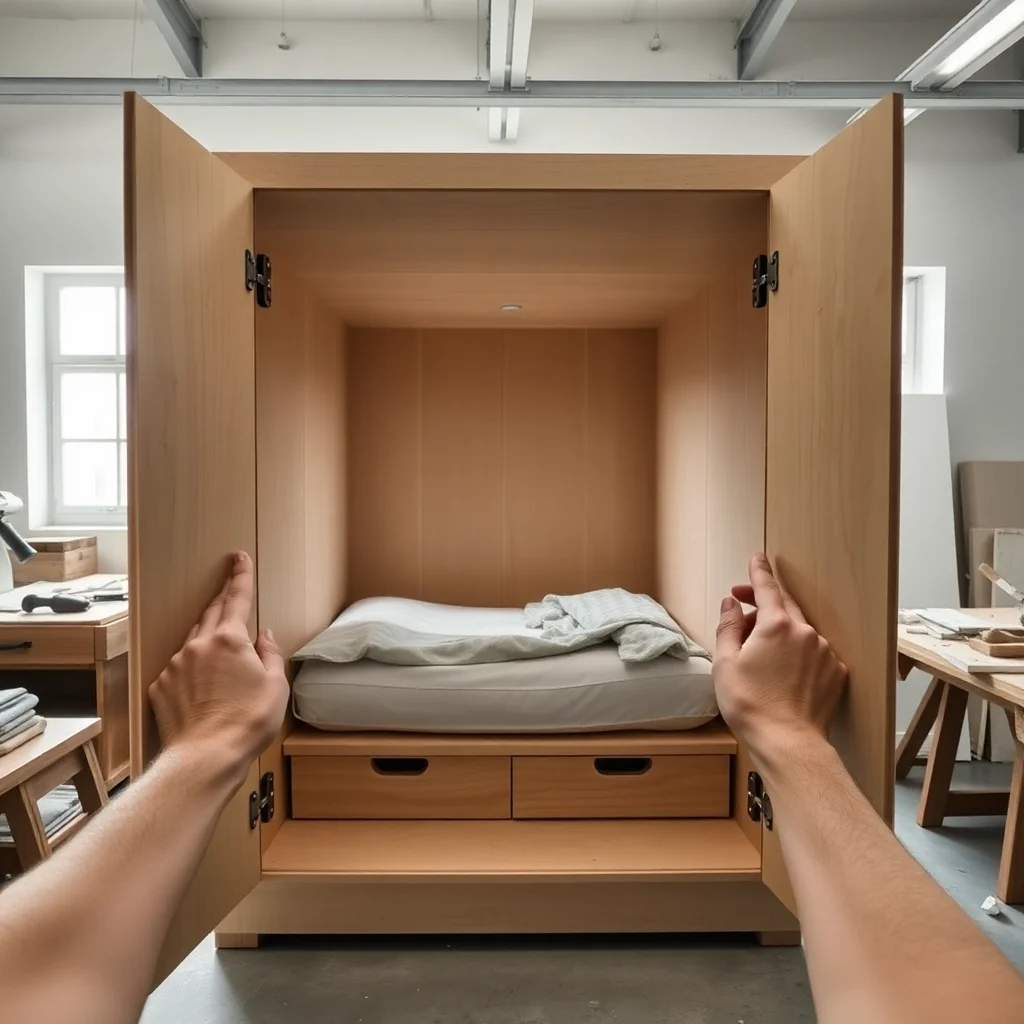
Furniture used to be understood as movable decoration, an adjunct to a stable architectural container. That boundary has collapsed. In dense cities, where rent punishes generosity and floor area is a luxury good, a table can be a desk, a shelf can be a wall, and a sleeping pod can be a substitute for a bedroom. The rise of compact domestic modules is not only a response to less space; it is a redesign of domestic sovereignty. The house becomes a script, and the furniture becomes the mechanism that performs it.
This is where projects like Campeggi’s catalog become culturally revealing. Campeggi has long operated in the territory between product and architecture, producing pieces that are less about style than about scenario. Bienvenue takes that to its logical conclusion: a shell that can host a guest without pretending to be a permanent room. It echoes the lineage of transformable design seen in the work of Clei, in the wall beds and retractable systems that proliferated in postwar compact housing, and in contemporary Japanese micro-interiors where every centimeter is negotiated with near-military precision. In such spaces, furniture is not supplemental. It is the building.
This shift also exposes a strange emotional inversion. The old ideal of the home promised stability, privacy, and a certain slowness. Portable architecture promises adaptability, but often delivers a life organized around contingency: pull out the bed, collapse the desk, stow the dining function, restore the wall. The domestic interior starts to resemble a stage set for optimization rather than a place of repose. And yet, there is no denying the intelligence of the response. If the city has become unaffordable in volume, design is attempting to reimburse us in seconds, in motion, in cleverness.
Japanese interiors are especially instructive here because they show how restraint can become a spatial language rather than a compromise. Their emphasis on timber, joinery, and compact precision often turns limitation into an aesthetic of clarity. That makes timber’s second life in Japanese interiors a natural companion piece to this discussion of modular living and engineered domestic calm.
The Pleasure of the Fold
To dismiss these systems as merely symptomatic of scarcity would be too easy. The best compact furniture is genuinely seductive. There is a bodily pleasure in folding, sliding, opening, and revealing. The act of transformation creates drama in a room; it gives agency back to the inhabitant. In this sense, Bienvenue participates in a design tradition that has always admired choreography: think of the convertible logic in Verner Panton interiors, the kinetic optimism of 1960s capsule thinking, or the contemporary fascination with the “magic trick” piece that conceals an entire program inside a plain exterior.
That pleasure is not superficial. It is rooted in control. A compact module promises that a home can change without requiring structural renovation, landlord approval, or a second mortgage. For renters especially, that is a potent fantasy. The guest room becomes a privilege you can switch on, rather than a permanent spatial commitment you can no longer afford. In the best cases, this produces a kind of democratic hospitality: the ability to host, to sleep, to work, to withdraw, all within a small footprint.
But the fold is also ideological. We are trained to experience flexibility as freedom, even when it masks a relentless demand for efficiency. Compact domestic modules reduce waste and expand usefulness, yes, but they also normalize the idea that all private life should be convertible, compressed, and accountably optimized. The room disappears not because it is unnecessary, but because it has become too expensive to justify without conversion. That is a design triumph with a political shadow.
When Hospitality Becomes a Device
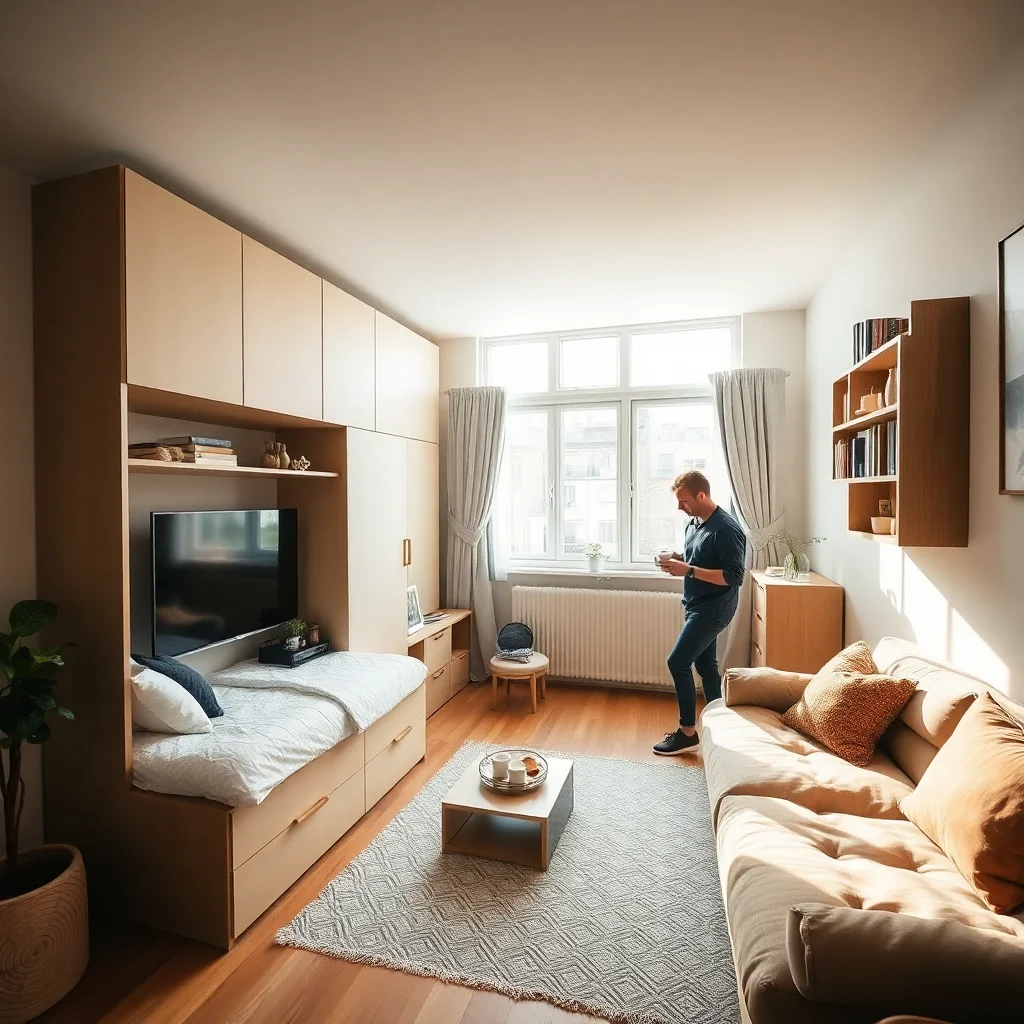
The guest room is one of the last symbolic luxuries in domestic life. It represents abundance that is not immediately monetized. A room for visitors suggests slack in the system, a household with enough margin to hold an absent body. When a guest room arrives in a box, that slack is replaced by a device. The generosity remains, but it is now engineered, pre-priced, and tightly bounded by instructions.
This is not inherently cynical. The reality is that cities from London to Barcelona to New York have priced out the spaciousness that earlier generations treated as ordinary. Compact living is not a trend; it is a structural condition. Designers responding to it are not merely chasing novelty. They are trying to preserve rituals—hosting, privacy, separation, pause—that otherwise vanish in ultra-efficient interiors. A well-designed transformable room can be more hospitable than a permanently cluttered studio. It can give a guest dignity rather than a sofa bed apology.
Still, the substitution is telling. Once hospitality requires deployment, concealment, and retraction, it begins to resemble logistics. You do not simply welcome someone; you activate a module. That shift matters because it changes the emotional texture of domestic life. The home becomes a system of prompts and presets rather than a stable backdrop for human time. We may admire the ingenuity, but we should also ask what kind of citizenship we are practicing when the household is redesigned around temporary occupancy.
Examples of a Smaller Future
Bienvenido-style thinking is spreading across interiors, not as a fringe experiment but as a governing principle. In tiny apartments in Tokyo, wall-integrated storage and retractable partitions are already a matter of spatial survival. In European micro-housing, the bed disappears into cabinetry, the kitchen shrinks to a service niche, and the dining room becomes a memory. At trade fairs, brands present modular domesticity as elegant inevitability: slim profiles, hidden mechanisms, furniture that behaves like architecture but ships like product.
There are clear precedents. Joe Colombo imagined total living systems that collapsed multiple functions into one enclosure. Alcove and other contemporary manufacturers have turned sleep niches into architectural furniture. Architects working on co-living and small-unit housing have adopted built-in transformability as a design baseline. Even in higher-end interiors, where space is not scarce, the aesthetic of compactness has become desirable: clutter is out, calibrated utility is in. Minimalism and crisis management now share the same visual language.
And that is exactly why Bienvenue is more than a clever object. It is an emblem of a cultural settlement. The home is no longer expected to expand to accommodate life. Life is expected to compress itself to fit the home. Furniture becomes the interface that makes this arrangement feel dignified. It is neither purely furniture nor quite architecture, but a soft infrastructure that teaches us how to live smaller without admitting defeat.
What We Gain, What We Lose
We gain agility. We gain the possibility of hosting, resting, and separating functions without expensive renovation. We gain a domestic culture that is less wasteful and more responsive to real constraints. For younger urban residents, especially renters, this is not theoretical. It is the difference between permanent improvisation and designed adaptability.
We lose something too. Permanent rooms carry a psychological weight that modules cannot fully replace: the reassurance of surplus, the dignity of disuse, the freedom to leave a function dormant. A guest room is not only for guests. It is a spatial reserve, a sign that the home contains more than immediate utility. When every room must justify itself by transforming, the house becomes a machine of perpetual performance. Nothing is allowed to simply be.
That is the provocation embedded in compact furniture today. It asks us to accept that domestic life will be increasingly organized by boxes, panels, hinges, and scripted conversions. The challenge is not to reject this future outright; it is to refuse the fantasy that it is neutral. Portable architecture is not just a convenience. It is a social model. The real question is whether we want our homes to remain places of surplus imagination, or whether we are ready to live inside beautifully engineered necessity.
- Bienvenue by Thélonious Goupil for Campeggi turns a simple plywood shell into a deployable spare room, collapsing the distance between furniture and architecture.
- Joe Colombo’s Total Furnishing Unit remains a crucial precedent for domestic systems that package living, sleeping, and storage into one compact device.
- Japanese micro-housing shows how retractable partitions, wall beds, and integrated storage have become a survival strategy rather than a novelty.
- Co-living interiors demonstrate how hospitality, privacy, and efficiency are increasingly negotiated through built-in modular infrastructure.
- Milan Design Week and Salone del Mobile have normalized the display of transformable domestic objects as a vision of urban adaptability.
- The rise of renter-friendly design reveals why portable architecture is becoming an essential language for people who cannot alter the buildings they inhabit.
FAQ
What is Thelonious Goupil’s Bienvenue?
Bienvenue is a compact plywood shell developed with Campeggi that unfolds into a spare room-like domestic module. It is designed as a witty response to shrinking living space and the need for temporary hospitality.
Why is portable furniture becoming more important now?
Because homes are getting smaller, more expensive, and less permanent for many people. Portable furniture fills the gap between architecture and daily life by adding functions that a fixed floor plan can no longer guarantee.
Is transformable furniture actually a solution to small-space living?
Yes, but only partially. It improves adaptability and can preserve rituals like hosting or working, yet it also normalizes the idea that every domestic function must be compressed and efficient.
Does compact domestic design reduce freedom?
It can. While it expands what a small home can do, it also ties domestic life to pre-engineered systems and conversion routines, which may reduce the sense of spatial surplus and spontaneity.
Image prompts should reflect the source context: if the article references a specific event like Milan Design Week, a material like plywood, or a discipline like interior design, those details should appear in the scene. Real people, real interiors, editorial light, and a believable atmosphere will make the images feel grounded rather than conceptual.
So is the guest room in a box a democratic tool for urban living, or the most elegant surrender to a life permanently organized by lack?
Get the Mainifesto weekly — curated design debates, speculative ideas and the week's best articles every Saturday.