
Who Owns the View of a Monument?
Who Owns the View of a Monument?
The postcard is not innocent. Before a visitor photographs a monument, someone has usually arranged the conditions of that photograph: cleared the foreground, organised the approach, controlled competing objects and established what deserves uninterrupted attention. We discuss monuments as if their power resides entirely in stone or steel. Much of it resides in the space that keeps everything else out.
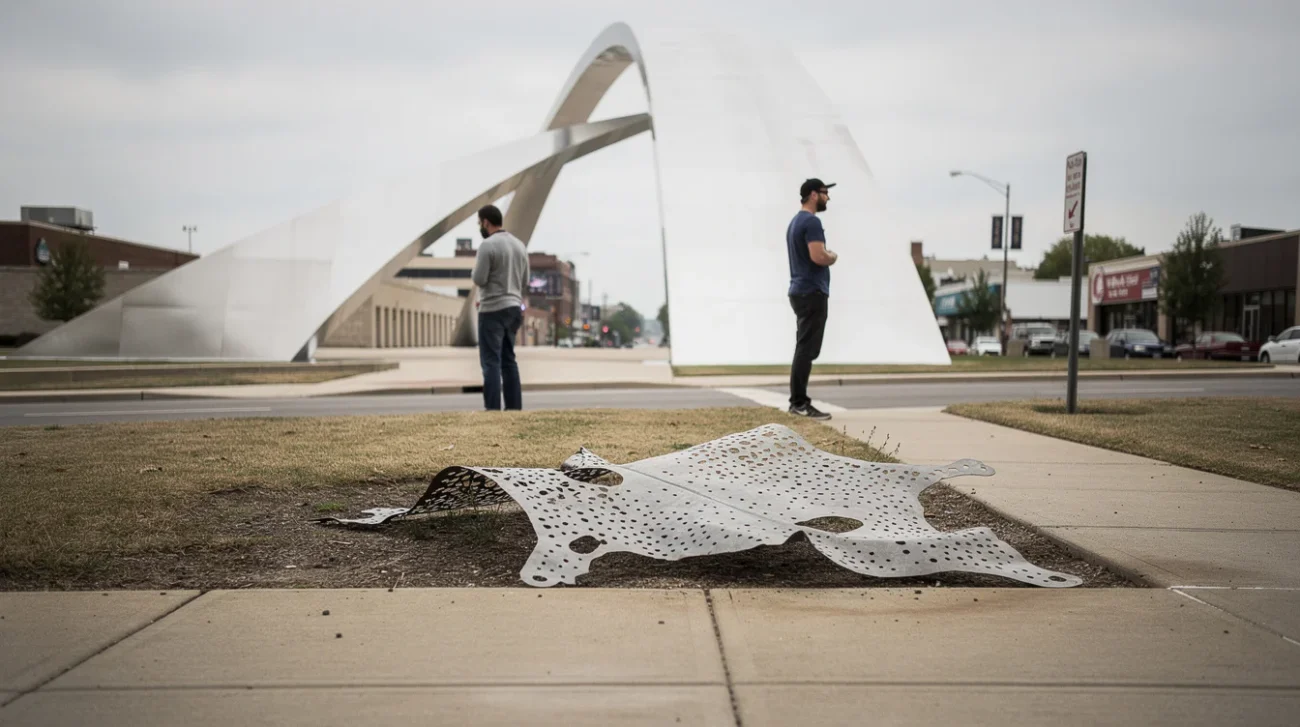
Nicholas Galanin’s Land is Never a Gateway (Sightline/Lifeline) makes that supporting space the subject. Created for Counterpublic in St Louis, the Alaska-based artist’s metal sculpture resembles a stretched animal hide and occupies a small sidewalk plot in front of Eero Saarinen’s Gateway Arch. As reported by Dezeen, the intervention challenges narratives of westward expansion. Its leverage comes not from matching the monument’s scale, but from entering its visual field.
This is the provocation: an unobstructed view can be an obstructed history. If the arch is allowed to dominate the image without interruption, its framing of the continent as a territory of movement and opportunity retains an extraordinary visual advantage. Galanin does not need to remove the structure to disturb that advantage. He introduces another claim into the picture—and makes the presumed neutrality of the picture collapse.
The Foreground Is Part of the Monument
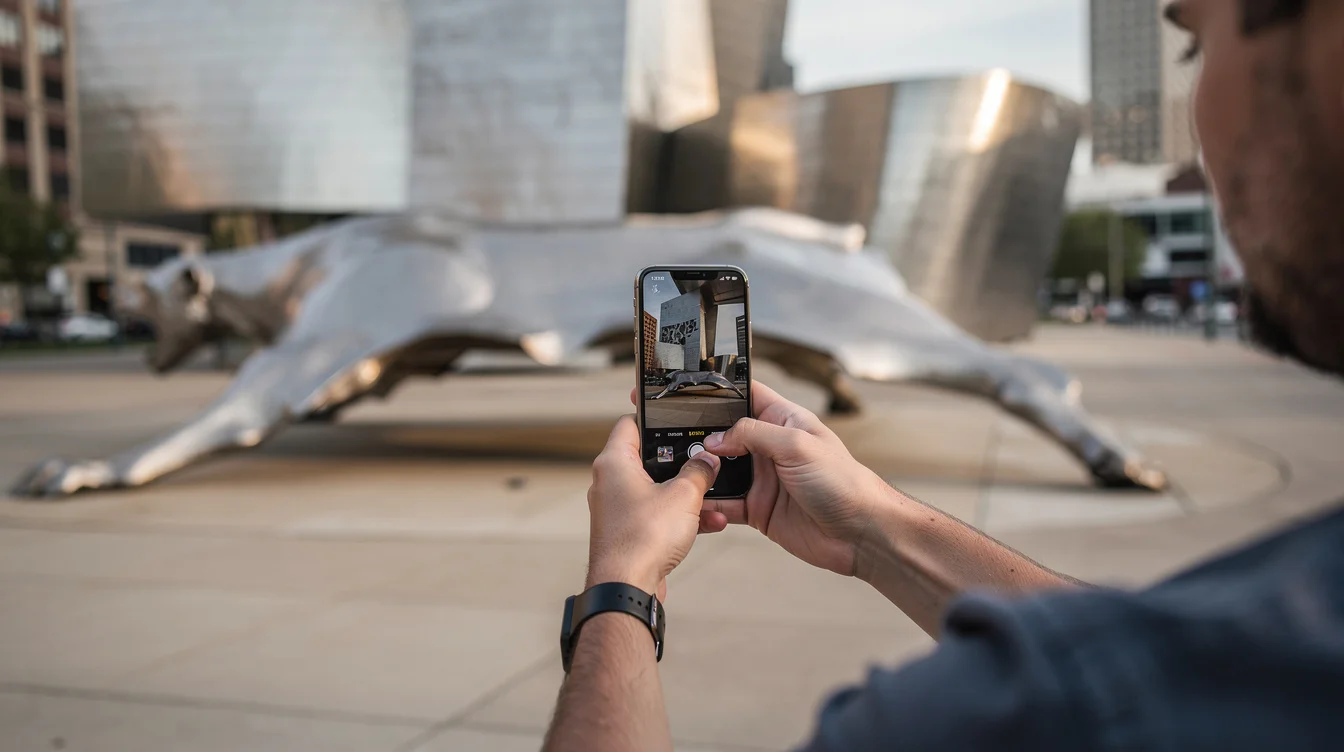
Completed in 1965, the Gateway Arch commemorates St Louis’s role in westward expansion. Its stainless-steel curve is an astonishing work of architectural abstraction. That abstraction is also politically useful: conquest can be encountered as an elegant line, territorial expansion as a soaring gesture, displacement as something outside the frame. Formal brilliance does not cancel ideological work. It can make that work harder to see.
The monument’s authority extends through its setting. Saarinen’s architecture and the landscape associated with Dan Kiley make clear that monumental experience is designed across distances, not confined to an object’s footprint. A lawn, an approach and a carefully composed interval of sky all contribute to how a structure is understood. The foreground is not leftover space. It is part of the apparatus.
That does not establish that Galanin’s particular viewpoint is subject to a specific legal sightline protection. The more immediate issue is the cultural demand for a clean, recognisable image. Formal view protections elsewhere, such as London’s managed views of St Paul’s Cathedral, demonstrate that visibility can become a planning asset. But custom, tourism and institutional taste can police a composition too. Calling an intervention a visual intrusion already decides whose presence belongs and whose requires justification.
A Small Plot Can Challenge a Vast Story
Galanin, a Tlingit and Unangax̂ artist, works here through asymmetry. The arch commands the skyline; the sculpture occupies the pedestrian foreground. One offers a monumental passage. The other resembles a hide stretched into a defined outline. Without assigning that form a specific ceremonial meaning unsupported by the available account, its bodily association is unmistakably different from the arch’s abstract sweep. The encounter brings land, living beings and vulnerability into a composition organised around national ambition.
The title does equally forceful work. Land is Never a Gateway rejects the premise that territory is primarily a threshold through which someone else advances. A gateway implies a destination beyond it. Land understood through Indigenous presence is not merely the space between departure and achievement. It holds relationships, histories and obligations that the language of expansion makes expendable.
This is not an isolated strategy in Galanin’s practice. His 2021 installation Never Forget, presented through Desert X in Palm Springs, used enormous letters spelling “INDIAN LAND” to redirect the familiar visual language of the Hollywood sign. In both projects, recognition becomes a trapdoor. Viewers encounter a legible, image-ready arrangement, then discover that the terms of ownership and belonging have changed. The iconic view becomes a carrier for a statement it was never designed to accommodate.
Preservation Is Not the Same as Visual Obedience
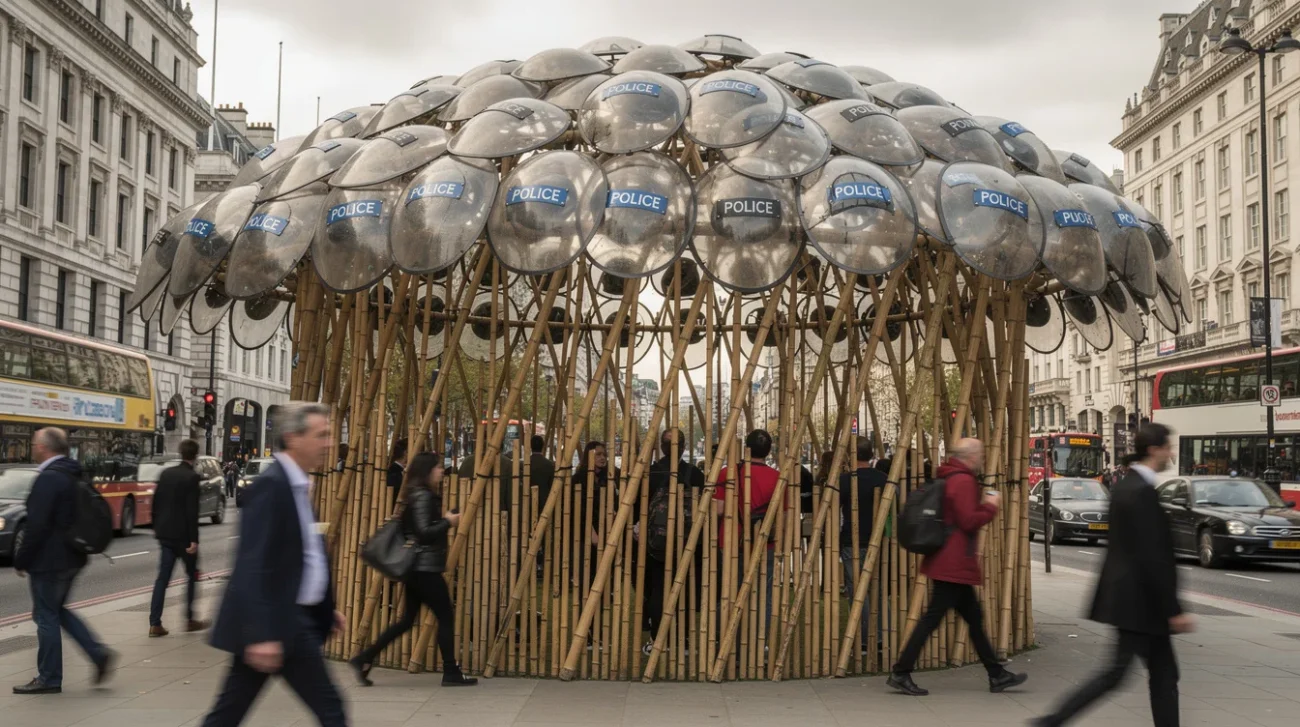
The predictable objection is that an iconic structure deserves to remain visible as its designer intended. Sometimes that argument protects a genuine public good. Buildings can be overwhelmed by advertising, speculative development or poorly considered event infrastructure. Not every obstruction is an act of liberation. A corporate activation in a civic foreground may privatise attention rather than redistribute it. The debate over police shields repurposed as a festival pavilion raises a related question: does a charged intervention redistribute power, or merely stage political spectacle?
But preserving a structure and preserving its uncontested authority are different tasks. One maintains material fabric and architectural legibility. The other attempts to freeze the hierarchy between the monument and everyone who encounters it. An intervention can leave the arch entirely intact while refusing to behave as visual background. That distinction should be central to conservation, not treated as an exception granted reluctantly to contemporary art.
London’s Fourth Plinth offers a useful comparison. Yinka Shonibare’s Nelson’s Ship in a Bottle, installed there in 2010, placed a model of HMS Victory with patterned textile sails within Trafalgar Square’s imperial setting. It did not dismantle Nelson’s Column; it complicated the surrounding narrative. Yet the designated plinth also reveals a limit: institutions can welcome disagreement while carefully assigning it a place. Galanin’s sidewalk position sharpens a different question. Must counter-narratives remain politely beside authority, or may they enter the very view through which authority reproduces itself?
Temporary Art Needs More Than Permission to Disappear
Temporary installations can make arguments that permanent monument commissions struggle to accommodate. They can test an unfamiliar visual relationship, provoke an institutional response and invite visitors to reconsider a place without demanding immediate demolition or irreversible construction. For a festival such as Counterpublic, duration can function as a design tool: a limited intervention opens a discussion larger than its physical footprint. The question of using a drone show as a memorial likewise tests what temporary spectacle can carry—and what must outlast it.
Temporariness is also convenient for the host. An institution can display its willingness to hear Indigenous perspectives, then restore the empty foreground on schedule. The monument remains; the challenge becomes documentation. If interruption is permitted only because its disappearance is guaranteed, the resulting pluralism is fragile.
Galanin’s Shadow on the Land, an excavation and bush burial, made for the 2020 Biennale of Sydney, offers another relevant precedent: an excavation taking the outline of a Captain Cook statue’s shadow shifted attention from heroic figure to ground and absence. Such work demonstrates that counter-monumental practice need not produce a rival pedestal. It can change the terms through which existing commemorative structures become visible.
The serious follow-through is therefore institutional. Who commissions the next intervention? Are Indigenous artists and relevant communities involved in decisions, rather than merely invited to supply content? Does interpretation acknowledge dispossession beyond the festival period? An altered photograph matters. An altered decision-making process matters more.
Design the Right to Interrupt
The strongest lesson here is not that every monument needs an object placed in front of it. That would turn a precise intervention into a curatorial formula. The lesson is that monument sightlines are public arguments, not sacred optical property. Their composition distributes attention, establishes priority and tells viewers which histories can appear together.
Designers already choreograph visibility with extraordinary care. Maya Lin’s Vietnam Veterans Memorial demonstrates how descent, reflection and the relationship between a visitor’s body and an inscribed surface can reorganise commemoration. Visibility is never simply available; it is constructed. The same design intelligence used to secure a commanding view can create opportunities for that view to be questioned.
For public agencies and festival organisers, this means treating the foreground as more than an events zone or a protected void. Temporary commissions should be assessed for accessibility, physical safety and effects on the site—but also for their capacity to expose what the established composition suppresses. Visual discomfort is not automatically damage.
Galanin’s intervention refuses the false choice between an untouched icon and an erased one. The arch can remain recognisable while the story attached to its recognition becomes less secure. That is not a failure of preservation. It is the point at which preservation stops demanding agreement.
FAQ
What is Nicholas Galanin’s intervention at the Gateway Arch?
Land is Never a Gateway (Sightline/Lifeline) is a metal sculpture resembling a stretched animal hide, created for Counterpublic in St Louis. Positioned on a small sidewalk plot in front of the arch, it challenges narratives of westward expansion through its relationship to the monument’s sightline.
Why do monument sightlines matter politically?
A sightline determines what commands attention and what remains peripheral. Keeping a monument visually isolated can reinforce the authority of its commemorative narrative, even when the practical justification is aesthetic continuity, visitor experience or architectural appreciation.
Can temporary installations challenge monuments without removing them?
Yes. They can introduce contrasting forms, histories and viewpoints while leaving the original structure intact. Their effectiveness depends on placement and interpretation, but also on whether the presenting institution sustains the conversation after the installation disappears.
Does preserving an iconic view always preserve its historical ideology?
Not necessarily. A view can be retained while interpretation and public programming challenge its inherited meaning. The problem arises when an unobstructed composition becomes non-negotiable and competing histories are allowed only where they cannot disturb it.
If a monument belongs to the public, should the public also have the right to interrupt the view that gives it authority?
Get the Mainifesto weekly — curated design debates, speculative ideas and the week's best articles every Saturday.
Editorial Perspectives
Questions and counterpoints developed by the Mainifesto editorial desk to extend the discussion.
Perspective 1
A clear sightline is not a neutral frame; it tells us what deserves attention and what can disappear. Galanin’s intervention makes the frame visible, asking whose absence gives the Arch its visual power.
Perspective 2
Preservation should protect a monument from damage, not protect its story from argument. The Arch commemorates westward expansion; Indigenous presence complicates that story because the history itself is complicated. A public landscape has to make room for that, not just for the postcard.
Perspective 3
We model sightlines as geometry, but deciding which view stays unobstructed is a political choice. I think the public should be able to interrupt that view temporarily, though the harder question is who gets permission and who gets removed.