

Manufactured Housing’s Hidden Material Health Costs

Affordable to Buy, Healthy to Inhabit? The Material Dilemma of Manufactured Housing
A home can be inexpensive at the dealership and expensive to live in. Energy bills, financing and site rent already expose the inadequacy of the sticker price. Material health demands a place in that calculation, too—not as a luxury upgrade, but as a question of what affordable housing is supposed to deliver.
According to Dezeen’s September 22, 2026 report, researchers at Parsons School of Design’s Healthy Materials Lab have released Manufactured Homes: An Analysis of Health and Environmental Impacts of Common Building Materials. The study raises concerns about potentially harmful substances in materials commonly used in American manufactured homes. That warning should unsettle an industry whose value proposition depends on delivering more house for less money.
But the provocation cannot stop at “plastic is toxic.” The available source summary does not establish measured exposure levels, illness rates or comparative risks across occupied homes. A material can contain a hazardous substance without every application producing the same exposure. The challenge is to turn a warning about hazards into a practical specification for healthier, still-attainable housing.
A Factory-Built Home Is Not a Disposable Product
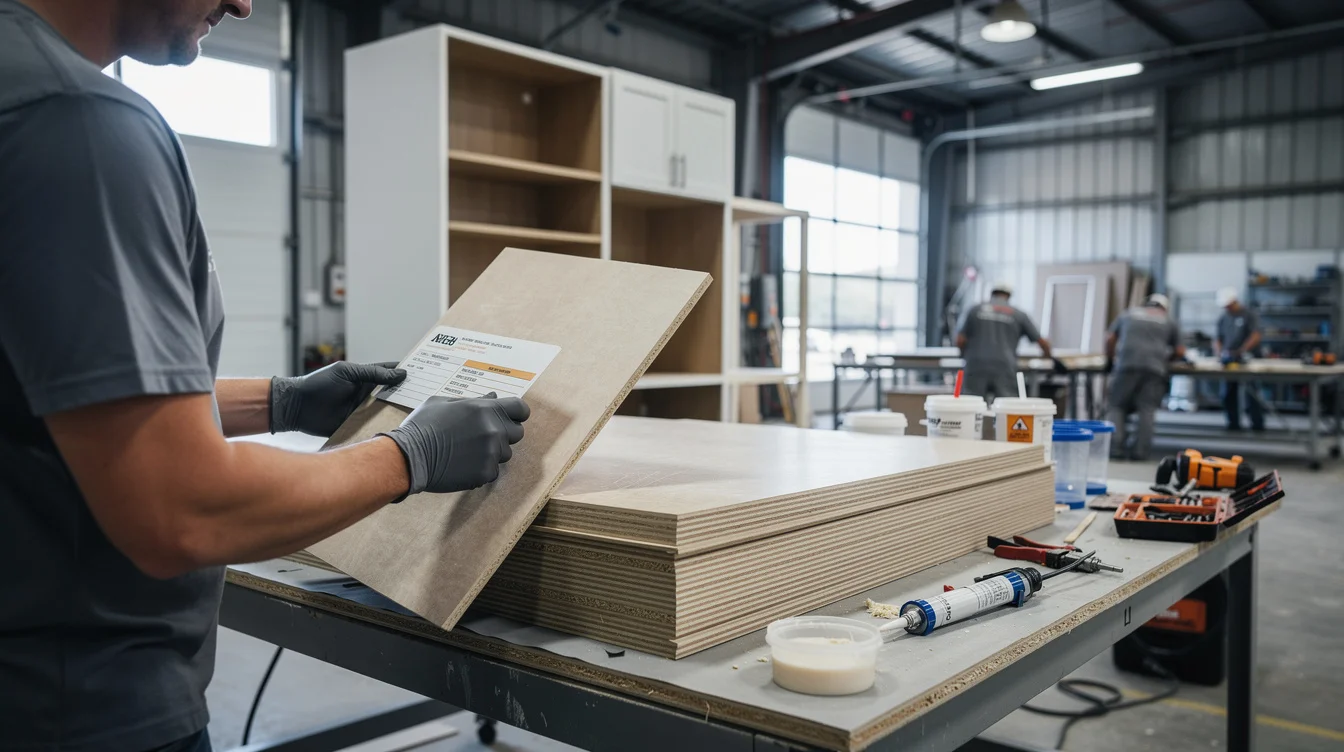
Terminology matters. In the United States, manufactured homes are built to the federal HUD Code, generally on a permanent chassis. Modular homes typically follow state and local building codes. “Prefabricated” describes a much broader family of construction methods. Conflating them obscures both the regulatory tools available and the households most affected.
Factory production is not itself the problem. Repetition can reduce waste, improve quality control and make a better material specification easier to replicate. The same procurement system that distributes a problematic adhesive across hundreds of homes could distribute a lower-emitting alternative instead.
Nor does conventional construction deserve a clean bill of health. Site-built houses also contain composite wood, resilient flooring, sealants, insulation and synthetic finishes. Manufactured housing deserves scrutiny because affordability pressures can constrain specifications and residents’ ability to replace materials—not because industrial production is inherently unhealthy.
Parsons’ Healthy Materials Lab, co-founded by Alison Mears and Jonsara Ruth, provides a useful design reference: material selection belongs within the architect’s responsibility, not outside it as an obscure purchasing decision. For an industry organized around repeatable assemblies, that responsibility extends directly to the product manager, supplier and procurement contract.
Identify the Exposure, Not Just the Villain
The following examples illustrate established material-health concerns; they should not be mistaken for a verified inventory of the Parsons study. Composite-wood cabinetry and panels can emit formaldehyde, depending on their resins and manufacture. Some flexible vinyl products contain plasticizers of concern. Certain adhesives, coatings and sealants release volatile organic compounds during installation or use.
These are different pathways, requiring different responses. Formaldehyde emissions are not equivalent to substances that migrate into household dust. Hazards associated with manufacturing a polymer are not automatically the same as risks from touching the finished product. Isocyanate exposure during the application of some polyurethane products, for example, requires a different assessment from exposure to a properly cured assembly.
“Contains plastic” is therefore a poor substitute for a material-health specification. Chemistry, concentration, accessibility, installation and use conditions matter. So do ventilation, temperature and humidity. A poorly ventilated interior can compound emissions from multiple products, regardless of how the home was constructed.
What is needed next is transparent, product-specific evidence: ingredient information, relevant emissions tests and measurements in occupied homes. Screening can identify priorities; field research must establish how those priorities translate into residents’ actual exposure.
Substitute the Assembly, Not the Marketing Label

The obvious response is substitution. The difficult part is refusing the comforting fiction that every “natural” material is safer, cheaper or technically interchangeable.
For cabinetry, a buyer could specify composite-wood products with verified low formaldehyde emissions and scrutinize finishes and edge treatments. No-added-formaldehyde resin systems may be an option, but that description does not mean a finished panel emits absolutely no formaldehyde. For flooring, linoleum or selected wood products might be evaluated against vinyl; their adhesives, coatings, moisture performance and maintenance requirements still need examination.
Insulation demands similar discipline. Mineral wool or cellulose may offer alternatives to particular foam applications, but wall depth, weight, thermal performance, moisture behavior and fire requirements affect whether the substitution works. Manufactured homes must also survive transport. A heavier or more brittle assembly can create problems that a showroom sample will never reveal.
Tools such as the Healthy Building Network’s Pharos database and the Living Building Challenge’s Red List can help identify chemicals for scrutiny. Neither replaces engineering or exposure assessment. The procurement brief should require a functionally equivalent, demonstrably preferable assembly, not merely a fashionable replacement material with a greener name. The question echoes the debate over whether a better cruise terminal solves a wider sustainability problem: improving one component does not establish the performance of the whole system.
Make Health a Procurement Standard, Not an Upgrade
A healthier specification sold only as a premium package would reproduce the problem in a more polished form. Residents with the least purchasing power would remain the market for the least transparent products.
Manufacturers can instead establish a minimum materials standard across their base models. Start with substantial interior sources and products with plausible exposure pathways: cabinetry, large-area finishes and installation chemicals. Require suppliers to disclose ingredients through recognized formats such as Health Product Declarations, provide relevant emissions evidence and notify the manufacturer before changing formulations.
These documents answer different questions. A Health Product Declaration communicates ingredient and hazard information within stated reporting limits; it is not a safety certificate. UL GREENGUARD Gold certification addresses specified chemical-emissions criteria, not every health or environmental concern. An Environmental Product Declaration reports life-cycle environmental information and should not be passed off as proof of a healthy interior.
Aggregated purchasing offers leverage. A nonprofit housing developer, public buyer or network of community owners could tender repeated orders against one healthier specification. Longer contracts and fewer material variants could help absorb testing and transition costs. That is a plausible strategy, not a demonstrated promise of cost neutrality.
Disclosure Must Change the Deal
American manufactured housing does not operate in a regulatory vacuum. Federal requirements already address formaldehyde emissions from relevant composite-wood products through HUD provisions and EPA’s TSCA Title VI framework. Compliance matters, but it does not answer every question about every chemical in an interior.
A useful disclosure requirement would provide a home-specific materials schedule before purchase: major interior products, available ingredient declarations, emissions certifications, installation products and known information gaps. It should distinguish “not disclosed” from “not present” and remain accessible when the home changes hands.
Yet disclosure alone can become an elegant method of transferring liability. A buyer facing scarce housing cannot negotiate with a technical appendix. Manufacturers and bulk purchasers need actionable exclusion criteria, performance requirements and independent verification—not simply permission to tell residents what they must accept.
The affordability test must also be honest. Evaluate purchase price, financing effects, durability, maintenance and replacement together. Do not invent a monetary value for avoided illness where exposure and health outcomes have not been established. A small material premium may still be a serious financing barrier; subsidies or procurement incentives should address that barrier rather than moralizing about residents’ choices.
Test Better Homes Without Making Residents the Experiment
The next move should be a controlled production pilot, not another aspirational mood board. A manufacturer working with an independent research team could compare its baseline specification with a revised package, documenting component prices, assembly time, transport damage, installation conditions and maintenance requirements.
Relevant indoor-air testing before and after occupancy could examine whether targeted substitutions reduce selected pollutants under comparable conditions. Where dust is the plausible pathway, air sampling alone would be inadequate. Residents should give informed consent, receive understandable results and have access to a remediation plan if problems are identified.
For existing homes, advice must be proportionate. Routine wholesale replacement can create debt, waste and fresh installation emissions. Source investigation, moisture control, appropriate ventilation and targeted intervention are more defensible than telling every household to strip out its interior. As with scrutinizing the green credentials of a pop-up city, the assessment must account for what is discarded as well as what is newly built.
The Parsons warning should trigger a redesign of purchasing power. Manufactured housing is too important to dismiss and too consequential to exempt from scrutiny. The meaningful innovation is not a boutique toxin-conscious model. It is a baseline home whose price is competitive, whose material claims are verifiable and whose residents are not required to become chemical researchers before signing a contract.
FAQ
Are manufactured homes inherently less healthy than site-built homes?
No. Both can contain materials with hazardous ingredients or emissions. Comparative health claims require evidence about actual products, exposure, ventilation and maintenance. Factory construction can also make a better specification easier to implement consistently.
Which material substitutions should manufacturers prioritize?
Prioritize products with substantial interior surface area, relevant emissions or plausible exposure pathways, including composite-wood cabinetry, flooring and installation chemicals. Assess replacements as complete assemblies, including adhesives, finishes, fire performance, moisture behavior and transport durability.
Can healthier materials remain affordable?
Potentially, through standardized specifications, pooled purchasing and longer supplier agreements. Savings are not guaranteed. Production pilots should disclose actual costs, while financing tools or targeted subsidies can prevent verified improvements from excluding lower-income buyers.
What should buyers request before purchasing?
Ask for a product-specific materials schedule, composite-wood compliance documentation, relevant emissions certifications and ventilation instructions. Ingredient disclosure and emissions testing provide different information; no single label guarantees that a whole home is harmless.
If healthier specifications increase the upfront price, who should carry that cost: the resident, the manufacturer or the public institutions relying on manufactured housing to close the affordability gap?
Get the Mainifesto weekly — curated design debates, speculative ideas and the week's best articles every Saturday.
Editorial Perspectives
Questions and counterpoints developed by the Mainifesto editorial desk to extend the discussion.
Perspective 1
We optimize factory-built housing down to the millimeter, so why not make material emissions a design constraint alongside cost and structure? I'd want to test whether shared specifications and pooled purchasing can shrink the premium before asking residents to pay it.
Perspective 2
Housing upgrades have a long history of becoming an excuse to price out the people they were meant to help. Manufacturers should be accountable for what they install, and any public support for safer materials should come with protections against rent hikes or displacement.
Perspective 3
The resident shouldn't have to buy a premium package to get healthier indoor air. Show me the added cost per unit, credible emissions testing and the replacement cycle; manufacturers should absorb routine specification improvements, with public bulk orders helping bring the price down.
Perspective 4
First, establish which substitutions meaningfully reduce exposure and what they actually add to the purchase price—not every 'healthy' label deserves a subsidy. Public buyers should set a verifiable minimum standard and fund any demonstrated affordability gap, rather than quietly passing it to residents.