
ZHA and the End of the Founder Name

When a name becomes a liability, the brand is no longer innocent
Architecture loves to pretend that names are merely labels. They are not. In the case of Zaha Hadid Architects becoming ZHA, the rename is a power move disguised as housekeeping: a studio that once traded on the unmistakable force of a singular authorial identity is now being asked to survive without the founder’s name as its permanent legal and cultural anchor. That is not a cosmetic shift. It is a stress test for the entire mythology of the starchitect era.
The immediate trigger, as reported by Dezeen, is a legal battle with the Zaha Hadid Foundation over use of Zaha Hadid’s name. But the deeper story is far more revealing. Patrik Schumacher has framed the change as a “natural brand evolution,” which is precisely the kind of phrase institutions use when they need to describe a rupture as continuity. The real question is not whether ZHA can change its letterhead. It is whether the practice can remain meaningful once it stops borrowing aura from the deceased architect whose name once functioned as its central guarantee.
This matters because the architecture world still runs on authorial shorthand. We do not just say “a project by a studio”; we say “a Zaha building,” “a Koolhaas project,” “a Gehry scheme,” as though identity, method, and market value can be condensed into a surname. When that surname is removed, what remains: a company, a method, a culture, or merely a well-capitalized machine?
The studio as institution, not shrine
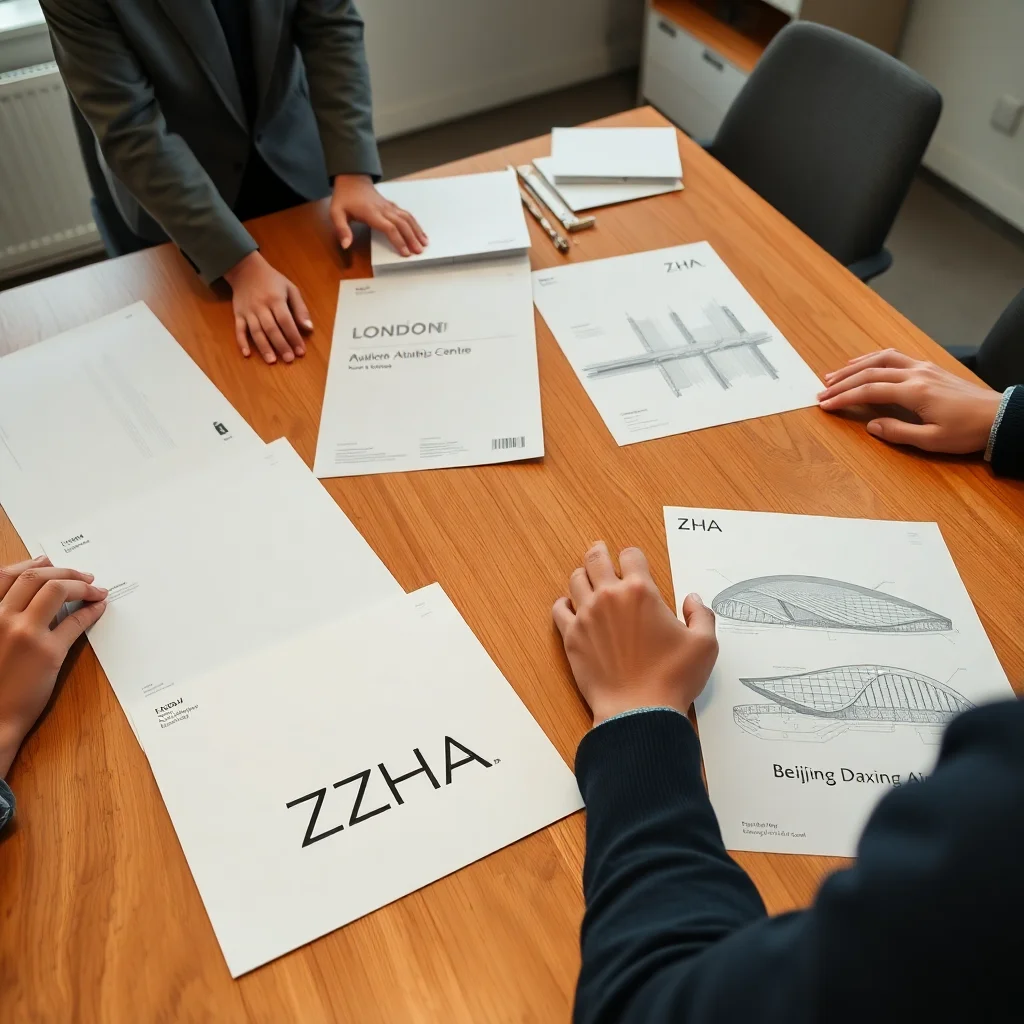
The most generous reading of the rename is also the most challenging: perhaps architecture needs to grow up. A practice of ZHA’s scale cannot function forever as a memorial to its founder. It has offices, teams, clients, procurement systems, computational workflows, planning consultants, legal obligations, and projects spanning continents. That is not the operating model of a lone genius; it is an institution. And institutions, by definition, must outlive the charisma that created them.
Seen this way, the removal of “Hadid” is not a deletion but an admission. It acknowledges that the studio’s output no longer depends on Zaha Hadid alone. Its current identity is produced by collaborators, project leads, designers, engineers, and directors who have been shaping work such as the Beijing Daxing International Airport, the King Abdullah Financial District Metro Station in Riyadh, and the High-Speed Train Station in Napoli Afragola. These projects were not designed by a ghost. They emerged from a highly structured collective intelligence—one that is easier to ignore when a single name sits above the door.
That is the uncomfortable truth many iconic firms avoid: legacy often becomes a decorative fiction. The founder’s name can freeze a living practice into a brand museum, as if relevance were inherited automatically. But architecture is not perfume. A signature may sell the story, yet the studio’s real value lies in its ability to produce work under new economic, technical, and cultural conditions. ZHA’s rename exposes that reality with rare bluntness.
It also resonates with the broader shift toward renovation as the new urban default, where value is increasingly found in adaptation rather than in perpetuating a singular original gesture. In both cases, the question is whether architecture can stop mistaking preservation of a name for preservation of meaning.
Why the founder myth was always unstable
The cult of authorship in architecture has always been a contradiction. Buildings are collective productions, but the discipline markets them as if they were singular artistic acts. The star system—strengthened by magazines, awards, museum exhibitions, and global capital—made that contradiction profitable. Zaha Hadid became one of its most powerful icons because her work, from the Vitra Fire Station to the London Aquatics Centre, was instantly legible as a forceful break from convention. Her name became both style and promise.
But the myth contained its own expiration date. Once a founder dies, the studio faces a brutal choice: either remain a mausoleum of “the vision” or become a living organization with its own evolving intelligence. Many practices fail this test. Some flatten into tribute acts. Others rebrand so aggressively that they sever continuity entirely. ZHA is trying to occupy the narrow and contentious middle ground: preserving the value of a globally recognized practice while refusing the full burden of the personal name.
This is where the debate turns cultural, not legal. A founder-name studio can retain prestige long after the founder’s death, but prestige is not the same as relevance. If ZHA is to stay potent, it must demonstrate that a practice can be iconic without being autobiographical. That is a direct challenge to the architecture industry’s dependence on personality as a substitute for institutional depth.
The stakes are similar in material culture debates such as cladding, local production and architectural control, where surface recognition can conceal the more consequential systems underneath. A name, like a façade, can reassure—but it can also obscure who actually makes the work and how authority is distributed.
What the rename signals about power, succession, and control

Renaming is never neutral. It redistributes authority. In this case, the move from Zaha Hadid Architects to ZHA compresses a biography into an acronym, and acronyms do difficult work: they retain recognition while stripping away intimacy. The founder remains present as a trace, but no longer as the whole story. That is elegant branding, yes—but it is also a political statement about succession.
Schumacher’s role is central here. As a long-standing principal and theorist of parametric urbanism, he has never been merely a caretaker. He has been a co-author of the studio’s intellectual identity, and his public defense of the change suggests a deliberate attempt to formalize a post-founder regime. The rename can therefore be read as consolidation: a way to stabilize control over a practice whose public meaning has been complicated by the legal claim of the foundation and by the difficulty of navigating a founder’s legacy without becoming captive to it.
This is familiar territory across design culture. When architects die, foundations, estates, and studios often compete over the right to define the afterlife of the name. The same tensions have surfaced around the legacies of Eileen Gray, Le Corbusier, and Carlo Scarpa in different ways, where authorship, stewardship, and commercial use become entangled. ZHA is simply the latest and one of the most visible examples of the broader problem: who gets to speak for a body of work once the originator can no longer answer?
Can a practice stay culturally potent after the surname is gone?
Yes—but only if it stops pretending that continuity is the same as repetition. The strongest post-founder studios are not archives; they are mechanisms for adaptation. They maintain recognizable DNA while allowing new teams to reinterpret it. That is how a practice remains culturally potent after detaching from the founder as its main source of meaning. Not by embalming a style, but by proving that the style was always only the surface of a deeper operational intelligence.
Look at how other globally recognized practices have evolved. OMA became more than Rem Koolhaas’s persona by developing a networked office culture and an ecosystem of associated entities. Foster + Partners long ago outgrew the mythology of Norman Foster alone, even as his name remains central. Bjarke Ingels Group, by contrast, was built from the start as a personality-led brand, which makes its future succession question unavoidable. ZHA enters this terrain with an unusual burden: it must preserve a radical visual legacy while claiming that its identity is no longer dependent on one person’s name.
That challenge may actually sharpen the work. A studio that cannot hide behind the founder’s aura has to produce cultural value through architecture itself: through spatial invention, technical rigor, urban ambition, and institutional consistency. If ZHA succeeds, the rename will look less like a dilution and more like a declaration that architectural identity can be collective, durable, and self-renewing.
That argument also mirrors the logic behind adaptive reuse as a code reform fight: the most durable forms of continuity are rarely the most literal ones. Survival often depends on changing the rules that once seemed fixed.
Six things the rename forces the discipline to confront
- Brand recognition is not the same as authorship. A famous name can sell a project, but it can also obscure the team, systems, and workflows that actually produce the work.
- Founders create institutions that outlive them. Once a studio grows into a global enterprise, it must be judged as an organization, not as a personal studio in perpetuity.
- Legacy is a battleground, not an inheritance. Foundations, studios, and estates often disagree over who may activate a name, and that struggle shapes the public memory of the work.
- Acronyms can preserve aura while changing authority. ZHA keeps recognition intact, but it also signals a shift from biography to corporate continuity.
- Architecture’s star system is structurally unstable. The discipline depends on singular authorship for marketing, yet its actual production is collective and distributed.
- Post-founder relevance must be earned. A practice remains culturally potent only if it can generate new ideas, not merely reproduce the founder’s visual vocabulary.
The real test: whether the work can speak without the ghost
The rename from Zaha Hadid Architects to ZHA is not just a fresh logo on a website. It is an attempt to transform an archive of fame into a functioning present tense. That is a risky maneuver, because architecture is full of firms that confuse continuity with entitlement. They assume that cultural capital will survive on memory alone. It rarely does.
If ZHA wants to remain more than a legacy brand, it must prove that the studio’s authority now resides in its methods, its projects, and its intellectual confidence—not merely in the afterimage of Zaha Hadid’s name. That means building work that can withstand comparison to the founder without becoming a parody of her. It means allowing institutional continuity to become its own kind of authorship.
In that sense, the rename is provocative precisely because it is honest. It admits that the founder’s name can no longer do all the work. The real question is whether architecture can finally accept what the rest of culture already knows: that lasting relevance depends not on preserving a name, but on making a practice capable of surviving its disappearance.
FAQ
Why did Zaha Hadid Architects rename itself ZHA? The rename followed a legal battle with the Zaha Hadid Foundation over use of the founder’s name. Beyond the legal issue, it also reflects a strategic attempt to reposition the studio as an autonomous institution rather than a practice defined solely by its origin story.
Does removing the founder’s name weaken the brand? It can, if the studio has no identity beyond the surname. But it can also strengthen the brand by forcing the practice to demonstrate value through its projects, methods, and leadership rather than inherited myth.
Is ZHA still connected to Zaha Hadid’s design legacy? Yes, unmistakably. The studio’s formal language, ambition, and global profile remain rooted in the legacy she established, but the rename signals that this legacy must now be carried by an institution, not only by a name.
What does this mean for other architecture firms named after founders? It sets a precedent. Firms built around a single architect may eventually need to separate brand equity from biography if they want to survive succession without becoming museum pieces.
So what is left when the name is gone?
That is the question ZHA now forces onto architecture’s table: if the founder’s name is no longer the main source of meaning, can the practice still command desire, trust, and cultural urgency? Or does the profession secretly need the myth of the singular author more than it admits?
Get the Mainifesto weekly — curated design debates, speculative ideas and the week's best articles every Saturday.
Editorial Perspectives
Questions and counterpoints developed by the Mainifesto editorial desk to extend the discussion.
Perspective 1
The renaming is less a rupture than an admission that the cult of the founder is finally wearing thin. In architecture, once the signature disappears, what remains must be a discipline of ideas, not merely a brand identity — otherwise the institution becomes a shell with expensive rendering.
Perspective 2
This is the real test for a practice like ZHA: can it stay culturally relevant through methods, research, and production, not just through a famous surname? If it can turn its computational intelligence into new spatial arguments, then the name change is a progression rather than a loss.
Perspective 3
I’m wary of the rename as a clean narrative of continuity, because institutions love to erase the messy labor that actually sustains them. If a practice wants to remain indispensable, it should produce buildings that can age, adapt, and serve communities without becoming another piece of prestige urbanism.