
Origami shelters folding: habitats for lightweight pop-up spaces

Origami Shelters Folding: Habitats for Lightweight Pop-Up Spaces
In an era defined by mobility, crisis response, and ecological sensitivity, the concept of origami shelters—lightweight, foldable structures inspired by the ancient Japanese art of paper folding—has emerged as a poetic yet pragmatic solution. These folding habitats are redefining how architects and designers conceive temporary architecture, merging structural ingenuity with aesthetic restraint. From disaster relief housing to nomadic art installations, origami-inspired design is shaping a new architectural lexicon of adaptability, efficiency, and grace.
The Geometry of Impermanence
Origami architecture occupies a fascinating intersection between structural engineering and art. The principle is deceptively simple: a flat surface transforms into a three-dimensional volume through precise folds. Yet behind this simplicity lies a sophisticated understanding of geometry, material behavior, and spatial dynamics. Architects are increasingly turning to folding mechanisms not merely as aesthetic gestures but as structural strategies that allow for rapid deployment, minimal material use, and maximum portability.
These shelters are often fabricated from advanced composites, aluminum alloys, or high-tensile fabrics that mimic the flexibility of paper while offering durability against wind, rain, and heat. When folded, they occupy a fraction of their expanded volume, making them ideal for transport and storage. When deployed, they unfold into fully functional living or working spaces—lightweight yet remarkably stable.
From Paper to Pavilion: The Evolution of Folding Architecture
The lineage of origami-inspired architecture can be traced to the mid-20th century, when designers began exploring kinetic and deployable structures. Yet the current renaissance owes much to computational design and digital fabrication. Parametric modeling allows architects to simulate fold patterns with mathematical precision, predicting how materials will behave when compressed or expanded. This digital fluency has led to a wave of experimental projects that bridge art, science, and humanitarian design.
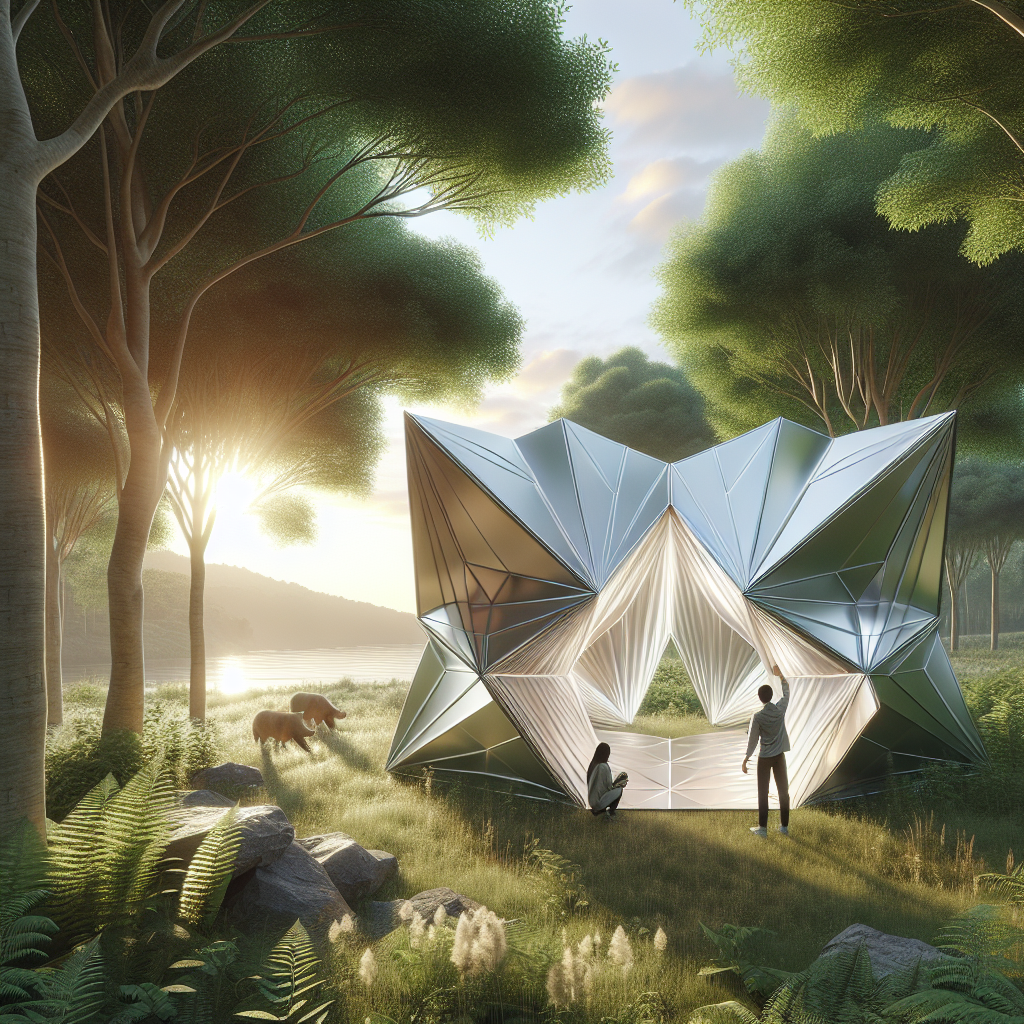
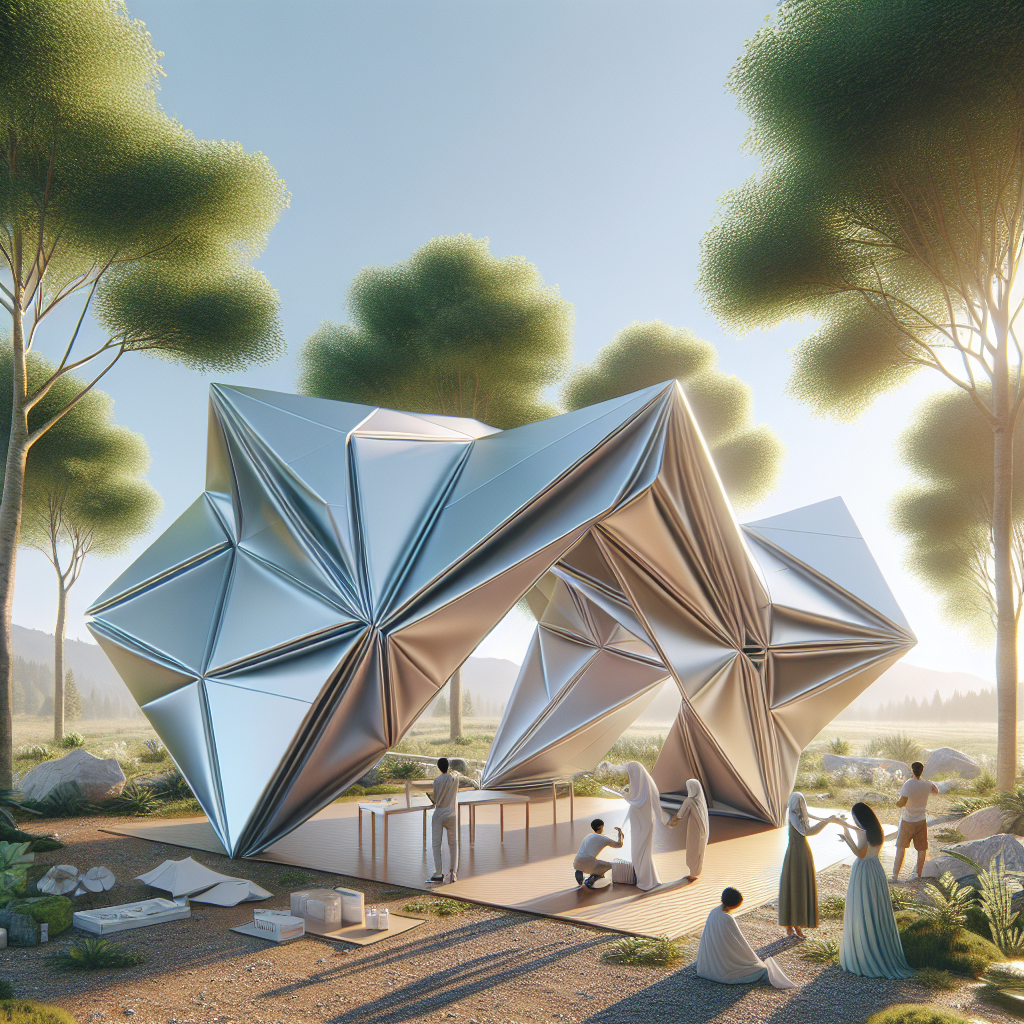
One of the most striking examples is the Origami Shelter developed by the Harvard Graduate School of Design’s Material Processes Lab. Constructed from folded aluminum panels, the structure can be collapsed into a compact form and reassembled in under an hour. Its faceted surfaces catch light like a crystalline sculpture, demonstrating how ephemeral architecture can achieve both technical and aesthetic sophistication.
Similarly, Japanese architect Shigeru Ban’s work with paper tubes—seen in his emergency shelters for post-disaster zones—embodies the same ethos of lightness and impermanence. His designs prove that temporary structures can be dignified, sustainable, and deeply human. Ban’s approach resonates with the principles of biophilic design, connecting occupants to nature through material honesty and spatial openness.
Engineering Elegance: The Science Behind the Fold
At the heart of origami architecture lies a structural paradox: flexibility that yields strength. Engineers employ mathematical algorithms derived from origami mathematics to design folding patterns that distribute loads efficiently while allowing for compact storage. The Miura-ori fold, for instance—a pattern originally developed for folding solar panels in space—has become a favorite among architects for its ability to expand and contract smoothly without compromising rigidity.
Recent research published in the *Journal of Architectural Engineering* indicates that foldable structures can reduce material use by up to 40% compared to conventional rigid frameworks. This efficiency aligns with the broader movement toward circular economy design, where materials are reused, reconfigured, and recycled rather than discarded.
Moreover, the adaptability of origami shelters makes them ideal for climate-responsive architecture. Panels can unfold to create shading canopies, adjust to optimize ventilation, or collapse to conserve heat. In essence, these structures behave like living organisms—responsive, efficient, and self-adjusting.
Humanitarian and Environmental Applications
In humanitarian contexts, the potential of origami shelters is transformative. Lightweight, flat-packed, and easy to assemble, they can be deployed rapidly in disaster zones, refugee camps, or remote research outposts. The United Nations High Commissioner for Refugees (UNHCR) has already explored prototypes that integrate solar panels and water filtration systems into foldable frameworks, creating self-sufficient micro-habitats.
Architects working in this field often draw inspiration from resilient building design principles, ensuring that temporary does not mean fragile. Some models incorporate biodegradable materials, aligning with the ethos of biodegradable architecture to minimize environmental impact once the shelters are decommissioned.
Beyond emergency use, origami shelters are finding their way into luxury glamping resorts, traveling exhibitions, and urban pop-up installations. Their portability allows for dynamic reconfiguration of public spaces—pavilions that bloom overnight and vanish without a trace, leaving no footprint behind. This ephemeral quality speaks to a growing cultural desire for mobility and minimalism, echoing the nomadic tendencies of the digital age.
Design Language: Aesthetics of the Fold
Visually, origami shelters possess a sculptural purity that appeals to contemporary sensibilities. Their faceted surfaces catch and refract light, creating ever-changing patterns of shadow and reflection. The interplay of sharp edges and soft materials evokes a tension between precision and impermanence—a dialogue that resonates deeply with the modern architectural imagination.
Inside, the spatial experience is equally compelling. Folded walls and ceilings generate subtle variations in volume, guiding light and airflow in unexpected ways. When illuminated at night, these shelters glow like paper lanterns, their translucency revealing the beauty of structural logic. The aesthetic is minimalist yet expressive, reminiscent of the origami-inspired furniture and lighting movement that has captivated interior designers in recent years.
Case Studies: From Concept to Context
In 2023, the design collective Atelier Nomade unveiled a series of foldable pavilions for the Venice Architecture Biennale. Each pavilion, constructed from laser-cut aluminum sheets, could be folded flat and transported by bicycle. Once unfolded, they formed shaded meeting areas along the city’s canals—an elegant commentary on mobility, sustainability, and civic engagement.
Meanwhile, the European Space Agency has been experimenting with origami-based modules for extraterrestrial habitats. These structures, designed to unfold autonomously upon landing, demonstrate how principles of folding architecture can extend beyond Earth. The connection between origami and space exploration is not coincidental; both disciplines share a fascination with compactness, efficiency, and transformation.
Closer to home, urban designers are exploring origami shelters as tools for social inclusion. Pop-up classrooms, mobile clinics, and temporary art galleries are being conceived as foldable interventions that can adapt to shifting community needs. These projects embody the ethos of community-driven architecture, where design becomes a participatory act rather than a static object.
The Future of Foldable Living
As cities grapple with population density, climate migration, and the need for flexible infrastructure, origami shelters offer a compelling blueprint for the future. They embody a philosophy of “design light”—a mindset that values adaptability over permanence, efficiency over excess. In a world increasingly defined by flux, the ability to fold, unfold, and refold may become the ultimate architectural virtue.
Advances in smart materials—such as shape-memory alloys and responsive fabrics—promise to make these shelters even more autonomous. Imagine a structure that senses wind direction and adjusts its folds accordingly, or a pavilion that compacts itself at night to conserve energy. These visions are no longer speculative; they are emerging realities within the field of adaptive architecture.
Ultimately, origami shelters challenge our understanding of what architecture can be. They remind us that strength can arise from flexibility, and that beauty often lies in the act of transformation. In their folds, we glimpse a future where architecture moves as gracefully as the people it serves—light, responsive, and endlessly unfolding.
Published on 12/23/2025